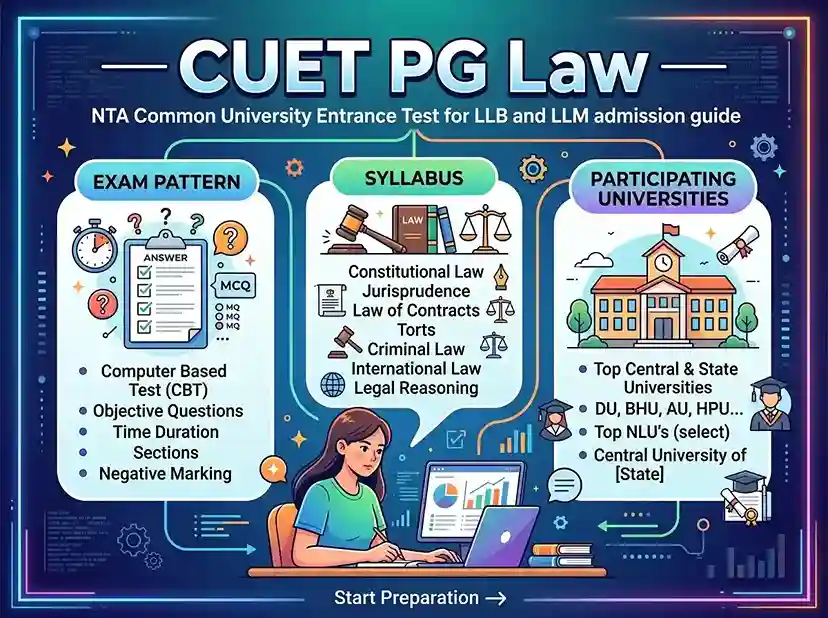
1. What is CUET PG Law?
The Common University Entrance Test for Postgraduate programmes (CUET PG) | Law is a national-level, computer-based entrance examination conducted by the National Testing Agency (NTA) for admission to law programmes at central, state, deemed, and private universities across India. It was introduced to replace the fragmented system of individual university entrance exams with a single, standardised "one exam, many universities" gateway.
CUET PG Law covers two distinct tracks:
Yes. The University of Delhi discontinued its separate DU LLB entrance exam from 2023. All admissions to DU's three Law Centres (Campus Law Centre, Law Centre-I, Law Centre-II) | with a combined intake of approximately 2,889 seats plus supernumerary seats | are now exclusively through CUET PG (COQP11). After the exam, candidates must separately register on DU's CSAS (PG) portal for counselling.
2. CUET PG Law Important Dates | 2026 (Actual) & 2027 (Expected)
CUET PG Law 2026 | Actual Dates
| Event | Date (2026) | Status |
|---|---|---|
| Notification Released | December 14, 2025 | ✅ Completed |
| Application Window Opens | December 14, 2025 | ✅ Completed |
| Application Last Date | January 14, 2026 (extended to Jan 20) | ✅ Completed |
| Application Correction Window | January 18–20, 2026 | ✅ Completed |
| Exam City Intimation | February 2026 | ✅ Completed |
| Admit Card Release | Early March 2026 | ✅ Released |
| CUET PG Law Exam Dates | March 6–27, 2026 (Law paper: mid-March) | ✅ Conducted |
| Provisional Answer Key | April 2026 | ✅ Released |
| Final Answer Key + Result | May 2026 | ✅ Declared |
| DU CSAS (PG) Counselling | May–June 2026 | 🔵 Ongoing |
CUET PG Law 2027 | Expected Dates
| Event | Expected Date (2027) | Based On |
|---|---|---|
| Notification Release | November–December 2026 | CUET PG 2026 notification: Dec 14, 2025 |
| Application Opens | December 2026 | Pattern from 2025–26 cycle |
| Application Closes | January 2027 | ~30-day window each year |
| Admit Card Release | Late February 2027 | ~2 weeks before exam |
| CUET PG Law Exam 2027 | March 2027 (estimated) | March exam slot maintained since 2024 |
| Result Declaration | April–May 2027 | ~6–8 weeks after exam |
| Counselling Begins | May–June 2027 | DU CSAS (PG) + other universities |
All CUET PG Law 2027 dates above are projections based on the 2026 cycle. NTA may revise the schedule. Always check the official portal exams.nta.nic.in/cuet-pg for confirmed dates. LawGuru India updates this page as soon as official announcements are made.
3. CUET PG Law Eligibility Criteria 2026
Eligibility for CUET PG LLB (3-Year LLB)
| Criterion | Requirement |
|---|---|
| Educational Qualification | Graduation degree (10+2+3 pattern) in any discipline from a recognised university or equivalent institution |
| Minimum Marks (General) | 45% aggregate in graduation (varies by university | DU requires 50%) |
| Minimum Marks (SC/ST/PwD) | 40% aggregate in graduation (DU requires 45% for SC/ST) |
| Final Year Students | Students appearing in final year of graduation are eligible to apply provisionally |
| Age Limit | No age limit specified by NTA for CUET PG LLB. Individual universities may set their own age criteria. |
| Domicile | No domicile restriction for CUET PG LLB. All Indian citizens are eligible. |
| Discipline / Stream | Open to all streams | BA, BCom, BSc, BBA, BCA, BTech, etc. |
Eligibility for CUET PG LLM (Master of Laws)
| Criterion | Requirement |
|---|---|
| Educational Qualification | 3-year LLB degree OR 5-year integrated BA LLB / BBA LLB / BCom LLB from a recognised university |
| Minimum Marks (General) | 55% aggregate in LLB (50% for SC/ST/PwD | varies by university) |
| Final Year Students | Final-year LLB students can apply provisionally |
| Age Limit | No age limit specified for CUET PG LLM by NTA. University-level age criteria (if any) apply. |
| Specialisation Requirements | Some universities may require specific LLB specialisation | check each university's prospectus |
While NTA sets minimum eligibility for appearing in CUET PG, each participating university may have additional or stricter eligibility requirements | including minimum marks, domicile criteria, or discipline restrictions. Always check the prospectus or official website of your target university (e.g., DU at du.ac.in, BHU at bhu.ac.in) before applying.
4. CUET PG Law Application Process & Fee
The CUET PG application is entirely online through the NTA portal. Candidates apply once for CUET PG and can choose multiple test papers (universities) in a single application. Here is the step-by-step process:
Visit the official CUET PG portal. Click "New Registration". Enter your name, mobile number, email address, and date of birth to create your login credentials. You will receive an OTP to verify your mobile and email.
Log in with your credentials and complete the application form | personal details, educational qualifications, choice of test papers (select COQP11 for LLB and/or the LLM paper code), and exam city preferences (up to 2 cities in 2026).
Upload your recent passport-size photograph (file size as specified, JPEG/JPG format) and scanned signature. Ensure both images meet NTA's specification requirements | rejections are common for non-compliant files.
Pay the application fee via credit card, debit card, net banking, or UPI through the NTA payment gateway. Keep the payment receipt. Fee structure (2026): General/EWS/OBC | ₹800 (1 paper), additional ₹200 per additional paper. SC/ST/PwD/Third Gender | ₹400 (1 paper).
Review all details carefully before final submission. Once submitted, changes are only possible during the designated correction window (typically one week after the application closes). Download and save your confirmation page and application number.
In CUET PG 2026, candidates can select only 2 preferred exam cities (reduced from 4 in previous years). The total number of exam centres was also reduced from 312 to 292. 16 international exam centres are available for overseas candidates. Exam city preferences can be edited during the correction window.
5. CUET PG LLB Exam Pattern 2026 (Paper Code: COQP11)
The CUET PG LLB 2026 exam tests general aptitude | not law knowledge. It is designed to assess a graduate's readiness for legal education. Here is the full pattern:
| Parameter | Details |
|---|---|
| Paper Code | COQP11 |
| Mode of Exam | Computer-Based Test (CBT) | Online |
| Duration | 90 Minutes (1 hour 30 minutes) |
| Total Questions | 75 Multiple Choice Questions (MCQs) |
| Maximum Marks | 300 |
| Marking Scheme | +4 for each correct answer | −1 for each wrong answer | 0 for unattempted |
| Medium of Exam | English and Hindi |
| Question Type | Objective MCQs (single correct answer) |
| Sections | Language Comprehension | General Knowledge & Current Affairs | Computer Basics | General Aptitude & Logical Reasoning |
| Changes from 2025 | No change in pattern | duration, marking scheme, question types remain identical |
CUET PG LLB Section-Wise Distribution (Indicative)
| Section | Indicative Questions | Focus Areas |
|---|---|---|
| Language Comprehension | ~25 questions | Reading passages, vocabulary, grammar, antonyms/synonyms, fill-in-the-blanks, sentence correction |
| General Knowledge & Current Affairs | ~25 questions | National/international current events, polity basics, legal history, Constitution, prominent law cases in news |
| Computer Basics | ~5–10 questions | Fundamental computer knowledge, MS Office basics, internet, input/output devices, basic terminology |
| General Aptitude & Logical Reasoning | ~15–20 questions | Analogies, series, coding-decoding, blood relations, direction sense, syllogisms, puzzles, statement-conclusions |
Unlike CLAT or AILET which include a Legal Reasoning section, CUET PG LLB (COQP11) does not test law knowledge. Any graduate | whether a science, commerce, or arts student | can prepare effectively. The exam is a general aptitude test. This makes CUET PG LLB more accessible to non-law background candidates targeting a career shift into law.
6. CUET PG LLB Syllabus 2026 | Topic-Wise Breakdown
The official CUET PG LLB syllabus is published by NTA at exams.nta.nic.in/cuet-pg/syllabus/. Below is the detailed topic-wise breakdown of all four sections:
Section A: Language Comprehension
- Reading comprehension passages (factual, analytical, literary) | 1–2 passages with 5–8 questions each
- Grammar: Articles, prepositions, tenses, active/passive voice, direct/indirect speech
- Vocabulary: Synonyms, antonyms, one-word substitution, idioms and phrases
- Error detection in sentences and sentence improvement
- Para-jumbles / sentence re-ordering
- Fill in the blanks (single and double blanks)
- Cloze test passages
Section B: General Knowledge & Current Affairs
- Current events (national and international) | last 12 months
- Indian Constitution: Preamble, fundamental rights, directive principles, amendments
- Indian polity: Parliament, executive, judiciary (basic structure)
- Legal current affairs: Landmark Supreme Court and High Court judgements in news
- History of legal/judicial system in India
- Geography: Basic Indian and world geography
- Science and technology basics
- Sports, awards, appointments (important positions)
- Static GK: National symbols, capitals, currencies, famous personalities
Section C: Computer Basics
- Computer fundamentals: hardware, software, input/output devices
- Operating systems: Windows basics, file management
- Microsoft Office: Word, Excel, PowerPoint (basic operations)
- Internet basics: WWW, browsers, email, search engines, cybersecurity basics
- Number systems: Binary, decimal (basic conversion)
- Computer memory: RAM, ROM, storage units (KB, MB, GB)
- Networking basics: LAN, WAN, Wi-Fi
Section D: General Aptitude & Logical Reasoning
- Number series and letter/symbol series
- Coding–decoding
- Blood relations
- Direction sense and distance problems
- Syllogisms and logical deductions
- Analogies (word, letter, number)
- Statement and conclusions / assumptions / inferences
- Arrangement and ranking problems (linear, circular)
- Calendar, clocks, and basic mathematical puzzles
- Data interpretation (tables, graphs | basic level)
7. CUET PG LLM Exam Pattern 2026
The CUET PG LLM exam is a domain-specific law paper that tests advanced legal knowledge across core LLB subjects. Unlike the LLB paper (COQP11), the LLM paper requires strong command over substantive law subjects.
| Parameter | Details |
|---|---|
| Programme | Master of Laws (LLM) |
| Mode of Exam | Computer-Based Test (CBT) | Online |
| Duration | 90 Minutes |
| Total Questions | 75 MCQs |
| Maximum Marks | 300 |
| Marking Scheme | +4 correct | −1 wrong | 0 unattempted |
| Type | Domain-specific law paper (no General Aptitude section) |
| Medium | English |
| Participating Universities | 54 universities offering LLM through CUET PG scores |
8. CUET PG LLM Syllabus 2026 | Subject-Wise Topics
The CUET PG LLM 2026 syllabus covers all major law subjects studied in a 3-year LLB programme. Questions test understanding, application, and analysis of legal provisions | not mere memorisation. Below is the complete subject-wise syllabus:
The CUET PG LLM syllabus is published as a downloadable PDF on the official NTA website. The subject weightages and specific topics included may vary slightly year to year. Always download and verify the latest official syllabus PDF at exams.nta.nic.in/cuet-pg/syllabus/ before starting your LLM preparation. LawGuru India updates this page when official changes are announced.
9. Participating Universities for CUET PG Law 2026
CUET PG Law 2026 is accepted by a wide range of central, state, deemed, and private universities. Candidates can target multiple institutions with a single exam score. Here are the key participating categories:
| University | Programme | Approx. Seats | State |
|---|---|---|---|
| University of Delhi (DU) | 3 Law Centres | 3-Year LLB | ~2,889 (+432 supernumerary) | Delhi |
| Banaras Hindu University (BHU) | 3-Year LLB | ~120 | Uttar Pradesh |
| Central University of Haryana | 3-Year LLB | ~60 | Haryana |
| Central University of South Bihar | 3-Year LLB | ~60 | Bihar |
| Central University of Karnataka | 3-Year LLB | ~60 | Karnataka |
| Central University of Rajasthan | 3-Year LLB | ~60 | Rajasthan |
| University Type | Number of Universities | Examples |
|---|---|---|
| Central Universities | ~20 | Delhi University, BHU, Jamia Millia Islamia, AMU, JMI, HCU |
| State Universities | ~20 | Various state universities across India accepting CUET PG LLM |
| Deemed Universities | ~10 | NLIU (Not CLAT NLUs), Symbiosis (partially), others |
| Private Universities | ~4 | Select private law schools accepting CUET PG scores |
* Seat counts are indicative and subject to annual revision. Always verify at the official university website or CUET PG portal. Note: National Law Universities (NLUs) do NOT participate in CUET PG | they use CLAT PG for LLM admissions.
It is important to clarify: National Law Universities (NLUs) like NLSIU Bangalore, NALSAR Hyderabad, NUJS Kolkata, etc. conduct admissions exclusively through CLAT (for UG) and CLAT PG (for LLM). They do not participate in CUET PG. If your target is an NLU for LLM, you must appear for CLAT PG | not CUET PG.
10. DU LLB 2026 via CUET PG | Everything You Need to Know
The University of Delhi (DU) is the biggest and most sought-after institution for 3-year LLB through CUET PG. With three prestigious law centres and nearly 3,000 seats, DU LLB through CUET PG is one of India's most competitive law programmes outside the NLUs.
How DU LLB Admission Works After CUET PG
- Step 1 | Appear in CUET PG (COQP11): Get a CUET PG scorecard. Your scores are valid for the current admission cycle only.
- Step 2 | Register on DU CSAS (PG) Portal: After result declaration, register separately on DU's Common Seat Allocation System for Postgraduate programmes at admission.uod.ac.in. This is mandatory | CUET PG score alone does not guarantee DU admission.
- Step 3 | Fill College and Programme Preferences: Submit your order of preference for the three Law Centres. Locking preferences at this stage is critical | once locked, order cannot be changed.
- Step 4 | Seat Allotment: DU releases multiple rounds of seat allotment based on CUET PG merit rank + reservation quotas. Accept the allotted seat within the deadline.
- Step 5 | Document Verification & Admission: Report to your allotted Law Centre with original documents (marksheets, degree certificate, category certificate if applicable, ID proof, photographs) for final verification and fee payment.
11. CUET PG Law Counselling & Admission Process
Unlike CLAT counselling which is centralised through the Consortium of NLUs, CUET PG Law counselling is decentralised | each participating university conducts its own admission process using CUET PG scores. Here is what candidates need to do after the result:
| University | Counselling Portal | Process |
|---|---|---|
| Delhi University (DU) | admission.uod.ac.in (CSAS PG) | Online preference filling → seat allotment → document verification at college |
| BHU (Banaras Hindu University) | bhucet.samarth.ac.in | BHU's own portal | register separately, upload documents, attend counselling |
| Central Universities | Individual university portals | Each central university has its own CUET PG counselling schedule; monitor their official websites |
| State/Private Universities | Respective university websites | Varies | some accept CUET PG directly; others require separate registration |
Getting a CUET PG scorecard is not enough for admission. You must separately register and apply at each university you are targeting. Missing a university's counselling registration deadline means losing your chance at that institution even with a valid CUET PG score. Track multiple university portals simultaneously after result declaration.
12. CUET PG Law vs CLAT vs AILET | Complete Comparison
Law aspirants often ask how CUET PG Law compares to CLAT and AILET. Here is a side-by-side comparison to help you decide which exam is right for your goals:
| Parameter | CUET PG LLB | CLAT (UG) | AILET (NLU Delhi) |
|---|---|---|---|
| Conducted By | NTA | Consortium of NLUs | NLU Delhi |
| Programme | 3-Year LLB | 5-Year BA LLB (UG) | 5-Year BA LLB (UG) |
| Eligibility | Any Graduate | Class 12 (10+2) | Class 12 (10+2) |
| Exam Mode | CBT (Online) | Pen & Paper (Offline) | CBT (Online) |
| Questions | 75 MCQs | 120 Questions | 150 MCQs |
| Duration | 90 mins | 120 mins | 90 mins |
| Law Questions | ❌ None | ✅ Legal Reasoning section | ✅ Legal Reasoning + GK |
| Negative Marking | −1 per wrong | −0.25 per wrong | −0.25 per wrong |
| Top Destination | DU Law Centres, BHU | NLSIU, NALSAR, NUJS | NLU Delhi (only) |
| Universities | 190+ (incl. DU) | 24 NLUs | NLU Delhi only |
| Seats (Law) | ~3,500+ (all universities) | ~4,500+ (NLUs only) | ~110 (NLU Delhi only) |
| Exam Frequency | Once a year (March) | Once a year (December) | Once a year (December) |
If you are a Class 12 student aiming for NLUs: Focus on CLAT and/or AILET. CUET PG LLB is not applicable. If you are a graduate wanting to enter law: CUET PG LLB (for DU Law Centres and central universities) is your primary option. You can also consider state-level law entrance exams (MH CET Law, TS LAWCET, AP LAWCET). If you want NLU LLM: Appear for CLAT PG, not CUET PG LLM.
13. CUET PG Law Preparation Strategy & Best Books
Since CUET PG LLB tests general aptitude (not law knowledge), preparation is relatively straightforward if done systematically. Here is a structured 60-day preparation plan:
60-Day CUET PG LLB Preparation Schedule
| Phase | Days | Focus |
|---|---|---|
| Phase 1 | Foundation | Days 1–15 | Complete official syllabus reading; start Language Comprehension (grammar rules + vocabulary building); revise 6 months of current affairs |
| Phase 2 | Core Practice | Days 16–35 | Logical Reasoning (one chapter/topic per day); Computer Basics (one week); daily newspaper for GK; 20 practice MCQs per day |
| Phase 3 | Mock Tests | Days 36–50 | 2 full-length mock tests per week (timed, 90 minutes); analyse errors; strengthen weak areas; revise current affairs monthly digests |
| Phase 4 | Revision | Days 51–60 | Rapid revision of all sections; solve 3–4 previous year CUET PG papers; focus on accuracy over speed; revise important GK lists |
Best Books for CUET PG LLB 2026
- Wren & Martin | High School English Grammar
- Word Power Made Easy | Norman Lewis
- Objective General English | R.S. Aggarwal
- The Hindu / Indian Express (daily reading habit)
- Manorama Yearbook 2026 (static + current GK)
- Current Affairs Monthly Magazine (Pratiyogita Darpan)
- Indian Polity | M. Laxmikanth (for Constitutional topics)
- Legal current affairs from Bar & Bench, LiveLaw (free)
- A Modern Approach to Logical Reasoning | R.S. Aggarwal
- Analytical Reasoning | M.K. Pandey
- CUET PG LLB Practice Papers | Pearson / Arihant
- NTA Abhyas App | official free mock tests
- Objective Computer Awareness | Arihant
- Any standard Computer Basics guide for competitive exams
- CUET PG Previous Year Papers (Computer section)
- Lucent's Computer | for fundamental concepts
Best Books for CUET PG LLM 2026
- Constitutional Law: V.N. Shukla's Constitution of India (MP Singh edition); M.P. Jain's Indian Constitutional Law
- Law of Contracts: Avtar Singh's Law of Contract; Universal's Guide to Indian Contract Act
- Law of Torts: Winfield & Jolowicz on Tort; Ramaswamy Iyer's Law of Torts
- Criminal Law: K.D. Gaur's Textbook on IPC; Ratanlal & Dhirajlal's Code of Criminal Procedure
- Property Law: Mulla on Transfer of Property Act
- Family Law: Paras Diwan's Family Law; Mulla on Mohammedan Law
- Jurisprudence: V.D. Mahajan's Jurisprudence; Dias on Jurisprudence
- Integrated Prep: Pearson CUET PG Law; LegalEdge CUET LLM material
14. CUET PG Law 2026 Result & Scorecard
The CUET PG Law 2026 result has been declared by NTA. Here is how to check your scorecard and what information it contains:
- Step 1: Visit the official NTA CUET PG website: exams.nta.nic.in/cuet-pg
- Step 2: Click on "Result / Scorecard for CUET (PG) 2026" link on the homepage
- Step 3: Enter your Application Number and Date of Birth (or Password)
- Step 4: Your CUET PG scorecard will be displayed | it shows your raw score, normalised score, percentile, and rank for each test paper
- Step 5: Download and save the PDF scorecard. You will need it for registration at each target university's counselling portal.
The CUET PG 2026 scorecard contains: Candidate's name, roll number, application number, date of birth, category, test paper codes attempted, raw score (for each paper), normalised score (if applicable), percentile score, and All-India rank. The rank mentioned on the scorecard is used for counselling and seat allocation at participating universities.