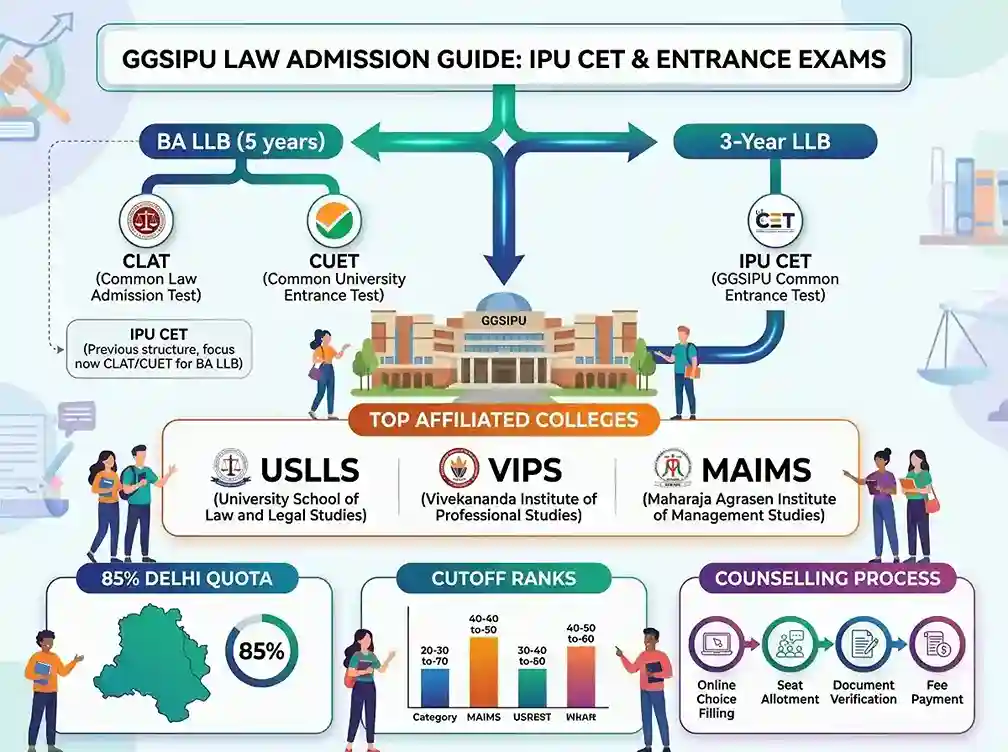
1. What is IPU CET Law? | Overview & 2026 Update
The IPU CET (Indraprastha University Common Entrance Test) is the university-level admission process conducted by Guru Gobind Singh Indraprastha University (GGSIPU), commonly known as IP University, for admission to its wide range of undergraduate and postgraduate programmes at the university's own schools and its network of over 100 affiliated colleges in Delhi NCR.
For law aspirants, "IPU CET Law" historically referred to an IP University-conducted entrance exam (formerly Code 128) for 5-year integrated BA LLB and BBA LLB programmes. However, this has changed significantly. As of 2026:
| Law Programme | Admission Route (2026) | Code/Exam | Status |
|---|---|---|---|
| BA LLB (Hons.) | 5 Years | CLAT UG 2026 (primary) / CUET Law (secondary, vacant seats) | Code 121 | No own CET | CLAT/CUET |
| BBA LLB (Hons.) | 5 Years | CLAT UG 2026 (primary) / CUET Law (secondary, vacant seats) | Code 121 | No own CET | CLAT/CUET |
| LLB | 3 Years | GGSIPU's own CET conducted Apr–May 2026 | Code 238 | Own CET conducted |
| LLM | Postgraduate | CLAT PG scores (for USLLS) / University-specific process | | | CLAT PG |
This major policy shift means that if you want to study BA LLB or BBA LLB at USLLS, VIPS, MAIMS, or any other GGSIPU-affiliated law college, you must appear for CLAT 2026 or CUET Law 2026 | not a separate IPU entrance test. Only for the 3-year LLB (post-graduation programme) does GGSIPU still conduct its own CET (Code 238).
2. Law Programmes at GGSIPU | 5-Year vs 3-Year LLB
Guru Gobind Singh Indraprastha University offers three distinct law pathways, each with a different eligibility and admission route:
3. IPU CET Law Eligibility Criteria 2026
For BA LLB & BBA LLB (5-Year Integrated) | Code 121
| Criterion | Requirement |
|---|---|
| Qualifying Exam | Class 12 (10+2) from a recognised board (CBSE, ICSE, State Boards, NIOS excluded per BCI rules) |
| English Mandatory | Must have English as a core, elective, or functional subject in 10+2 |
| Min. Marks | General/EWS | 50% aggregate in 10+2 |
| Min. Marks | SC/ST/OBC/PwD | 45% aggregate in 10+2 |
| Age Limit | No upper age limit (as per BCI guidelines) |
| Stream | Any stream | Science, Commerce, Humanities, Arts |
| Entrance Test Required | Valid CLAT UG 2026 score (primary) OR CUET (UG) Law 2026 score (secondary/vacant seat round) |
| Appearing Candidates | Class 12 appearing students can apply; must submit marksheet with required percentage at counselling |
| NIOS/Open University | NOT eligible | BCI has specifically disallowed open university 10+2 for law programmes |
For 3-Year LLB | Code 238 (Own CET)
| Criterion | Requirement |
|---|---|
| Qualifying Exam | Graduation (Bachelor's degree) in any discipline from a UGC-recognised university |
| Min. Marks | General | 50% aggregate in graduation |
| Min. Marks | SC/ST/OBC/PwD | 45% aggregate in graduation (as per GGSIPU brochure) |
| Age Limit | No upper age limit |
| Entrance Test | GGSIPU CET Code 238 (university-conducted) |
| Final Year Students | Eligible to appear; must produce graduation result before admission |
CLAT (for NLUs) requires only 45% in Class 12 for General category. IPU law admission (BA LLB/BBA LLB via CLAT) requires a higher bar of 50% in Class 12 from GGSIPU's side. So even if you clear CLAT, you may not meet GGSIPU's own eligibility if you scored below 50% in 10+2. SC/ST/OBC/PwD candidates follow GGSIPU's 45% norm | consistent with CLAT's standard. Always verify your marks against GGSIPU's eligibility before applying.
4. IPU CET Law 2026 | Important Dates
5. IPU Law Admission Process 2026 | Two Distinct Pathways
Pathway A: BA LLB / BBA LLB via CLAT and CUET
The CLAT-based pathway is the primary route for 5-year integrated law at GGSIPU. Here is how it works:
CLAT UG 2026 was conducted on December 7, 2025. Candidates with a valid CLAT score form the primary merit pool. CUET (UG) Law 2026 (May 11–31, 2026) scores are used as a secondary fallback | only candidates who were not placed through CLAT in the first rounds may be considered through CUET for any remaining vacant seats.
Having a CLAT or CUET score alone is not enough | you must separately register on the GGSIPU admission portal and fill the IPU law application form. Pay the ₹2,500 non-refundable application fee. Enter your CLAT application number, CLAT score, and programme preferences. Upload all required documents including Class 10 and 12 marksheets and category certificate if applicable.
GGSIPU publishes a college-wise and category-wise CLAT score cutoff list. Only candidates whose CLAT score meets the cutoff for their preferred college are shortlisted. The cutoff list is released separately for Delhi Region (85% seats) and Outside Delhi (15% seats). Multiple rounds ensure all seats are filled progressively.
Shortlisted candidates register for counselling on ipu.admissions.nic.in, pay a counselling participation fee, and fill their college and programme preferences in order of priority. Seat allotment is done based on merit (CLAT score) and preference. Multiple rounds: Round 1, Round 2, Sliding Round (upgrade), and Spot Round (for leftover seats).
Once a seat is allotted, candidates must report to the allotted GGSIPU-affiliated law college within the stipulated deadline, submit original documents for verification, and pay the first semester/year fee to confirm admission. Failure to report within the deadline results in the seat being cancelled and re-allotted in the next round.
Pathway B: 3-Year LLB via GGSIPU Own CET (Code 238)
For graduates seeking a law degree through the 3-year LLB, GGSIPU continues to conduct its own CET. This pathway is entirely separate from the CLAT/CUET route and is specifically for candidates who have completed their bachelor's degree:
| Stage | Details |
|---|---|
| Registration | Online on ipu.admissions.nic.in | Fee: ₹2,500 | Closed March 31, 2026 |
| CET Exam | Offline (pen-and-paper) | April 25 – May 17, 2026 | 100 MCQs | 400 marks | 2.5 hours | -1 for wrong |
| Result | Common Merit Rank (CML) released on ipu.ac.in (expected June 2026) |
| Counselling | Offline mode | Round 1: June 8, 2026 | Round 2: June 23, 2026 | Spot Round thereafter |
| Seat Allotment | Based on CML rank, category, and college preference in descending merit order |
6. IPU CET 3-Year LLB | Exam Pattern & Syllabus (Code 238)
For graduates applying to the 3-year LLB programme (Code 238), GGSIPU conducts its own university CET. Here is the complete exam pattern and syllabus:
| IPU CET 3-Year LLB | Exam Pattern 2026 | |
|---|---|
| Exam Mode | Offline (Pen and Paper) or CBT (Computer-Based Test) |
| Total Questions | 100 MCQs (4 options each) |
| Total Marks | 400 (each correct = +4 marks) |
| Negative Marking | -1 mark for each incorrect answer; 0 for unattempted |
| Duration | 2 hours 30 minutes (150 minutes) |
| Language | English only |
| Sectional Time Limit | None | answer in any order |
IPU CET 3-Year LLB | Section-Wise Syllabus
- Unseen passages (comprehension of text, main idea, inference)
- Reading comprehension | factual and analytical passages
- Vocabulary in context | synonyms, antonyms, word usage
- Grammar | error spotting, sentence correction, fill in the blanks
- Para-jumbles (sentence rearrangement)
- Idioms and phrases
- National and international current affairs (last 12 months)
- Indian Constitution basics | Preamble, Fundamental Rights, DPSPs, Amendments
- Indian polity | Parliament, Judiciary, Executive
- Important Supreme Court judgments and legal developments
- Indian history | Independence movement, post-independence events
- Geography | India and world
- Economy | Budget, GST, major schemes, banking basics
- Science and technology | major discoveries, space missions
- Sports | major tournaments, award winners
- Important national and international personalities
- Principle-based Legal Reasoning: A legal principle is stated; you apply it to a given factual situation to determine the correct legal outcome (no prior law knowledge needed for these)
- Constitutional law | Fundamental Rights, Article 14, 19, 21; judicial review
- Law of Torts | Negligence, Defamation, Nuisance, Vicarious Liability
- Law of Contract | Offer, Acceptance, Consideration, Void agreements
- Criminal Law basics | IPC sections, Mens Rea, Actus Reus, Offences against person and property
- Family Law basics | Marriage, Divorce, Maintenance (Hindu and Muslim law concepts)
- Legal maxims | Volenti non fit injuria, Res ipsa loquitur, Caveat emptor, etc.
- Important legal terms | FIR, Cognizable offences, Bail, Habeas Corpus, Mandamus
- Legal aptitude | Analogy, series completion based on legal contexts
Since Legal Reasoning carries 50 questions (200 marks out of 400), it is the single most important section for the IPU CET 3-year LLB. Unlike traditional general knowledge, this section tests your ability to apply a given principle to facts | no prior law degree needed. The pattern is identical to CLAT legal reasoning. Practice principle-based legal questions from CLAT question banks and previous IPU CET papers. Aim to score 75% in Legal Reasoning to secure a strong rank.
7. Top Law Colleges Under GGSIPU 2026
There are over 15 GGSIPU-affiliated law colleges in Delhi NCR offering BA LLB and BBA LLB programmes. Admission to all of them is through the same centralised GGSIPU counselling process based on CLAT/CUET scores. Here are the most sought-after institutions:
* CLAT score cutoffs are estimates based on 2025 GGSIPU counselling data for Delhi Region, General category. Actual 2026 cutoffs will vary. Official data at ipu.admissions.nic.in post-counselling.
8. IPU Law Cutoff 2025 & 2026 | CLAT Score & Rank Analysis
Since 2026 IPU law admissions are based on CLAT scores, cutoffs are expressed as the minimum CLAT score (out of 150) or CLAT All India Rank required for each college under GGSIPU. Here is what the data shows:
| College | Delhi Region Cutoff (CLAT Score/150) | Outside Delhi (Approx. CLAT Rank) | 2026 Target Score |
|---|---|---|---|
| USLLS (Govt.) | ~78 / 150 | ~Top 2,420 | 80+ |
| VIPS School of Law | ~70 / 150 | ~Top 3,500 | 72+ |
| MAIMS School of Law | ~65 / 150 | ~Top 4,500 | 67+ |
| CPJ College of Law | ~60 / 150 | ~Top 5,500 | 62+ |
| FIMT / Other colleges | ~50 / 150 | ~Top 8,879 | 52+ |
* Data sourced from 2025 GGSIPU counselling data and ipu.co.in cutoff analysis. 2026 cutoffs will be released by GGSIPU after counselling in July 2026. Delhi Region = 85% seats. Outside Delhi = 15% seats (highly competitive).
9. Delhi vs Outside Delhi Quota | Understanding the 85%/15% Split
The most critical factor in GGSIPU law admissions is the regional domicile quota. Here is a clear breakdown:
- Open to candidates who are domicile residents of Delhi
- Proof required: Delhi voter ID, ration card, Aadhaar, electricity bill or school leaving certificate from Delhi school
- Significantly more relaxed CLAT score cutoffs
- 2025 cutoff rank for most colleges: up to ~8,879 CLAT rank
- Strong advantage | 85% of all seats reserved exclusively for Delhi candidates
- Open to candidates from all states except Delhi
- Only 15% of each college's seats are available
- Highly competitive | far tighter cutoffs
- 2025 cutoff rank for most colleges: approximately ~2,420 CLAT rank or better
- Non-Delhi candidates with CLAT ranks below 2,000–3,000 have realistic chances at top colleges like USLLS and VIPS
In addition to the 85%/15% split, unaided (private) GGSIPU-affiliated law colleges may have a Management Quota of up to 10% of their sanctioned intake under Chapter 12 of GGSIPU's admission brochure. Even for management quota seats, candidates must have a valid CLAT or CUET score as of 2026. Students with CLAT ranks between 5,000 to 15,000 can realistically explore management quota seats at top private law colleges under GGSIPU. Government college USLLS does not have a management quota.
10. IPU Law Counselling Process 2026
GGSIPU conducts a centralised online counselling for BA LLB/BBA LLB (CLAT route) and a separate offline counselling for 3-year LLB (CET route). Here is how each works:
BA LLB / BBA LLB | Online Counselling (CLAT/CUET Route)
| Counselling Stage | What Happens | Timeline |
|---|---|---|
| Registration for Counselling | Register on ipu.admissions.nic.in, pay counselling fee, upload documents | July 2026 |
| Choice Filling | Fill college and programme preferences in priority order online | July 2026 |
| Round 1 Seat Allotment | Seats allotted based on CLAT score, domicile quota, and preference | July 2026 |
| Round 2 Seat Allotment | Candidates who missed/upgraded in Round 1 | August 2026 |
| Sliding Round | Candidates can upgrade to better colleges if higher preference opens up | August 2026 |
| Spot Round | Remaining vacant seats filled in offline mode | August–September 2026 |
| Document Verification | At allotted college | originals required within deadline | After each round |
Fill all your preferences meticulously | list all GGSIPU law colleges you are willing to attend, from most preferred to least preferred. The system automatically allots the best available option. If you get a lower-preference college in Round 1, you can try to upgrade in the Sliding Round. Always keep your original documents ready | 10th and 12th marksheets, domicile certificate (critical for Delhi quota), CLAT admit card and scorecard, category certificate (SC/ST/OBC/PwD/EWS), and two passport photographs.
11. How to Apply for IPU Law Admission 2026 | Step-by-Step
CLAT 2026 was conducted in December 2025. If you missed CLAT, you can use CUET Law 2026 (May–June 2026) as a secondary route for vacant seats. For 3-year LLB, register and appear in GGSIPU CET Code 238 instead.
Go to the official GGSIPU admissions portal. Click on "Admission 2026" and then select "Non-CET" (for BA LLB/BBA LLB via CLAT/CUET) or the appropriate CET programme. Create an account with your active email and mobile number | all future communications will come here.
Enter personal details (name as in Class 10, date of birth, gender, category, nationality), academic details (Class 10 and 12 marks, board), CLAT/CUET score and application number, domicile status (Delhi/Outside Delhi), and contact information. Select the programme code (121 for BA LLB/BBA LLB).
Upload: Scanned passport-size photograph (white background, recent), scanned signature, Class 10 marksheet, Class 12 marksheet (if results declared), and category certificate if applicable. Pay ₹2,500 application fee online (credit/debit card, net banking, UPI). Fee is non-refundable. Save the payment receipt.
Review every field carefully before final submission. Download and save the application confirmation page with your GGSIPU application number | this is your reference for all future counselling steps. You cannot edit the form after submission.
When GGSIPU releases the counselling schedule (expected July 2026), register again on ipu.admissions.nic.in specifically for counselling, pay the counselling fee, and fill your college preferences. Your merit is your CLAT score | the system will automatically allot the best matching option from your list.
12. Preparation Strategy for IPU Law 2026
For BA LLB / BBA LLB via CLAT (Primary Route)
Since GGSIPU's BA LLB/BBA LLB admission is now based on CLAT scores, the most important thing you can do is prepare rigorously for CLAT 2027 (for 2027 admissions) or leverage your existing CLAT 2026 score strategically for 2026 counselling. Your CLAT score directly determines which GGSIPU law college you can access.
| CLAT Score Target | Expected GGSIPU College Access | Strategy |
|---|---|---|
| 80–120+ / 150 | USLLS (Delhi quota) | VIPS, MAIMS (Outside Delhi) | Top 5% performance | compete for NLUs also; GGSIPU is a strong fallback |
| 65–80 / 150 | VIPS, MAIMS, CPJ (Delhi quota) | Good GGSIPU options | focus on improving score further for USLLS |
| 50–65 / 150 | FIMT, Ideal, other affiliated colleges (Delhi quota) | Moderate score | focus on counselling strategy and college preference order |
| Below 50 / 150 | Limited options at GGSIPU affiliated colleges | Consider CUET route for vacant seats; explore other Delhi law entrance tests |
For 3-Year LLB via GGSIPU CET (Code 238)
The 3-year LLB CET has a distinct syllabus with heavy emphasis on Legal Reasoning (50% of the paper). Here is a targeted preparation approach:
- Practice CLAT Legal Reasoning papers (2015–2025) | same format
- Master principle-fact application | never use outside knowledge
- Cover tort, contract, criminal, constitutional scenarios
- Target 38–42 correct out of 50 for a competitive rank
- Read one national newspaper daily (The Hindu, Indian Express)
- Maintain monthly current affairs notes
- Cover Indian polity (NCERT Class 11 Political Science)
- Follow major Supreme Court judgments and law news
- Practice reading comprehension passages daily (2–3 per day)
- Revise grammar rules (error spotting, fill in blanks)
- Build vocabulary from editorials and word-a-day apps
- Time yourself | each passage should take 3–5 minutes
- There is negative marking (-1) | avoid random guessing
- Start with Legal Reasoning (strongest section for most)
- Allocate time: LR = 60 min, GK = 25 min, English = 25 min
- Aim to attempt 85–90 questions with 80%+ accuracy
13. IPU CET Law 2026 | Frequently Asked Questions
No. As of 2026, Guru Gobind Singh Indraprastha University (GGSIPU) does not conduct its own entrance test for the 5-year integrated BA LLB and BBA LLB programmes. Admission to these programmes is now based on: (1) CLAT UG 2026 scores as the primary route, and (2) CUET (UG) Law 2026 scores as a secondary route for any remaining vacant seats. GGSIPU only conducts its own CET (Code 238) for the 3-year LLB programme for graduates. Candidates must apply separately to GGSIPU on ipu.admissions.nic.in with their CLAT score.
For IP University BA LLB 2026: You must have passed Class 12 (10+2) from a recognised board with English as a mandatory subject (core, elective, or functional). Minimum marks: 50% aggregate for General and EWS candidates; 45% for SC/ST/OBC/PwD. A valid CLAT UG 2026 score is required. Candidates from NIOS or open university 10+2 are not eligible per Bar Council of India rules. Appearing candidates (Class 12 in 2026) may apply, subject to submitting their marksheet at counselling. There is no upper age limit.
Based on 2025 GGSIPU counselling data, the CLAT score cutoff for USLLS (University School of Law and Legal Studies) for the Delhi Region General category was approximately 78 out of 150 in Round 1. For Outside Delhi candidates, the cutoff is much more stringent | only candidates with an approximate CLAT All India Rank within the top 2,420 had realistic access to GGSIPU's top law college. For 2026, aim for a CLAT score of 80+/150 for a strong chance at USLLS in Delhi quota. CLAT scores below 65 are unlikely to yield USLLS admission but can still access VIPS, MAIMS, and other affiliated colleges.
The IPU CET 3-year LLB (Code 238) has 100 MCQs worth 400 marks in 2.5 hours (offline mode). Marking: +4 for correct, -1 for wrong. Three sections: (1) Language and Comprehension | 25 questions (RC passages, grammar, vocabulary); (2) General Knowledge and Current Affairs | 25 questions (national/international events, Indian polity, legal news); (3) Basic Understanding of Law and Legal Reasoning | 50 questions (principle-fact based legal reasoning covering tort, contract, criminal, constitutional law | no prior legal knowledge needed, principles are given in each question). Eligibility: Graduation with 50% marks from a UGC-recognised university.
Yes, for candidates seeking seats under the Delhi Region quota (85% seats), you must prove Delhi domicile at the time of counselling. Acceptable proof includes: Delhi voter ID card, Delhi ration card, Delhi Aadhaar (with Delhi address), electricity/water bill (Delhi address), or a school leaving certificate from a Delhi-based school. Without domicile proof, you will be considered under the Outside Delhi (All India) quota, which covers only 15% of seats and requires a significantly higher CLAT score.
Yes, but with limitations. CUET (UG) Law 2026 scores are accepted by GGSIPU as a secondary route | only for vacant seats remaining after CLAT counselling is exhausted. CLAT candidates fill seats first in all counselling rounds. If you have a CUET score but no CLAT score, you can apply and be considered in later rounds or for seats in management quota (10% at private colleges). Additionally, CUET scores also qualify you for the 10% management quota at unaided affiliated law colleges per GGSIPU Chapter 12. Having both CLAT and CUET scores maximises your options.
The IP University law application fee for 2026 is ₹2,500 (non-refundable) for both the BA LLB/BBA LLB (via CLAT/CUET) and the 3-year LLB (via own CET). Payment is made online on ipu.admissions.nic.in through credit/debit card, net banking, or UPI. Separate counselling registration fees will be charged at the time of counselling participation. The application fee is the same regardless of category (General, SC/ST, OBC, PwD).
No. IPU CET (or GGSIPU admissions) does not give access to National Law Universities (NLUs). NLUs | such as NLSIU Bangalore, NALSAR Hyderabad, GNLU Gandhinagar | admit students through CLAT (Common Law Admission Test) via the Consortium of NLUs. GGSIPU's law colleges (USLLS, VIPS, MAIMS, etc.) are separate, Delhi-based institutions. If you want NLU admission, you must appear for CLAT (and optionally AILET for NLU Delhi). However, GGSIPU law colleges are excellent institutions in their own right | USLLS in particular is considered among Delhi's top law schools and is well-regarded for litigation and corporate law careers.