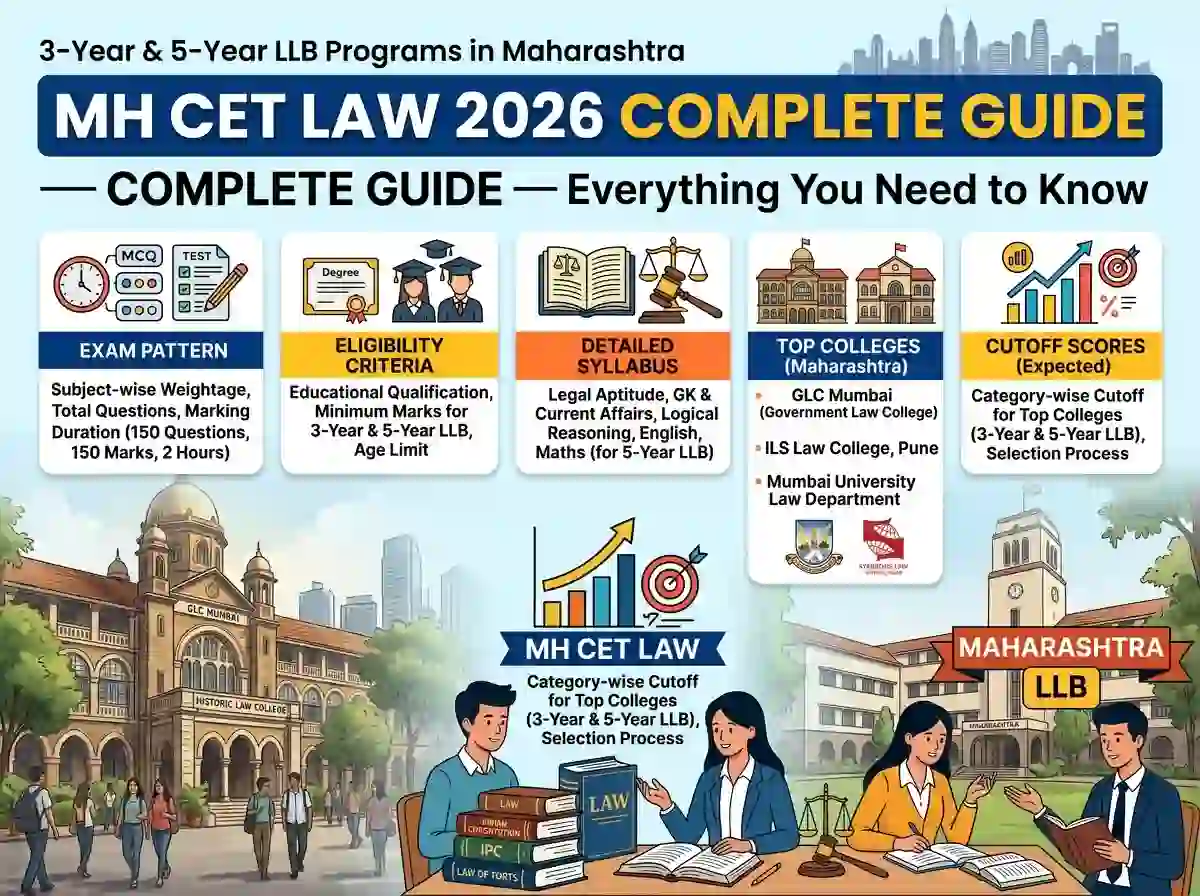
MH CET Law 2026 is conducted by the State Common Entrance Test Cell, Maharashtra for admission to 3-year LLB and 5-year integrated LLB programs across 140+ law colleges in Maharashtra. The exam consists of 120 multiple-choice questions worth 120 marks, has no negative marking, lasts 2 hours, and is conducted in online CBT mode in English and Marathi. Top colleges include GLC Mumbai (cutoff: 99.68–100 marks), ILS Pune (cutoff: 99.40–100 marks), and KC Law College Mumbai. The official website is cetcell.mahacet.org.
1. What is MH CET Law 2026? | Complete Overview
MH CET Law (Maharashtra Common Entrance Test for Law) is a state-level law entrance exam conducted by the State Common Entrance Test Cell, Maharashtra in collaboration with the Directorate of Higher Education, Mumbai. It is the gateway to law education in Maharashtra — the state with the largest concentration of quality law colleges outside the NLU system in India.
The exam is conducted separately for two programs: the 5-year integrated LLB (for Class 12 pass students) and the 3-year LLB (for graduation-pass students). Both exams share a similar structure — 120 MCQ questions, 120 marks, 2-hour duration — with the 5-year LLB adding a Mathematics section that the 3-year LLB does not include.
2. MH CET Law 2026 Key Dates | Important Events & Timeline
The exam schedule for MH CET Law 2026 was announced by the State CET Cell Maharashtra. Here is the complete timeline for both the 3-Year LLB and 5-Year LLB programs:
Based on the 2026 schedule, MH CET Law 2027 registration for 3-Year LLB is expected to open in December 2026 (closing February 2027), and registration for 5-Year LLB in January 2027 (closing March 2027). The application fee is ₹1,000 for Open/OMS candidates and ₹800 for reserved category candidates. Monitor cetcell.mahacet.org for official updates.
3. MH CET Law 2026 Eligibility Criteria
The eligibility criteria for MH CET Law 2026 differ for the 3-year and 5-year LLB programs. Understanding these requirements before applying is essential — candidates who do not meet the criteria will have their admissions cancelled even after seat allotment.
| Eligibility Parameter | 5-Year LLB (Integrated) | 3-Year LLB |
|---|---|---|
| Qualifying Examination | Class 12 / HSC or equivalent | Graduation in any stream |
| Minimum Marks (General / OMS) | 45% aggregate | 45% aggregate |
| Minimum Marks (OBC / VJNT / SBC) | 42% aggregate | 42% aggregate |
| Minimum Marks (SC / ST) | 40% aggregate | 40% aggregate |
| Age Limit | No upper age limit | No upper age limit |
| Appearing Students | Eligible (conditional) | Eligible (conditional) |
| Domicile Requirement | MS / OMS categories (separate seat quota) | MS / OMS categories (separate seat quota) |
| Stream of Study | Any stream (Arts, Science, Commerce) | Any graduation stream |
4. MH CET Law 2026 Exam Pattern | 3-Year & 5-Year LLB
The MH CET Law 2026 exam pattern was revised in 2023-24, reducing the total number of questions from 150 to 120 questions for 120 marks. This revision also changed the section-wise distribution. Understanding the pattern is the first step in building an effective preparation strategy.
MH CET Law 2026 has zero negative marking. There is absolutely no penalty for wrong answers — a wrong answer gives 0 marks, not –0.25. This means: never leave a question unattempted. Even a random guess gives you a 25% probability of scoring 1 mark. Candidates who attempt all 120 questions always outperform those who leave questions unanswered. This is one of the most strategically important differences between MH CET Law and CLAT (which has 0.25 negative marking).
5. MH CET Law 2026 Syllabus | Section-Wise Topics & Coverage
The MH CET Law 2026 syllabus is prescribed by the State CET Cell Maharashtra. It covers five broad subjects (four for 3-year LLB, five for 5-year LLB). Here is the detailed section-wise breakdown of topics you must prepare:
6. Top MH CET Law Colleges 2026 | Cutoffs, Seats & Fees
Over 140 law colleges in Maharashtra accept MH CET Law 2026 scores through the Centralised Admission Process (CAP). These colleges collectively offer approximately 10,860–11,520 seats for 5-year LLB and 16,000–16,420 seats for 3-year LLB. Here are the top MH CET Law colleges you should target:
GLC Mumbai is the most prestigious and competitive MH CET Law college. Established in 1855, it is one of the oldest law schools in Asia. The college is government-run with extremely low fees and produces a large number of prominent lawyers, judges, and legal academics. Admission here is fiercely competitive — the cutoff routinely touches 100% of the maximum score.
ILS Law College Pune is one of the leading law colleges in Maharashtra. NAAC-accredited and established in 1924, ILS is known for rigorous academics, strong moot court culture, and excellent placements in law firms and corporate roles. It offers BA LLB, BBA LLB, and 3-year LLB programs. The cutoff at ILS Pune closely follows GLC Mumbai in competitiveness.
KC Law College is one of Mumbai's most sought-after law colleges, known for its strong alumni network, court proximity (Bombay High Court), and active legal culture. Located in the heart of South Mumbai, the college offers excellent opportunities for internships, mooting, and court observation.
Part of the SVKM group (which also runs NMIMS and Narsee Monjee), Pravin Gandhi College of Law is one of the newer entrants with an excellent reputation for corporate law placements. It is a preferred choice for candidates aiming for a corporate or commercial law career.
One of the most popular private law colleges in Pune, Bharati Vidyapeeth New Law College offers both 3-year LLB and 5-year integrated programs. Known for strong faculty, regular moot courts, and consistent placements. A reliable choice for candidates in the 90–98 marks range who may miss GLC or ILS.
MNLU Mumbai is the NLU in Maharashtra's system, admitting through CLAT scores for most candidates. However, a domicile quota accepts MH CET Law scores for Maharashtra state candidates. This makes MNLU a unique option for high-scoring MH CET Law candidates from Maharashtra who want an NLU education without a national-level CLAT rank.
7. MH CET Law Score vs College | What Can You Get?
Use this score band chart to set a realistic target. Under the revised 2026 exam pattern (120 marks total), a score above 100 is considered excellent for General category candidates. The competition is most intense for GLC Mumbai and ILS Pune, which require near-perfect scores.
Maharashtra State (MS) candidates and Outside Maharashtra State (OMS) candidates have separate seat quotas. OMS cutoffs are typically 5–8 marks higher than MS cutoffs at the same college. For example, if the MS cutoff at GLC Mumbai is 99.68 marks, the OMS cutoff may be 100 marks. OMS candidates have a significantly smaller seat quota (approximately 15% of seats) and face stiffer competition. If you are an OMS candidate, aim for 5 additional marks above the MS cutoff estimate.
8. MH CET Law 2026 CAP Counselling Process
Admission to law colleges through MH CET Law 2026 is conducted via the Centralised Admission Process (CAP) managed by the State CET Cell Maharashtra. The entire counselling process — from registration to seat allotment — is conducted online.
9. MH CET Law 2026 Preparation Strategy | How to Score 110+
Scoring 110+ out of 120 in MH CET Law — the score needed for top colleges — requires a strategic, section-specific approach. Here is the preparation framework that consistently produces high scores:
Because there is no negative marking, the optimal strategy is to answer every single question — never leave one blank. For questions you are unsure about: (1) eliminate clearly wrong options to improve your odds, (2) make your best educated guess, (3) move on. In a 120-question exam, even getting 20 guesses right at 25% probability adds 5 marks. That 5-mark difference can separate GLC Mumbai from the next college in the cutoff list.
Best books for MH CET Law 2026 preparation: Legal Aptitude — AP Bhardwaj's Legal Awareness and Legal Reasoning; GK — Lucent's General Knowledge + monthly current affairs compilations; English — Word Power Made Easy (Norman Lewis), SP Bakshi Objective English; Logical Reasoning — RS Aggarwal's A Modern Approach to Logical Reasoning; Maths (5-year) — Arihant Quantitative Aptitude. Supplement all sections with previous year MH CET Law question papers (2018–2025) as the most reliable exam-pattern practice tool.
10. MH CET Law vs CLAT 2027 | Key Differences
Many law aspirants appear in both MH CET Law and CLAT. Understanding the key differences between the two exams helps you prepare efficiently for both simultaneously — since there is significant syllabus overlap:
| Parameter | MH CET Law 2026 | CLAT 2027 |
|---|---|---|
| Conducting Body | State CET Cell, Maharashtra | Consortium of NLUs |
| Exam Level | State-level (Maharashtra) | National-level (All India) |
| Questions / Marks | 120 questions / 120 marks | 120 questions / 120 marks |
| Negative Marking | ❌ None — Attempt All | ⚠️ –0.25 per wrong answer |
| Question Style | Traditional MCQ + some passage-based | 100% passage-based |
| Legal Reasoning | Knowledge-based + principle application | Passage-based only — no prior law knowledge needed |
| Difficulty Level | Moderate — easier than CLAT | High — complex analytical reasoning |
| Colleges via Exam | 140+ Maharashtra law colleges | 25 NLUs + private colleges across India |
| Language Options | English + Marathi | English only |
| Application Fee | ₹1,000 (Open/OMS) | ₹800 (Reserved) | ₹4,000 (General) | ₹3,500 (SC/ST/PwD) |
| Best For | Maharashtra-based students, GLC / ILS aspirants | NLSIU, NALSAR, NUJS, GNLU and other NLU aspirants |
11. MH CET Law 2026 — Frequently Asked Questions
MH CET Law 2026 is the Maharashtra State Common Entrance Test for Law, conducted by the State CET Cell, Maharashtra for admission to 3-year LLB and 5-year integrated LLB programs across 140+ law colleges in Maharashtra. The 3-year LLB exam was conducted on April 1–2, 2026, and the 5-year LLB exam on May 8, 2026. The exam has 120 MCQ questions, 120 marks, 2-hour duration, no negative marking, and is conducted in online CBT mode in English and Marathi. Official website: cetcell.mahacet.org.
No. MH CET Law 2026 has no negative marking. Each correct answer awards 1 mark, and wrong answers are awarded 0 marks — no deduction. This means candidates should attempt all 120 questions without any concern about penalties. Attempting every question — even with an educated guess — maximises your score. This is a significant advantage over CLAT, which deducts 0.25 marks for wrong answers.
Government Law College (GLC) Mumbai is the most competitive MH CET Law college. In the previous admission cycle (2025), the 3-year LLB cutoff at GLC ranged between 99.68 and 100 marks for the General (MS) category. For the 5-year LLB, the GLC cutoff exceeds the 99th percentile. A safe target score is 115–120 marks for GLC Mumbai General (MS) category. OMS candidates need 5–8 additional marks compared to MS candidates at the same college.
MH CET Law 2026 offers approximately 10,860–11,520 seats for the 5-year LLB program and 16,000–16,420 seats for the 3-year LLB program across 140+ participating colleges in Maharashtra. This makes MH CET Law one of the largest law entrance exams in India by total seat availability — significantly more seats than CLAT's 4,500+ NLU seats. Seat availability means even an average score can secure a decent college in Maharashtra.
Yes. Candidates from outside Maharashtra can apply as OMS (Outside Maharashtra State) candidates. OMS candidates are eligible for approximately 15% of the seats at each participating college (the exact percentage varies by institution). OMS cutoffs are typically 5–8 marks higher than MS (Maharashtra State) cutoffs at the same college because OMS candidates have fewer seats and face a smaller but equally competitive pool. There is no domicile restriction on appearing for the exam itself.
The MH CET Law 3-year LLB is for candidates who have completed graduation (any stream) and want to pursue a traditional LLB degree in 3 years. The MH CET Law 5-year LLB is for Class 12 pass candidates who want an integrated law degree (BA LLB, BBA LLB, B.Com LLB) in 5 years. The 5-year exam has an additional Mathematical Aptitude section (~12 questions) not in the 3-year exam. Both programs have separate registration windows, exam dates, result declarations, and separate CAP counselling processes. Candidates can apply for both programs simultaneously.
The official MH CET Law 2027 dates have not been announced as of May 2026. Based on historical patterns: the 3-year LLB exam is typically held in late March or early April 2027, and the 5-year LLB exam in May 2027. Registration for the 3-year LLB is expected to open in December 2026 (closing February 2027), and registration for the 5-year LLB in January 2027 (closing March 2027). Monitor cetcell.mahacet.org for official announcements.