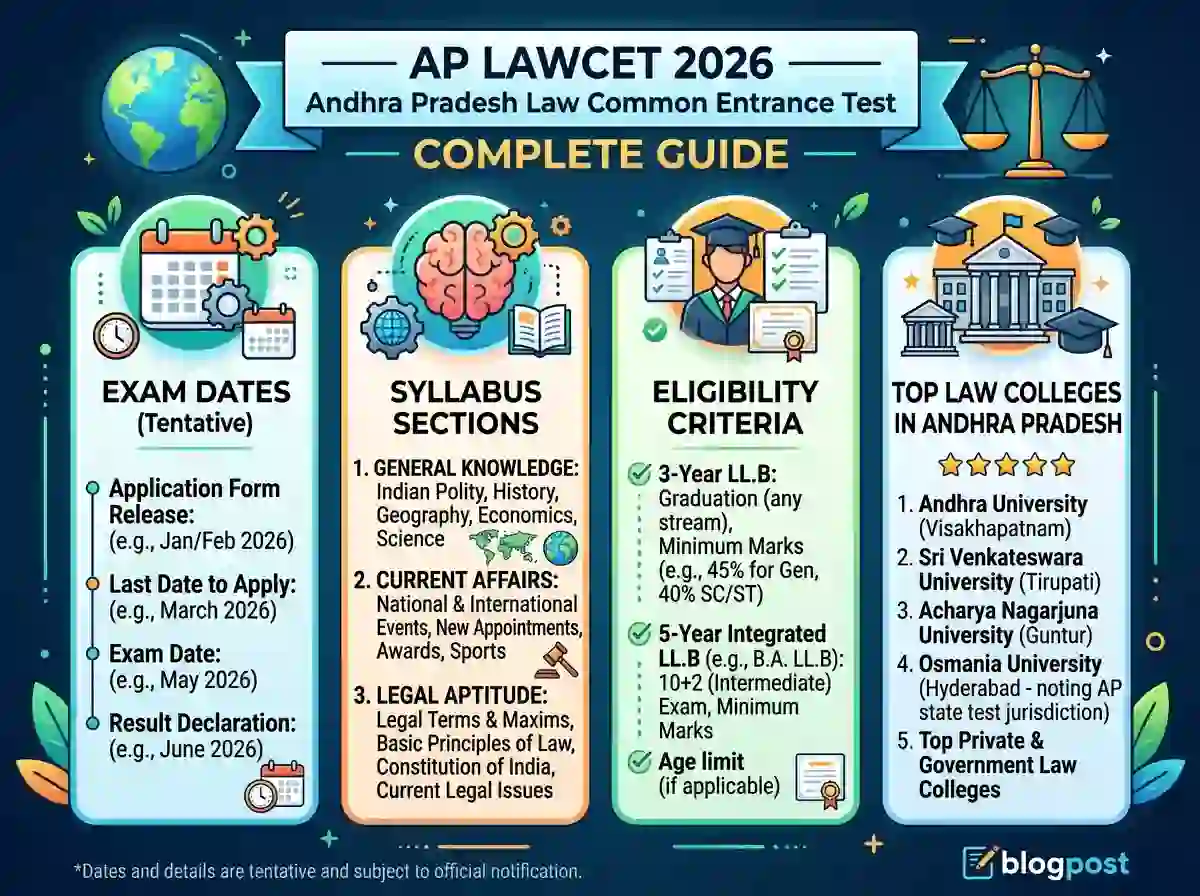
1. What is AP LAWCET? Overview & Key Facts
The Andhra Pradesh Law Common Entrance Test (AP LAWCET) is a state-level law entrance exam conducted annually by Sri Padmavati Mahila Visvavidyalayam (SPMV), Tirupati, on behalf of the Andhra Pradesh State Council of Higher Education (APSCHE). It is the gateway to admission in 3-year LLB and 5-year integrated LLB programmes offered by universities and affiliated law colleges across Andhra Pradesh for the academic year 2026–27.
AP LAWCET is one of the most important state law entrance exams in South India. Over 27,000 candidates registered for AP LAWCET 2025 (21,251 appeared), reflecting the strong competition for law seats in Andhra Pradesh. The exam tests candidates across three domains — General Knowledge & Mental Ability, Current Affairs, and Aptitude for the Study of Law — with the Legal Aptitude section carrying the highest weightage of 50%.
| Exam Name | AP LAWCET 2026 |
| Full Form | Andhra Pradesh Law Common Entrance Test |
| Conducting Body | SPMV Tirupati / APSCHE |
| Exam Level | State Level (Andhra Pradesh) |
| Frequency | Once a Year |
| Programmes Offered | 3-Year LLB & 5-Year Integrated LLB |
| Official Website | cets-apsche.ap.gov.in |
| Total Registered | 27,253 candidates |
| Total Appeared | 21,251 candidates |
| Pass Percentage | ~98% (20,826) |
| Qualifying Marks (Gen) | 42/120 (35%) |
| Total Seats (2026) | ~8,767 seats |
| 5-Year LLB Seats | ~3,041 seats |
| 3-Year LLB Seats | ~5,726 seats |
2. AP LAWCET 2026 Important Dates
The following table lists all key AP LAWCET 2026 dates based on the official APSCHE schedule. The exam has been completed; candidates who appeared should now focus on the result, answer key challenge, and upcoming counselling process.
AP LAWCET (Undergraduate) covers 3-year LLB and 5-year integrated LLB programmes. AP PGLCET (Postgraduate) is a separate exam for LLM admission with 501 seats. Both are conducted by APSCHE. If you are a law graduate seeking an LLM in Andhra Pradesh, you must appear for AP PGLCET, not AP LAWCET.
3. AP LAWCET Eligibility Criteria — 3-Year & 5-Year LLB
APSCHE prescribes separate eligibility criteria for the 3-year LLB and 5-year integrated LLB programmes. The key distinction is the qualifying examination: 5-year LLB requires Class 12 (Intermediate), while the 3-year LLB requires a bachelor's degree. Category-wise relaxation is also available.
Candidates appearing in their final year of Class 12 (for 5-year LLB) or final year of graduation (for 3-year LLB) are also eligible to apply for AP LAWCET 2026, provided they complete their qualifying examination before the date of admission/counselling. They must submit proof of passing at the time of college reporting, failing which their admission will be cancelled.
4. AP LAWCET 2026 Exam Pattern — Sections, Marks & Duration
AP LAWCET 2026 was conducted in Computer-Based Test (CBT) mode in both English and Telugu. The exam pattern for 2026 is identical to previous years — 120 objective-type MCQs in 90 minutes with no negative marking. The same paper is used for both 3-year LLB and 5-year LLB admissions; however, the difficulty level of qualifying expectations differs slightly based on the programme.
| Section | Part | No. of Questions | Maximum Marks | Weightage |
|---|---|---|---|---|
| General Knowledge & Mental Ability | Part A | 30 | 30 | 25% |
| Current Affairs | Part B | 30 | 30 | 25% |
| Aptitude for the Study of Law | Part C | 60 | 60 | 50% ★ Highest |
| TOTAL | — | 120 | 120 | 100% |
5. AP LAWCET Syllabus 2026 — Section-Wise Topics
The AP LAWCET 2026 syllabus is divided into three parts. Part C (Aptitude for the Study of Law) carries the maximum weightage of 50% and is the most important section for determining your rank. Candidates should allocate more study time to Part C while ensuring solid coverage of Parts A and B. The syllabus for 5-year LLB is at the Class 12 level; the 3-year LLB syllabus is at the graduation level.
This section evaluates your general awareness, logical reasoning, and basic mental ability. Questions are drawn from both static GK and analytical reasoning.
Current Affairs questions cover events from the past 12–18 months, with emphasis on national and international developments relevant to law, governance, and society. Andhra Pradesh-specific current events are also included.
The Legal Aptitude section tests your understanding of fundamental legal principles, Indian Constitution, contract law, criminal law basics, and your ability to apply legal reasoning to practical scenarios. No prior law study is required — the exam is designed to test aptitude, not memorised law.
6. How to Prepare for AP LAWCET 2026 — Strategy & Study Plan
AP LAWCET preparation requires a structured approach across all three sections. Since there is no negative marking, the strategy differs fundamentally from CLAT preparation — you should attempt every single question regardless of confidence level. The focus shifts from accuracy alone to a combination of speed, accuracy, and full coverage.
6.1 Section-Wise Preparation Strategy
6.2 Recommended Books for AP LAWCET
| Book / Resource | Section | Publisher/Author |
|---|---|---|
| Arihant Self-Study Guide — LLB Entrance | All Sections (A, B, C) | Arihant Publications |
| Lucent's General Knowledge | Part A — General Knowledge | Lucent Publications |
| A Modern Approach to Verbal Reasoning | Part A — Mental Ability | R.S. Aggarwal (S. Chand) |
| The Constitution of India (Bare Act) | Part C — Legal Aptitude | Government of India |
| Indian Polity (Class 11–12 NCERT) | Part A + Part C | NCERT |
| AP LAWCET Previous Year Papers | All Sections | Various (available at official site) |
| Monthly Current Affairs (The Hindu / GK Today) | Part B — Current Affairs | Online (updated monthly) |
6.3 AP LAWCET Study Plan — 3-Month Schedule
| Month | Focus Area | Daily Target | Weekly Milestone |
|---|---|---|---|
| Month 1 | Part C — Constitution of India + Legal Maxims; Part A — Indian History & Geography | 4–5 hours daily; 3 hours Part C, 2 hours Part A | Complete Constitution Parts I–IV; finish Indian History & Geography chapters |
| Month 2 | Part C — Contract Law, Torts, IPC basics; Part A — Polity & Science; Part B — Current Affairs catch-up | 4–5 hours daily; 2.5h Part C, 1.5h Part A, 1h Part B | Finish legal subject overviews; compile 6-month current affairs notes |
| Month 3 | Revision + Mock Tests; Previous Year Papers (2020–2025); weak-area targeting | 2 mock tests per week + daily 2-hour revision | Score 85+ consistently in mocks; complete all 5 PYQs |
7. AP LAWCET 2026 Result & Rank Card
The AP LAWCET 2026 Result was declared on May 18, 2026 on the official APSCHE website at cets-apsche.ap.gov.in. Candidates can download their rank card by logging in with their registration number and date of birth. The rank card contains the candidate's name, roll number, section-wise marks, total marks, overall rank, and category rank.
- Visit the official website: cets-apsche.ap.gov.in
- Click on the "AP LAWCET 2026 Result" link on the homepage
- Enter your Registration Number and Date of Birth
- Click "Submit" and your rank card will appear on screen
- Download and print your rank card for counselling registration
- Verify your personal details, marks, and rank carefully
To appear in the AP LAWCET 2026 rank list and be eligible for counselling, General and BC category candidates must score at least 42 marks out of 120 (35%). SC and ST category candidates have no minimum qualifying marks — they automatically receive a rank based on their score. Candidates below the qualifying threshold in General/BC categories will not be included in the rank list and cannot participate in counselling.
8. AP LAWCET Cutoff 2026 — Qualifying Marks & Expected Rank Trends
The AP LAWCET 2026 cutoff refers to two different things: (1) the qualifying cutoff — the minimum score to appear in the rank list, and (2) the admission cutoff — the last rank at which a specific college admits candidates. The final college-wise cutoff will be released during counselling. Below are the expected rank trends based on previous year data and 2026 pass percentage.
| Score Range (out of 120) | Expected Rank Range | Admission Chances |
|---|---|---|
| 90 – 120 | AIR 1 – 500 | Top government law colleges; highest preference colleges guaranteed |
| 80 – 89 | AIR 500 – 1,500 | Good government and top-tier private law colleges |
| 70 – 79 | AIR 1,500 – 3,500 | Reputed private and aided law colleges in Andhra Pradesh |
| 60 – 69 | AIR 3,500 – 6,000 | Mid-level institutions; additional rounds may help |
| 50 – 59 | AIR 6,000 – 10,000 | Later counselling rounds or private institutions |
| 42 – 49 (Qualifying) | AIR 10,000+ | Spot admissions or private college direct admission |
* Rank ranges are estimates based on AP LAWCET 2025 data. Final 2026 ranks will depend on total candidates, exam difficulty, and pass percentage.
8.1 Category-Wise Qualifying Cutoff
| Category | Minimum Qualifying Marks | % of Total (120) | Rank List Inclusion |
|---|---|---|---|
| General (UR) | 42 / 120 | 35% | Yes, if score ≥ 42 |
| BC (Backward Class) | 42 / 120 | 35% | Yes, if score ≥ 42 |
| SC (Scheduled Caste) | No minimum | — | Yes, regardless of score |
| ST (Scheduled Tribe) | No minimum | — | Yes, regardless of score |
| PwD (Differently Abled) | As per category | — | Yes, with disability certificate |
9. AP LAWCET 2026 Counselling Process — Step-by-Step Guide
The AP LAWCET 2026 counselling process is conducted by APSCHE in web-based (online) mode. Candidates who appear in the rank list are eligible to participate. The counselling typically takes place in 2 phases — Phase 1 for all ranks and Phase 2 (if vacancies exist) for unfilled seats. Admission is based purely on merit (rank) and the preferences submitted during web options entry.
9.1 Documents Required for AP LAWCET 2026 Counselling
- AP LAWCET 2026 Rank Card (downloaded)
- Class 10 Certificate & Marks Sheet (SSC)
- Class 12 / Intermediate Marks Sheet (for 5-yr LLB)
- Graduation Marks Sheets (for 3-yr LLB)
- Graduation Degree Certificate
- Transfer Certificate (TC) from last institution
- Conduct / Migration Certificate
- Caste Certificate (SC/ST/BC — if applicable)
- EWS Certificate (if applicable)
- PwD Certificate (if applicable)
- Aadhaar Card (original + photocopy)
- Income Certificate (for fee reimbursement)
- Passport-size photographs (6–8 copies)
- Allotment Letter (printed from portal)
10. Top Law Colleges Accepting AP LAWCET 2026 in Andhra Pradesh
Andhra Pradesh has a well-established network of government, aided, and private law colleges under the AP LAWCET counselling framework. Government law colleges offer significantly lower fees (₹10,000–₹30,000 per year) and are highly competitive in terms of cutoff ranks. Below are the top law colleges in Andhra Pradesh that accept AP LAWCET scores, along with expected cutoff trends.
| College | Type | Location | Programme | Expected Cutoff Rank (Gen) |
|---|---|---|---|---|
| Dr. B.R. Ambedkar College of Law, Andhra University | Govt | Visakhapatnam | 3-Year LLB | Rank 1–800 |
| Sri Venkateswara University — School of Law | Govt | Tirupati | 5-Year & 3-Year LLB | Rank 1–1,000 |
| Acharya Nagarjuna University — Law College | Govt | Guntur | 5-Year & 3-Year LLB | Rank 1–1,200 |
| Krishna University College of Law | Govt | Machilipatnam | 5-Year & 3-Year LLB | Rank 500–2,000 |
| DSNLU — Damodaram Sanjivayya NLU | NLU | Visakhapatnam | 5-Year LLB (via CLAT) | Via CLAT only |
| Nalanda Law College | Private | Guntur | 3-Year LLB | Rank 1,000–4,000 |
| Sri Krishnadevaraya University — Law College | Govt | Ananthapuramu | 3-Year LLB | Rank 800–2,500 |
| Vignan Law College | Private | Guntur | 5-Year & 3-Year LLB | Rank 2,000–6,000 |
| Basavatarakam Memorial Law College | Aided | Vijayawada | 3-Year LLB | Rank 1,500–4,500 |
| GITAM School of Law | Private (Deemed) | Visakhapatnam | 5-Year & 3-Year LLB | Direct admission + AP LAWCET |
Damodaram Sanjivayya National Law University (DSNLU), Visakhapatnam, is the only NLU in Andhra Pradesh. However, DSNLU admits students through CLAT, not AP LAWCET. If you are targeting DSNLU, you must appear for CLAT (DSNLU's CLAT 2026 General category closing rank was approximately AIR 4,200–5,500). DSNLU is not part of the APSCHE counselling framework. Visit our DSNLU profile page for details.
11. AP LAWCET vs CLAT — Key Differences (2026)
Many law aspirants in Andhra Pradesh wonder whether to appear for AP LAWCET, CLAT, or both. The straightforward answer is: appear for both if you qualify for both. AP LAWCET opens doors to all law colleges in Andhra Pradesh; CLAT opens doors to 27 National Law Universities across India. Here is a side-by-side comparison to help you understand which exam to prioritise:
| Aspect | AP LAWCET 2026 | CLAT 2027 |
|---|---|---|
| Conducting Body | SPMV Tirupati / APSCHE | Consortium of NLUs |
| Level | State (Andhra Pradesh only) | National (all 27 NLUs) |
| Programmes | 3-Year LLB + 5-Year LLB (AP colleges) | 5-Year LLB (NLUs only) |
| Exam Mode | CBT (Online/Computer) | Offline (Pen & Paper, OMR) |
| Questions | 120 MCQs | 120 Passage-Based MCQs |
| Duration | 90 minutes | 120 minutes |
| Negative Marking | No negative marking ✓ | Yes — −0.25 per wrong answer |
| Exam Language | English & Telugu | English only |
| Difficulty Level | Moderate (direct MCQs) | Moderate–Hard (passage-based) |
| Eligibility (5-Yr LLB) | 45% in Class 12 (Gen); 40% SC/ST | 45% in Class 12 (Gen); 40% SC/ST |
| Eligibility (3-Yr LLB) | 45% in Graduation | Not applicable (CLAT is for 5-yr LLB only) |
| Total Seats | ~8,767 (AP colleges) | ~4,500 (NLUs across India) |
| Application Fee | ₹250–750 (varies by category) | ₹4,000 (Gen); ₹3,500 (SC/ST/PwD) |
| Best For | AP domicile candidates; 3-yr LLB seekers; regional language comfort | National NLU aspirants; high scorers targeting top NLUs |