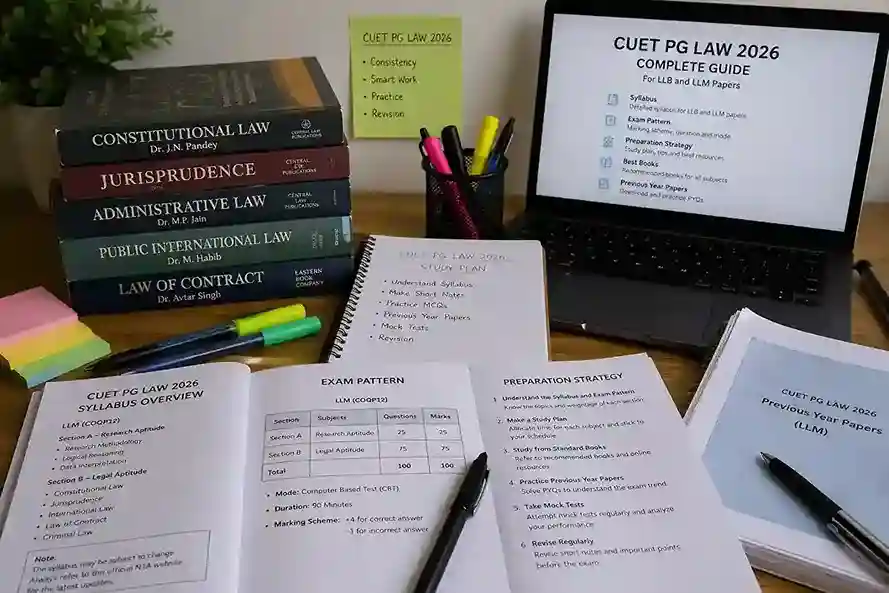
What Is CUET PG Law? A Clear Starting Point
CUET PG stands for Common University Entrance Test Postgraduate. The National Testing Agency (NTA) conducts it each year.
Within CUET PG, there are two separate law papers. The first is CUET PG LLB with the code COQP11. It is for students who want to join the 3-year LLB programme at central universities. The second is CUET PG LLM with the code COQP14. It is for law graduates who want to study for the LLM degree.
These two papers are different in purpose, eligibility, and subject matter. They need different preparation approaches. This guide covers both clearly.
More than 190 universities across India participate in the CUET PG system. However, not all of them accept LLB or LLM CUET scores. Always verify on the official portal at exams.nta.ac.in/CUET-PG which specific universities accept each paper before you apply.
The Two CUET PG Law Papers | LLB vs LLM
The two papers serve completely different purposes. Confusing them is one of the most common mistakes aspirants make. Here is a clear side-by-side comparison.
CUET PG Law 2026 Exam Pattern | Everything You Need to Know
The exam pattern tells you how the test is structured. Know this before you start preparing.
| Parameter | CUET PG LLB (COQP11) | CUET PG LLM (COQP14) |
|---|---|---|
| Mode | Computer-Based Test (CBT) | Computer-Based Test (CBT) |
| Language | English / Hindi (candidate's choice) | English / Hindi |
| Total Questions | 75 MCQs | 75 MCQs |
| Duration | 90 minutes | 90 minutes |
| Marks Per Correct Answer | +4 | +4 |
| Marks Deducted (Wrong) | -1 | -1 |
| Unattempted Questions | 0 marks | 0 marks |
| Maximum Marks | 300 | 300 |
| Type of Questions | Objective MCQ (4 options) | Objective MCQ (4 options) |
| Number of Sections | 5 sections | Subject-based (law topics) |
| Expected Exam Window | March–April 2026 (Verify at exams.nta.ac.in/CUET-PG) | |
CUET PG LLB Syllabus 2026 | Section-Wise Topics (COQP11)
The LLB paper tests general skills and awareness. No prior law knowledge is required. The five sections are equally important. Neglecting any one of them can hurt your total score.
CUET PG LLM Syllabus 2026 | Core Law Subjects (COQP14)
The LLM paper is different. It directly tests your law knowledge from your LLB years. Here is a clear breakdown by subject area.
| Subject | Key Topics Tested | Approx. Weight |
|---|---|---|
| Constitutional Law | Fundamental Rights, DPSP, Amendment procedures, Basic Structure Doctrine, landmark SC judgments, federalism, emergency provisions | ~18–20% |
| Law of Contracts | Indian Contract Act 1872 | offer, acceptance, consideration, capacity, void agreements, quasi-contracts, specific relief, formation of contracts | ~15% |
| Criminal Law | IPC provisions (now BNS 2023), CrPC (BNSS), mens rea, actus reus, defences, offences against persons and property, criminal procedure | ~15% |
| Jurisprudence | Schools of jurisprudence (Austin, Hart, Dworkin), nature of law, sources of law, legal concepts (rights, duties, property, ownership), legal positivism vs natural law | ~15% |
| Law of Torts | Negligence, Rylands v Fletcher, strict and absolute liability, defamation, nuisance, trespass, vicarious liability, consumer protection | ~12% |
| International Law | Sources of international law (ICJ Statute Art. 38), treaties, state responsibility, law of the sea, human rights law, WTO basics, diplomatic immunity | ~12% |
| Family Law | Hindu Marriage Act, Muslim personal law, adoption, guardianship, maintenance, divorce grounds | ~6% |
| Administrative Law | Delegated legislation, judicial review, natural justice (audi alteram partem, nemo judex), writ jurisdiction | ~5% |
| Total | All core LLB law subjects | LLB knowledge essential | 100% |
Best Study Material for CUET PG Law 2026 | What to Use and Why
The right study material makes preparation faster and more effective. Here is what works best for each paper.
For CUET PG LLB (COQP11) | General Aptitude Paper
For CUET PG LLM (COQP14) | Law Subject Paper
LLM preparation requires revisiting your LLB textbooks. Focus on principles, landmark cases, and statutory provisions. Here are the key resources by subject.
| Subject | Recommended Textbook | Focus Area |
|---|---|---|
| Constitutional Law | M.P. Jain | Indian Constitutional Law | Fundamental Rights, DPSP, landmark cases, amendments |
| Contracts | Avtar Singh | Law of Contract | Indian Contract Act provisions, case application |
| Criminal Law | Ratanlal & Dhirajlal | BNS/IPC Commentary | BNS 2023 provisions, mens rea, defences |
| Jurisprudence | V.D. Mahajan | Jurisprudence and Legal Theory | Schools of thought, legal concepts, Austin vs Hart |
| Torts | Ratanlal & Dhirajlal | Law of Torts | Negligence, Rylands v Fletcher, defamation, vicarious liability |
| International Law | S.K. Kapoor | International Law and Human Rights | Sources, ICJ Statute, treaties, IHL basics |
| Family Law | Paras Diwan | Modern Hindu Law | HMA, adoption, guardianship, divorce |
| Admin Law | C.K. Takwani | Lectures on Administrative Law | Natural justice, judicial review, delegated legislation |
Online and Free Resources
Alongside textbooks, these resources add significant value without extra cost.
- NTA Official Website: exams.nta.ac.in/CUET-PG | Download the official syllabus PDF, previous year question papers, and official answer keys here. This is your single most important resource.
- Previous Year Question Papers: Practice all available CUET PG Law papers from 2022 onward. The pattern and difficulty level have stayed consistent. PYQs reveal exactly what level of detail the exam requires.
- Monthly Current Affairs PDFs: Several free monthly current affairs PDFs are available from NTA-affiliated platforms. Focus on the last 12 months before your exam date.
- Bar and Bench / Live Law: For the LLM paper, reading legal news updates helps you track important Supreme Court judgments and legislative changes that may appear as GK-style questions.
- YouTube Legal Lectures: For LLM subjects, free lectures covering Constitutional Law, Jurisprudence, and Contracts are available from multiple educators. These help review concepts you studied years ago during your LLB.
Month-Wise Preparation Plan | CUET PG Law 2026
Most students have three to four months before CUET PG. This plan works for both LLB and LLM papers with slight adjustments for each.
Understand the Paper and Build Core Skills
Download the official syllabus from exams.nta.ac.in/CUET-PG. Read it fully. For LLB paper: start English grammar fundamentals, basic arithmetic, and reasoning basics. For LLM paper: begin revising Constitutional Law and Jurisprudence | the two largest sections. Take one diagnostic mock test at the end of this month. Do not panic about your score. Use it to identify your weakest areas.
Go Through Each Section in Depth
For LLB: Cover all five sections systematically. Spend three days on each. Practice 20–30 questions per section daily. For LLM: Complete Constitutional Law and start Contracts and Criminal Law. Read landmark cases for each subject | not just the names, but what each case decided. Begin reading current affairs daily. This month builds the content knowledge you need.
Take One Full Mock Per Week and Fix Mistakes
From this month, take one full CUET PG Law mock test every weekend. Use the official syllabus structure. After each mock, spend two hours on error analysis. Which questions did you get wrong? Why? Was it a concept gap, a reading mistake, or a time pressure error? Fix the specific gaps before the next mock. Revise all subjects at least once this month. Build short summary notes for each section | one page per topic.
Accelerate Mocks, Revise Weak Areas, Lock Your Strategy
Take two to three mocks per week. Focus revision on your error log | the same mistakes should not appear twice. For LLM: do a final revision of all landmark cases and key statutory provisions. Decide your section-attempt order based on what your mock data shows. In the last week before the exam, stop learning new material. Revise only what you already know. Sleep well. Arrive at the centre early with your admit card printed.
Universities Accepting CUET PG Law Scores 2026
Knowing where your CUET PG score can take you shapes how seriously you prepare. Here are the main institutions accepting CUET PG LLB and LLM scores.
| University | Programme | CUET Paper | Location |
|---|---|---|---|
| University of Delhi (Faculty of Law) | 3-Year LLB, LLM | COQP11 / COQP14 | New Delhi |
| Banaras Hindu University (BHU) | LLB, LLM | COQP11 / COQP14 | Varanasi, UP |
| Jamia Millia Islamia | LLB, LLM | COQP11 / COQP14 | New Delhi |
| University of Hyderabad | LLM | COQP14 | Hyderabad |
| Pondicherry University | LLB, LLM | COQP11 / COQP14 | Puducherry |
| Aligarh Muslim University | LLB, LLM | COQP11 / COQP14 | Aligarh, UP |
| Other Central Universities | LLB / LLM (varies) | COQP11 / COQP14 | Multiple states |
Delhi University Faculty of Law is the most sought-after destination for CUET PG LLB applicants. The Faculty of Law at Delhi University runs the 3-year LLB programme at its North Campus and is one of India's oldest and most respected law institutions. Getting in requires both a strong CUET PG score and clearing DU's individual cutoff for that year.
Preparation Tips That Actually Work | From Those Who Cracked It
CUET PG Law vs CLAT | Which Should You Appear For?
This is one of the most common questions from law aspirants. The answer depends on where you want to study.
| Comparison Point | CUET PG Law | CLAT / CLAT PG |
|---|---|---|
| Conducted By | NTA (National Testing Agency) | Consortium of National Law Universities |
| Institutions Covered | Central universities (DU, BHU, JMI, and others) | 24 National Law Universities |
| Best For | Delhi University Law, BHU Law, central universities | NLSIU Bangalore, NALSAR, NLU Delhi, GNLU, etc. |
| Exam Format | Computer-based, MCQ, sections on GK / English / Aptitude / Computer | Offline (pen-paper), all passage-based MCQs |
| Marks Scheme | +4 correct, -1 wrong | +1 correct, -0.25 wrong |
| Competition Level | Moderate to high (DU LLB is extremely competitive) | High to very high (top NLUs require top 0.5–2%) |
| Should You Appear for Both? | Yes | if your targets include both NLUs and central universities, appear for both. Preparation overlaps significantly for English, GK, and reasoning sections. | |
Most serious law aspirants appear for both CUET PG and CLAT. The exams have different patterns but similar underlying skills. CLAT preparation | especially the English and GK sections | directly strengthens your CUET PG LLB preparation. For students who want DU Law specifically, CUET PG LLB is the primary focus. Read our CLAT preparation guide and compare both to plan your strategy.
Career After CUET PG Law | What Comes Next
Getting admission through CUET PG Law opens the door to a legal career. What you do after the degree determines the trajectory.
After 3-Year LLB (via CUET PG LLB)
The 3-year LLB leads to enrollment with the Bar Council of India. After enrollment, you need to pass AIBE (All India Bar Examination) to get your Certificate of Practice. This allows you to practice as an advocate in Indian courts. Read our litigation lawyer career guide for a full picture of what practice looks like after LLB.
You can also sit for the Judicial Services Examination in your state after LLB. District Judge positions are available through this route after acquiring required years of experience.
Corporate legal careers are also accessible. In-house counsel positions, compliance roles, and advisory work at companies are common paths for LLB graduates who prefer non-litigation environments.
After LLM (via CUET PG LLM)
The LLM from DU, BHU, or other central universities opens opportunities in academia, legal research, specialised practice, and higher judicial education. LLM graduates with strong grades often pursue PhD programmes or join law school faculties. Specialised practice in areas like international law, IP, or environmental law is also more accessible with an LLM credential.
Read our international law course guide for details on how LLM specialisations connect to specific career paths in organisations like the UN, ICSID, and global law firms.
Eligibility Criteria | Who Can Apply for CUET PG Law 2026
The eligibility requirements are set by NTA and may vary slightly by university. Here are the standard criteria.
| Criterion | CUET PG LLB (COQP11) | CUET PG LLM (COQP14) |
|---|---|---|
| Minimum Qualification | Bachelor's degree in any discipline from a recognised university | LLB or BA LLB from a BCI-recognised institution |
| Minimum Marks (General) | 50% aggregate in bachelor's degree | 50% aggregate in LLB |
| Minimum Marks (SC/ST) | 45% | 45% |
| Age Limit | No upper age limit (as per BCI norms) | No upper age limit |
| Final Year Students | Can apply provisionally | Can apply provisionally |
| Stream in Bachelor's | Any stream (Science, Commerce, Arts) | Must be a law graduate |
Frequently Asked Questions
CUET PG Law includes two separate papers conducted by NTA. The first is the LLB paper (COQP11) for graduates from any discipline seeking admission to the 3-year LLB programme at central universities. The second is the LLM paper (COQP14) for law graduates seeking the LLM postgraduate degree. Both papers have 75 MCQs and a 90-minute duration with +4 for correct and -1 for wrong answers. CUET PG Law is not used for admission to National Law Universities | those use CLAT or AILET.
CUET PG LLB and CLAT serve different institutions. CLAT gives access to 24 National Law Universities. CUET PG LLB gives access to central universities like Delhi University and BHU. CLAT is a passage-based comprehension test covering English, GK, Legal Reasoning, Logical Reasoning, and QT. CUET PG LLB tests English, GK, Logical Reasoning, General Aptitude, and Computer Knowledge | with no Legal Reasoning section. CLAT is offline; CUET PG is computer-based. Serious law aspirants often appear for both to maximise their college options.
The CUET PG LLB paper is moderate in difficulty. The questions are not complex by themselves | they test skills most graduates have developed through their bachelor's degree: reading comprehension, GK awareness, basic reasoning, and simple arithmetic. The challenge comes from the negative marking system (+4 for correct, -1 for wrong) and the time pressure of 75 questions in 90 minutes. Consistent practice with previous year papers and timed mocks makes the exam very manageable. For DU Law specifically, the competition is intense | so a strong score is needed even if individual questions are not exceptionally hard.
Based on historical patterns, the CUET PG 2026 schedule is expected to follow this timeline: Application Form releases in the first week of January 2026. Last date for application is around the second week of February 2026. Admit card releases in March 2026. The exam is conducted in the March to April 2026 window. Results are typically declared in May 2026. These are expected dates based on previous year patterns. Always verify exact dates on the official NTA portal at exams.nta.ac.in/CUET-PG, as NTA announces changes to the schedule.
You can appear for CUET PG LLM only if you hold an LLB or BA LLB degree from a BCI-recognised institution. If you are still completing your LLB, you would only be eligible for CUET PG LLB (provided you have a bachelor's degree from another field) or you can apply provisionally to CUET PG LLM if you are in your final LLB year. Most LLB graduates appearing for CUET PG only appear for the LLM paper. If someone has both a non-law bachelor's degree and an LLB, they could theoretically appear for both, but this is an unusual situation. Verify eligibility on the official NTA portal.
Delhi University Faculty of Law is one of the most competitive destinations for CUET PG LLB applicants. The cutoff score varies each year based on the number of applicants and the difficulty of that year's paper. General category cutoffs for DU Law have historically been very high | often requiring scores in the 220–250 range out of 300 for open category seats. SC/ST cutoffs are lower. The final cutoff is set by DU directly after CUET PG results are declared. Monitor DU Faculty of Law's official admission notices after CUET PG 2026 results for the exact cutoff. Prepare to score as high as possible | do not aim for just a passing score.