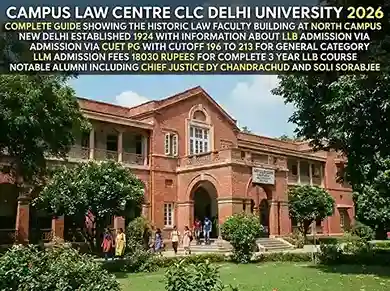
Campus Law Centre (CLC) | Delhi UniversityEst. 1924 | North Campus, New Delhi3-yr LLB via CUET PG | 2-yr LLM
Campus Law Centre (CLC), Delhi University 2026 | Admission, Courses, Fees, Cutoff, Faculty, Placements & Rankings
The Campus Law Centre (CLC) is the most competitive of the three law centres under the Faculty of Law, University of Delhi | one of India's oldest and most distinguished law schools, established in 1924. CLC sits on the iconic North Campus, New Delhi, offering the 3-year LLB (via CUET PG), 2-year LLM, and through the Faculty of Law, 5-year integrated BA LLB and BBA LLB (via CLAT). With a total LLB fee of just ₹18,030 and alumni including the 50th Chief Justice of India Dr. D.Y. Chandrachud, CLC represents India's greatest value-to-prestige ratio in legal education.
1924
Year Established
1,214
LLB Seats (DU Total)
₹18K
LLB Total Fee (3-yr)
213
CUET PG Cutoff R1 '25
CJI
Alumni Legacy
📅 Updated: May 29, 2026 | CUET PG 2026 Cycle | DU Faculty of Law
✍️ By Arjun Kumar, LLB NLU Delhi | Senior Law Education Editor
🔍 Data: Official DU Admission Portal | CUET PG Official | clc.du.ac.in | NIRF India
Campus Law Centre (CLC), University of Delhi | North Campus, New Delhi | Est. 1924 | Source: LawGuru India | Data: Official DU Admission Portal 2026
⚡ Quick Answer: Campus Law Centre DU 2026 at a Glance
Campus Law Centre (CLC) is the flagship law centre of the Faculty of Law, University of Delhi. Established in 1924, it is among India's oldest and most prestigious law schools. The 3-year LLB programme at CLC admits students through CUET PG scores | the 2025 General category (UR) cutoff was 213 in Round 1 and approximately 196 in the final round. CLC has the highest cutoff among DU's three law centres. Total LLB fee: ₹18,030 for the complete 3-year programme | the most affordable top law school in India. Alumni include the 50th CJI Dr. D.Y. Chandrachud, Attorney General Soli Sorabjee, and Ram Jethmalani.
🏛 Est. 1924 | 100+ Years💰 LLB Fee: Just ₹18,030 Total📋 3-yr LLB via CUET PG🎓 CJI + AG Alumni Legacy
1. Campus Law Centre, Delhi University | Overview & 100-Year History
The Faculty of Law, University of Delhi stands as one of India's most storied legal education institutions | established in 1924, more than six decades before the first National Law University opened in 1986. The Faculty operates through three law centres on the University of Delhi's North Campus: Campus Law Centre (CLC), Law Centre I (LC-I), and Law Centre II (LC-II). Of these three, CLC is universally regarded as the most prestigious and competitive | located on the main North Campus premises, closest to the University's central library, administration, and the iconic Delhi landmarks that define the institution's century-old identity.
The University of Delhi's Faculty of Law has been the training ground for India's most distinguished legal minds across the 20th and 21st centuries. The 50th Chief Justice of India, Dr. D.Y. Chandrachud, is an alumnus. The legendary Attorney General Soli J. Sorabjee | described by his peers as one of the finest constitutional lawyers India has ever produced | studied here. Ram Jethmalani, whose courtroom career spanned six decades and redefined criminal defence law in India, is a connected alumnus. Union Minister of Law and Justice Kiren Rijiju is an alumnus. This alumnus network is not a footnote to the CLC story | it is its central narrative, and the reason that a DU law degree, despite its remarkably low fee, carries weight in every court, law firm, and government institution in India.
🏛 CLC DU | Quick Facts 2026
Established
1924 (Faculty of Law, DU)
Location
North Campus, University of Delhi
Type
Public (Central University)
UGC Recognition
✓ Recognised
BCI Approval
✓ Approved
LLB Admission via
CUET PG (NTA)
Official Website
clc.du.ac.in
🏫 Three DU Law Centres | Comparison
Campus Law Centre
Most competitive | Main North Campus
Law Centre I
Mid-level cutoff | North Campus area
Law Centre II
Most accessible cutoff | DU area
2025 CLC Cutoff (UR R1)
213 / 300
CLC LLB Total Seats
1,214 (DU total)
2. Courses & Programmes at Campus Law Centre DU 2026
The Faculty of Law, University of Delhi offers a comprehensive range of law programmes | from undergraduate to doctoral level. Campus Law Centre (CLC) primarily runs the 3-year LLB and 2-year LLM; the 5-year integrated BA LLB and BBA LLB programmes are housed at the Faculty's Kanad Bhawan building and admitted through a common CLAT-based process.
Bachelor of Laws | LLB (3-Year) Primary Programme at CLC
3 Years | 6 SemestersVia CUET PGTotal Fee: ₹18,0301,214 Total DU Seats
The flagship 3-year LLB at CLC is a post-graduation programme for students who have completed their graduation in any discipline. It spans 6 semesters over 3 years and covers the core subjects required by the Bar Council of India for legal practice | Constitutional Law, Contract Law, Criminal Law (BNS), Civil Procedure, Evidence (BSA), Family Law, Company Law, Property Law, Environmental Law, Jurisprudence, Labour Law, and Legal Research Methodology. The programme follows an internal assessment and semester examination pattern with regular practical components including moot courts, seminars, and legal aid clinic work. Admission is strictly merit-based through the CUET PG Law paper (COQP14) conducted by NTA. Total 3-year academic fee: ₹18,030 | making it the most affordable degree from any top law institution in India.
Master of Laws | LLM (2-Year) PG Programme
2 Years | 4 SemestersVia CUET PG / DU Entrance TestTotal Fee: ~₹12,040–₹12,400Dissertation + Coursework
The 2-year LLM at DU Faculty of Law is offered through Campus Law Centre as well as Law Centres I and II. It is a rigorous research-oriented programme comprising coursework across specialisation areas and a dissertation. Admission is through CUET PG (Paper Code: COQP14) and in some years through DU's own LLM entrance test (100 MCQs, 4 marks each, −1 negative). The LLM syllabus tested in the entrance exam covers Constitutional Law, Jurisprudence, Contracts, Torts, Consumer Protection, Criminal Law, Family Law, International Law, IP Law, Cyber Law, Environmental Law, and Company Law. The 2025 LLM General category cutoff at DU was 217 in Round 1 and 211 in Round 2. Also available is a 3-year LLM programme for students seeking a longer, more comprehensive research experience.
BA LLB (Hons.) | 5-Year Integrated Via CLAT | North Campus
5 Years | 10 SemestersVia CLAT | University of Delhi60 SeatsStarted: Academic Year 2023–24
The Faculty of Law, University of Delhi launched 5-year integrated BA LLB (Hons.) and BBA LLB (Hons.) programmes starting from the academic year 2023–24. These programmes are housed at the Kanad Bhawan building on the North Campus. Admission is through the CLAT (Common Law Admission Test) score, aligning DU with the national law admission framework. 60 seats per programme (120 total UG integrated intake). The application fee for UG law programmes is ₹1,500 for UR/OBC-NCL/EWS candidates. Minimum eligibility: 45% in Class 12 (General/EWS/OBC); 40% for SC/ST/PwBD. These 5-year programmes are in addition to the long-standing 3-year LLB tradition at the Faculty.
5 Years | 10 SemestersVia CLATCombines Management + Law
The BBA LLB (Hons.) 5-year integrated programme combines legal education with business administration | equipping graduates for corporate law, M&A, and commercial litigation careers. Like the BA LLB, it is admitted via CLAT scores and housed at Kanad Bhawan. 60 seats. This programme, being relatively new (started 2023–24), is still building its placement record but benefits enormously from the DU Faculty of Law brand name and the proximity to Delhi's corporate and legal ecosystem.
PhD in Law Research Degree
3–5 YearsResearch Entrance Test (RET) + InterviewNET Qualified Exempt from RET
The Faculty of Law offers PhD programmes for candidates with an LLM degree (55% marks). Admission is through the University of Delhi's Research Entrance Test (RET) followed by an interview. Candidates who have cleared UGC-NET/JRF are exempt from RET and can directly apply for the interview. The PhD programme allows candidates to research any area of law under the supervision of Faculty members. DU Law faculty research output, while historically below NLU standards, has been improving steadily.
3. Admission Process 2026 | LLB, LLM & 5-Year Programmes
Understanding the admission route is critical before applying to CLC DU | because the 3-year LLB and 5-year integrated programmes use entirely different national entrance exams.
3.1 Admission to 3-Year LLB | via CUET PG
1
Register for CUET PG 2026 (NTA)
Paper Code: COQP14 | Duration: 90–105 minutes | 100 MCQs
The Common University Entrance Test for Postgraduate Admissions (CUET PG) conducted by the National Testing Agency (NTA) is the gateway to 3-year LLB admission at all three DU law centres. Register through the official NTA portal. Choose Paper Code COQP14 (Law). The CUET PG Law paper has 100 objective-type questions; each correct answer carries 4 marks; each incorrect answer deducts 1 mark. Total marks: 400 (scaled to 300 for comparison). Subjects tested: Constitutional Law of India, Jurisprudence, Law of Contracts, Sale of Goods, Law of Torts, Consumer Protection, Criminal Law, Family Law, Public International Law, IP Law, Cyber Law, Environmental Law, Company Law, and Partnership.
2
Apply on DU Admission Portal (CSAS-PG)
After CUET PG result | Indicate programme and centre preference
After the CUET PG result is declared, visit the DU Common Seat Allocation System (CSAS) portal and register. Submit the DU-specific application. Choose your preferred law centre (CLC, LC-I, or LC-II) and programme in order of preference. Upload required documents: CUET PG scorecard, graduation marksheets and degree, Class 10 and 12 certificates, caste/category certificate (if applicable), PwBD certificate (if applicable), and passport-size photograph. Pay the DU admission application fee.
3
Seat Allotment via CSAS Merit List
Multiple rounds | Based on CUET PG score + Category
DU releases multiple rounds of merit lists through the CSAS portal | typically Round 1, Round 2, and one or more Spot Rounds depending on vacancy. Allotment is strictly based on CUET PG Law score and category. For General category, Campus Law Centre is the most competitive with the highest cutoff. If you are allotted a seat, accept the allotment and pay the confirmation fee within the specified deadline. Document verification is conducted at the centre.
4
Document Verification & Reporting
At Campus Law Centre | Original documents required
Carry original documents for verification at Campus Law Centre: graduation degree and all semester marksheets; Class 10 certificate; Class 12 marksheet; caste/category certificate (if applicable); migration certificate from previous institution; two passport-size photographs; government-issued photo ID (Aadhaar or passport). After document verification, pay the semester fee (approximately ₹6,500 per semester) and collect your admission receipt. Report to the centre on the date specified by the Faculty of Law for orientation.
3.2 Admission to 5-Year BA LLB / BBA LLB | via CLAT
📋 5-Year LLB Admission at DU Faculty of Law | via CLAT
The 5-year integrated BA LLB (Hons.) and BBA LLB (Hons.) at DU Faculty of Law (Kanad Bhawan, North Campus) are admitted through CLAT scores. Application is via the DU CSAS portal. Application fee: ₹1,500 for UR/OBC-NCL/EWS; fee waivers for SC/ST/PwBD as per DU norms. Eligibility: 45% in Class 12 (General/EWS/OBC); 40% for SC/ST/PwBD. Total 60 seats each for BA LLB and BBA LLB. Note: These 5-year programmes are relatively new (started 2023–24) and are housed separately at Kanad Bhawan, not at the traditional CLC/LC-I/LC-II buildings where the 3-year LLB runs.
4. Eligibility Criteria | All Programmes 2026
Programme
Minimum Qualification
Min. Marks (General)
Min. Marks (SC/ST/PwBD)
Entrance Test
LLB (3-Year)
Graduation (any discipline) from recognised university
50% aggregate
45%
CUET PG (COQP14)
LLM (2-Year)
LLB (3-yr or 5-yr integrated) from recognised university
50% in LLB
45%
CUET PG / DU Entrance Test
BA LLB (Hons.) 5-yr
Class 12 (any stream) from recognised board
45% in Class 12
40%
CLAT (via DU CSAS)
BBA LLB (Hons.) 5-yr
Class 12 (any stream) from recognised board
45% in Class 12
40%
CLAT (via DU CSAS)
PhD in Law
LLM from recognised university
55% in LLM
50%
DU-RET + Interview
📌 No Age Limit | Any Graduation Stream Qualifies for LLB
There is no age limit for admission to the 3-year LLB at Campus Law Centre. Candidates from any graduation background | BA, B.Com, B.Sc, B.Tech, MBBS, BCA, BBA | are eligible as long as they meet the minimum marks criterion. This makes the DU LLB uniquely accessible to career changers, science graduates seeking IP law, technology graduates targeting tech law, and commerce graduates interested in corporate law. Final-year graduation students may apply provisionally | they must submit proof of graduation before final document verification.
5. Campus Law Centre DU Cutoff 2025 & Expected 2026 | LLB & LLM
Campus Law Centre consistently records the highest CUET PG cutoff among all three DU law centres. Understanding both the Round 1 and final round cutoffs is essential for strategic preparation.
* Scores are out of 300 (CUET PG scaled score). Source: DU Official CSAS Portal 2025 admission data. CLC consistently has the highest cutoff. LC-I is next; LC-II has the lowest cutoff. For 2026, target 210+ for CLC General category to be safe in Round 1.
5.2 LLM CUET PG Cutoff 2025 | DU Faculty of Law
LLM Programme
Round 1 Cutoff (Gen)
Round 2 Cutoff (Gen)
Notes
LLM (2-Year)
217 / 300
211 / 300
General (AI quota) | All DU centres combined
LLM (3-Year)
216 / 300
208 / 300
General (AI quota)
OBC-NCL (LLM 2-yr)
~185
~175
|
SC (LLM 2-yr)
~155
~145
|
🎯 2026 Expected Cutoff for CLC LLB General Category
Based on the 2025 Round 1 cutoff of 213 and the historical trend, the 2026 expected CLC LLB General category cutoff is approximately 210–220 in Round 1. A safe preparation target is 215+ out of 300 in CUET PG (Law). The CUET PG Law score is out of 300 (100 questions × 3 marks net or based on NTA scaling). Note: CUET PG does not have a fixed total | scores are normalised using NTA's percentile-based system. Focus your preparation on Constitutional Law (highest weightage), Criminal Law (BNS 2023 now tested), and Jurisprudence for the highest score.
6. Campus Law Centre DU Fee Structure 2026
The fee structure at Campus Law Centre is among the lowest of any reputed law institution in India | a reflection of its status as a Central Government-funded institution. This is one of the most compelling reasons to target CLC DU: the combination of extraordinary alumni legacy, Delhi location, and near-zero tuition creates unmatched return on investment.
Fee Component
LLB (3-Year)
LLM (2-Year)
Notes
Total Academic Fee (Full Programme)
₹18,030
₹12,040–₹12,400
Entire course; not per year
Per Semester Tuition
~₹6,500
~₹3,000–₹4,000
6 semesters (LLB); 4 semesters (LLM)
Examination Fee
~₹1,500/semester
~₹1,500/semester
Paid separately each semester
Library / Development Fee
₹500–₹700/year
₹500–₹700/year
Miscellaneous institutional charges
Total Annual Outgoing (approx.)
~₹9,000–₹10,000/year
~₹7,500–₹9,000/year
Including exam + misc. fees
Application Form Fee (DU)
₹1,500 (UR/OBC/EWS)
Fee waiver for SC/ST/PwBD as per DU norms
Category-Based Fee Concession
Only PwBD concession; others pay same fee
NSP scholarship available via income criteria
Total 3-Year Cost (incl. all charges)
~₹30,000–₹33,000
Excluding accommodation / hostel
💡 Why DU LLB Is the Best Value Law Degree in India
The 3-year LLB at Campus Law Centre costs ₹18,030 in total academic fees | for comparison, JGLS Sonipat charges ₹26.30 lakh for 5 years and SLS Pune charges ₹26.30 lakh. Even top NLUs charge ₹12–22 lakh total. A DU LLB carries brand recognition with the Supreme Court, Delhi High Court, and every major law firm in India, costs effectively nothing, and is taught in a campus where case law is made 20 minutes away. The value-to-cost equation is unmatched in Indian legal education.
7. Faculty & Academic Environment at DU Faculty of Law
The Faculty of Law, University of Delhi has a teaching staff drawn from some of India's most experienced legal academics, practitioners, and scholars. The Faculty has historically attracted distinguished visiting lecturers | including sitting and retired judges of the Delhi High Court and Supreme Court, senior advocates, and government law officers | who conduct seminars, moot court training, and guest lectures.
The Faculty operates with a permanent faculty of approximately 40–50 law teachers across the three centres, supplemented by ad-hoc and visiting faculty. The Faculty has acknowledged a long-standing issue of teacher vacancies | a challenge that the University of Delhi's Executive Council and Faculty of Law have been addressing through recruitment. Students and observer groups have noted this challenge, particularly at LC-I and LC-II, while CLC generally maintains stronger staffing due to its administrative centrality.
Despite the faculty challenges, several academics at the Faculty of Law are leading scholars in their fields | publishing in peer-reviewed law journals, participating in law reform committees, and contributing to government advisory processes. The academic culture at CLC rewards students who engage proactively with faculty, participate in moot courts, and pursue independent legal research | capabilities that the Delhi legal ecosystem uniquely facilitates through proximity to the Supreme Court, Delhi High Court, and all major government law institutions.
📚 Academic Highlights at DU Faculty of Law / CLC
Moot Court: The Faculty runs a comprehensive moot court programme with students regularly participating in national and international competitions including the Jessup Moot Court Competition, Vis Arbitration Moot, and Bar Council of India competitions. The proximity to Delhi's legal ecosystem gives DU law students unparalleled access to practising advocates as coaches and judges.
Legal Aid Clinic: The Faculty operates a Legal Aid Clinic providing free legal assistance to economically weaker sections | giving students real client interaction experience that most law schools only provide in simulation. Students assist in filing matters before courts under supervision.
Library: The Faculty of Law library houses over 1.5 lakh volumes | one of the largest law libraries in South Asia. It provides access to SCC Online, Manupatra, and other legal databases. The library is open to all registered students and is a critical resource for research. CLC students benefit from both the Faculty library and the Central Library of the University of Delhi.
Seminars & Conferences: The Faculty regularly hosts seminars, workshops, and conferences featuring judges, senior advocates, government officials, and international scholars. These events are mandatory exposure for serious law students and provide networking opportunities that no other law school in India can replicate given Delhi's concentration of legal talent.
CUET PG LLM Exam Pattern (tested by DU in own entrance): 100 MCQs | 4 marks per correct answer | −1 for incorrect | 100 minutes | Covers Constitutional Law, Jurisprudence, Contracts, Torts, Criminal Law, Family Law, International Law, IP, Environmental Law, Company Law, Consumer Protection, Cyber Law.
8. Campus, Library & Hostel | North Campus, University of Delhi
Campus Law Centre is located on the iconic University of Delhi North Campus | one of the most historically significant and vibrant university campuses in India. The North Campus is well-connected by the Delhi Metro (nearest station: Vishwavidyalaya on the Yellow Line) and DTC bus network, making it exceptionally accessible from across Delhi-NCR.
📍 Location & Connectivity
North Campus, University of Delhi, Delhi | 110007
Metro: Vishwavidyalaya Station (Yellow Line) | 5-minute walk
Distance from Supreme Court of India: ~15 km (30 min)
Distance from Delhi High Court: ~10 km (25 min)
Distance from Central Secretariat: ~12 km
DTC bus connectivity from all parts of Delhi
🏛 Campus Facilities
Dedicated Faculty of Law building with lecture halls
Central Library of DU (accessible to all students)
Canteen / cafeteria on campus
Wi-Fi connectivity in academic buildings
Student unions and law society activity spaces
8.1 Hostel Facilities at Delhi University
The University of Delhi operates several hostels on the North Campus. However, law students should note that hostel seats at DU are limited and heavily contested | the University maintains separate hostels for male and female students, but allocation is not guaranteed to all law students, particularly in the first year. A significant proportion of CLC students choose to rent private accommodation (PG/flat) in the university area | North Campus has a well-developed ecosystem of affordable student accommodation. Budget accommodation near the campus ranges from ₹5,000–₹12,000/month depending on sharing arrangement and amenities.
📌 Accommodation Reality for CLC Students
Unlike NLUs which are fully residential campuses, DU is an urban commuter-style institution where most students live in surrounding areas rather than on campus. The advantage: North Delhi near the University has the most affordable student accommodation in any major Indian city near a top law school. Students can live reasonably well within ₹6,000–₹10,000/month (shared accommodation, meals included at PGs). The total monthly cost of living while studying at CLC | accommodation + food + transport | is approximately ₹10,000–₹15,000/month, making it the most affordable legal education lifestyle in any major metro in India.
9. Placements & Career Outcomes at Campus Law Centre DU
DU Faculty of Law placements work differently from NLUs | and understanding this difference is important before making a career decision. CLC does not conduct formal mass campus placements in the manner of NLUs or MBA institutions. The placement model here is a combination of informal alumni networking, self-driven internship/job seeking, and selective campus recruitment drives.
9.1 Formal Placement Data
When formal campus placement drives are conducted at the Faculty of Law, the reported median placement package is approximately ₹5 LPA. Top recruiters at DU Faculty of Law include:
Luthra & Luthra Law OfficesDua AssociatesLexOrbis Intellectual PropertyBank Debt Recovery Tribunals (DRT)Various Government Legal DepartmentsDelhi NCR Law FirmsLegal Process Outsourcing (LPO) CompaniesCorporate In-House Legal Teams
9.2 The Real CLC Career Pathway
The true value of a DU Faculty of Law education is not captured in placement median figures alone. CLC graduates build careers through three primary routes:
1
Delhi Court Litigation | The Most Travelled Path
The majority of CLC LLB graduates enter the Delhi court ecosystem | starting as junior advocates under senior practitioners, building a client base, and working their way up through the Delhi District Courts, Delhi High Court, and eventually the Supreme Court. This path does not appear in placement statistics but produces India's most distinguished advocates over a 15–20 year career arc. The value of a DU degree for this path is unmatched: every court officer, clerk, and senior advocate in Delhi knows and respects the DU Faculty of Law alumni network.
2
Government Services | Judiciary, UPSC, APP Exams
CLC produces a disproportionate share of successful judicial service exam candidates | Delhi Judicial Service, Rajasthan JSE, and other state judicial services regularly see DU Faculty of Law alumni in their selection lists. The faculty's strong foundation in civil procedure, evidence, and constitutional law directly prepares students for these exams. UPSC Civil Services is also a popular route | the overlap between Law Optional and the DU LLB curriculum gives CLC graduates a structural advantage.
3
Corporate Law Firms & In-House | Via Networking and Merit
While NLU graduates dominate direct Tier-1 law firm placements, DU Faculty of Law graduates who demonstrate exceptional research skills, internship track records (Supreme Court internships, High Court clerkships), moot court achievements, and academic performance do secure positions at Delhi's prominent law firms. The informal alumni network at DU also facilitates referrals that formal placement drives do not capture. Corporate and in-house roles at PSUs, regulatory bodies (SEBI, RBI), and government ministries are also strong career paths for CLC graduates.
10. Rankings & Recognitions | DU Faculty of Law 2026
The ranking story for DU Faculty of Law is nuanced and worth understanding carefully, as it directly affects how you should evaluate this institution relative to NLUs.
Ranking Body
Rank / Score
Notes
NIRF Law Rankings 2025
Not ranked in top 25 Law
DU Faculty of Law first participated in NIRF in 2022; not consistently in published top 25 Law category. DU as a university ranks strongly in overall university category.
NIRF University 2025 (DU overall)
Top 10 Universities India
University of Delhi consistently ranks in top 10 national universities, validating institutional quality even where the Law-specific category lags.
QS World University Rankings (DU)
Top 500 globally
University of Delhi has QS World ranking | the Faculty of Law benefits from this global recognition context.
India Today Law Rankings 2025
Top 10 Government Law Colleges
DU Faculty of Law consistently appears among India's top government law institutions due to its alumni strength and historical standing.
Informal Peer Reputation
#1 Among Non-NLU Law Schools
Practitioners and alumni consistently rate DU Faculty of Law as the most respected non-NLU law institution, particularly for litigation and government service careers.
📊 Why DU's NIRF Law Ranking Doesn't Reflect Its True Standing
DU Faculty of Law's relatively modest NIRF Law ranking (relative to its actual reputation) reflects a structural measurement challenge: NIRF heavily weights research output, formal placement statistics, and infrastructure metrics | areas where NLUs with smaller, more curated batches and dedicated placement cells outperform the Faculty's mass-intake model. However, the Faculty's Perception score (how academics and employers actually rate it) and its alumni network in the judiciary and advocacy are fundamentally different strengths that NIRF's current parameters do not fully capture. When Supreme Court judges, Senior Advocates, and government legal officers are surveyed about India's best law schools, DU Faculty of Law appears in every conversation alongside NLSIU Bangalore and NLU Delhi.
11. Notable Alumni of DU Faculty of Law | The Gold Standard
No discussion of Campus Law Centre is complete without its most defining feature: an alumni network that has shaped India's legal history for over a century. These are the people who studied where you will study | and their achievements define what a DU law degree can become in the right hands.
DYC
Dr. D.Y. Chandrachud
50th Chief Justice of India (2022–2024)
India's most recently retired Chief Justice. A transformative judicial figure known for landmark judgments on privacy, LGBTQ+ rights, women's rights, and constitutional morality. His journey from DU Faculty of Law to the Supreme Court's highest seat is the institution's most powerful testament.
SJS
Soli J. Sorabjee
Attorney General of India (1989–90, 1998–2004)
Widely regarded as one of India's greatest constitutional lawyers. Voted one of the top 10 lawyers in the world by Euromoney. Led landmark cases on freedom of expression, emergency powers, and international arbitration. His legal brilliance is associated directly with his DU Faculty of Law education.
RJ
Ram Jethmalani
Senior Advocate | Former Union Minister of Law
One of India's most celebrated and controversial advocates | famous for representing accused in high-profile cases including Rajiv Gandhi assassination, Parliament attack, and Jessica Lal cases. His courtroom career spanning six decades remains a legend in the Indian Bar's history.
HS
Harish Salve
Former Solicitor General of India | QC (UK)
One of India's foremost international arbitration and commercial law specialists. Represented India in the Kulbhushan Jadhav case at the International Court of Justice (ICJ). Currently one of the highest-fee-charging advocates in India and holds Queen's Counsel (QC) status in the UK.
KR
Kiren Rijiju
Union Minister of Law & Justice, Government of India
Currently the Union Minister for Parliamentary Affairs and Minority Affairs; formerly Minister of Law and Justice. His political career built on a law degree from DU Faculty of Law represents the institution's pipeline into governance and policy at the highest levels of the Indian government.
PU
Multiple Sitting & Former High Court Judges
Delhi HC, Bombay HC, and other state High Courts
The DU Faculty of Law alumni list in the judiciary extends to dozens of sitting and retired judges across India's High Courts. This judicial alumni presence reinforces the Faculty's reputation as the proving ground for India's most distinguished legal professionals across every domain of law.
12. Frequently Asked Questions | Campus Law Centre DU 2026
What is the CUET PG cutoff for CLC DU LLB 2025?
+
Campus Law Centre had the highest LLB cutoff among all DU law centres in 2025. General category (UR): 213 in Round 1, approximately 196 in the final spot round (out of 300 scaled CUET PG score). OBC-NCL approximately 165. For 2026, target 210+ for a safe Round 1 allotment at CLC for General category candidates.
What is the total fee for LLB at Campus Law Centre DU?
+
The total academic tuition fee for the complete 3-year LLB at Campus Law Centre, University of Delhi is approximately ₹18,030 | approximately ₹6,500 per semester across 6 semesters. This makes it one of the most affordable full law programmes in India. Additional charges (examination fee ~₹1,500/semester, library and development fee ~₹500–700/year) bring the total annual outgoing to approximately ₹9,000–₹10,000 per year. The LLM total fee is approximately ₹12,040–₹12,400 for the complete 2-year programme.
What courses does Campus Law Centre DU offer?
+
Campus Law Centre (CLC) primarily offers: LLB (3-year) via CUET PG, 1,214 total DU seats; LLM (2-year) via CUET PG. The Faculty of Law also offers BA LLB (Hons.) 5-year (60 seats) and BBA LLB (Hons.) 5-year (60 seats) via CLAT at Kanad Bhawan, plus PhD in Law. The 5-year integrated programmes are new (started 2023–24) and not housed at CLC building specifically but at the Faculty's Kanad Bhawan premises.
What is the CUET PG LLM entrance test pattern at DU?
+
DU LLM entrance test (when conducted separately from CUET PG): 100 objective-type MCQs | 4 marks per correct answer | −1 mark per wrong answer | Total: 400 marks. Subjects: Constitutional Law of India, Jurisprudence, Law of Contracts, Sale of Goods, Law of Torts, Consumer Protection, Criminal Law, Family Law, Public International Law, Intellectual Property Law, Cyber Law, Environmental Law, Company Law, and Partnership. Duration: 100 minutes. The 2025 General category LLM cutoff (CUET PG score) was 217 (Round 1) and 211 (Round 2).
Who are the famous alumni of DU Faculty of Law / Campus Law Centre?
+
The Faculty of Law, University of Delhi alumni include: Chief Justice of India Dr. D.Y. Chandrachud (50th CJI, 2022–2024); Soli J. Sorabjee (Attorney General of India 1989–90 and 1998–2004; voted top 10 lawyer globally); Ram Jethmalani (legendary criminal defence advocate and former Law Minister); Harish Salve (former Solicitor General, now UK QC); Kiren Rijiju (Union Minister of Law and Justice); and numerous sitting and former High Court judges across India. This alumni network makes DU the most judicially influential non-NLU law school in India.
Does DU Campus Law Centre accept CLAT scores?
+
For the 3-year LLB programme at Campus Law Centre: No, CLAT scores are not accepted. Admission is via CUET PG (NTA) scores. For the 5-year integrated BA LLB (Hons.) and BBA LLB (Hons.) programmes (started from 2023–24): Yes, these are admitted via CLAT scores through the DU CSAS portal. These 5-year programmes are housed at Kanad Bhawan (Faculty of Law building) rather than at CLC specifically.
Is CLC DU better than NLU for a law career?
+
This depends on your career goals: For corporate law at Tier-1 firms and immediate high-package placements | NLUs (especially top 5: NLSIU, NLU Delhi, NALSAR, NUJS, GNLU) are significantly stronger, with formal placements, structured career development, and higher average starting packages. For litigation, judiciary, government service, and building a Delhi-based practice | CLC DU offers advantages through its extraordinary alumni network in the bar and judiciary, its location 15 minutes from the Supreme Court, and unmatched brand recognition in the Delhi court ecosystem. CLC also costs practically nothing (₹18,030 total) vs ₹12–26 lakh at NLUs. For candidates targeting UPSC, judicial services, and advocacy, CLC DU is a serious competitor to all but the top 3 NLUs.
Senior Law Education Editor, LawGuru India | LLB NLU Delhi
LLB from National Law University Delhi. Comprehensive research on DU Faculty of Law, Campus Law Centre, and Delhi's legal ecosystem. Data sourced from official DU Admissions Portal (du.ac.in), CSAS official notifications, CUET PG official data (NTA), clc.du.ac.in official website, and Faculty of Law official communications. Cutoff data from official DU CSAS portal 2025 admission rounds. Updated: May 29, 2026.
Targeting Campus Law Centre DU? Prepare for CUET PG Law Now.
CLC DU General category requires 210+ in CUET PG Law. Prepare with LawGuru India's free law study material, previous year papers, and CLAT/CUET resources to secure India's most prestigious affordable law degree.