Study Material for Law Courses in India: Complete Subject-Wise Guide
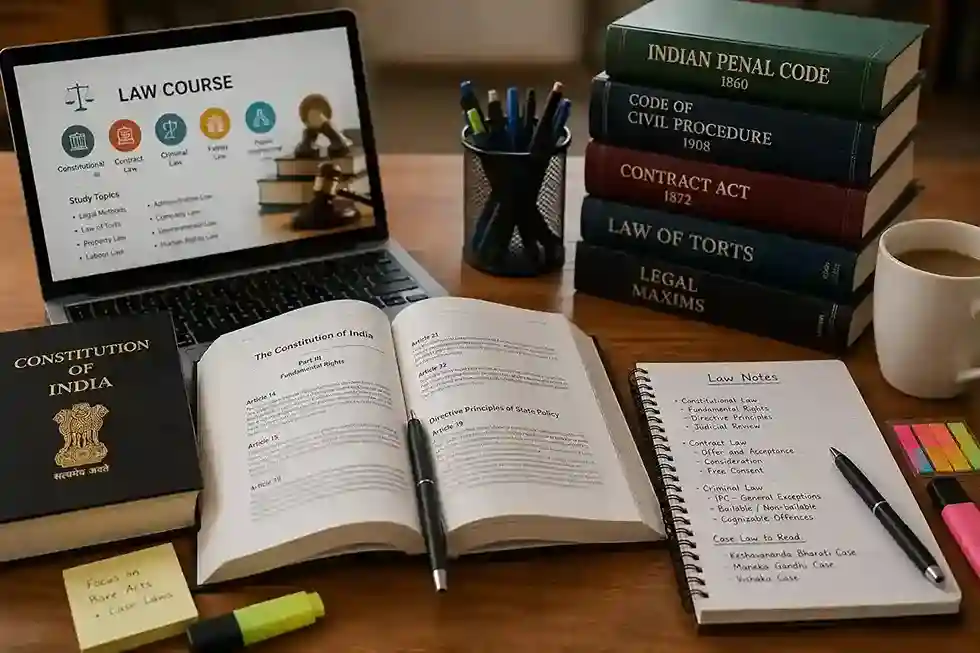
Law students in India face a strange problem. There is too much content available online. Yet very little of it is organized well.
One website hands you bare acts with no context. Another gives you case summaries with no structure. A third sells coaching notes that just repeat your textbook. None of this tells you what to read first, or why.
This guide fixes that gap. It walks through exactly what to read, in what order, across every major law course in India. That includes degree subjects, entrance exam prep, and the bar exam you sit after graduation. No filler. No vague advice. Just a clear path from your first semester to your law license.
What Counts as Study Material in a Law Course
Law preparation is not one single thing. It has four distinct layers. Most students rely on only one or two of them.
The first layer is the textbook or class notes. These explain legal ideas in plain language, using examples. The second layer is the bare act. This is the exact text of a law, passed by Parliament or a state legislature, with no explanation added.
The third layer is case law. Courts interpret laws whenever a dispute reaches them. Their judgments often matter more than the bare text. They show how a rule plays out in real situations, not just on paper.
The fourth layer is exam-specific content. This includes mock tests, previous year papers, and revision guides built around a particular exam pattern. A student who only reads textbooks will struggle with questions based on case law. A student who only memorizes bare acts will miss the reasoning examiners expect. You need all four layers. The right mix depends on which stage of your course you are in.
Resources for Each Law Degree
India offers law degrees in two formats. The five-year integrated course, such as BA LLB or BBA LLB, starts right after Class 12. The three-year LLB is for graduates who already hold a degree in another subject. Both formats share a common legal core. They differ mainly in elective subjects and a few foundation papers.
In the first two years, you cover foundational subjects. These include Constitutional Law, Law of Contracts, Law of Torts, Family Law, and Jurisprudence. Each subject needs a standard textbook, the relevant bare act, and a short list of landmark judgments. Skipping the Constitution itself, even reading it in parts, leaves gaps that surface later in exams and in practice.
By the third year, subjects shift toward specialization. Criminal Law, the Civil Procedure Code, Evidence Law, Company Law, and Intellectual Property Law take center stage. These subjects connect directly to courtroom practice. Case law matters more here than it did in your first year.
The final years usually bring in Labour Law, Environmental Law, Taxation Law, and a research project or dissertation. At this stage, recent amendments and policy shifts deserve as much attention as the original statute. These subjects change often, sometimes within a single academic year.
LLM candidates go deeper into one specialization. Common choices include Constitutional Law, Criminal Law, and Corporate Law. Their reading list leans heavily on journal articles, comparative law texts, and recent Supreme Court rulings. LLM coursework expects original analysis. Summary notes alone will not carry you through a thesis or seminar paper.
Preparing for Law Entrance Exams
Before you even start a law degree, you must clear an entrance exam. Each test checks a slightly different skill set. Using identical prep for all of them wastes valuable time.
CLAT is the most common gateway into National Law Universities. The current pattern has 120 questions across five sections. You get two hours to finish, with a small penalty for wrong answers. Current Affairs and Legal Reasoning carry the heaviest weight. Daily news reading and short legal passages matter more here than rote memorization.
If Delhi University's law school is your target, you need AILET instead. It tests skills similar to CLAT. Yet it follows its own question style and a different difficulty curve. Practicing AILET-specific papers brings better results than relying only on CLAT-focused prep.
Students aiming for Symbiosis or similar private universities usually take SLAT. Its English and logical reasoning sections run tougher than CLAT's. Its legal knowledge component, by contrast, stays lighter.
For law colleges in Telangana, TS LAWCET is the relevant entrance test. It follows a state-specific pattern. General knowledge and aptitude carry strong weight, alongside basic legal awareness.
Postgraduate aspirants need an entirely different approach. CLAT PG tests applied knowledge across core subjects like Constitutional Law, Jurisprudence, and Criminal Law. It assumes you already hold an LLB. Reviewing subject-wise notes from your own degree years works better here than starting fresh with new textbooks.
Across every one of these exams, mock tests matter more than any single book. Reading builds your understanding of concepts. Timed practice builds the speed and accuracy the actual paper demands.
Bare Acts and Primary Legal Sources
Once you are inside a law course, bare acts become unavoidable. A bare act is the original, unedited text of a statute. There is no explanation, no commentary, just the sections exactly as the legislature wrote them.
Students often skip bare acts because the language feels dry. This is a costly mistake. Examiners frequently ask you to quote a specific section, or apply one to a hypothetical fact pattern. You cannot manage either task if you have only read someone else's summary.
A handful of statutes carry the most weight for Indian law students. These include the Constitution of India, the Indian Penal Code, the Indian Contract Act, the Code of Civil Procedure, the Code of Criminal Procedure, and the Indian Evidence Act. Depending on your chosen specialization, you will also need the Companies Act, the Transfer of Property Act, and several labour and family law statutes.
One practical habit helps here. Read the bare act section first, on its own. Then read your textbook's explanation of that same section. This sequence separates what the law literally says from how scholars choose to interpret it. That distinction is exactly what most exams test.
Case Law and Judgments
Bare acts tell you what a rule is. Case law tells you how that rule actually plays out in real disputes. Indian law leans heavily on judicial precedent. A strong grasp of landmark rulings separates an average answer from a genuinely strong one.
You do not need to memorize hundreds of cases for every subject. A focused list of ten to fifteen landmark judgments per subject usually covers most exam needs. For each case, note the core facts, the legal question raised, and the final ruling. For Constitutional Law, this might include rulings that shaped fundamental rights over the decades. For Criminal Law, it might include judgments that clarified intent and liability.
Judicial interpretation also shifts over time. A ruling from last year can change how an old section gets read going forward. Build a habit of skimming short case updates every week. This keeps your knowledge current without forcing a last-minute scramble before exams.
When you cite a case in an exam or assignment, mention the case name, the deciding court, and the key principle it established. Avoid quoting long passages from the judgment itself. Examiners want proof that you grasp the principle. They are not testing your ability to copy text.
Free and Official Resources Worth Using
Not everything you need costs money. Several government bodies and academic institutions publish free, dependable content covering core law subjects in real depth.
University law department websites often publish their own syllabus, reading lists, and sometimes complete lecture notes for each semester. These tend to align more closely with your actual exam than third-party guides, since your own faculty sets the question paper.
National-level digital learning platforms run by government education bodies offer free courses on topics like the Constitution, environmental law, and intellectual property. Senior law professors often design these courses. They work well as a second pass after you have already covered a topic in class, since they explain the same idea from a different angle.
The official websites of regulatory bodies, including the Bar Council of India and the Consortium of National Law Universities, publish notifications, syllabi, and exam patterns directly. For anything tied to deadlines, eligibility, or policy changes, these sources beat third-party summaries. Rules around legal education shift from year to year, and only the regulator's own site reflects the latest version with certainty.
Free resources work best alongside a structured textbook, not as a replacement for one. They fill gaps and support revision well. They rarely substitute for a complete, organized walkthrough of your syllabus.
Preparing for AIBE After Your Law Degree
Finishing your LLB does not automatically let you practice law. You must first clear the All India Bar Examination, conducted by the Bar Council of India.
AIBE has 100 multiple-choice questions. You get three and a half hours, with no negative marking for wrong answers. General and OBC candidates need 45 marks to pass. SC and ST candidates need 40. The exam spans 19 subjects in total. Its core sits around Constitutional Law, the Civil Procedure Code, the Criminal Procedure Code, and the Indian Penal Code. Specialized areas like Company Law and Environmental Law fill out the remaining portion.
Unlike CLAT or AILET, AIBE allows certain reference material during the exam. Familiarity matters more here than pure memorization. Your preparation should focus on applying rules to practical scenarios. The exam reflects situations you will actually face as a practicing advocate, not abstract theory built for a university paper.
Since AIBE draws directly from subjects covered during your degree, revisiting your semester notes for Constitutional Law, CrPC, and Evidence Law gives you a strong head start. Add AIBE-specific practice papers on top of that foundation, rather than starting from zero.
How to Organize Everything Without Burning Out
Collecting content is the easy part. Organizing it so you can use it effectively before an exam is the harder task.
Start by sorting everything into three groups: concept notes, bare act extracts, and case law summaries. Keep these subject-wise, not exam-wise. A single Constitutional Law folder can then serve your semester exam, your CLAT PG attempt, and later, your AIBE revision.
Revisit each subject in short, repeated cycles rather than one long read-through. Legal concepts build on each other. A second pass through Contract Law, taken right after finishing Tort Law, often clarifies ideas that felt confusing the first time around.
Track amendments in a separate, running note. Laws change often, and an outdated bare act or an old textbook edition can cost you marks in any exam testing current law. Update this note every few months. It keeps your core content accurate without forcing you to buy new books every single year.
Finally, test yourself with past papers well before you feel ready. Confidence built purely from reading often collapses under real exam pressure. Mock tests and old papers reveal genuine gaps that simple re-reading cannot show you.
Funding Your Law Education
Quality resources, coaching, and law school fees add up fast across five or six years. If you belong to a reserved category or an economically weaker section, several state and central schemes can offset a meaningful part of this cost.
Our scholarships for law students page lists current schemes you may qualify for. It also covers eligibility and the exact application steps, so financial pressure does not interrupt your preparation.
Frequently Asked Questions
What study material do I need for a law course in India?
You need subject textbooks, bare acts for laws like the Constitution and the Indian Penal Code, case law digests, and exam-specific guides if you are preparing for CLAT, AILET, or AIBE. The right mix depends on your course and year.
Is a bare act enough to study law, or do I need separate notes?
A bare act alone will not get you far. It gives you the exact legal text, but you also need a textbook or notes that explain the reasoning, exceptions, and case laws behind each section.
Can I prepare for law entrance exams without coaching?
Yes. Exams like CLAT and AILET test reading comprehension, reasoning, and general legal awareness. A clear plan, the official syllabus, regular mock tests, and a daily reading habit work well for most self-taught students.
Which subjects are common across all law degrees in India?
Constitutional Law, Law of Contracts, Law of Torts, Criminal Law, Family Law, and Jurisprudence appear in nearly every law degree. This holds true whether you are pursuing an LLB, a BA LLB, or a BBA LLB.
How is AIBE different from CLAT or AILET in terms of preparation?
CLAT and AILET are entrance tests for admission, so they focus on reasoning, English, and general legal awareness. AIBE comes after your LLB and tests applied knowledge of 19 core law subjects, since it qualifies you to practice as an advocate.
Where can I find free resources for law courses in India?
Government education portals, university law department websites, and the official websites of bodies like the Bar Council of India and the Consortium of NLUs publish free syllabi, bare acts, and notifications that form the backbone of reliable preparation.