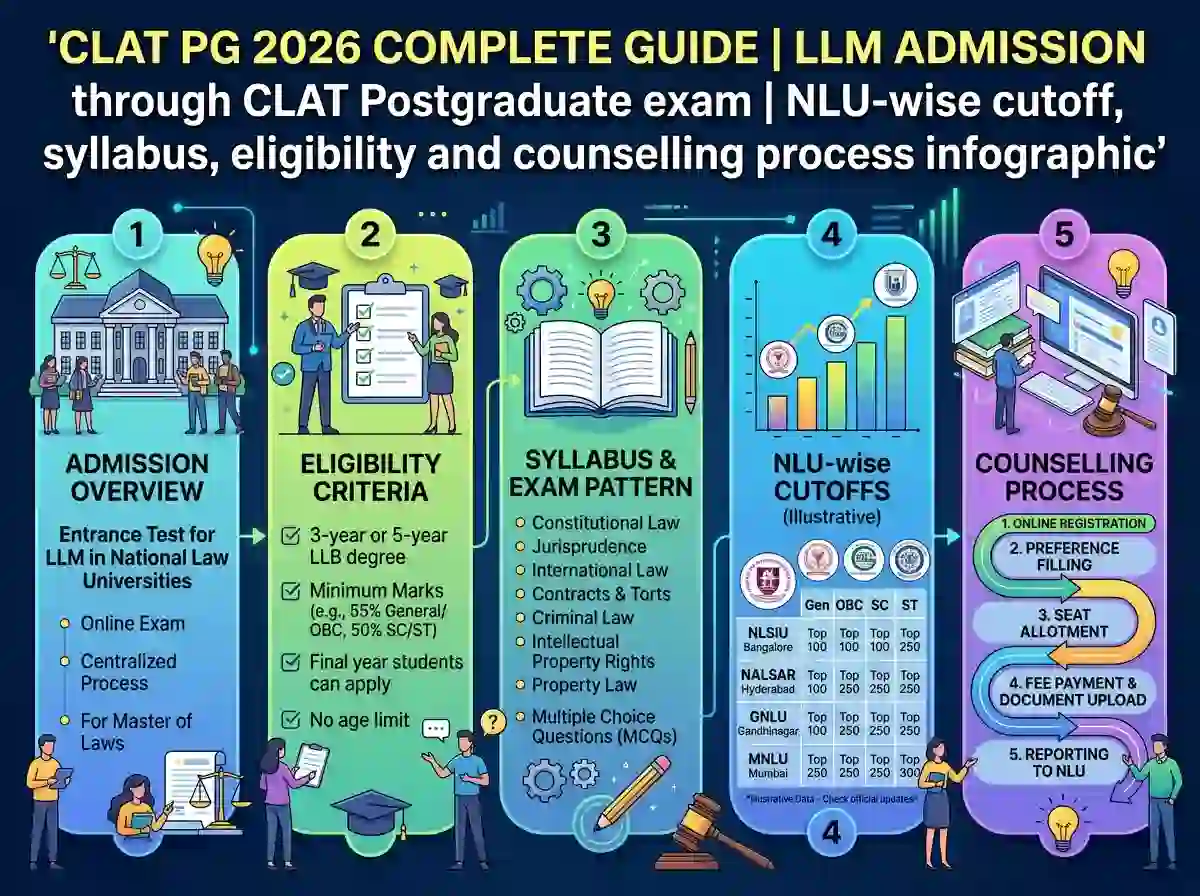
1. What is CLAT PG? Complete Overview
CLAT PG (Common Law Admission Test | Postgraduate) is a national-level entrance examination conducted annually by the Consortium of National Law Universities (NLUs) for admission to one-year LLM (Master of Laws) programmes at participating NLUs across India. It is the primary gateway for law graduates seeking postgraduate specialisation at India's premier National Law Universities.
Unlike CLAT UG, which is designed for Class 12 students entering the 5-year integrated BA LLB programme, CLAT PG is for practising lawyers, law graduates, and legal professionals who hold an LLB degree and wish to pursue advanced legal education. The examination was held on December 7, 2025 for the academic year 2026–27, with results declared on December 16–17, 2025.
In CLAT PG 2026, 17,335 candidates registered and 16,026 appeared across 141 test centres in 25 states. The topper, Mayank Goel, secured AIR 1 with a score of 104.25 out of 120. A total of 1,590 LLM seats are available across 24 NLUs through CLAT PG counselling.
- For LLB graduates seeking LLM admission
- 120 MCQs | 120 minutes | Comprehension-based
- Tests knowledge of undergraduate law subjects
- 1-year LLM programme at 24 NLUs
- ~16,000 candidates appear each year
- ~1,590 seats available nationally
- For Class 12 students seeking BA LLB admission
- 120 MCQs | 120 minutes | Passage-based reasoning
- Tests English, GK, Legal Reasoning, Logic, Quant
- 5-year integrated BA LLB programme
- ~75,000 candidates appear each year
- ~4,500+ seats across 24 NLUs
NLU Delhi does NOT accept CLAT PG scores. NLU Delhi is ranked #3 in India (NIRF) but conducts its own AILET PG (All India Law Entrance Test | Postgraduate) separately. If your goal is LLM at NLU Delhi, you must separately apply and appear for AILET PG. All 24 other NLUs in the Consortium accept CLAT PG scores for LLM admission.
2. CLAT PG 2026 Eligibility Criteria
Before applying for CLAT PG, ensure you meet all the eligibility criteria set by the Consortium of National Law Universities. The criteria are straightforward but have important nuances:
| Criterion | Requirement | Notes |
|---|---|---|
| Qualifying Degree | LLB (3-year) or Integrated 5-year LLB/BA LLB | From a University Grants Commission (UGC) recognised university |
| Minimum Marks (General / OBC / EWS) | 50% aggregate in the qualifying law degree | Aggregate across all years/semesters of the LLB degree |
| Minimum Marks (SC / ST) | 45% aggregate in the qualifying law degree | Relaxation of 5% for Scheduled Caste and Scheduled Tribe candidates |
| Final-Year Students | Eligible to apply provisionally | Must complete degree with required marks before the admission deadline set by the respective NLU. Admission is cancelled if marks are not achieved |
| Age Limit | No upper age limit | CLAT PG has no age restriction. Working professionals can apply |
| Nationality | Indian nationals or persons of Indian origin | NRI/OCI candidates may apply subject to NLU-specific rules |
| Supplementary / Compartment | Eligible if final marks meet the percentage criteria | Must submit proof of achieving required marks before admission deadline |
If you hold an LLB (or integrated BA LLB / BBA LLB) degree from a UGC-recognised university with at least 50% marks (45% for SC/ST), you are eligible for CLAT PG. There is no age bar, no requirement for prior work experience, and no restriction on the number of attempts. Even if you are a practising advocate, you can appear for CLAT PG.
3. CLAT PG Exam Pattern 2026
The CLAT PG exam has a comprehension-based MCQ format | a key difference from traditional law entrance exams that tested rote knowledge. The paper is drawn from extracts of important court judgments, statutes, and legal regulations, and candidates must answer questions based on their reading and understanding of those extracts combined with their existing legal knowledge.
| Aspect | Details |
|---|---|
| Exam Mode | Pen and Paper (Offline) | OMR-based answer sheet |
| Question Type | Multiple Choice Questions (MCQs) with comprehension passages from legal texts |
| Total Marks | 120 marks (1 mark per question) |
| Negative Marking | −0.25 marks for each incorrect answer. No deduction for unattempted questions |
| Language | English only |
| Source of Questions | Legal extracts from Supreme Court judgments, High Court decisions, statutes, treaties, and legal regulations |
| Difficulty Level | Moderate to Difficult. CLAT PG 2026 was rated Moderate. Highest score: 104.25/120 |
| Paper Type | Single paper covering all law subjects (not section-wise) |
| Centres | 141 test centres across 25 states in India (CLAT PG 2026) |
How CLAT PG Comprehension Format Works
Each question in CLAT PG is based on a legal extract | typically a paragraph from a landmark judgment, a statutory provision, or a regulatory framework. The extract tests whether candidates can:
- Identify the legal principle being discussed in the extract
- Apply that principle to a given factual scenario
- Distinguish between similar doctrines based on their characteristics
- Evaluate the reasoning behind a judicial decision or statutory scheme
This format rewards candidates who have deeply understood the rationale behind legal principles rather than those who have memorised bare provisions. Preparation should therefore focus on reading and analysing primary legal sources, particularly Supreme Court judgments.
4. CLAT PG Syllabus 2026 | Subject-Wise Breakdown
The CLAT PG 2026 syllabus is based on the mandatory subjects of the 5-year undergraduate law programme as prescribed by the Bar Council of India. The Consortium does not publish a fixed section-wise weightage, but based on previous years' papers and expert analysis, the following subject distribution is most accurate.
CLAT PG does not test isolated factual knowledge. Instead, it tests comprehension of legal principles through extracts from judgments and statutes. You must know the core doctrines, landmark cases, and statutory frameworks for each subject listed below. The exam paper provides the extract; your legal knowledge allows you to answer correctly.
Key Cases: Kesavananda Bharati, Maneka Gandhi, Minerva Mills, Navtej Singh Johar, Puttaswamy (Privacy), ADM Jabalpur, S.R. Bommai, Indra Sawhney (Mandal), EWS Reservation case.
Key Theorists: Bentham, Austin, Hart, Kelsen, Fuller, Dworkin, Rawls, Roscoe Pound, Savigny, Karl Llewellyn.
2026 Update: CLAT PG now includes questions on the new criminal law trinity | BNS, BNSS, and BSA (replacing IPC, CrPC, and Indian Evidence Act respectively).
5. CLAT PG 2026 Important Dates
| Event | Date (CLAT PG 2026) | Status |
|---|---|---|
| Registration Opens | August 1, 2025 | ✅ Completed |
| Registration Closes | November 1, 2025 | ✅ Completed |
| Admit Card Release | November 25–28, 2025 | ✅ Completed |
| CLAT PG Exam Date | December 7, 2025 | ✅ Held |
| Provisional Answer Key | December 9–10, 2025 | ✅ Released |
| Result Declaration | December 16–17, 2025 | ✅ Declared |
| Counselling Registration | December 18–27, 2025 | ✅ Closed |
| Round 1 Allotment | January 7, 2026 | ✅ Released |
| Round 2 Allotment | January 22, 2026 | ✅ Released |
| Round 3 Allotment | February 5, 2026 | ✅ Released |
| Round 4 Allotment | March 2026 | ✅ Released |
| Round 5 (Final) Allotment | May 15, 2026 | ✅ Released |
| CLAT PG 2027 Registration Expected | August 2026 | ⏳ Upcoming |
| CLAT PG 2027 Exam Expected | December 2026 | ⏳ Upcoming |
6. CLAT PG 2026 Cutoff | NLU-Wise LLM Closing Ranks
The CLAT PG 2026 cutoff represents the closing rank of the last candidate admitted to an NLU's LLM programme in each counselling round. With 16,026 candidates competing for 1,590 seats, the competition ratio is approximately 10 candidates per seat | significantly tighter than CLAT UG.
Cutoff ranks below are compiled from official 5th allotment list data (released May 15, 2026) and previous rounds, supplemented by LawGuru India analysis. For the most current data, always verify at consortiumofnlus.ac.in.
| NLU | NIRF Rank | LLM Seats (Gen) | R1 Closing Rank | R5 Closing Rank | Score Required (~) |
|---|---|---|---|---|---|
| NLSIU Bangalore | #1 | ~40 | Rank 50–80 | Rank 80–100 | 71+ marks |
| NALSAR Hyderabad | #2 | ~60 | Rank 80–150 | Rank 150–220 | 68+ marks |
| WBNUJS Kolkata | #4 | ~45 | Rank 200–300 | Rank 300–400 | 64+ marks |
| NLU | State | LLM Seats (~) | R1 Closing Rank | R5 Closing Rank | Score Required (~) |
|---|---|---|---|---|---|
| NLU Jodhpur | Rajasthan | ~50 | Rank 300–500 | Rank 500–700 | 60+ marks |
| GNLU Gandhinagar | Gujarat | ~60 | Rank 400–600 | Rank 600–800 | 58+ marks |
| NLIU Bhopal | Madhya Pradesh | ~50 | Rank 500–800 | Rank 700–1000 | 56+ marks |
| MNLU Mumbai | Maharashtra | ~55 | Rank 600–900 | Rank 800–1100 | 54+ marks |
| HNLU Raipur | Chhattisgarh | ~45 | Rank 700–1000 | Rank 900–1200 | 52+ marks |
| RMLNLU Lucknow | Uttar Pradesh | ~55 | Rank 800–1100 | Rank 1000–1400 | 50+ marks |
| CNLU Patna | Bihar | ~45 | Rank 1000–1500 | Rank 1300–1800 | 45+ marks |
| NLUO Cuttack | Odisha | ~45 | Rank 1100–1600 | Rank 1400–1900 | 44+ marks |
| NLU | State | R1 Closing Rank (~) | R5 Closing Rank (~) |
|---|---|---|---|
| NUSRL Ranchi | Jharkhand | Rank 1400–1900 | Rank 1800–2200 |
| RGNUL Patiala | Punjab | Rank 1500–2000 | Rank 1900–2400 |
| DNLU Jabalpur | Madhya Pradesh | Rank 1600–2100 | Rank 2000–2500 |
| NLUJA Guwahati | Assam | Rank 1800–2300 | Rank 2200–2700 |
| NUALS Kochi | Kerala | Rank 1700–2200 | Rank 2100–2600 |
| DSNLU Visakhapatnam | Andhra Pradesh | Rank 1900–2400 | Rank 2300–2900 |
| TNNLS Tiruchirappalli | Tamil Nadu | Rank 2000–2600 | Rank 2500–3000 |
| MNLU Aurangabad | Maharashtra | Rank 2200–2800 | Rank 2600–3200 |
* Tier 3 data are LawGuru India estimates based on 2024–2026 trends. Candidates with Rank 2854+ in General category face challenges at most NLUs; spot rounds or non-NLU LLM programmes (BHU, UPES, LPU) may be better options.
7. CLAT PG 2026 Category-Wise Cutoff
CLAT PG follows the same reservation matrix as CLAT UG: 27% OBC (NCL), 15% SC, 7.5% ST, 10% EWS, and 5% PWD (horizontal). Category-wise closing ranks for CLAT PG are significantly lower (i.e., numerically higher ranks are acceptable) for reserved categories.
| NLU | General (UR) | EWS | OBC (NCL) | SC | ST |
|---|---|---|---|---|---|
| NLSIU Bangalore | 50–80 | 150–250 | 200–400 | 400–800 | 600–1200 |
| NALSAR Hyderabad | 80–150 | 250–450 | 350–600 | 600–1100 | 1000–1800 |
| WBNUJS Kolkata | 200–300 | 450–700 | 600–900 | 1000–1600 | 1400–2200 |
| NLU Jodhpur | 300–500 | 700–1100 | 800–1300 | 1400–2200 | 2000–3000 |
| GNLU Gandhinagar | 400–600 | 800–1200 | 1000–1600 | 1800–2800 | 2500–3500 |
| MNLU Mumbai | 600–900 | 1000–1500 | 1300–1900 | 2200–3200 | 3000–4200 |
| HNLU Raipur | 700–1000 | 1100–1700 | 1500–2200 | 2600–3800 | 3500–5000 |
| RMLNLU Lucknow | 800–1100 | 1300–2000 | 1800–2600 | 3000–4200 | 4000–5500 |
If you belong to OBC (NCL), SC, ST, or EWS category, your effective competition pool is much smaller. For example, an SC candidate with CLAT PG Rank 700 can likely get NLSIU Bangalore LLM, whereas a General category candidate needs Rank 80 or better. Always check your category-specific closing rank, not the General category cutoff.
8. NLU-Wise LLM Seats & Specialisations Available Through CLAT PG 2026
Each NLU offers different LLM specialisations and seat capacities. The LLM is a 1-year full-time programme (2 semesters) at all NLUs. Choosing the right NLU involves considering not just the cutoff but also the specialisation tracks available, faculty strength, placement record, and research opportunities.
| NLU | Total LLM Seats (~) | Key LLM Specialisations | Annual Fees (~) |
|---|---|---|---|
| NLSIU Bangalore | 50–60 | Constitutional Law, Business Law, International Law, IPR, Criminal Justice | ₹2.50 L/yr |
| NALSAR Hyderabad | 70–80 | Business Laws & Financial Regulation, IPR, Human Rights, Constitutional Law | ₹2.30 L/yr |
| WBNUJS Kolkata | 50–60 | Corporate Law, International Law, Criminal Law, IPR | ₹2.20 L/yr |
| NLU Jodhpur | 55–65 | Business Law, Constitutional Law, Criminal Law, Family Law, ADR | ₹2.10 L/yr |
| GNLU Gandhinagar | 65–75 | Business Law, Corporate Governance, IPR, Environmental Law, International Law | ₹2.00 L/yr |
| NLIU Bhopal | 55–65 | Business Law, Constitutional Law, Criminal Law, IPR | ₹1.90 L/yr |
| MNLU Mumbai | 60–70 | Corporate Law, Constitutional Law, Criminal Law, Labour Law | ₹2.20 L/yr |
| HNLU Raipur | 50–60 | Constitutional Law, Criminal Law, Business Law, Environmental Law | ₹1.85 L/yr |
| RMLNLU Lucknow | 55–65 | Constitutional Law, Business Law, Criminal Law, Family Law, Labour Law | ₹1.80 L/yr |
9. CLAT PG Score vs Rank | Which NLU Can You Target?
Based on CLAT PG 2026 data (highest score 104.25/120; 16,026 candidates), here is a practical guide to which NLUs you can target based on your score:
10. CLAT PG Counselling 2026 | Step-by-Step Process
CLAT PG counselling is conducted online by the Consortium of NLUs through the same portal used for CLAT UG counselling. There are up to 5 rounds of allotment. Understanding the process is critical to maximising your chances of getting your preferred NLU and specialisation.
- Result & Rank Declaration (December 16–17, 2025): After the provisional answer key challenge period, the final result is declared. Every candidate receives an All-India Rank (AIR). Tie-breaking is based on higher positive marks, then lower negative marks, then age (older candidate gets preference).
- Counselling Registration (December 18–27, 2025): Qualified candidates must register on the official CLAT PG counselling portal and pay the counselling registration fee (approximately ₹30,000 as a seat acceptance deposit). You submit your NLU preference list during this stage.
- Filling Preference List: You rank the NLUs in order of your preference. You can choose "Float" (upgrade if a better-ranked NLU becomes available in subsequent rounds) or "Freeze" (lock your current allotment). Do not set your preferences casually | they determine your allocation algorithm.
- Round 1 Allotment (January 7, 2026): The Consortium releases the first allotment list. If allotted a seat, candidates must either Accept + Freeze, Accept + Float, or Exit. Paying the seat confirmation fee (₹20,000) is mandatory to confirm the allotment.
- Subsequent Rounds (Rounds 2–5): Candidates who opted "Float" may be upgraded in subsequent rounds as seats vacated by candidates who exit are reallocated. The final allotment (Round 5, May 15, 2026) represents the definitive seat allocation.
- Document Verification & Admission: After the final allotment, candidates must report to their allotted NLU for physical document verification and fee payment. Required documents include the LLB marksheets, degree certificate, category certificate (if applicable), CLAT PG admit card, and identity proof.
Always choose "Float" in early rounds if you have any higher-preference NLUs above your current allotment. Float means you keep your current seat AND remain in the pool for upgrades. Freeze only when you are completely satisfied with your current allotment. Choosing "Exit" permanently removes you from all subsequent rounds | be certain before exiting.
11. How to Prepare for CLAT PG 2027 | Strategy & Recommended Books
CLAT PG preparation requires a fundamentally different approach than CLAT UG. Since the exam tests legal comprehension of primary sources (not encyclopaedic knowledge), your preparation must focus on reading and deeply understanding landmark judgments and key statutory provisions rather than memorising facts.
Phase 1: Foundation Building (Months 1–3)
Start by revisiting the fundamentals of each subject in the CLAT PG syllabus. Focus on understanding the principles, not just the names of cases. For Constitutional Law, understand why the Basic Structure Doctrine was established, what it protects, and how subsequent courts have applied it. This conceptual clarity is what CLAT PG rewards.
- Re-read your LLB textbooks for Constitutional Law, Jurisprudence, Contract, and Tort
- Begin reading SCC summaries of landmark judgments (1950 onwards for constitutional cases)
- Create subject-wise notes on key doctrines, landmark cases, and statutory provisions
- Cover the new criminal law codes: BNS 2023, BNSS 2023, and BSA 2023 | these replaced IPC, CrPC, and Evidence Act
Phase 2: Practice & Speed Building (Months 4–7)
Solve all available previous year CLAT PG papers. Analyse your errors | are they comprehension errors (you misread the extract) or knowledge gaps (you did not know the principle being tested)? This distinction shapes your subsequent preparation focus.
- Solve previous year CLAT PG papers (2019–2025) under timed conditions (120 minutes)
- Target at least 90% attempted questions per paper with an accuracy rate above 75%
- Practice reading dense legal passages and extracting key propositions
- Subscribe to SCC Online, Manupatra, or Bar & Bench for recent Supreme Court decisions
Phase 3: Mock Tests & Revision (Months 8–10)
The final phase is about simulating exam conditions and plugging gaps. Take full-length mock tests every week, review all errors, and revise your notes on weaker subjects.
| Subject | Recommended Books/Resources | Priority |
|---|---|---|
| Constitutional Law | M.P. Jain (Indian Constitutional Law); Nani Palkhivala (Our Constitution Defaced and Defiled); SCC landmark judgments compilation | ⭐⭐⭐⭐⭐ Very High |
| Jurisprudence | N.V. Paranjape (Studies in Jurisprudence); V.D. Mahajan (Jurisprudence and Legal Theory) | ⭐⭐⭐⭐⭐ Very High |
| Contract & Tort | Avtar Singh (Law of Contract); Ratanlal & Dhirajlal (Law of Torts) | ⭐⭐⭐⭐ High |
| Criminal Law | PSA Pillai (Criminal Law); BNS/BNSS/BSA bare acts 2023 | ⭐⭐⭐⭐ High |
| International Law | S.K. Kapoor (International Law); Malcom Shaw (International Law) | ⭐⭐⭐ Medium |
| Company Law / IPR | Avtar Singh (Company Law); P. Narayanan (Intellectual Property Law) | ⭐⭐⭐ Medium |
| Previous Year Papers | All CLAT PG papers 2016–2025 with official answer keys | ⭐⭐⭐⭐⭐ Essential |
12. CLAT PG vs AILET PG | LLM at NLU Delhi
This is one of the most frequently misunderstood aspects of LLM admissions in India. NLU Delhi (National Law University, Delhi) does not participate in the CLAT PG consortium and conducts its own separate entrance exam | AILET PG (All India Law Entrance Test | Postgraduate).
| Feature | CLAT PG | AILET PG (NLU Delhi) |
|---|---|---|
| Organising Body | Consortium of National Law Universities | National Law University, Delhi |
| NLUs Covered | 24 NLUs (all NLUs except NLU Delhi) | NLU Delhi only |
| Total Seats | ~1,590 LLM seats | ~60 LLM seats |
| Exam Format | 120 MCQs, 120 mins, comprehension-based | Separate format (check NLU Delhi website) |
| Application Fee | ~₹4,000 | Separate fee |
| Competition Level | ~10 candidates per seat | Extremely high | top 60 out of thousands |
| Recommendation | Apply CLAT PG for 24 NLUs | Apply AILET PG separately if targeting NLU Delhi |
If LLM at NLU Delhi is your goal, you must apply for AILET PG separately in addition to (or instead of) CLAT PG. Having a CLAT PG rank does not give you any consideration at NLU Delhi. Check the official NLU Delhi website (nludelhi.ac.in) for AILET PG dates, which usually overlap with the CLAT PG timeline.
13. CLAT PG 2027 | Expected Dates & How to Start Preparing Now
With the CLAT PG 2026 admissions now complete (5th allotment released May 15, 2026), the CLAT PG 2027 cycle is expected to begin in August 2026. The exam will be held in December 2026, and counselling will run January–March 2027.
If you are planning to appear for CLAT PG 2027, the best time to begin preparation is immediately after your LLB results (or now, if you are a final-year LLB student). A structured 6–8 month preparation plan is ideal. Given that the CLAT PG 2026 highest score was 104.25/120 and a score of 71+ is needed for NLSIU admission, the bar is high but achievable with focused preparation.
- Notification Release: July–August 2026
- Registration Opens: August 1, 2026 (expected)
- Registration Closes: October–November 2026
- Exam Date: December 2026 (first Sunday)
- Result: December 2026 (within 10 days)
- Counselling Round 1: January 2027