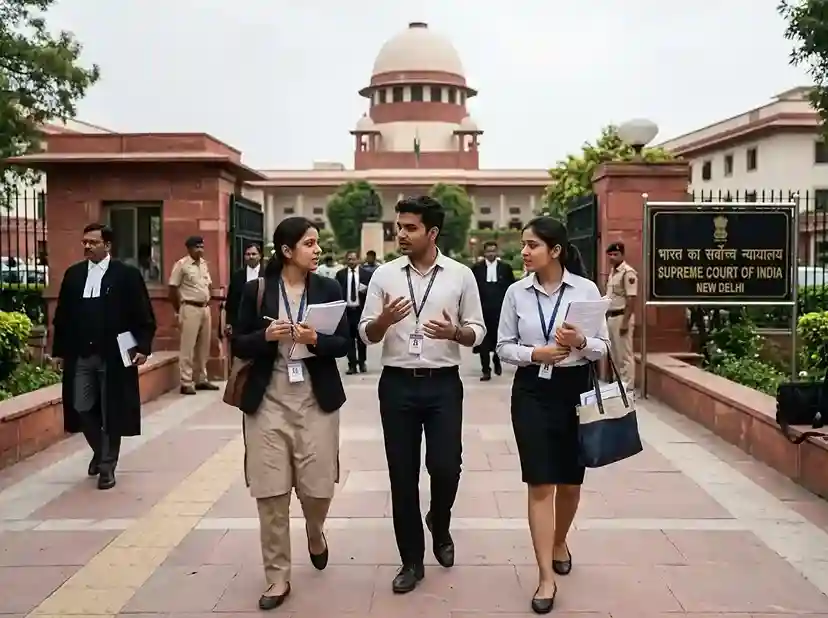
Internship Guide 2026Updated May 2026All Years of LLB50+ Opportunities
Law Internships in India 2026 | Complete Guide | Law Firms, Courts, Government & NGOs for LLB Students
The most comprehensive law internship guide for Indian law students in 2026: government internships paying up to ₹15,000/month (CCI), Tier-1 law firm programmes (₹10,000–₹50,000/month), Supreme Court judicial internships, NALSA, SEBI, Ministry of Law, NGOs, YUKTI programme, year-wise strategy, ready-to-use application email templates, and everything you need to build a career-defining internship record.
📅 Updated: May 30, 2026
✍️ By Priya Kumari, LLM NALSAR | Senior Law Education Editor
⏱ 20 min read | 3,500+ words
Law Internships India 2026 | Complete Guide for LLB Students | Firms, Courts, Government & NGOs | LawGuru India
Law Internships India 2026 | At a Glance
CCI (Competition Commission of India): ₹15,000/month honorarium
SEBI Legal Department: ₹10,000/month stipend | 4th/5th year only
Ministry of Law & Justice: ₹5,000/month | 2nd year+ eligible
NALSA: Unpaid | 1-month | All years | Apply at nalsa.gov.in
1. Why Law Internships Are Critical | More Than BCI Compliance
Every law student in India knows that the Bar Council of India (BCI) mandates internship hours as part of the LLB curriculum. But treating internships as a mere compliance exercise is one of the most costly mistakes a law student can make. Internships are, in reality, the primary mechanism by which legal careers are built, differentiated, and launched.
Research consistently shows that over 60% of final placements at top NLUs come through direct internship-to-job conversions or introductions made during internship stints. The top law firms | Cyril Amarchand Mangaldas, AZB & Partners, Khaitan & Co., Trilegal | routinely extend PPOs (Pre-Placement Offers) to interns they wish to hire. A student who completes a strong third-year internship at a Tier-1 firm and receives a PPO effectively removes placement season anxiety entirely.
Beyond job prospects, internships build the skills that no classroom teaches: reading a live contract with real financial stakes, researching a case where the outcome matters to an actual client, drafting a pleading that will be filed in court, attending hearings, and | most critically | building relationships with senior lawyers who will shape your career for the next decade. The quality of your internship network by the time you graduate determines your career trajectory more than your CGPA in most practice areas.
📌 The One Rule That Changes Everything
Every internship should be treated as a 30-day extended job interview. The supervising partner or senior associate forms an opinion of you by Day 3 that is very hard to change. Arrive early. Submit work before deadlines. Ask intelligent questions. Request feedback before you leave. The students who receive PPOs are almost always students who treated the internship with the same seriousness as a full-time job | not those with the best grades.
60%
Final jobs via internship network
₹50K
Max monthly stipend (Tier-1 firms)
₹15K
CCI govt internship honorarium
2–3
Months advance notice needed
2. Types of Law Internships in India | Full Overview
India's legal internship ecosystem spans seven distinct categories, each building a different skill set, career signal, and professional network. Understanding this taxonomy is the first step in strategic planning:
All TypesGovernment (Paid)JudicialLaw FirmsLegal AidNGOOnline/Remote
Type
Best For
Stipend 2026
Prestige Signal
Ideal Year
Tier-1 Law Firms
Corporate law, M&A, PE, Tax
₹10K–₹50K/month
Very High
Year 3–5
Government Regulatory (CCI, SEBI)
Regulatory, competition, securities law
₹10K–₹15K/month
Very High
Year 3–5
Ministry of Law & Justice
Constitutional, admin, policy
₹5,000/month
High
Year 2–5
Supreme Court (Judicial)
Litigation, constitutional career
Unpaid (prestige)
Highest (Litigation)
Year 3–5
High Courts
Litigation, appellate practice
Unpaid
High
Year 2–5
NALSA
Legal aid, access to justice
Unpaid
High (Legal Aid)
Year 1–5 (all years)
NGOs (HRLN, ALF, Lawyers Collective)
Human rights, PIL, public interest
Mostly unpaid
Medium–High
Year 1–3
In-House Corporate (IT Companies)
Compliance, contracts, tech law
₹8K–₹25K/month
Medium
Year 3–5
YUKTI / Special Programmes
In-house corporate training
Programme-based
High (Niche)
Year 3–5
3. Government & Regulatory Internships 2026 (Paid) | CCI, SEBI, Ministry of Law
Government and regulatory body internships are among the most underrated opportunities in India's legal internship landscape. They are paid, intellectually rigorous, provide exposure to live regulatory enforcement and policy-making, and carry substantial credibility signals for future employers. The three most important paid government legal internships in 2026 are:
1. Competition Commission of India (CCI) | Legal Internship 2026
Govt | Paid ★★★★★
Honorarium₹15,000/month
LocationNew Delhi
Duration1 month
ApplicationPrescribed format + institutional recommendation
Apply DeadlineJune 1, 2026 (for next batch)
ModeOffline (New Delhi)
The Competition Commission of India (CCI) is India's competition law regulator, enforcing the Competition Act 2002. Its legal internship is the highest-paying government law internship in India at ₹15,000/month honorarium, subject to satisfactory performance and completion. Interns work on live cases involving cartels, abuse of dominance, mergers, and market study research. The application must be submitted in the prescribed format with a recommendation from the competent authority of the applicant's academic institution. The CCI internship is particularly valuable for students targeting corporate law, competition law, regulatory practice, or policy roles. To apply: submit the prescribed form (available on the official CCI website) to the CCI Internship Coordinator before the advertised deadline. A minimum mark requirement typically applies.
2. Securities and Exchange Board of India (SEBI) | Legal Internship 2026
Govt | Paid ★★★★★
Stipend₹10,000/month
LocationMumbai (SEBI Head Office)
Duration1 month (typically)
Eligibility4th/5th yr (5-yr) or 2nd/final yr (3-yr) | Min 60% in prev. semester | Below 28 yrs
ModeFull-time, physical (Mumbai)
Apply AtOfficial SEBI website
The Securities and Exchange Board of India (SEBI) Legal Department Internship is one of India's most prestigious and paid government legal internships. Interns gain hands-on experience in securities law, capital markets regulation, enforcement, and compliance monitoring within India's primary capital market regulator. Eligibility requirements: enrolled in a BCI and UGC-recognised law institution; 4th or 5th year of 5-year LLB OR 2nd or final year of 3-year LLB; minimum 60% aggregate marks or equivalent CGPA in the previous semester; below 28 years of age. Students who have already appeared for their final semester exams are NOT eligible. The internship is full-time and physical (offline) at SEBI's Mumbai office. Unauthorised absence or incomplete internship may lead to disqualification from future SEBI internships. Applications are submitted through the official SEBI website (sebi.gov.in).
3. Ministry of Law & Justice, Government of India | Legal Internship 2026
DeadlineTypically 10th of the month preceding the internship month
The Ministry of Law & Justice internship provides training in constitutional & administrative law, finance law, infrastructure law, economic law, labour law, conveyancing, arbitration & contract law, and research & referencing work. Interns are deployed with officers and sections at the Main Secretariat in New Delhi, the Central Agency Section at the Supreme Court, the Litigation HC Section at Delhi, and branch secretariats in Chennai, Mumbai, Kolkata, and Bengaluru. Advance knowledge of computers (MS Office, infographics) is preferred. Eligibility: Indian students who have passed the 2nd year of 3-year LLB or 3rd year of 5-year LLB, or persons who have completed a law degree from any recognised institution. Applications are submitted to the Ministry of Law & Justice through their official internship portal. The previous application deadline was April 10, 2026 for the May 2026 batch.
4. Shipping Corporation of India (SCI) | Summer Internship Programme 2026
PSU | Paid
TypeGovernment PSU Legal Internship
EligibilityLaw students (UG/PG)
Application PeriodApplications typically in March each year
The Shipping Corporation of India (SCI) offers a Summer Internship Programme for law students interested in admiralty law, maritime regulation, commercial contracts, and the legal aspects of shipping and logistics. As one of India's largest government-owned shipping companies, SCI's legal department handles complex contractual, regulatory, and admiralty matters. Applications for the 2026 Summer Internship Programme were open until approximately March 16, 2026. This is an excellent opportunity for students interested in shipping, maritime, or commercial law.
4. Judicial Internships | Supreme Court, High Courts & District Courts
A judicial internship is the most prestigious opportunity available to a litigation-focused law student in India. Working in a judge's chamber or under an Advocate-on-Record (AoR) at the Supreme Court of India exposes you to the highest levels of constitutional reasoning, appellate advocacy, and legal drafting | an education impossible to replicate anywhere else.
Supreme Court of India | Judge's Chamber / AoR Internship 2026
Judicial | Unpaid | ★★★★★ Prestige
StipendUnpaid
LocationSupreme Court of India, New Delhi
Duration1 month (minimum)
How to ApplyEmail directly to judge's personal secretary or AoR
Apply When6–8 weeks before desired month
Active Opening (2026)Office of HMJ R. Mahadevan | HMJ Satish Chandra Sharma | June 2026 batch
An internship at the Supreme Court of India is the pinnacle of judicial internships in the country. Two types are available: (1) Judge's Chamber Internship | working directly with a Supreme Court judge's staff, preparing briefing notes, summarising pending matters, legal research; (2) Advocate-on-Record (AoR) Internship | working under an AoR who files matters directly before the SC, involves live research, drafting miscellaneous applications, court attendance, and brief preparation. Recent openings advertised include internship at the Office of HMJ R. Mahadevan (Judge, Supreme Court) and the Office of HMJ Satish Chandra Sharma (Judge, Supreme Court) for June 2026. The Centre for Research and Planning at the Supreme Court also occasionally offers internship positions. Apply by email to the judge's personal secretary or the AoR with CV + academic transcripts + writing sample 6–8 weeks before desired month.
High Court Internships | Allahabad, Delhi, Bombay, Calcutta, Madras, Kerala High Courts
Judicial | Unpaid | ★★★★ Prestige
StipendUnpaid
DurationMinimum 4 weeks (Allahabad HC formal programme)
ModePhysical, full-time
Allahabad HC Eligibility2nd year+ (3-yr) or enrolled in 5-yr programme; 5th/6th semester students eligible
Dress CodeFormal; black & white as per Bar Council norms at some courts
Several High Courts have formalised internship programmes for law students. The High Court of Judicature at Allahabad (at Prayagraj & Lucknow) accepts applications for a formal minimum 4-week non-remunerative internship. Eligibility: 2nd or 3rd year of 3-year LLB, or 5-year integrated LLB (BCI-recognised); students who appeared for their 6th semester (5-year) or 1st year (3-year) final exam may also apply with a satisfactory academic record. Applications are submitted online through the official Allahabad HC internship portal. Delhi High Court, Bombay HC, Calcutta HC, Madras HC, and Kerala HC also offer internship opportunities | either through formal portals or direct applications to judges' chambers or senior advocates practising there. HC internships are highly recommended for students targeting litigation or judicial service careers.
District Court / Sessions Court Internships
Trial Court | Unpaid | Year 1+ Eligible
StipendUnpaid (typically)
ModePhysical, under a local advocate
EligibilityYear 1+ of 5-yr or 3-yr LLB
ValueTrial-level procedure, bail hearings, examination of witnesses
District Court internships are less glamorous than Supreme Court or High Court internships but are invaluable for understanding how most Indian litigation actually works at the trial level | bail hearings, arguments, examination of witnesses, summoning orders, and criminal trials. Particularly recommended for Year 1 and Year 2 students who want to observe the legal system before targeting more competitive judicial internships. Apply by approaching any advocate practising at your local District Court; most advocates are willing to take enthusiastic law students for a month of court observation.
5. Legal Aid & Statutory Body Internships | NALSA, NHRC, CBI
🌿Legal Aid & Statutory Body Internships 2026NALSA | NHRC | CBI | Law Commission
National Legal Services Authority (NALSA) | Internship Programme 2026
Legal Aid | Unpaid | All Years Eligible
StipendUnpaid (no TA/DA/accommodation)
LocationNALSA Headquarters, New Delhi
Duration1 month (full-time, Mon–Sat)
EligibilityAny year of 3-yr or 5-yr LLB (preference: senior-year students)
AttendanceMinimum 90% mandatory for certificate
Apply Atnalsa.gov.in (2 months before target month)
The National Legal Services Authority (NALSA) Internship Programme 2026 is designed to acquaint young law students with the functioning of India's foremost legal aid institution, constituted under the Legal Services Authorities Act, 1987. Interns gain hands-on exposure through field visits to Supreme Court Mediation Centre, Supreme Court Library, National Lok Adalat, and Legal Aid Defence Counsel Offices. Interns interact with NALSA officials and gain a comprehensive understanding of India's legal services ecosystem. Requirements: formal black & white dress code per Bar Council norms; interns must carry their own laptops; no recommendation letters issued by NALSA; certificate issued only upon successful completion. Application is completely online via nalsa.gov.in | the form activates 2 months before the target internship month. June & July 2026 batches are currently open for applications. Preference is given to 3rd–5th year (5-yr course) and 2nd–3rd year (3-yr course) students.
Law Commission of India | Research Internship 2026
Govt | Unpaid | Research Focus
StipendUnpaid (highly prestigious)
LocationNew Delhi
FocusLegislative research, comparative law, law reform reports
EligibilityStrong academic record; research writing ability essential
The Law Commission of India, a body that advises the Government of India on law reform, offers research internship positions for law students with strong analytical and writing abilities. Interns produce research memos, conduct comparative law analysis across jurisdictions, and contribute to the drafting of Law Commission reports. The Law Commission's reports on subjects ranging from electoral reform to death penalty to criminal law revision carry enormous policy significance. An internship here is particularly valuable for students targeting academic careers, legislative drafting, or policy advisory roles. Apply by letter/email to the Law Commission of India, New Delhi, with CV and a sample of legal research writing.
NHRC (National Human Rights Commission) | Research Internship
Govt | Paid (Senior Roles) | Research Focus
Stipend₹70,000/month (Junior Research Consultant | contractual)
Regular internship: unpaid
LocationNew Delhi
FocusHuman rights law, complaint analysis, research memos
The National Human Rights Commission (NHRC) offers both regular internships (unpaid) and contractual Junior Research Consultant roles (₹70,000/month remuneration | competitive). For the Junior Research Consultant role, the most recent application deadline was June 9, 2026. Regular NHRC internships for law students involve complaint file analysis, research on human rights jurisprudence, and assistance with policy documentation. Excellent for students targeting human rights law, constitutional litigation, or international law careers.
Law firm internships remain the most coveted opportunities in India's legal market, particularly for students targeting corporate law careers. The firm ecosystem is organised into tiers based on deal value, client profile, and attorney headcount | and understanding this structure is essential for strategic application planning.
🏢Tier-1 Law Firm Internships | India's Top Corporate Firms₹10,000–₹50,000/month | Year 3+ Priority
Apply 2–3 months in advance for summer (May–July) and winter (December–January) batches. Tier-1 firms receive thousands of applications | distinguish yourself with a targeted, researched email (under 200 words) that mentions a specific deal, case, or publication of the firm. Quality over quantity: 10 researched emails to 10 firms you genuinely want to work at will outperform 100 identical blasts every single time. See Section 11 for email templates.
7. NGO & Public Interest Law Internships 2026
For law students who want to use law as an instrument of social change, NGO internships provide exposure to India's most critical constitutional issues | human rights violations, environmental justice, women's rights, labour rights, and access to justice for marginalised communities. These internships are mostly unpaid but build credentials and skills that are invaluable for public interest law, academic, and policy careers.
🤝NGO & Public Interest Law Internships 2026Mostly Unpaid | Year 1 Eligible | High Impact
🤝 Human Rights Law Network (HRLN)
Small honorarium available
India's most active PIL organisation | drafts and argues PILs before SC and High Courts for marginalised communities. Interns work on active cases. Year 1 eligible. Strong career signal for public interest law paths.
⚖️ Lawyers Collective
Unpaid
Pioneered landmark constitutional litigation | Section 377 decriminalisation, HIV/AIDS law reform. Mumbai & Delhi offices. Strategic constitutional litigation experience for senior years.
🌱 Alternative Law Forum (ALF), Bangalore
Unpaid
Intersection of law, social movements, and critical legal theory. LGBTQ+, labour rights, environmental justice. Interns engage in research and casework. Ideal for students interested in socio-legal research careers.
📜 Vidhi Centre for Legal Policy
Research-intensive | Competitive
India's most prominent legal policy think-tank. Produces influential law reform reports. Interns produce publishable policy memos. Very competitive | recommended for 4th–5th year or LLM students. Delhi & Bangalore offices.
🌍 Environmental Justice India / NGT-focused NGOs
Unpaid
Focus on NGT cases, forest rights litigation, and climate justice advocacy. Environmental law is a rapidly growing practice area | NGO experience here is becoming valuable even for corporate careers.
🎓 Square Circle Clinic, NALSAR University of Law
Stipend ₹10,000 + ₹5,000
NALSAR's clinical legal education programme. 2026 opening: internship programme with stipend of ₹10,000 (senior) and ₹5,000 (junior) positions. Application deadline: May 31, 2026. Based at NALSAR, Hyderabad. Research + client interaction format.
8. Special Programmes | YUKTI (GCAI), Online & Research Fellowships
YUKTI Programme | General Counsels' Association of India (GCAI)
In-House Corporate | Premium Programme | 2026
Full NameYouth Unchained Through Knowledge and Transformative Internships
Duration19 days (immersive, residential)
LocationDr. Ambedkar International Centre, New Delhi
Programme LaunchJanuary 5, 2026 (inaugural batch)
Batch Size~100 law students (selected from law schools across India)
FacultySenior in-house leaders, law firm partners, judges, government officials
YUKTI is described as a first-of-its-kind programme globally | a 19-day immersive corporate internship designed to bridge the gap between classroom legal education and real-world in-house legal practice. Launched by the General Counsels' Association of India (GCAI) on January 5, 2026, the inaugural batch hosted approximately 100 law students selected from law schools and universities across India. The programme features senior in-house legal leaders, law firm partners, judges, and government officials as faculty. It is specifically focused on corporate advisory, compliance, transactions, and in-house litigation exposure | skills directly relevant for corporate counsel careers. The convocation ceremony (January 30, 2026) was attended by senior judiciary members and cabinet ministers, reflecting the programme's political and institutional backing. Applications for future YUKTI batches are routed through participating law schools. GCAI describes YUKTI as contributing to Viksit Bharat @ 2047 | India's development vision. Watch for the 2026-27 YUKTI batch announcement through official GCAI channels.
EligibilityAny semester/year of UG/PG law; research scholars also eligible
Intake~100 interns per batch
The National Human Rights Commission (NHRC) offers a regular Online Short Term Internship Programme (OSTI) for law and other social science students. The May 2026 batch ran from May 18–29, 2026 with approximately 100 interns. Eligibility includes students of any semester/year of any postgraduate degree course, 3-year LLB programme students, and research scholars in any stream. The virtual format makes it accessible to students across India without relocation costs. NHRC internship provides valuable exposure to human rights case handling and commission functioning.
NLSIU Litigation Fellowship | National Law School of India University
NLSIU Bengaluru has advertised a full-time contractual role of Manager – Litigation Fellowships, a post-degree fellowship opportunity based at India's #1 law school. This reflects NLSIU's expanding fellowship and clinical legal education infrastructure. While this is more of a contractual role than a student internship, it represents the growing category of law school-based fellowships that bridge academic and practical legal work | particularly relevant for LLM graduates and final-year BA LLB students considering a transition into academia or legal research before entering practice.
9. Law Internship Stipend Guide 2026 | Who Pays What
Understanding the stipend landscape is critical for financial planning. Here is the most comprehensive stipend guide for law internships in India in 2026:
Organisation/Category
Stipend / Honorarium (2026)
Paid?
Notes
CCI (Competition Commission)
₹15,000/month
✅ Yes
Honorarium; subject to satisfactory performance; prescribed format application
SEBI Legal Department
₹10,000/month
✅ Yes
Stipend; 4th/5th yr (5-yr) or 2nd/final yr (3-yr); min 60% marks; Mumbai-based
Ministry of Law & Justice
₹5,000/month
✅ Yes
2nd yr+ (3-yr) or 3rd yr+ (5-yr) eligible; multiple cities
NHRC (Junior Research Consultant)
₹70,000/month (contractual)
✅ Yes (contractual)
Not standard internship; contractual researcher role; competitive selection
Square Circle Clinic, NALSAR
₹10,000 or ₹5,000/month
✅ Yes
Senior/junior positions; clinical work
Tier-1 Firms (CAM, SAM, Trilegal)
₹15,000–₹50,000/month
✅ Yes
Varies significantly by city and performance; Mumbai/Delhi highest
AZB & Partners, Khaitan & Co.
Performance-based; up to ₹20K
✅ Merit-based
Exceptional interns paid more
Tier-2 Firms (Phoenix, ELP, Argus)
₹5,000–₹15,000/month
✅ Most paid
Varies by firm and city
In-house Corporate (IT companies)
₹8,000–₹25,000/month
✅ Yes
Strong for Bangalore/Hyderabad tech in-house
Supreme Court (Judicial)
Unpaid
❌ Unpaid
Extremely prestigious; career-defining for litigators
High Courts
Unpaid
❌ Unpaid
Formal programme at some HCs (Allahabad, Delhi)
NALSA
Unpaid (no TA/DA)
❌ Unpaid
Apply 2 months before at nalsa.gov.in; certificate on completion
Law Commission of India
Unpaid
❌ Unpaid
Very prestigious for policy/research careers
NGOs (HRLN, ALF, Vidhi, etc.)
Mostly unpaid; HRLN: small honorarium
⚠️ Usually unpaid
Vidhi is competitive; all others more accessible
⚠️ The Golden Rule: Substance Over Stipend
Never choose a mediocre firm's paid internship over an unpaid Supreme Court or CCI internship. In legal education, the prestige and quality of experience determine career trajectory far more than a monthly stipend. A CCI internship (₹15,000/month, meaningful work) is worth more than a ₹20,000/month internship at a small firm with no real work. Choose quality of experience, quality of supervision, and quality of work product first. The stipend only matters when choosing between genuinely equal-quality opportunities.
10. Year-Wise Internship Strategy | From Year 1 to Final Year
The most successful law students in India follow a structured 5-year internship plan, not an ad hoc approach. Each year has a specific goal, target category, and milestone:
Year 1 Foundation
Goal: Legal exposure + foundational skills + BCI compliance hours. Target: Law school legal aid cell, NALSA (apply at nalsa.gov.in | all years eligible), NGO internships (HRLN, ALF, environmental NGOs), NHRC Online Short Term Internship. District court observation under local advocate. Avoid: Applying to Tier-1 firms | premature applications create a negative impression and the rejection provides no useful feedback. Milestone: 1–2 NGO/NALSA certificates, foundational drafting and research skills, updated CV ready for Year 2 applications.
Year 2 Building
Goal: First law firm or government body internship. Identify career direction. Target: Tier-2/3 law firms, Ministry of Law & Justice (₹5,000/month, 2nd yr+ eligible), High Court internship under a junior advocate, Law Commission (for research-oriented students). Apply: 2–3 months in advance. Summer window (May–July): apply in February–March. 10 targeted emails, not 100 generic ones. Milestone: First law firm certificate, clearer practice area preference, CV now ready for Tier-1 firm applications in Year 3.
Year 3 Targeting
Goal: Tier-1 firm internship OR government regulatory body (CCI/SEBI). Target (Corporate track): First Tier-1 firm application | JSA, Trilegal, or Luthra as more accessible entry Tier-1 firms. CCI or SEBI for regulatory track (SEBI requires 4th/5th yr | apply in Year 3 for Year 4 batch). Target (Litigation track): AoR internship at Supreme Court or Delhi HC. Apply 6–8 weeks before desired month. Milestone: First Tier-1/regulatory experience; CV now signals serious professional intent to final-year employers.
Year 4 Specialising
Goal: Specialisation internship + PPO chase begins. Target: Return to the same Tier-1 firm if previous internship was strong (PPO conversions begin here). CCI (₹15,000/month) or SEBI (₹10,000/month) for regulatory careers. YUKTI programme for in-house corporate track. Anand & Anand for IP specialisation. PPO Priority: Many Tier-1 firms begin giving PPOs from Year 4 internships. A PPO eliminates placement season anxiety | treat Year 4 as an extended job interview. Milestone: Practice area specialisation on CV, PPO if secured, specialised recruiter relationships built.
Year 5 Converting
Goal: Convert internship capital into job offer. Placement ready. If PPO secured: Confirm it and redirect energy to thesis, CLAT PG (if LLM planned), or bar examination preparation. If no PPO: Use semester break for a targeted final internship at the exact firm you want to join | this is your final job interview. Stay focused; do not try a new category in Year 5. Milestone: Job offer confirmed (PPO or placement), AIBE preparation underway.
11. How to Apply | Cold Email Template & CV Tips
The quality of your application separates those who get Tier-1 internships from those who do not. Most students send copy-paste emails. A targeted, researched application stands out immediately in a pile of generic requests.
📧 Template | Law Firm Internship Application (Cold Email)
Subject: Application for Internship – June 2026 | Rahul Kumar | 3rd Year BA LLB | NALSAR Hyderabad
Dear [Partner/Associate Name],
I am a third-year BA LLB (Hons) student at NALSAR University of Law, Hyderabad. I write to apply for an internship with [Firm Name] for the month of June 2026.
I am particularly drawn to your firm's work in [specific practice area | e.g., competition law/M&A/IP]. I found your team's advisory role in [specific recent deal or publication of the firm] particularly instructive | especially the regulatory structuring approach taken in [specific aspect].
I have previously interned at [Previous Firm/Organisation] where I researched [brief topic]. I have completed coursework in [Advanced Contract Law / Competition Law / IPR] and maintained a CGPA of X.X/10.
I have attached a one-page CV and am happy to provide a writing sample on request. I am available for the full month of June 2026.
I would be grateful for the opportunity.
Yours sincerely,
Rahul Kumar
3rd Year, BA LLB (Hons) | NALSAR University of Law, Hyderabad
Mobile: 91XXXXXXXX | rahul.kumar@nalsar.ac.in
✅ Five Rules for Cold Emails That Get Replies
1. Research first: Mention something specific the firm did recently | proves you researched, not copy-pasted. 2. Under 200 words: Partners do not read long emails from unknown law students. Every word must earn its place. 3. Attach only CV initially: 1-page CV. Offer writing sample. Attach it only if explicitly welcome. 4. Subject line formula: "Application for Internship – [Month Year] | [Name] | [Year] | [Law School]" 5. One follow-up: After 10–14 days | polite, brief. Not WhatsApp. Not LinkedIn DM.
CV Tips Specific to Law Internship Applications
1 page maximum. You are a law student, not a senior partner. One page builds discipline and forces prioritisation.
Lead with Education. Your law school and CGPA are your most valuable current credentials. Place them first.
Quantify everything. Not "worked on research" but "researched 14 Supreme Court judgments on Section 7 IBC matters for a filed brief."
List relevant coursework for specialised roles | Competition Law, Tax Law, IPR, Cyber Law. Shows genuine interest beyond grades.
Moot court and publications matter. A Best Memorial award or published article signals research quality far more than a participation certificate.
No photo, DOB, religion, or marital status. These are not legally required and can trigger unconscious bias in some selection processes.
LinkedIn URL. Keep it updated and consistent with your CV. Many partners search LinkedIn before responding to a cold email.
12. Common Internship Mistakes Law Students Make
❌Sending copy-paste emails to 100+ firms: A mass-blast email is immediately identifiable. Partners receive dozens of these weekly. 10 targeted, researched, personalised emails consistently outperform 100 generic ones. Invest 15 minutes researching each firm before writing.
❌Applying to Tier-1 firms in Year 1–2: Premature applications with no relevant experience create a negative impression. Tier-1 firms screen by institution and prior experience. Build sequentially | Year 1: NGO/NALSA → Year 2: Tier-3 firms → Year 3: Tier-2 → Year 4: Tier-1.
❌Treating internships as checkbox exercises: Students who arrive late, contribute minimally, and treat the internship as a certificate-collection exercise actively harm their reputations. The supervising partner's opinion follows you for years through India's small legal community.
❌Not asking for feedback: At the end of every internship, request a 15-minute debrief. "What could I have done better?" is the most valuable question you can ask. Most students never ask it | those who do consistently receive PPOs and strong referrals.
❌Neglecting sloppy citations: Inconsistent citation style, unedited drafts, and incorrect case citations mark you as unprepared instantly. Precision in small things signals reliability in big ones | the core quality legal employers look for.
❌Ignoring non-corporate internship tracks in early years: A student with only one Tier-1 corporate internship and zero court/NGO exposure is less well-rounded than one with an NGO experience, a District Court stint, and a mid-size firm. Breadth matters before depth at the early stages.
❌Missing government application deadlines: CCI, SEBI, Ministry of Law, and NALSA all have strict deadlines (often the 10th of the preceding month). Missing by a single day means waiting for the next cycle. Set calendar reminders 3 weeks before every application deadline.
13. Frequently Asked Questions | Law Internships India 2026
The best paid law internships in India for 2026, by stipend level: (1) CCI (Competition Commission of India) | ₹15,000/month honorarium for its legal internship programme; (2) SEBI Legal Department | ₹10,000/month stipend for 4th/5th year (5-yr) or 2nd/final year (3-yr) students with minimum 60% marks; (3) Ministry of Law & Justice | ₹5,000/month for students who have passed 2nd year (3-yr) or 3rd year (5-yr). For law firms: Tier-1 firms like Cyril Amarchand Mangaldas (₹15,000–₹50,000/month), Shardul Amarchand Mangaldas, and Trilegal offer the highest law firm stipends. NHRC's Junior Research Consultant contractual role pays ₹70,000/month, though this is a post-degree contractual position, not a standard student internship. NALSA, Supreme Court, and most High Court judicial internships are unpaid.
To apply for the Competition Commission of India (CCI) Legal Internship 2026: (1) Download the prescribed application format from the official CCI website (cci.gov.in); (2) Fill out the form completely; (3) Obtain a recommendation letter or endorsement from the competent authority of your academic institution (typically the Registrar or Dean of your law school); (4) Submit the application by the advertised deadline | the June 2026 batch deadline was June 1, 2026. The honorarium is ₹15,000 per month, subject to satisfactory performance and completion. The internship is offline and based in New Delhi. A minimum marks requirement typically applies | check the current notification on the official CCI website for the specific criterion for your application cycle.
The NALSA (National Legal Services Authority) Internship Programme 2026 application process is entirely online: (1) Visit the official NALSA website | nalsa.gov.in; (2) Navigate to the Internship Programme 2026 section; (3) The application form activates 2 months before the desired internship month (e.g., for July 2026, apply in May 2026); (4) Fill out the form with academic details, law school information, and year of study. Eligibility: any year of 3-year LLB or 5-year integrated law course from a recognised institution; preference given to 3rd–5th year (5-yr) and 2nd–3rd year (3-yr) students. The internship is 1 month long, full-time, Monday to Saturday, in New Delhi. No stipend, TA/DA, or accommodation is provided | interns arrange their own stay. Minimum 90% attendance is required for the certificate. Interns must carry their own laptop.
Yes, first-year LLB students can get internships, though the most competitive government and law firm opportunities typically require 3rd year (5-yr) or 2nd year (3-yr) standing. Best options for Year 1 students: (1) NALSA internship | open to all years of 3-yr and 5-yr courses (apply at nalsa.gov.in); (2) NHRC Online Short Term Internship Programme | open to UG students of any year; (3) NGO internships (HRLN, ALF, environmental NGOs) | most accept Year 1 students for research and outreach work; (4) Your law school's legal aid cell; (5) District court observation under a local advocate; (6) Virtual research internships in legal publishing or legal news platforms. Year 1 students should focus on building foundational skills | legal research, OSCOLA/Bluebook citation, drafting | rather than chasing prestigious placements. SEBI requires minimum 4th/5th year standing; Tier-1 law firms effectively prefer 3rd year minimum.
A cold email for a law internship that gets responses follows this formula: Subject: "Application for Internship – [Month Year] | [Name] | [Year] | [Law School]". Body (under 200 words): (1) One sentence identifying who you are and what you want; (2) Why THIS specific firm | mention a specific deal, case, article, or practice area the firm is known for. This proves you researched, not copy-pasted; (3) What you bring in 1–2 sentences | prior internship, relevant coursework, a specific skill; (4) Available dates clearly stated; (5) Professional closing with contact details. Attach: 1-page CV. Offer a writing sample but attach only if invited. Follow up once after 10–14 days with a short polite email. Send 10 targeted, researched emails rather than 100 generic blasts. See the full email template in Section 11 above.
Apply 2–3 months before your desired internship month. Key timelines: Summer internships (May–July): apply in February–March; Winter internships (December–January): apply in September–October. For judicial internships at the Supreme Court: apply 6–8 weeks before the desired month. For NALSA: apply online at nalsa.gov.in 2 months before the desired month (the application form activates at that time). For CCI: apply by the 1st of the month preceding the batch (e.g., June 1 deadline for July batch). For SEBI: check the official SEBI website for current batch notifications. For Tier-1 law firms: many accept rolling applications year-round through their careers portal | apply as early as possible, especially for competitive summer windows.
Build Your Legal Career Starting with the Right Internships
Strategic internships start with the right law school. CLAT 2027 opens doors to NLUs where Tier-1 firms, CCI, SEBI, and Supreme Court internships are most accessible. Registration opens July 2026.