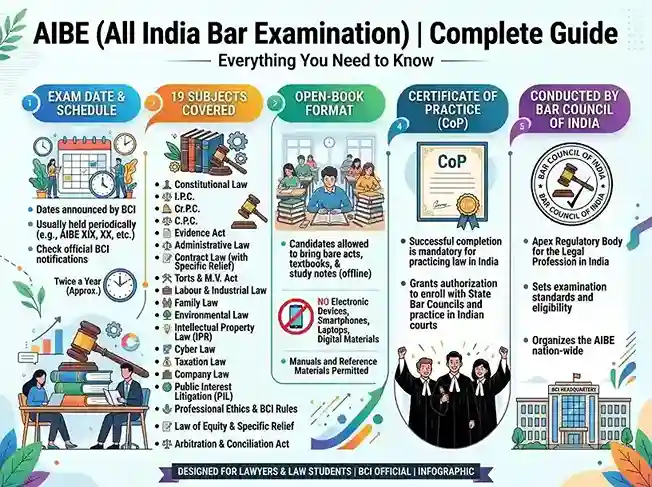
1. What is AIBE? Full Form, Purpose & Importance
AIBE stands for All India Bar Examination. It is India's national bar certification exam, conducted by the Bar Council of India (BCI) under the Advocates Act, 1961. Every law graduate in India who wishes to legally practise as an advocate | representing clients in courts and tribunals | must clear AIBE to obtain the Certificate of Practice (CoP).
AIBE is not a competitive entrance exam like CLAT or AILET. It is a qualifying exam | meaning you do not compete against others for a limited number of seats. Instead, you simply need to score above the minimum passing threshold (45 out of 100 for General/OBC, 40 for SC/ST/PwD) to receive your CoP. The pass percentage nationwide typically ranges between 60–70%.
The examination tests whether a law graduate has the basic legal knowledge and practical competence required to function as an advocate. It is intentionally designed as an open-book test | exactly simulating how a practising lawyer works: by reading and applying bare acts, not reciting them from memory.
Why is AIBE Important?
AIBE is crucial for every law graduate for one simple reason: without passing AIBE, you cannot legally argue a case in any Indian court. Here is why it matters:
- Legal Mandate: The BCI made AIBE mandatory under Section 24 of the Advocates Act, 1961 (as amended). It is not optional.
- Certificate of Practice: The CoP received after passing AIBE is your formal licence to practise law. It is required by State Bar Councils before allowing full enrollment.
- Professional Credibility: Law firms, courts, and clients view the CoP as confirmation that a lawyer meets BCI's baseline competency standard.
- Career Entry Point: Whether you want to join a law firm, practise independently, or appear in court for any purpose | the CoP is your entry ticket to the legal profession.
- Provisional Practice: Law graduates can practise provisionally for up to two years while awaiting their CoP | but they must clear AIBE within this provisional period.
2. AIBE 2026 (XXI) Important Dates
The Bar Council of India announced the AIBE XXI schedule via official press release on January 7, 2026. All dates below are official unless marked as estimated.
| Event | Date | Status |
|---|---|---|
| AIBE XXI Schedule Announced | January 7, 2026 | ✓ Done |
| AIBE 21 Registration Opens | February 11, 2026 | ✓ Done |
| Last Date to Apply (with fee) | April 30, 2026 | ✓ Done |
| Form Correction Window | April 2026 (est.) | ✓ Done |
| AIBE XXI Admit Card | May 22, 2026 | ✓ Done |
| AIBE XXI Exam Date | June 7, 2026 | Upcoming |
| Provisional Answer Key | June 2026 (est.) | Upcoming |
| AIBE 21 Result | September 2026 (est.) | Upcoming |
| Certificate of Practice Dispatch | Post-Result | Upcoming |
The AIBE 20 (2025) result was declared on January 7, 2026. If you appeared for AIBE 20, check your result on allindiabarexamination.com using your enrolment number and date of birth. Results are not communicated by post | they are only available on the portal. Status shows as Pass, Fail, Rejected, or Withheld.
3. AIBE 2026 Eligibility Criteria
AIBE eligibility is straightforward | it is open to all law graduates and, from recent years, even to final-year law students. Here is the complete eligibility breakdown.
| Criterion | Requirement |
|---|---|
| Educational Qualification | LLB degree (3-year or 5-year BA LLB/BBA LLB/B.Com LLB) from a BCI-recognised university |
| Final Year Students | Eligible | final semester/year students without backlogs can apply; result will be provisional until graduation is confirmed |
| State Bar Council Enrolment | Must be enrolled with any State Bar Council (provisional enrolment accepted) |
| Without Enrolment Certificate | Can apply but must submit the enrolment certificate after result; result will be withheld otherwise |
| Age Limit | No upper or lower age limit |
| Nationality | Indian citizens; foreign law graduates enrolled with Indian State Bar Councils also eligible |
| Maximum Attempts | Unlimited attempts; must clear within provisional enrolment period (up to 3 years from State Bar Council enrolment) |
✅ Who CAN Apply for AIBE 2026
- LLB (3-year) graduates from any BCI-recognised university
- 5-year integrated BA LLB, BBA LLB, B.Com LLB graduates
- Final semester/year students (no backlogs)
- Candidates who failed previous AIBE attempts (re-appearing)
- Law graduates enrolled with any State Bar Council in India
❌ Who CANNOT Apply for AIBE 2026
- Graduates from colleges not recognised by BCI
- Law students in first, second, or third year (except final year)
- Graduates who have already received their Certificate of Practice
- Law graduates who have crossed their provisional enrolment period without BCI extension
If you are in your final semester of LLB, apply for AIBE XXI now | don't wait until after your results. You can appear provisionally. This way, you can get your CoP faster instead of waiting an entire year for the next AIBE session. BCI now conducts AIBE twice a year, so opportunities are more frequent than before.
4. How to Register for AIBE 2026 | Step-by-Step Process
AIBE registration is entirely online on the official AIBE portal: allindiabarexamination.com. Here is the step-by-step process.
Go to the official AIBE website and click 'Register Here' for AIBE XXI. Create a new account using your enrolment number (from your State Bar Council), State Bar Council name, year of enrolment, and a valid email address and mobile number.
Enter your full name (as on enrolment certificate), date of birth, category (General/OBC/SC/ST/PwD), State Bar Council details, LLB college name, year of passing, and your choice of exam city and language of examination.
Upload: (a) Recent passport-size photograph; (b) Scanned signature; (c) State Bar Council Enrolment Certificate or Provisional Enrollment document; (d) LLB degree certificate or marksheet (final year students: latest semester marksheet); (e) Category certificate if applicable (OBC/SC/ST/PwD).
Application fee: ₹3,560 for General and OBC (NCL) candidates; ₹2,560 for SC, ST, and PwD candidates. Payment is accepted online via credit card, debit card, net banking, or UPI. Fees are non-refundable.
Review all details carefully before final submission. After submission, save and print the application acknowledgement. Your registration number is needed for admit card download, result checking, and CoP issuance.
Admit cards will be available from May 22, 2026 on allindiabarexamination.com. Log in with your registration number and date of birth, download and print the admit card. It will contain your exam centre address, roll number, and reporting time.
5. AIBE 2026 Exam Pattern
Understanding the AIBE exam pattern is essential for effective preparation. The exam is straightforward in structure | 100 MCQs from 19 subjects in 3.5 hours, open-book, with no negative marking.
| Parameter | Details |
|---|---|
| Exam Mode | Offline | Pen and Paper (OMR-based) |
| Type of Questions | Multiple Choice Questions (MCQs) | 4 options per question |
| Total Questions | 100 MCQs |
| Total Marks | 100 marks (1 mark per correct answer) |
| Negative Marking | NONE | no penalty for wrong or unattempted answers |
| Duration | 3 hours 30 minutes (210 minutes) |
| Open Book | YES | Bare Acts (without annotations) allowed |
| Number of Subjects | 19 subjects (covering all core LLB topics) |
| Medium of Exam | 25 languages (English, Hindi, Gujarati, Telugu, Tamil, Malayalam, Punjabi, Urdu, Kashmiri, Nepali, Konkani, Dogri, and more) |
| Exam Centres | 55+ cities across India |
| Passing Marks (General/OBC) | 45 out of 100 (45%) |
| Passing Marks (SC/ST/PwD) | 40 out of 100 (40%) |
Since there is no negative marking in AIBE, you should attempt all 100 questions without hesitation. Never leave a question unattempted. If you are unsure about a question after looking at the relevant bare act provision, use elimination to pick the best option among the 4 choices. Even a random guess has a 25% chance of scoring | far better than 0 for an unattempted question.
6. AIBE 2026 Syllabus | All 19 Subjects with Weightage
The AIBE XXI 2026 syllabus covers 19 core law subjects from the LLB curriculum. In 2024, three new subjects were added: Bharatiya Nyaya Sanhita (BNS), Bharatiya Nagarik Suraksha Sanhita (BNSS), and Bharatiya Sakshya Adhiniyam (BSA) | reflecting India's new criminal laws that replaced the IPC, CrPC, and Evidence Act respectively. Both old and new criminal laws appear in the AIBE 2026 syllabus.
Subjects are divided into High Weightage (8–10 questions) and Medium/Low Weightage (2–5 questions) categories. Focus your preparation on high-weightage subjects first.
* Question distribution is based on AIBE 20 (2025) and historical patterns. BCI may adjust distribution in AIBE XXI (2026). Always verify the official syllabus PDF at allindiabarexamination.com. Total = 100 questions across 19 subjects.
7. AIBE Open-Book Exam Rules | What You Can and Cannot Carry
AIBE is India's premier open-book law examination. This is a deliberate design choice by BCI: a practising advocate works with bare acts, not memorised laws. The open-book format tests whether you can locate, read, and apply legal provisions correctly | the same skill you will use every day as a lawyer.
However, the open-book rule has strict conditions. Not everything is allowed. Violating these rules can result in confiscation of materials or disqualification.
One practical strategy many AIBE qualifiers use is to tab their bare acts with small, plain white paper tabs labelled only with chapter/section numbers | for example, a tab labelled "S. 300" for the IPC section on culpable homicide. Plain numerical/section-reference tabs that help you navigate the bare act are generally permitted, but blank paper tabs (no text) are safest. Avoid coloured sticky tabs with law summaries. Arrive at the exam with your bare acts already tabbed for fast navigation | this can save you 15–20 minutes during the 3.5-hour exam.
8. AIBE 2026 Passing Marks and Cut-Off
AIBE is a qualifying examination | the cut-off is a fixed threshold, not a merit-based competitive rank. Here is the complete cut-off structure.
| Category | Minimum Passing Marks | Out of | Percentage Required |
|---|---|---|---|
| General (Unreserved) | 45 marks | 100 | 45% |
| OBC (Non-Creamy Layer) | 45 marks | 100 | 45% |
| SC (Scheduled Caste) | 40 marks | 100 | 40% |
| ST (Scheduled Tribe) | 40 marks | 100 | 40% |
| PwD / Differently Abled | 40 marks | 100 | 40% |
The AIBE pass percentage across categories typically ranges between 60–70% nationwide, with approximately 1.2–1.5 lakh candidates appearing each session. This means AIBE is not a highly difficult exam | with focused preparation and effective use of bare acts in the exam hall, most candidates who prepare sincerely will qualify.
📊 Historical Pass Rate
Overall: 60–70% pass rate. The pass rate has generally improved over successive AIBE editions as candidates have better preparation resources available. SC/ST candidates benefit from the 40% threshold, giving additional cushion.
🎯 Target Score to Be Safe
Target 55–60 out of 100 for comfort. Attempting all 100 questions (no negative marking) is essential. With effective bare act use and focused preparation on high-weightage subjects, scoring 55+ is very achievable.
9. Certificate of Practice (CoP) | What It Is and How to Get It
What is the Certificate of Practice (CoP)?
The Certificate of Practice (CoP) is the official document issued by the Bar Council of India to law graduates who successfully pass AIBE. It is your formal licence to practise law in India | authorising you to represent clients, argue cases, draft legal documents, and appear in courts and tribunals across the country. Without the CoP, you cannot legally practise as an advocate, even if you are enrolled with a State Bar Council.
How the CoP Process Works
Score 45+ (General/OBC) or 40+ (SC/ST/PwD) out of 100 in AIBE. The result is available on allindiabarexamination.com | it shows Pass, Fail, Withheld, or Rejected.
After result declaration, BCI processes CoPs for all passing candidates. The CoP is dispatched to the State Bar Council where the candidate is enrolled, and also made available for digital download on the AIBE portal.
Collect your CoP from your State Bar Council or download it digitally. Submit it to your State Bar Council for final conversion from provisional to full enrollment as an advocate. After this, you are a fully enrolled, CoP-holding practising advocate.
With your CoP and full enrollment, you can now legally represent clients in all courts and tribunals in India | district courts, high courts, and subject to eligibility, the Supreme Court of India.
If your AIBE result shows "Withheld," it typically means your enrolment certificate was not submitted or had discrepancies. Final-year students whose results are withheld must submit their graduation marksheet/degree certificate and enrolment certificate to BCI. Similarly, candidates who registered without an enrolment certificate must submit it post-result. The withheld result is released after document verification | the exam is not re-taken.
10. AIBE Now Held Twice a Year | What This Means for You
One of the most significant changes in 2026 is that BCI has announced AIBE will be conducted twice a year from 2026 onwards. Previously, AIBE was held only once annually, which meant candidates who failed had to wait nearly a year for their next attempt. From 2026, candidates who fail or miss AIBE XXI (June 2026) can appear for the second session later in the year, expected around October–November 2026.
📅 Two AIBE Sessions Per Year (2026)
Session 1: AIBE XXI | June 7, 2026 (registration open till April 30, 2026)
Session 2: AIBE XXII | Expected October–November 2026 (dates to be announced by BCI)
✅ Benefits of Twice-Yearly AIBE
Candidates who fail or miss Session 1 get a second chance within the same year. Fresh LLB graduates don't have to wait 12 months. More frequent CoP issuance allows faster career entry for law graduates across India.
11. AIBE 2026 Preparation Strategy | Subject-Wise Plan
AIBE preparation is fundamentally different from competitive exam preparation like CLAT or AILET. Since it is open-book, your focus should not be on memorisation but on understanding, navigation speed, and application. Here is a comprehensive, subject-wise strategy.
Phase 1: Know Your Subjects (Week 1–2)
Begin by reading through the AIBE syllabus completely. Identify which subjects you studied well during LLB and which are gaps. Score subjects on a scale of 1–5 based on your current confidence. Prioritise high-weightage subjects where you are weakest | these offer the most points for effort invested.
| Subject | Questions | AIBE-Specific Strategy |
|---|---|---|
| Constitutional Law | 10 | Focus on Fundamental Rights (Art. 12–35), DPSPs, Constitutional Amendments, and landmark Supreme Court judgements. Tab your Constitution bare act by Article number for speed. |
| CPC / BNSS | 10 | Master Orders and Rules in CPC. Focus on Order VII (Plaint), Order VIII (Written Statement), Order IX, Order XIV, Order XXXIX (Injunctions), and Section 9, 10, 11. Speed-tab by Order number. |
| IPC / BNS | 10 | Know IPC Sections 299–304 (homicide), 378–381 (theft), 415–420 (cheating), 499–500 (defamation). Also study BNS equivalents. Tab by section clusters. |
| CrPC / BNSS | 10 | Focus on bail (Ss. 436–437), FIR (S. 154), Cognisance (S. 190), Trial procedures, and BNSS equivalents. Master the bail provisions thoroughly. |
| Evidence Act / BSA | 8 | Key sections: S. 3 (Definitions), S. 17–23 (Admissions), S. 45 (Expert Opinion), S. 65 (Secondary Evidence), S. 101–106 (Burden of Proof). Tab by topic. |
| Family Law I & II | 10 | Hindu Marriage Act (grounds for divorce, void/voidable), Hindu Succession Act, Muslim Personal Law (talaq, mahr, inheritance). Focus on practical scenarios. |
| Contract Law | 5 | Focus on Ss. 10–11 (valid contract), S. 23 (unlawful consideration), S. 73–75 (breach and compensation), and specific performance provisions. |
| Professional Ethics | 3 | Read BCI Rules on Professional Standards (Part VI, Chapter II of BCI Rules). Know duties of advocates to clients, courts, and opponents. |
| ADR / Arbitration | 3 | Arbitration & Conciliation Act 1996: Ss. 7, 8, 11, 16, 34. Focus on grounds for setting aside arbitral awards. |
Phase 2: Previous Year Paper Practice (Week 3–4)
Solve all available AIBE previous year question papers (AIBE XIV through AIBE XX) under simulated exam conditions | 3.5 hours, with bare acts. This helps you calibrate your time management and identify which subjects are harder to navigate under exam pressure. Most importantly, it familiarises you with the style of questions asked.
Phase 3: Bare Act Navigation Drills (Week 5–6)
Speed is crucial in AIBE. With 100 questions in 210 minutes, you have approximately 2 minutes per question | including the time to look up relevant provisions. Practice bare act navigation: time yourself finding specific sections within 15–20 seconds. Organise your bare acts in the order they will be most useful and ensure your tabs are in place.
You cannot carry all 19 subjects' bare acts | that would be impractical. Prioritise the ones with most questions: Constitution of India, CPC, IPC + BNS, CrPC + BNSS, Evidence Act + BSA, Hindu Marriage Act, Indian Contract Act, and Arbitration Act. For lower-weightage subjects like PIL, Arbitration, and IPR, carry compact editions or combined bare act books. Many experienced AIBE qualifiers recommend EBC's Bare Acts series for their compact, clean format.
12. Best Books and Bare Acts for AIBE 2026
Since AIBE is open-book, your "books" are your bare acts | not textbooks. However, for study and understanding, certain resources help build the conceptual foundation needed to answer MCQs correctly.
| Resource Type | Recommended Resource | Purpose |
|---|---|---|
| Constitutional Law | EBC's Constitution of India (Bare Act) | Clean edition, no notes | Carry to exam hall | most frequently consulted |
| CPC | EBC or Universal | Code of Civil Procedure 1908 (Bare Act) | Carry to exam | Tab by Order number |
| IPC + BNS | IPC 1860 + Bharatiya Nyaya Sanhita Bare Act | Combined or separate editions | Carry to exam | Tab by section |
| CrPC + BNSS | CrPC 1973 + BNSS Bare Act | Carry to exam | Focus on bail, trial, FIR |
| Evidence | Indian Evidence Act 1872 + BSA (Bare Act) | Carry to exam | Tab by chapter |
| AIBE Practice | AIBE Previous Year Question Papers (AIBE XIV–XX) | Available on allindiabarexamination.com and legal ed platforms | Practice under timed conditions |
| Combined Bare Acts | EBC "AIBE Bare Act Kit" | Comprehensive collection tailored for AIBE | Convenient | covers all 19 subjects in one set |
| Online Resources | Bar & Bench, SCC Online (free sections), Vakalat AIBE course | Subject revision and MCQ practice |
13. AIBE 2026 | Frequently Asked Questions
Yes. AIBE is mandatory for all law graduates in India who wish to practise as advocates. Under the Advocates Act, 1961 (as amended), every person seeking enrollment as an advocate must pass AIBE to obtain the Certificate of Practice (CoP). Without the CoP, you can be provisionally enrolled with a State Bar Council but cannot legally represent clients in court. There are no exemptions from AIBE | not for gold medallists, rank holders, or graduates from any specific university.
AIBE is not considered a difficult exam by most law graduates. The open-book format, absence of negative marking, and relatively low passing threshold (45%) make it accessible to prepared candidates. The overall pass rate typically ranges between 60–70%. The exam becomes harder only when candidates are unfamiliar with bare act navigation, run out of time, or attempt to study all 19 subjects from scratch without a structured plan. With 4–6 weeks of focused preparation and practise navigating bare acts, most LLB graduates should be able to clear AIBE comfortably.
There is no limit on AIBE attempts. You can appear for AIBE as many times as needed until you pass. However, you must clear AIBE within 3 years of enrollment with the State Bar Council (the provisional enrollment period specified by BCI). From 2026, BCI conducts AIBE twice a year, meaning you have more frequent opportunities to clear the exam.
Yes. Final-year LLB students (last semester, without any backlogs) are eligible to appear for AIBE. If they pass, the result is provisional and becomes final upon submission of the degree certificate/passing marksheet. This allows fresh graduates to receive their CoP sooner. Candidates without an enrollment certificate at the time of AIBE registration must submit it post-result | otherwise the result will be withheld.
AIBE XXI (2026) application fee: ₹3,560 for General and OBC (Non-Creamy Layer) candidates; ₹2,560 for SC, ST, and Persons with Disabilities (PwD) candidates. Payment is made online at allindiabarexamination.com via credit card, debit card, net banking, or UPI. Fees are non-refundable once submitted. The last date to pay and submit the application is April 30, 2026.
AIBE 2026 is available in 25 languages including English, Hindi, Gujarati, Telugu, Tamil, Malayalam, Kannada, Punjabi, Urdu, Bengali, Marathi, Odia, Assamese, Kashmiri, Konkani, Nepali, Dogri, Sindhi, and others. Candidates choose their preferred language during registration. The question paper is provided in the selected language. This makes AIBE accessible to law graduates across all Indian states and regions.
CLAT (Common Law Admission Test) is a competitive entrance exam for admission to 5-year BA LLB programmes at 24 NLUs. It is taken before law school by students completing Class 12. AIBE (All India Bar Examination) is a mandatory post-graduation certification exam taken after completing LLB (3-year or 5-year). CLAT determines who gets into an NLU; AIBE determines whether a law graduate can legally practise in court. They serve entirely different purposes at different career stages.
If you fail AIBE, you can re-appear in the next AIBE session without any additional waiting period or penalty beyond re-registration and re-payment of the application fee. From 2026, AIBE is held twice a year, so the next opportunity comes within 6 months instead of a full year. During the time between sessions, you can continue practising provisionally under your State Bar Council provisional enrollment. Failing AIBE does not affect your State Bar Council enrollment | you simply cannot obtain the full CoP until you pass.
The All India Bar Examination (AIBE) 2026, officially AIBE XXI, is conducted by the Bar Council of India on June 7, 2026. Registration is open from February 11 to April 30, 2026 on allindiabarexamination.com. The application fee is ₹3,560 (General) and ₹2,560 (SC/ST). AIBE is an offline, open-book exam with 100 MCQs from 19 law subjects, conducted over 3 hours 30 minutes. There is no negative marking. Candidates need 45% (General/OBC) or 40% (SC/ST/PwD) to pass. Passing AIBE grants the Certificate of Practice (CoP) | mandatory to legally practise as an advocate in Indian courts. High-weightage subjects include Constitutional Law, CPC, IPC/BNS, CrPC/BNSS, and Evidence/BSA. The exam is available in 25 Indian languages across 55+ cities. From 2026, BCI conducts AIBE twice a year. Admit cards are released May 22, 2026. Results expected by September 2026.