1. What is JSAT Law? Overview & Key Facts
The Jindal Scholastic Aptitude Test | Law (JSAT Law) is an online, AI-enabled, remote-proctored university-level entrance exam for admission to law and law-adjacent programmes at Jindal Global Law School (JGLS), part of O.P. Jindal Global University (JGU) in Sonipat, Haryana. The exam is designed, administered, and proctored by Pearson VUE | one of the world's most trusted educational testing organisations | on behalf of JGU.
Unlike state-level exams such as AP LAWCET or the national CLAT, JSAT Law is a university-level exam that serves as the exclusive gateway to JGLS for programmes like BA Legal Studies, BA Criminology & Criminal Justice, BA in Artificial Intelligence and Law, 3-Year LLB, and LLM. It is taken from home on a laptop or desktop with a webcam, making it one of the most accessible law entrance exams in India | no travel to a test centre required.
A key feature that sets JSAT Law apart is its flexible testing model: candidates can schedule their exam at a date and time of their choosing (subject to slot availability), attempt the exam up to 3 times during the annual testing window, and have their best score submitted for admission consideration. Results are published within 48 hours directly to the candidate's application portal.
| Exam Name | JSAT Law 2026 |
| Conducted By | Pearson VUE (for O.P. JGU) |
| Exam Level | University Level |
| Mode | Online, AI-Enabled, Remote-Proctored |
| Frequency | Rolling | Flexible slot booking |
| Official Website | lawadmissions.jgu.edu.in |
| Pearson VUE | pearsonvue.com/jgu |
| Location | Sonipat, Haryana (28 km from Delhi) |
| University | O.P. Jindal Global University (JGU) |
| Type | Private Deemed University (UGC) |
| NIRF Law Rank | Top 10 (consistently) |
| UG Fees (BA LLB) | ₹31.25 Lakh (5-year total) |
| LLM Total Fee | ₹8.56 Lakh (1 year) |
| Bar Council Approved | ✓ Yes |
2. Programmes Offered Through JSAT Law at JGLS
JSAT Law serves as the admission test for six specific programmes at Jindal Global Law School. It is important to note that JSAT Law is not applicable for the flagship 5-year BA LLB (Hons) and BBA LLB (Hons) programmes | those require LNAT or LSAT-India scores. Understanding which programmes accept JSAT Law helps candidates plan their application strategy correctly.
JSAT Law is not accepted for the 5-year integrated BA LLB (Hons), BBA LLB (Hons), and BCom LLB (Hons) programmes at JGLS. For these flagship integrated programmes, candidates must qualify the LNAT (Law National Aptitude Test, UK) or LSAT-India. If you are targeting the 5-year BA LLB at JGLS, visit our LNAT 2026 guide and LSAT-India 2026 guide for preparation resources.
3. JSAT Law 2026 Important Dates & Application Window
Unlike most Indian law entrance exams that have fixed exam dates, JSAT Law operates on a rolling application and testing model | candidates can register at any time during the open window and schedule their exam slot as per their convenience. This flexibility is one of JSAT Law's biggest advantages. Below are the key dates for the 2026 admission cycle.
4. JSAT Law Eligibility Criteria | Programme-Wise
JGLS prescribes programme-specific eligibility criteria for JSAT Law 2026. Unlike state-level entrance exams, JGLS does not mandate a specific minimum percentage for most JSAT Law programmes | however, competitive candidates typically have 80%+ in Class 12. The eligibility criteria are straightforward and designed to be inclusive.
| Programme | Duration | Qualifying Examination | Minimum Marks | Entrance Test |
|---|---|---|---|---|
| BA Legal Studies | 3 Years | Class 12 (10+2) | any stream | No official minimum; 45%+ preferred | JSAT Law |
| BA Criminology & Criminal Justice | 3 Years | Class 12 (10+2) | any stream | No official minimum; 45%+ preferred | JSAT Law |
| BA in AI and Law | 3 Years | Class 12 (10+2) | any stream | No official minimum; 45%+ preferred | JSAT Law |
| 3-Year LLB | 3 Years | Graduation (any discipline) from a recognised university | 45% aggregate (Gen); relaxation for SC/ST | JSAT Law |
| LLM (Master of Laws) | 1 Year | 3-Year LLB from a recognised university | 55% aggregate (Gen); 50% SC/ST | JSAT Law / CLAT-PG / CUET-PG |
| 5-Year BA LLB (Hons) ✗ NOT via JSAT | 5 Years | Class 12 | any stream | 45% aggregate | LNAT / LSAT-India only |
- Indian citizens, NRIs, and PIOs are eligible to apply
- There is no upper age limit for any JSAT Law programme
- Final-year students (Class 12 or graduation) can apply with provisional marks
- International students from foreign boards (IB, Cambridge, etc.) are eligible
- A valid score in SAT (1100+) or ACT exempts from JSAT (not JSAT Law)
- Candidates with CLAT/CUET scores may also apply for certain LLM courses
- Device: Desktop or laptop only (no mobile/tablet)
- Webcam: Built-in or external | mandatory for AI proctoring
- Internet: Minimum 1 Mbps stable broadband
- Browser: Compatible browser as specified by Pearson VUE
- OS: Windows 10+ or macOS 10.14+
- Environment: Quiet room, no other people, ID document ready
5. JSAT Law 2026 Exam Pattern | Questions, Marks & Duration
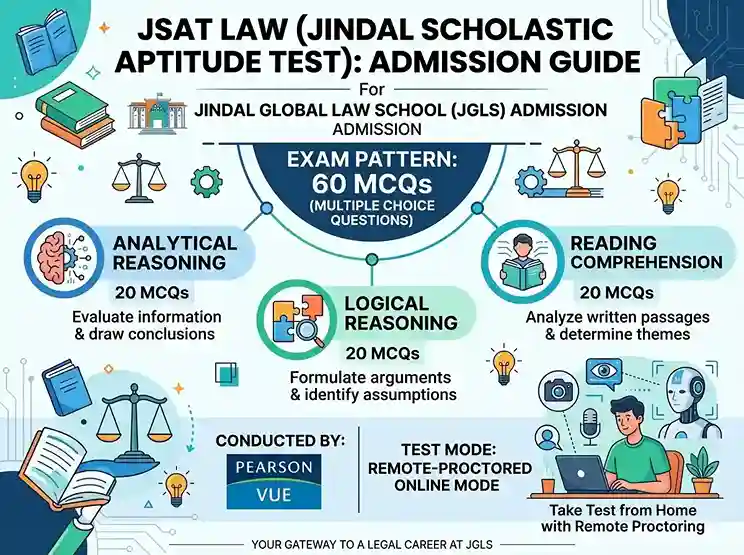
The JSAT Law exam is designed to assess aptitude for law study | not knowledge of law itself. No prior legal knowledge is required or tested. The exam has three equal sections of 20 questions each, covering Analytical Reasoning, Logical Reasoning, and Reading Comprehension. The total duration is 90 minutes for 60 MCQs, giving an average of 90 seconds per question.
| Section | No. of Questions | Marks | Weightage | Skill Tested |
|---|---|---|---|---|
| Analytical Reasoning | 20 | 20 | 33.3% | Logical deduction, data sufficiency, arrangement problems, pattern analysis |
| Logical Reasoning | 20 | 20 | 33.3% | Argument evaluation, cause-effect, statement-conclusion, critical reasoning |
| Reading Comprehension | 20 | 20 | 33.3% | Passage inference, vocabulary in context, author's tone, main idea |
| TOTAL | 60 | 60 | 100% | | |
Unlike many competitive exams, JSAT Law does not allow candidates to return to skipped questions. Once you move past a question, it cannot be revisited. This makes time management and answering every question in sequence critically important. Since there is no negative marking, always select your best guess before proceeding | never leave a question blank.
6. JSAT Law Syllabus 2026 | Section-Wise Topics
The JSAT Law syllabus tests aptitude skills, not legal knowledge. Candidates do not need to study law books, the Indian Constitution, or legal principles for this exam. The three sections | Analytical Reasoning, Logical Reasoning, and Reading Comprehension | require structured thinking, clear reading, and the ability to work under time pressure. Below is the detailed section-wise syllabus.
Analytical Reasoning evaluates your ability to interpret information, identify relationships, and draw conclusions from structured data. This section is closest to what law schools call "legal problem-solving" | applying given rules to given facts.
Logical Reasoning tests the ability to critically evaluate arguments, identify flaws, and reason about cause and effect. This mirrors the kind of reasoning lawyers use when building or challenging legal arguments.
Reading Comprehension tests your ability to read dense, complex passages and extract meaning, identify the author's position, infer unstated conclusions, and understand vocabulary in context. Passages are typically 400–600 words and drawn from social sciences, humanities, law-adjacent topics, and editorial commentary.
7. How to Apply for JSAT Law 2026 | Step-by-Step Guide
The JSAT Law 2026 application is a two-part process: first, you complete the JGLS admissions portal registration; second, you book your exam slot through the Pearson VUE platform. Both steps must be completed before you can appear for the exam.
8. JGLS Admission Process After JSAT Law
Qualifying JSAT Law is not the final step | it is the first of three rounds in the JGLS admission process. The overall selection is holistic, considering academic performance, JSAT score, Statement of Purpose (SOP), and a faculty interview. Here is how the full process works:
| Round | Component | What is Evaluated | Weight in Selection |
|---|---|---|---|
| Round 1 | Application Screening | Academic records (Class 12 or graduation marks), Statement of Purpose (SOP), CV/extracurricular profile | Shortlisting gate |
| Round 2 | JSAT Law Exam + Faculty Interview | JSAT Law score (Analytical Reasoning, Logical Reasoning, RC) + structured interview with faculty assessing motivation, clarity of purpose, communication | Primary evaluation |
| Round 3 | Final Admission Offer | Combined assessment of academic performance, JSAT score, SOP quality, and interview performance | Final decision |
| Post-Offer | Fee Payment & Enrollment | Seat confirmation fee payment within the given deadline; document verification; college reporting | Seat confirmation |
Candidates who already hold valid scores in SAT (1100+), ACT, LSAT-India, or CLAT may apply through those scores and skip the JSAT Law test. They are called directly for the faculty interview. If you have already taken CLAT or LSAT-India, check whether your score qualifies you for the direct interview route before registering for JSAT Law.
9. How to Prepare for JSAT Law 2026 | Section-Wise Strategy
JSAT Law preparation is fundamentally different from CLAT preparation. You need no knowledge of law | instead, focus entirely on building three core aptitude skills: analytical pattern recognition, argument evaluation, and fast passage reading. Here is a section-wise strategy used by successful JGLS admits:
9.1 Analytical Reasoning | Build Systematic Diagramming
Analytical Reasoning in JSAT Law tests your ability to apply a set of given constraints to a problem (seating arrangements, scheduling, ordering). The key skill is speed plus accuracy in constraint satisfaction. Practise 5 analytical reasoning games daily from LSAT PrepTest books (available on Amazon or 7Sage). Focus on: (a) identifying the setup type in 10 seconds, (b) drawing the base diagram before reading questions, (c) working rule deductions before the first question.
9.2 Logical Reasoning | Master Argument Structure
For Logical Reasoning, the best preparation resources are GMAT Official Guide | Critical Reasoning and CLAT previous year logical reasoning passages. The key concept is argument anatomy: every argument has premises (evidence) and a conclusion. Questions ask you to find what the argument assumes, what would strengthen it, what would weaken it, or what must be true if the premises are correct. Practice identifying all four elements in every argument you encounter | in textbooks, newspapers, and online articles.
9.3 Reading Comprehension | Speed + Inference
JSAT Law's RC section rewards candidates who read quickly and infer accurately. Build a daily reading habit: one 600-word passage from The Economist or a LSAT PrepTest RC section. For each passage, answer: What is the author's main argument? What evidence supports it? What does the author imply but not state? This three-question framework mirrors 70% of RC questions in JSAT Law.
9.4 Recommended Resources
| Resource | Section | Publisher/Platform |
|---|---|---|
| LSAT PrepTest Series (10 Actual Tests) | Analytical + Logical Reasoning | LSAC Official (Amazon) |
| GMAT Official Guide | Critical Reasoning | Logical Reasoning | GMAC Official |
| LSAT Reading Comprehension Strategy Guide | Reading Comprehension | Manhattan Prep |
| The Economist Weekly Editions | Reading Comprehension | The Economist (online) |
| CLAT Previous Year Papers (2020–2026) | Logical + Analytical | LawGuru India (Free PDF) |
| Verbal Reasoning by R.S. Aggarwal | Logical Reasoning (basics) | S. Chand Publications |
10. What is a Good JSAT Law Score? Cutoff & Benchmarks
JGLS does not publicly release official cutoff scores for JSAT Law. However, based on admission patterns and feedback from successful JGLS admits, the following benchmarks give a reliable indication of where your score stands:
* Benchmarks are estimates based on reported admission data from JGLS admits. Final admission depends on the holistic assessment including SOP, academics, and interview performance.
11. JSAT Law vs CLAT vs LNAT | Detailed Comparison
Law aspirants in India often need to choose which combination of entrance exams to appear for. Here is a direct, honest comparison of JSAT Law against CLAT (for NLUs) and LNAT (for JGLS 5-year LLB) | the three exams most relevant to candidates considering Jindal Global Law School.
| Aspect | JSAT Law 2026 | CLAT 2027 | LNAT (JGLS) |
|---|---|---|---|
| Conducting Body | Pearson VUE (for JGU) | Consortium of NLUs | LNAT Consortium (UK) |
| Level | University (JGLS only) | National (27 NLUs) | University (JGLS 5-yr LLB) |
| Programmes Covered | BA Legal Studies, BA Crim, BA AI&Law, 3-yr LLB, LLM | 5-Year LLB (NLUs) | 5-Year BA/BBA LLB (JGLS only) |
| Questions | 60 MCQs | 120 MCQs (passage-based) | 42 MCQs + Essay (Essay not scored at JGLS) |
| Duration | 90 minutes | 120 minutes | 2 hrs 15 min (95 min MCQ) |
| Mode | Online (Home) ✓ | Offline (Pen & Paper) | Offline (Test Centre) |
| Negative Marking | No ✓ | Yes (−0.25) | Yes (−0.25) |
| Legal Knowledge Required? | No | Pure Aptitude | Yes (Legal Reasoning passages) | No | Reading & Reasoning |
| Retakes | 3 Attempts ✓ | 1 Attempt only | Twice per year |
| Result Time | 48 Hours ✓ | ~2 Weeks | ~3 Weeks |
| Application Fee | ~₹1,000 | ₹4,000 (Gen) | ~£50 + logistics |
| Exam Date Flexibility | Choose your own date ✓ | Fixed (December) | Fixed windows |
| Interview After Test? | Yes | Faculty Interview | No | Merit only | Yes | Faculty Review |
Yes | if you are targeting a law career and are open to both NLUs and private top-tier institutions like JGLS, appearing for both CLAT and JSAT Law maximises your options. CLAT gives you access to 27 NLUs; JSAT Law gives you access to JGLS's specialised programmes (especially BA AI & Law and BA Criminology, which NLUs do not offer). The preparation overlap is significant | CLAT's Logical Reasoning and English Language sections directly support JSAT Law preparation.
12. About Jindal Global Law School (JGLS) | India's Top Private Law School
Jindal Global Law School (JGLS) is part of O.P. Jindal Global University (JGU), a UGC-recognised deemed university established in 2009 in Sonipat, Haryana | approximately 28 km from Delhi. It is consistently ranked among the top 10 law schools in India and is the first Indian law school to receive international accreditation from the QS World University Rankings.
JGLS distinguishes itself from government NLUs through its global curriculum, international faculty (many with degrees from Harvard, Oxford, and Yale), strong industry connections, mandatory internship programmes, and a campus that closely resembles an international law school environment. Its moot court programme, law review publications, and placement record in top law firms and global organisations have made it the preferred choice for students who do not secure NLU admission but seek a rigorous legal education.
| Programme at JGLS | Duration | Entrance Accepted | Annual Fee (Approx.) |
|---|---|---|---|
| BA LLB (Hons) | 5 Years | LNAT / LSAT-India | ₹5.70–6.25 Lakh/year |
| BBA LLB (Hons) | 5 Years | LNAT / LSAT-India | ₹5.70–6.25 Lakh/year |
| BCom LLB (Hons) | 5 Years | LNAT / LSAT-India | ₹5.70–6.25 Lakh/year |
| BA Legal Studies | 3 Years | JSAT Law ✓ | ~₹3.50 Lakh/year |
| BA Criminology & Criminal Justice | 3 Years | JSAT Law ✓ | ~₹3.50 Lakh/year |
| BA in AI and Law | 3 Years | JSAT Law ✓ | ~₹3.50 Lakh/year |
| 3-Year LLB | 3 Years | JSAT Law / CLAT ✓ | ~₹3.80 Lakh/year |
| LLM (Master of Laws) | 1 Year | JSAT Law / CLAT-PG / CUET-PG ✓ | ₹8.56 Lakh (total) |