Career Guide | Indian Judiciary 2026Judicial Service Exam | District to Supreme CourtUpdated: May 2026
How to Become a Judge in India 2026 | Eligibility, Exam, Salary, Types & Career Path
A judgeship is among the most respected and impactful careers in India's legal system. From Civil Judge to Chief Justice of India — this complete guide covers every step, every exam, every salary figure, and every career milestone you need to know about becoming a judge in India in 2026.
LLB
Minimum Qualification
3
Exam Stages (Pre + Mains + Interview)
₹1.08L
Civil Judge Starting Salary
₹2.5L
HC Judge Monthly (Fixed)
62/65
HC/SC Retirement Age
📅 Updated: May 27, 2026 | Judge Career Guide — India 2026
✍️ By Priya Sharma, LLM NALSAR | Senior Law Education Editor
🔍 Sources: 7th Pay Commission, Supreme Court of India, State PSC Notifications
How to Become a Judge in India 2026 | Career Path from Civil Judge to Chief Justice | LawGuru India
⚡ Quick Answer: How to Become a Judge in India
To become a judge in India, complete an LLB degree from a BCI-recognised college, enrol with the State Bar Council as an advocate, then clear the State Judicial Service Examination — a 3-stage process: Preliminary (objective MCQs) → Mains (descriptive law papers) → Interview (before the High Court). Entry-level appointment is as Civil Judge (Junior Division) or Judicial Magistrate First Class. Salary starts at ₹77,840/month and rises to ₹2,50,000/month for High Court judges. For District Judge by direct recruitment, 7 years of advocacy experience is required under Article 233(2) of the Constitution.
📜 LLB + Bar Council Enrolment📋 3-Stage Judicial Service Exam💰 Salary: ₹77,840–₹2,80,000/month⏱ Retirement: HC 62 yrs | SC 65 yrs
1. Types of Judges in India | The Judicial Hierarchy Explained
India's judiciary is a unified hierarchical structure with the Supreme Court at the apex and subordinate courts spread across all 28 states and 8 Union Territories. Understanding the hierarchy is the first step in planning your judicial career — because each level has different entry routes, eligibility rules, and appointment authorities.
Civil Judge (Junior Division) / Judicial Magistrate First Class (JMFC) Entry Level
Via Judicial Service Exam (State PSC)LLB + Bar EnrolmentAge: 21–35 yrs (General)
This is the starting point of a judicial career for most law graduates. Civil Judges (Junior Division) handle civil suits up to a pecuniary limit set by each state (typically ₹3–₹5 lakh in original jurisdiction). Judicial Magistrate First Class (JMFC) handles criminal cases under the Code of Criminal Procedure (CrPC), including trials for offences punishable up to 7 years. Entry is exclusively through the State Judicial Service Examination — a three-stage competitive process.
Promotion from Junior Division3–5 Years Service Typically RequiredDepartmental Exam + ACR
Civil Judge (Senior Division) exercises unlimited pecuniary jurisdiction in civil matters at the district level and can try matrimonial cases, probate, and insolvency matters. The Chief Judicial Magistrate (CJM) is the head of the criminal judicial administration at the district level under the CJM's court. Promotion from Junior to Senior Division is based on merit, seniority, and departmental exam performance — typically within 3–6 years of joining.
District & Sessions Judge District Head
Promotion from Senior Division OR Direct (7 yrs advocacy)Article 233 — Appointed by Governor + HC ConsultationHighest District Court
The District & Sessions Judge (DSJ) is the most senior judicial officer at the district level — heading both the civil (District Judge) and criminal (Sessions Judge) sides of the district court. A DSJ has the power to try the most serious criminal cases including those punishable with life imprisonment and death sentence. Appointment is by the Governor in consultation with the High Court. Entry is either by promotion from the State Judicial Service or by direct recruitment requiring 7 years of advocacy experience as mandated by Article 233(2) of the Constitution.
High Court Judge Constitutional Court
Collegium RecommendationArticle 217 — Appointed by PresidentRetirement: 62 Years
High Court judges are Constitutional court judges appointed under Article 217 by the President of India, after consultation with the Chief Justice of India, the Chief Justice of the High Court, and the Governor of the concerned state. There is no competitive exam for HC appointment. The Collegium — comprising the CJI and senior-most Supreme Court judges — recommends names from: (a) district judges with 5+ years of service, (b) advocates with 10+ years of High Court practice. India has 25 High Courts with approximately 1,100 sanctioned judge positions.
Supreme Court Judge / Chief Justice of India Apex Court
Collegium System — Article 124Appointed by PresidentRetirement: 65 Years
Supreme Court judges are the most senior judicial officers in India, appointed by the President under Article 124(2) on the recommendation of the Supreme Court Collegium. Eligibility requires being a High Court judge for at least 5 years, or being an advocate in a High Court for at least 10 years, or being a distinguished jurist in the President's opinion. The Supreme Court has a sanctioned strength of 34 judges (including the Chief Justice). There is no separate exam — appointment is purely through the Collegium recommendation process, which evaluates judicial record, integrity, seniority, and merit.
2. Eligibility to Become a Judge in India 2026
Eligibility requirements differ significantly across judicial levels. The table below covers the Judicial Service Exam route — the primary competitive path for entry-level and district judge positions:
Eligibility Criterion
Civil Judge Jr. Division
District Judge (Direct)
High Court Judge
Minimum Qualification
LLB (5-yr or 3-yr) from BCI-recognised institution
LLB from BCI-recognised institution
HC advocate for 10 yrs or HC/District Judge for 5 yrs
The Supreme Court of India struck down the Bar Council of India's age limit for LLB admission — so there is no age restriction on obtaining an LLB degree. However, state judicial service exams have their own age limits for appearing in the competitive examination itself. Maximum age limits vary significantly: UPPCS-J allows up to 35 years for General, while Rajasthan allows 40 years. Always check the specific notification for your target state. SC/ST/OBC candidates typically get 3–5 years of age relaxation above the General limit.
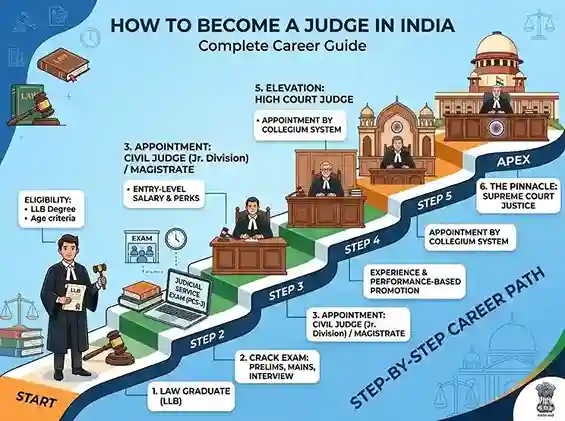
3. How to Become a Judge in India — Step-by-Step Path
The path from law student to judge in India follows a structured progression. Here is the complete roadmap — from choosing your LLB college to receiving your appointment order:
1
Complete Your LLB Degree from a BCI-Recognised College
The foundational requirement for any judicial career in India is an LLB degree — either the 5-year integrated BA LLB (after Class 12) or the 3-year LLB (after graduation in any stream). The college must be recognised by the Bar Council of India (BCI) under the Advocates Act, 1961. Many states prefer or require a first division (55–60%) in LLB for the judicial service exam. Target a NIRF-ranked law school — the quality of legal education and faculty significantly impacts your judicial exam preparation. Top choices: NLSIU Bangalore (CLAT), NLU Delhi (AILET), NALSAR Hyderabad (CLAT).
2
Enrol with the State Bar Council as an Advocate
After obtaining your LLB degree, enrol with the Bar Council of your state (e.g., Bar Council of Uttar Pradesh, Bar Council of Delhi, Bar Council of Maharashtra). Submit the prescribed application form, LLB degree certificate, photographs, ID proof, and the enrolment fee (typically ₹750–₹3,000). You will receive a Certificate of Enrolment and an Advocate ID. This enrolment is a mandatory prerequisite for appearing in the Judicial Service Examination in most states. The process takes 30–90 days. While awaiting enrolment, begin your judicial exam preparation.
3
Practise at the Bar (Build Advocacy Experience)
For Civil Judge (Junior Division) entry, you only need Bar Council enrolment — no minimum advocacy years are required. However, building actual courtroom experience is invaluable: it strengthens your understanding of procedure, improves your Mains exam answers, and prepares you for the viva voce. For District Judge by direct recruitment, Article 233(2) of the Constitution mandates 7 years of advocacy at the Bar — measured from the date of enrolment. Use your years of advocacy to prepare for judicial exams simultaneously.
4
Apply for the State Judicial Service Examination
Monitor the official websites of your state's Public Service Commission (PSC) and the High Court for annual notifications. Key states release notifications: UPPSC for UPPCS-J (Uttar Pradesh), Delhi High Court for Delhi Judicial Services, Rajasthan PSC for Rajasthan Judicial Service, Maharashtra PSC for Maharashtra Civil Judicial Service, etc. Submit the online application form with all required documents — LLB certificate, Bar Council enrolment certificate, graduation certificate, category certificate, and photographs — within the notification window.
5
Clear the Preliminary Examination
The Preliminary exam is an objective MCQ test (150–200 questions, 2–3 hours). It tests legal knowledge across IPC, CrPC, CPC, Evidence Act, and basic GK. Only the top candidates — typically 10–15 times the number of vacancies — are shortlisted for the Mains. The Preliminary score is generally not counted in the final merit list — it is purely a screening filter. Strategy: attempt all questions, focus on accuracy in Law sections (IPC + CrPC + CPC carries highest weight), and do not spend excessive time on GK.
6
Clear the Mains Examination (The Core Selection Stage)
The Mains is the most critical stage — descriptive papers testing deep legal knowledge. Typically 4–5 papers of 3 hours each, covering: IPC & Cr.PC, CPC & Limitation Act, Evidence Act, Constitution of India, and Transfer of Property Act + Contract Act. Some states include a language paper (Hindi/English). Mains scores carry the highest weightage in the final merit list. Answers must demonstrate legal reasoning, correct citation of sections, and structured analytical writing — not just rote reproduction of law text. One paper in most states also covers an essay and a legal translation/drafting exercise.
7
Clear the Interview / Viva Voce
Candidates who clear Mains are called for the Viva Voce before a panel of the High Court judges (typically 3–5 judges). The interview carries 100 marks in most states. The panel assesses: (a) depth of legal knowledge and application, (b) communication skills and clarity of expression, (c) judicial temperament — composure, objectivity, fairness, (d) general awareness and current legal developments, and (e) personality and character. Preparation: practise structured verbal answers to legal problem questions, stay updated on recent Supreme Court judgments, and maintain poise under questioning.
8
Medical Examination, Police Verification & Appointment
Selected candidates undergo a medical fitness examination prescribed by the state government. Simultaneously, police verification of character and antecedents is conducted. After clearance, appointment letters are issued and candidates are allocated to their initial posting — typically as Civil Judge (Junior Division) or JMFC at a sub-divisional court. Most states require new judicial officers to undergo a 6-month training program at the State Judicial Academy before independent charge.
4. Judicial Service Exam Pattern 2026 | All Three Stages
While each state conducts its own exam, the three-stage structure — Preliminary, Mains, and Interview — is standard across India. Below is the generalised pattern, with UPPCS-J (the largest and most competitive) used as the primary reference:
Typically: 150–200 MCQs | 2–2.5 hours | 150–200 marks | Shortlisting only (score not in final merit)
The Preliminary exam is a pure screening test. Questions are objective (MCQ) type covering core law subjects (IPC, CrPC, CPC, Evidence, Constitution) plus GK. UPPCS-J Preliminary: 150 questions, 150 marks, 2 hours, negative marking (−0.33 per wrong). Only the top 3,000–5,000 candidates (for typical 300–600 vacancies) are shortlisted for Mains. Preliminary marks are not added to the final merit — it is purely a filter. Focus on accuracy over speed, especially in the law sections.
Typically: 4–6 papers | 3 hours each | 400–700 total marks | Most critical stage — counts in final merit
Mains is the heart of the judicial service exam — it determines who gets selected. Papers are descriptive, requiring structured written answers, legal analysis, and proper citation of sections and case names. Standard Mains paper structure (UPPCS-J example): Paper I — General Knowledge + Hindi/English (100 marks each); Paper II — Law of Evidence + CPC + Limitation Act (200 marks); Paper III — IPC + CrPC (200 marks); Paper IV — Constitution + Transfer of Property + Contract (200 marks). Each paper is 3 hours. The written Mains carries approximately 70–80% weight in the final merit list.
High Court Panel | 100 marks | 20–30 minutes per candidate | Career-defining stage
The Viva Voce is conducted by a High Court judges' panel — typically 3 sitting HC judges. It tests legal problem-solving verbally (the panel reads a short factual scenario and asks how you'd rule and why), current awareness of Supreme Court judgments and legislation, general personality, composure, and integrity. The interview carries 100 marks in the final merit in most states. Even strong Mains performers can be overtaken in the final list by candidates who excel at the Viva. Preparation: practise answering legal problems out loud, revise recent landmark judgments, and build confident but respectful communication style.
Parameter
Preliminary
Mains
Interview
Question Type
MCQ (Objective)
Descriptive (Essay + Problem)
Oral / Verbal
Duration
2–2.5 hours
3 hours per paper (4–6 papers)
20–30 min/candidate
Total Marks
150–200
400–700
100
Counted in Final Merit?
No — screening only
Yes — 70–80% weight
Yes — 10–15% weight
Negative Marking
Yes (−0.25 to −0.33)
No
N/A
Language
English + Hindi/Regional
English + Hindi/Regional
English + Hindi/Regional
5. Judicial Service Exam Syllabus 2026 | Subject-Wise Breakdown
The judicial service exam syllabus is law-heavy — unlike CLAT (which tests legal reasoning) or UPSC Civil Services (which tests a wide generalist syllabus). You must develop deep, application-level mastery of specific core law subjects. Here is the standard syllabus across Indian states:
⚖️ Criminal Law — IPC & CrPC High Weight
Indian Penal Code, 1860 — all chapters, offences, exceptions, and sentencing provisions (now Bharatiya Nyaya Sanhita, 2023 — BNS)
🌍 General Knowledge & Language Papers Prelims + Mains
Current affairs — national and international events, recent legislation, Supreme Court landmark judgments of the year
Indian history — ancient, medieval, modern, and freedom struggle
Indian geography, economy, environment, and science
General Hindi / Regional Language — comprehension, translation, drafting (legal correspondence, judgment summary)
General English — comprehension, précis writing, grammar, essay, legal drafting (pleadings, applications)
New Criminal Laws (2023): BNS, BNSS, BSA — replacing IPC, CrPC, Evidence Act from July 1, 2024
⚠️ Critical 2024–2026 Update: New Criminal Laws in Effect
From July 1, 2024, India's three principal criminal laws were replaced: IPC → Bharatiya Nyaya Sanhita (BNS) 2023; CrPC → Bharatiya Nagarik Suraksha Sanhita (BNSS) 2023; Indian Evidence Act → Bharatiya Sakshya Adhiniyam (BSA) 2023. All Judicial Service Exams from 2025 onwards will test candidates on the new laws. Section numbers have changed significantly. Ensure your study material is updated for BNS/BNSS/BSA — do not rely on older books that reference only IPC/CrPC/Evidence Act numbering.
6. State-Wise Judicial Service Exams 2026 | Key Notifications
Every state in India has its own judicial service exam for entry-level Civil Judge / JMFC recruitment. Here are the major exams with their conducting authorities and key details for 2026:
State / UT
Exam Name
Conducting Body
Approx. Vacancies (2025–26)
Max Age (Gen)
Uttar Pradesh
UP PCS-J (Civil Judge Jr. Div.)
UP PSC (UPPSC)
610 (2025)
35 years
Rajasthan
Rajasthan Judicial Service
Rajasthan PSC (RPSC)
280 (2024–25)
40 years
Delhi
Delhi Judicial Service Exam
Delhi High Court
76 (2025)
32 years
Maharashtra
Maharashtra Civil Judicial Service
Maharashtra PSC (MPSC)
200+ (2025)
45 years
Madhya Pradesh
MP Judicial Service Exam
MP High Court
138 (2024–25)
35 years
Bihar
Bihar Judicial Service Exam
Patna HC / BPSC
180+ (2025)
35 years
Gujarat
Gujarat Civil Service (Judicial)
Gujarat PSC (GPSC)
145 (2025)
35 years
Haryana
Haryana Civil Service (Judicial Branch)
HPSC
75 (2025)
42 years
Karnataka
Karnataka Judicial Service Exam
Karnataka PSC (KPSC)
160 (2025)
35 years
Tamil Nadu
Tamil Nadu Judicial Service Exam
Tamil Nadu PSC (TNPSC)
120 (2025)
35 years
📌 How to Track Judicial Service Notifications
Judicial service exam notifications are published on: (1) the State Public Service Commission's official website, (2) the High Court's official website, (3) the state government's gazette. No central portal aggregates all state notifications. Bookmark your state PSC website and set up Google Alerts for "[State Name] Judicial Service 2026 notification" to never miss a window. Most notifications are published between October and March each year for exams held between April and September.
7. Judge Salary in India 2026 | Level-Wise Complete Salary Structure
Judge salaries in India are governed by the 7th Pay Commission recommendations for subordinate judiciary (revised in 2021 by the Supreme Court in All India Judges' Association case) and separate statutory provisions for High Court and Supreme Court judges. Here is the complete salary structure at every level:
Bungalow/official residence, staff car, full pension
High Court Judge
₹2,50,000 (Fixed by statute — HC Judges Act)
₹2,50,000 + allowances
Full official residence, official car + driver, full medical, pension ₹1,25,000/month
Chief Justice of High Court
₹2,50,000 (Fixed — same as HC Judge)
₹2,50,000 + additional allowances
Larger official residence, additional staff, enhanced pension
Supreme Court Judge
₹2,50,000 (Fixed — SC Judges Act, 1958)
₹2,50,000 + full official perquisites
Official residence in Lutyens' Delhi, official car, full medical, pension ₹1,50,000/month
Chief Justice of India
₹2,80,000 (Fixed — SC Judges Act)
₹2,80,000 + highest perquisites
Official residence (Type VIII bungalow), official car, unlimited medical, pension ₹1,68,000/month post-retirement
💰 Beyond Salary — Complete Compensation Picture for Judges
The stated salary figures understate the true compensation. Judges also receive: official government accommodation (eliminating the largest urban living expense), sumptuary allowance (for official entertainment), travel allowance for court visits and conferences, free medical treatment for self and dependants at government hospitals, a court library subscription, staff (peon, orderly, clerk), and on retirement: a pension equivalent to 50% of last salary + gratuity + retained residence for a period. The effective total compensation including perquisites is 2–3x the stated cash salary.
8. High Court & Supreme Court Judge Appointment | The Collegium System
The pathway to becoming a High Court or Supreme Court judge is fundamentally different from the Judicial Service Exam route — there is no competitive examination. Appointment is through the Collegium System, a convention developed through three landmark Supreme Court judgments.
⚖️ High Court Judge Appointment (Article 217)
Who recommends: The Collegium of the Supreme Court (CJI + 4 senior-most judges) in consultation with the HC Chief Justice
Who appoints: President of India, after mandatory consultation with CJI, Governor, and HC Chief Justice
Eligibility path 1: Advocate for 10+ years in a High Court
Eligibility path 2: District/Sessions Judge or subordinate judge for 5+ years
No competitive exam: Selection is based on the advocate's/judge's legal reputation, judgments, character, and Collegium's assessment
Service: Holds office until age 62; transfers between HCs possible
Salary: ₹2,50,000/month fixed + full official perquisites
🏛 Supreme Court Judge Appointment (Article 124)
Who recommends: The Supreme Court Collegium (CJI + 4 senior-most SC judges); HC Collegium for initial lists
Who appoints: President of India, after mandatory consultation with the SC Collegium
Eligibility path 1: HC judge for 5+ years
Eligibility path 2: Advocate for 10+ years in a High Court
Eligibility path 3: "Distinguished jurist" in the President's opinion (rarely used)
Sanctioned strength: 34 judges including the Chief Justice
Service: Holds office until age 65; cannot practise in any court post-retirement (no return to bar)
The Collegium system evolved through three Supreme Court cases — SP Gupta v. Union of India (1981, First Judges case), Supreme Court Advocates-on-Record Association v. Union of India (1993, Second Judges case), and the Third Judges case (Presidential Reference, 1998). In the Second Judges case, the Supreme Court held that the CJI's opinion — which is the Collegium's — must be given primacy in judicial appointments, effectively transferring the predominant role in HC and SC judge appointments from the Executive to the Judiciary.
9. Judicial Service Exam Preparation Strategy 2026
The judicial service exam is one of the most rigorous competitive examinations in India — comparable to UPSC in terms of commitment required. Most successful candidates spend 12–24 months in structured preparation. Here is the proven strategy framework:
📚 Step 1 — Master Your Foundation Texts (Bare Acts First)
Unlike UPSC where textbooks dominate, judicial exams are won by deep knowledge of bare acts. Read and re-read: IPC (now BNS 2023), CrPC (now BNSS 2023), Indian Evidence Act (now BSA 2023), CPC, Limitation Act, Transfer of Property Act, Contract Act, and the Constitution of India. Do not just read — annotate with section numbers, exceptions, provisos, and key case names. Every section you can cite verbatim in a Mains answer is worth marks. Use bare acts with commentary (MP Jain for Constitution, Ratanlal & Dhirajlal for IPC, Mulla for CPC) — not digest-style books.
📰 Step 2 — Daily Current Affairs (1 Hour Minimum)
Legal current affairs matter enormously for both Preliminary GK and Mains essay questions. Follow: (a) Supreme Court of India website — daily cause list and judgment summaries, (b) The Hindu law beat and editorial, (c) Bar & Bench / Live Law for landmark HC and SC judgments, (d) PRS India for legislative developments. Maintain a running current affairs register with: event → legal issue → relevant section/article → SC position. This register is invaluable for Mains essay questions and Viva voce. Pay special attention to constitutional amendment cases, criminal law reform updates, and new legislation (BNS, BNSS, BSA, DPDP Act, etc.).
✍️ Step 3 — Daily Answer Writing Practice (Non-Negotiable for Mains)
The biggest mistake judicial service aspirants make is studying hard but writing poorly in the exam. Mains answers require: proper legal structure (IRAC — Issue, Rule, Application, Conclusion), correct section citation, relevant case names, and clean handwriting (examiners penalise illegibility). Practice writing: 2 long-form answers (10–15 marks each) and 2 short-form answers (5 marks each) every day — totalling approximately 45–60 minutes of daily writing practice. Use past-year question papers for practice questions. Get your answers evaluated — ideally by a mentor or judicial coaching faculty.
📝 Step 4 — Solve Previous Year Papers (2015–2025 for Your State)
Previous year question papers for your target state's judicial exam are the single most valuable preparation resource. They reveal: which sections/topics are repeatedly tested, the examiner's preferred question styles, the difficulty level of the Preliminary vs Mains, and specific GK patterns. Solve at least 10 years of Preliminary papers under timed conditions. For Mains, write out full model answers to at least 5 years of past papers. Notice that the same legal issues — bail jurisprudence, property disputes, evidence rules, constitutional review — recur with variations. Mastering these recurring areas yields disproportionate marks.
The Viva carries 100 marks — enough to change your rank by 30–50 positions. Three months before your expected interview date, begin: (a) practising verbal legal problem-solving (read a problem, formulate a structured answer in 60 seconds, deliver it clearly and confidently), (b) revising all landmark Supreme Court judgments from the past 2 years, (c) mock viva sessions — either with a senior advocate mentor or a judicial coaching centre that runs mock interview panels. Dress formally, make eye contact, correct yourself gracefully if you make an error, and never guess a section number — say "I don't recall the exact section number, but the principle is..." rather than citing wrong numbers.
🗓️ Step 6 — 12-Month Preparation Timeline
Months 1–3 (Foundation): Bare acts reading (BNS/BNSS/BSA + CPC + Constitution) + daily newspaper. Months 4–6 (Subject Depth): One subject per week in detail — CPC, Transfer of Property, Contract Act, Evidence; begin Preliminary MCQ practice. Months 7–9 (Integration): Full Preliminary mock tests every weekend; daily Mains answer writing (2 answers/day). Months 10–12 (Final Push): Mains full mock papers, previous year Mains answers, Viva preparation, current affairs consolidation. Apply for the exam notification — typically released 3–4 months before the exam date.
📚 Best Books for Judicial Service Exam 2026
Constitution of India: M.P. Jain — Indian Constitutional Law (7th Ed.) | V.N. Shukla's Constitution of India | D.D. Basu's Shorter Constitution
BNS / IPC: Ratanlal & Dhirajlal — The Indian Penal Code (latest edition with BNS 2023 updates) | PSA Pillai's Criminal Law
BNSS / CrPC: R.V. Kelkar — Lectures on Criminal Procedure | Sarkar's Code of Criminal Procedure (latest with BNSS 2023)
CPC: Mulla's Code of Civil Procedure | C.K. Takwani — Civil Procedure with Limitation Act
Evidence: Batuk Lal — The Law of Evidence | Avtar Singh — Principles of the Law of Evidence (updated for BSA 2023)
Transfer of Property: Mulla's Transfer of Property Act | Dr. G.P. Tripathi — Transfer of Property Act
GK & Current Affairs: The Hindu daily + Live Law / Bar & Bench weekly digest + Supreme Court yearly judgment compilations
10. How to Become a Judge in India — FAQs
How to become a judge in India?
+
To become a judge in India: (1) complete an LLB degree (5-year BA LLB or 3-year LLB after graduation) from a BCI-recognised law college, (2) enrol as an Advocate with your State Bar Council, (3) appear for and clear the State Judicial Service Examination — Preliminary (MCQ screening) → Mains (descriptive law papers) → Interview (before HC judges panel), (4) clear the medical examination and police verification, and (5) receive appointment as Civil Judge (Junior Division) or Judicial Magistrate First Class. For High Court and Supreme Court judges, appointment is through the Collegium system — no competitive exam required.
What is the salary of a judge in India in 2026?
+
Judge salaries in India as of 2026: Civil Judge (Junior Division): ₹77,840–₹1,36,520/month; Civil Judge (Senior Division): ₹1,08,000–₹1,58,400/month; District & Sessions Judge: ₹1,44,840–₹2,17,860/month; High Court Judge: ₹2,50,000/month (fixed by statute); Supreme Court Judge: ₹2,50,000/month; Chief Justice of India: ₹2,80,000/month. All levels also receive official residence, car, medical coverage, and pension. Gross effective compensation is 2–3x the stated salary when perquisites are included.
What subjects are in the judicial service exam?
+
The Judicial Service Examination tests: Criminal Law — BNS 2023 (earlier IPC) and BNSS 2023 (earlier CrPC); Civil Law — CPC, Limitation Act, Transfer of Property Act, Contract Act, Specific Relief Act; Evidence Law — Bharatiya Sakshya Adhiniyam 2023 (earlier Indian Evidence Act); Constitutional Law — Constitution of India (all parts), fundamental rights, judicial review, constitutional amendments; General Knowledge — current affairs, legal developments, landmark judgments; Language Papers — Hindi/regional language and English (comprehension, drafting, translation). Note: BNS, BNSS, and BSA replaced IPC, CrPC, and Evidence Act from July 1, 2024 — all exams from 2025 onwards test the new laws.
What is the age limit to become a judge in India?
+
The age limit for judicial service exams varies by state. For Civil Judge (Junior Division): minimum age 21 years; maximum age typically 35 years (General) in states like UP, Delhi, Gujarat, Karnataka; up to 40–45 years in states like Rajasthan and Maharashtra. Reserved categories (SC/ST/OBC/PwD) get 3–5 years of age relaxation above the General limit. For High Court and Supreme Court judges, there is no prescribed maximum age for appointment — they retire at 62 (HC) and 65 (SC) years respectively. Always check the specific notification for your target state since age limits vary significantly.
How long does it take to become a judge in India?
+
The minimum time to become a judge (Civil Judge Junior Division) from Class 12 is approximately 7–9 years: 5 years for BA LLB + 1–2 years of Bar Council enrolment + judicial exam preparation and selection process (typically 1–3 attempts spanning 1–3 years). Candidates who clear the judicial service exam on their first attempt within a year of LLB can achieve this in 6–7 years. For District Judge by direct recruitment, 7 years of advocacy experience must be added post-LLB, making the minimum 12–14 years from Class 12. High Court and Supreme Court judgeships typically come after 20–35 years of distinguished legal career.
Can a commerce or science graduate become a judge?
+
Yes. A commerce or science graduate can absolutely become a judge in India. The qualification requirement is an LLB degree — not necessarily from a law-only undergraduate background. A B.Com or B.Sc graduate can pursue the 3-year LLB after graduation and then appear for the judicial service exam. In fact, many successful judges in India's district judiciary have backgrounds in commerce, science, and engineering before law. The judicial service exam tests legal knowledge — not your undergraduate stream. However, the 5-year BA LLB integrated programme (which requires choosing law from Class 12) is also a valid and often preferred route.
Is the judicial service exam harder than UPSC?
+
The judicial service exam and UPSC Civil Services are different in character. UPSC has a broader syllabus spanning 26+ GS subjects plus optional papers, requiring generalist depth. The judicial exam is narrower but demands exceptional depth in core law subjects — every section of IPC/BNS, CrPC/BNSS, CPC, Evidence Act, Constitution, Transfer of Property Act, and Contract Act must be memorised with case-law. UPSC has a 0.1% selection rate; large state judicial exams like UPPCS-J have a 2–5% selection rate from among law graduates. Both require 12–24 months of serious preparation. For candidates with strong legal aptitude and writing skills, the judicial exam may be more accessible; for those with a diverse academic interest, UPSC may suit better.
LLM from NALSAR University of Law, Hyderabad. 8+ years covering judicial career paths, law exam preparation, and NLU admissions across India. Salary data sourced from 7th Pay Commission recommendations, Supreme Court of India All India Judges' Association case (2021), and State PSC official notifications. Last updated: May 27, 2026.
Aspiring to Be a Judge? Start with the Right Law Degree.
A career on the bench begins with the right law school. Use LawGuru India's free resources to find your ideal law college, crack CLAT 2027, and chart your judicial career path.