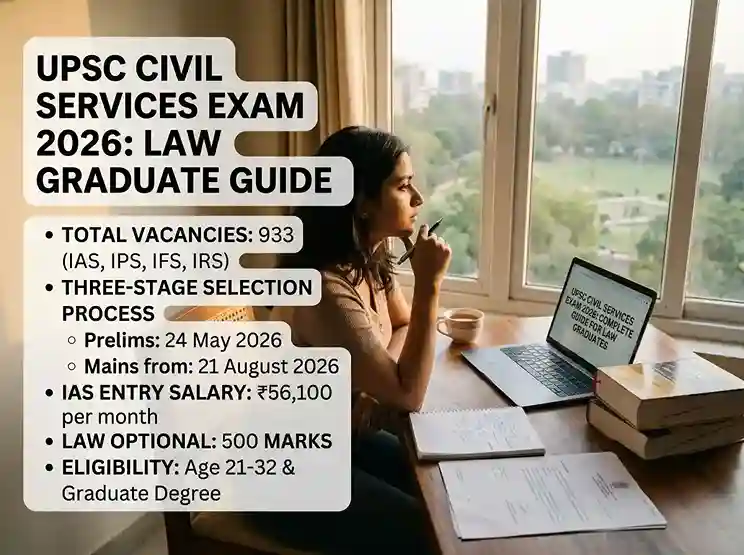
UPSC CSE 2026 | 933 VacanciesPrelims: 24 May 2026 | Mains: 21 Aug 2026IAS | IPS | IFS | IRS | Group A & B Services
UPSC Civil Services Exam 2026 | Complete Guide: Eligibility, Syllabus, Pattern, Law Optional, Salary & Strategy for Law Graduates
The UPSC Civil Services Examination (CSE) 2026 | India's most prestigious competitive examination | has been notified for 933 vacancies across IAS, IPS, IFS, IRS, and other Group A and B services. This comprehensive guide is specifically tailored for law graduates and LLB students who want to understand the exam, leverage their legal education as a competitive advantage, and build a structured preparation strategy.
933
2026 Vacancies
3
Exam Stages
₹56.1K
IAS Entry Basic Pay/mo
500
Law Optional Marks
6
Attempts (General)
📅 Updated: May 29, 2026 | UPSC CSE 2026 | Active Exam Cycle
✍️ By Priya Kumari, LLM NALSAR | Senior Law Careers Editor
UPSC Civil Services Exam 2026 | Complete Guide for Law Graduates | Prelims 24 May 2026 | 933 Vacancies | Source: LawGuru India | Data: Official UPSC Notification 2026
⚡ Quick Answer: UPSC Civil Services 2026 at a Glance
The UPSC Civil Services Examination 2026 has been notified for 933 vacancies across IAS, IPS, IFS, IRS, and other Group A & B Central Services. Prelims: 24 May 2026. Mains: from 21 August 2026. The exam has 3 stages: Prelims (objective, screening) → Mains (9 descriptive papers, 1750 marks) → Personality Test (275 marks). Final merit = Mains + Interview (2025 total marks). Eligibility: Any graduate, age 21–32 (General), 6 attempts. Salary: All services start at ₹56,100/month basic (Level-10, 7th CPC). Law graduates can choose Law as optional subject (500 marks, 2 papers of 250 each) | a major strategic advantage.
🏛 IAS | IPS | IFS | IRS Included📅 Prelims: 24 May 2026💰 Entry Salary: ₹56,100/mo⚖️ Law Optional: 500 Marks
The Union Public Service Commission Civil Services Examination (UPSC CSE) | colloquially called the IAS exam | is India's most prestigious, competitive, and comprehensive national-level competitive examination. Conducted annually by the Union Public Service Commission (UPSC), it recruits candidates for Group A and Group B services of the Government of India, including the Indian Administrative Service (IAS), Indian Police Service (IPS), Indian Foreign Service (IFS), Indian Revenue Service (IRS), and over 20 other central government services.
For a law graduate, the UPSC Civil Services Examination represents an exceptional alternative career path | one that leverages the analytical, research, and constitutional knowledge developed during an LLB degree. Unlike the judicial service examination (which is state-specific and primarily for courtroom careers) or prosecution exams (which serve the criminal justice system), the civil services pathway opens India's entire administrative, diplomatic, and revenue machinery to law graduates.
The UPSC CSE 2026 notification was released on 4 February 2026, announcing 933 vacancies | a figure that includes 66 posts reserved for Persons with Benchmark Disability (PwBD). The Preliminary examination is scheduled for 24 May 2026, and the Mains examination from 21 August 2026. The final results of the complete selection process are typically declared approximately one year after the Prelims.
The UPSC CSE recruits for three categories of services: All India Services (AIS), Group A Central Services, and Group B Central Services. The service you are allocated depends on your final merit rank and your cadre/service preferences submitted before the Mains examination. Here is the comprehensive breakdown:
Indian Administrative Service (IAS) All India Service | Highest Prestige
The IAS is India's premier civil service | officers hold the highest administrative positions in districts, states, and central ministries. An IAS officer's career spans: Sub-Divisional Magistrate (SDM) → District Collector/Deputy Commissioner → Commissioner → Secretary to State Government → Joint Secretary/Additional Secretary in Central Ministries → Secretary to Government of India → Cabinet Secretary (the peak, basic pay ₹2,50,000/month). IAS officers are involved in policy formulation, implementation, land administration, disaster management, and public service delivery. For law graduates, the IAS role involves working on legislation, court cases filed against the government, regulatory compliance, and constitutional matters | making the legal training directly relevant. The IAS is the most coveted rank in UPSC, typically requiring a rank within the top 100–200 depending on the year's vacancies.
Indian Police Service (IPS) All India Service | Law Enforcement
IPS officers are responsible for maintaining law and order, leading police forces at state and national levels, and heading central police organisations (CBI, NIA, IB, RAW, NSG). Career progression: Assistant Superintendent of Police (ASP) → SP → DIG → IG → ADGP → DGP (state apex). Central deputation positions include DG of CBI, NIA Director, and IB Director. For law graduates, the IPS role directly interfaces with the legal system | arrest procedures, criminal investigations, trial processes, evidence gathering, and police-prosecution cooperation are daily realities. Law graduates who choose IPS find their NLU or law school training immediately relevant to their work.
Indian Foreign Service (IFS) Group A | Diplomacy & International Relations
Ministry of External AffairsAmbassador → High Commissioner LevelGlobal Postings | Language Training
IFS officers represent India in foreign countries through embassies, high commissions, and consulates, and handle international treaties, trade agreements, diplomatic protocols, and crisis management. Career path: Third Secretary → Second Secretary → First Secretary → Counsellor → Minister → Ambassador/High Commissioner. For law graduates with interest in international law, treaties, and foreign policy, the IFS is an ideal career alignment. International Law | the subject tested in UPSC Law Optional Paper 1 | is directly relevant to IFS work. IFS officers negotiate bilateral agreements, represent India in international courts, and work on extradition treaties, trade disputes, and consular matters.
Indian Revenue Service (IRS) Group A | Income Tax & Customs
IT (Income Tax) & IRS-C&IT (Customs)Ministry of FinanceBest Work-Life Balance Among Top Services
IRS officers serve in two sub-cadres: IRS (Income Tax) and IRS (Customs & Indirect Taxes). IT officers assess, investigate, and enforce direct tax law | conducting raids, processing assessments, and handling appellate matters. C&IT officers manage customs duties, GST enforcement, and anti-smuggling operations. For law graduates, IRS is an excellent fit | tax law knowledge, understanding of PMLA, FEMA, and economic offences, and the ability to interpret statutory provisions are daily requirements. IRS offers the best work-life balance among the top four services and strong post-retirement earning potential through private sector tax advisory.
Other Central Services | Group A & B 24 Services in Total
IAAS | IDAS | IRTS | IDAS | IPoS | ICLSAll at Pay Level 10 (₹56,100 entry)
Beyond the flagship four services, UPSC CSE fills 20+ other central services. Particularly relevant for law graduates: Indian Corporate Law Service (ICLS) | works under the Ministry of Corporate Affairs, enforces Companies Act, SEBI regulations, and insolvency law; ideal for NLU corporate law graduates. Indian Legal Service (ILS) is a separate service not recruited through UPSC CSE but through a separate UPSC exam | it involves drafting legislation, representing the Government of India in courts, and advising ministries. Other services: IRTS (Indian Railway Traffic Service), IDAS (Indian Defence Accounts Service), IAAS (Indian Audit and Accounts Service), all starting at Pay Level 10.
3. UPSC Civil Services 2026 Eligibility Criteria
Criterion
General / EWS
OBC
SC / ST
PwBD
Nationality
Indian citizen (for IAS/IPS/IFS | mandatory); certain PIOs/OCI eligible for other services
Educational Qualification
Graduate degree from a recognised university in any discipline. LLB fully qualifies. Final-year students can apply provisionally.
Must meet physical/medical standards as specified for each service. IPS has stricter physical requirements. Details in official notification.
📌 What Counts as an "Attempt"?
An attempt is counted the moment you appear in the Preliminary examination | even if you submit a blank answer sheet. If you apply but do not appear in Prelims, it does not count as an attempt. Withdrawal of the application after form submission but before appearing also does not count. Candidates who appear provisionally (in final year of graduation) | an attempt is counted even if the degree is not completed. Final-year students must submit proof of graduation before applying for the Mains examination.
The UPSC CSE selection process has three distinct stages. The Prelims acts as a screening gate; only those who clear Prelims can appear for Mains. The final merit list is prepared exclusively based on Mains (1750 marks) + Interview (275 marks) | the Prelims score does not count in the final rank.
1
Stage 1 | Preliminary Examination (Screening)
24 May 2026 | 2 Papers | 400 Marks | Offline | NOT counted in final merit
The Prelims is a screening test | its marks do not count in the final rank. It has two objective (MCQ) papers: GS Paper 1 (100 questions, 200 marks, 2 hours) covering Current Affairs, Indian History, Geography, Polity, Economy, Environment, and Science & Technology; and CSAT Paper 2 (80 questions, 200 marks, 2 hours) covering Comprehension, Logical Reasoning, Basic Numeracy, and Data Interpretation. Both papers carry ⅓ negative marking for wrong answers. CSAT is qualifying only | you need to score 33% (66/200); only GS Paper 1 is used for Prelims cutoff. Prelims GS Paper 1 cutoff for General category is typically 95–110 marks.
2
Stage 2 | Main Examination (Written)
From 21 August 2026 | 9 Papers | 1750 Marks Counted (+ 2 Qualifying Papers) | Descriptive
The Mains is the core of UPSC | where your legal knowledge and optional subject advantage come into play. 9 papers total; 7 papers count for merit (1750 marks), 2 are qualifying language papers (Paper A | Indian language; Paper B | English). Counted papers: Essay (250), GS 1 (250), GS 2 (250), GS 3 (250), GS 4 (250), Optional Paper 1 (250), Optional Paper 2 (250). All papers are 3 hours each. The language qualifying papers require minimum 25% to proceed | marks not counted in merit. The Mains requires analytical answer writing (200-300 word responses), not objective answers. This is where law graduates' writing skills and constitutional knowledge create a decisive advantage.
3
Stage 3 | Personality Test / Interview
UPSC Board | 275 Marks | Evaluates mental calibre, suitability for public service
The Personality Test is conducted by a board of UPSC members. It is not a test of knowledge | the board evaluates mental alertness, critical powers of assimilation, clear and logical exposition, balance of judgment, variety and depth of interest, social cohesion, leadership, and intellectual and moral integrity. Duration is typically 30–45 minutes. For law graduates, the interview rewards their ability to articulate constitutional positions, debate policy, and demonstrate analytical thinking honed through moot courts and legal argumentation. Candidates are questioned on their optional subject, educational background, current affairs, and general awareness. Final merit = Mains (1750) + Interview (275) = 2025 total marks.
General Science | Biology, Chemistry, Physics basics
CSAT Paper 2 | 200 Marks | 80 Qs | 2 Hours | Qualifying (33%)
Topics (Qualifying only | marks not counted):
Comprehension (English passages) | Law graduates typically score very high here
Interpersonal skills including communication
Logical Reasoning & Analytical Ability
Decision Making & Problem Solving
General Mental Ability
Basic Numeracy (Class 10 level) | numbers, magnitudes, data interpretation
Data Interpretation (charts, graphs, tables)
⚖️ Law Graduate Advantage in CSAT
CSAT Paper 2 is where law graduates have a structural advantage. The Comprehension and Logical Reasoning sections | which form the bulk of CSAT | are directly aligned with skills developed through passage-based reading in CLAT, moot court argumentation, and legal reasoning at NLUs. Most serious law graduates can clear the 33% CSAT threshold (66/200) with minimal dedicated preparation, freeing up maximum study time for GS Paper 1 (which determines the Prelims cutoff) and Mains preparation.
7. UPSC CSE 2026 Mains | All 9 Papers Explained
Paper
Marks
Duration
Content / Law Graduate Relevance
Paper A | Indian Language
300 (Qualifying)
3 hours
Qualifying only | need 25%. Choose from 8th Schedule languages. Does not count in merit.
Paper B | English Language
300 (Qualifying)
3 hours
Qualifying only | 25% needed. Law graduates typically score well here given their extensive English writing practice.
Paper 1 | Essay
250
3 hours
2 essays of 1000–1200 words each. Legal and ethical topics appear frequently. LLB writing skills directly applicable.
Paper 2 | GS 1
250
3 hours
Indian Heritage & Culture, History, World Geography, Society. Historical constitutional development overlaps with law curriculum.
Paper 3 | GS 2
250
3 hours
Highest overlap with law curriculum: Governance, Constitution, Polity, Social Justice, International Relations. LLB graduates have a major natural advantage here.
Ethics, Integrity, Aptitude, Case Studies. Law graduates' training in legal ethics, jurisprudence, and moral philosophy provides strong foundation.
Paper 6 | Optional I
250
3 hours
Optional subject Paper 1 | Law Optional covers Constitutional & Administrative Law + International Law (250 marks).
Paper 7 | Optional II
250
3 hours
Optional subject Paper 2 | Law Optional covers Law of Crimes, Torts, Contracts & Mercantile Law + Contemporary Legal Developments (250 marks).
TOTAL (Counted)
1,750
|
+ Interview 275 = 2025 total marks for final merit
8. Law as Optional Subject in UPSC Mains | Complete Syllabus
Law is one of 48 optional subjects available in UPSC Mains. It consists of two papers of 250 marks each | totalling 500 marks out of 2025. For LLB graduates, this is a strategically significant advantage: they already have coverage of most of the syllabus from their law degree, reducing the marginal preparation effort substantially compared to starting an unfamiliar optional from scratch.
📚 UPSC Law Optional | Paper 1 (250 Marks)
Part A: Constitutional and Administrative Law | Constitution of India (nature, federalism, fundamental rights, DPSPs, judicial review), separation of powers, parliamentary government, constitutional amendments, emergency provisions, judicial independence, principles of natural justice, ultra vires doctrine, delegated legislation, judicial control of administrative action.
Part B: International Law | Nature and definition of international law, sources (treaties, custom, general principles), relationship between international and municipal law, recognition of states and governments, jurisdiction, extradition, asylum, international organisations (UN, ICJ), treaties (Vienna Convention), state responsibility, laws of the sea (UNCLOS), international human rights law, international humanitarian law, WTO and trade law, law of outer space.
📚 UPSC Law Optional | Paper 2 (250 Marks)
Part A: Law of Crimes | BNS 2023 (Bharatiya Nyaya Sanhita | replacing IPC), general principles of criminal liability (mens rea, actus reus, strict liability), specific offences (against person, property, state, and public order), criminal conspiracy, abetment, organised crime (new BNS provisions), BNSS 2023 (criminal procedure | replacing CrPC), BSA 2023 (evidence | replacing Indian Evidence Act).
Part B: Law of Torts | Nature and definition of tort, general conditions of liability, specific torts (negligence, defamation, trespass, nuisance, Rylands v Fletcher), vicarious liability, strict and absolute liability (Oleum Gas case, Bhopal gas tragedy), defences, remedies, consumer protection law.
Part C: Law of Contracts and Mercantile Law | Contract Act 1872 (offer, acceptance, consideration, capacity, free consent, void/voidable contracts, discharge, breach, remedies), specific performance, Negotiable Instruments Act, Sale of Goods Act, Partnership Act, Company Law (Companies Act 2013 | key provisions), Consumer Protection Act 2019.
Part D: Contemporary Legal Developments | Public interest litigation, environmental law (NGT, environmental principles, international conventions), intellectual property rights (patents, copyright, trademarks), competition law (CCI), ADR (arbitration under Arbitration Act 2015), human rights (NHRC, SHRC, UDHR, ICCPR), cyber law (IT Act, DPDPA 2023), right to information (RTI Act), women's rights legislation.
💡 Is Law a Good Optional for UPSC? | Honest Analysis
Advantages for LLB graduates: (1) 80%+ of Paper 1 (Constitutional Law + International Law) is directly covered in NLU curriculum; (2) Paper 2 (Crimes, Torts, Contracts) is standard LLB content; (3) Contemporary Legal Developments (Paper 2 Part D) overlaps with current affairs and GS; (4) Answer structure is similar to legal memo writing | law graduates have a natural stylistic advantage. Considerations: Law optional is moderately competitive | Anthropology, Geography, and PSIR tend to show higher success rates among toppers statistically. However, for LLB graduates, the reduced preparation time for Law optional (given existing coverage) is a significant efficiency advantage that more than compensates for any subject-level competition differences. The overlap with GS Paper 2 (Constitution, governance) means every hour spent on Law optional also prepares GS | maximising preparation ROI.
One of the most frequently asked questions by law graduates considering UPSC is the salary comparison. All civil services start at the same basic pay under the 7th Pay Commission Pay Level 10 | the service differentiation is in the scope of authority, not the starting salary.
Government accommodation / HRA, official vehicle (senior grades), medical coverage (CGHS), pension (NPS), LTC, free official telephone
10. Law Graduate Advantage in UPSC Civil Services | 6 Key Edges
Pursuing UPSC as a law graduate is not just feasible | it carries structural advantages that many other graduation backgrounds do not have. Here is why LLB/NLU graduates are particularly well-positioned:
1
GS Paper 2 (Governance & Constitution) | Natural Advantage
GS Mains Paper 2 covers Indian Constitution (structure, provisions, amendments, judicial review), governance, social justice, and international relations | topics that directly overlap with constitutional law, administrative law, and international law courses in any NLU or law school curriculum. LLB graduates effectively begin their GS 2 preparation from an advanced position, requiring revision rather than initial learning for a substantial portion of this 250-mark paper.
2
Law Optional | 500 Marks of Ready Knowledge
For most UPSC aspirants, the optional subject requires 6–12 months of intensive preparation. For an LLB graduate, Law optional is largely a revision and structuring exercise | the Constitutional Law, International Law, Criminal Law, Torts, and Contracts content is either already covered or partially covered. This frees up 3–6 months of preparation time that can be redirected to GS and current affairs | a significant competitive advantage in an exam where time is the most precious resource.
3
Essay Writing | Legal Argumentation Skills
The Essay paper (250 marks) rewards candidates who can present a balanced, analytical argument with supporting evidence | precisely the skill taught through moot court competitions, legal research papers, and NLU essay writing at top institutions. Law graduates who have practiced the principle-fact-argument-conclusion structure in legal writing find UPSC essay writing to be a natural extension of their existing capabilities.
4
GS Paper 4 (Ethics) | Jurisprudence & Moral Philosophy Foundation
GS Mains Paper 4 (Ethics, Integrity, Aptitude) includes case studies and theoretical questions on ethical frameworks, values in public service, and governance ethics. Law students who have studied jurisprudence | natural law theory, legal positivism, Rawlsian justice, Dworkin's rights thesis | have an advanced conceptual toolkit for this paper that most non-law graduates lack.
5
Personality Test | Articulation and Constitutional Awareness
The UPSC Personality Test rewards candidates who can discuss governance issues, constitutional principles, international affairs, and policy positions with clarity and balance. Four years at an NLU | with moots, seminars, case discussions, and interactions with judges and senior advocates | produces exactly this kind of informed, articulate, legally aware personality. Law graduates are naturally well-prepared for interview-style intellectual engagement.
6
ICS Career Alignment | Law Knowledge in Administration
As an IAS officer, you will regularly deal with: court cases against your department, legal interpretations of government orders, drafting of government notifications and rules, land acquisition proceedings, labour law compliance, and RTI responses. As an IPS officer: criminal law, evidence law, arrest powers, and police-prosecution coordination are daily work. As an IRS officer: income tax law, GST, PMLA enforcement, and transfer pricing are technical realities. An LLB foundation makes you a significantly more effective civil servant | one who can navigate legal challenges that stymie colleagues without legal training.
11. UPSC CSE 2026/2027 Preparation Strategy for LLB Graduates
A law graduate targeting UPSC CSE with a 12–18 month preparation timeline should structure their effort around five phases. The key insight: your LLB gives you a head start on approximately 40% of the total UPSC syllabus | use this strategically.
📅 Phase 1 (Months 1–3): Foundation + NCERT + Law Optional Paper 1
Start with NCERT books for Class 6–12 in History, Geography, Polity, Economy, and Science | these form the factual base for GS Prelims and Mains. Simultaneously, begin structuring your Law Optional Paper 1 notes (Constitutional and Administrative Law + International Law). For NLU graduates, this phase is faster because constitutional law is already mastered | use the time to organise and expand existing knowledge into UPSC answer-writing format. Read one daily newspaper (The Hindu or Indian Express) | make notes on governance, judicial news, international relations, and environment.
📖 Phase 2 (Months 3–6): Standard References + Law Optional Paper 2
Cover standard reference books: M. Laxmikanth (Indian Polity | LLB graduates will find 60% of this is a revision); Ramesh Singh (Indian Economy | new territory for most law grads); Nitin Singhania (Art & Culture); Shankar IAS (Environment). Simultaneously, complete Law Optional Paper 2 (Criminal Law, Torts, Contracts, Contemporary Legal Developments). For law graduates, Paper 2 is largely revision of LLB coursework | BNS 2023 (updated from IPC), BNSS 2023, BSA 2023. Note: all UPSC exams from 2025 onwards test BNS/BNSS/BSA | update your criminal law knowledge accordingly.
Begin daily answer-writing practice | 2–3 Mains-style answers per day (250 words each, structured with introduction, key arguments, case studies, and conclusion). Join a test series for Prelims mock tests. Write previous year Mains papers under timed conditions. Get evaluated on your optional answers | Law optional answers require analytical application, not mere reproduction of legal text. Focus on GS 3 (Economy, Technology, Security) and GS 4 (Ethics case studies) as these require the most dedicated effort beyond your law background.
📰 Phase 4 (Months 10–14): Current Affairs Integration + Revision
At this stage, integrate current affairs into every GS paper. Legal news is now more relevant than ever | DPDPA enforcement, Supreme Court constitutional bench decisions, new legislation (Competition Amendment Act, BNS implementation), and international treaty developments all appear directly in UPSC questions. Maintain a running notes document with monthly current affairs organised by GS paper. For Law optional, update your notes with recent Supreme Court constitutional judgments and contemporary legal developments like AI governance, data privacy, and fintech regulation.
Appear in full-length UPSC Prelims mock tests daily. Revise your complete notes | one subject per day. Prepare your Detailed Application Form (DAF) for the Personality Test stage carefully | every detail can become an interview question. Practice mock interviews with fellow aspirants or mentors. Prepare 5–10 minutes of prepared content on your optional subject (constitutional law for most NLU graduates), your home state, current policy debates, and your law school experience. Be ready to discuss landmark Supreme Court judgments from the past 12 months.
11.1 Essential Books for Law Graduates Targeting UPSC
Subject / Paper
Recommended Books
Priority for Law Grads
Indian Polity (GS 2)
M. Laxmikanth | Indian Polity (6th Ed.)
Medium | mostly revision
Indian Economy (GS 3)
Ramesh Singh | Indian Economy (11th Ed.)
High | new territory
Ancient/Medieval History (GS 1)
NCERT Class 11–12 + Bipin Chandra
High | mostly new
Geography (GS 1)
NCERT Class 6–12 Geography
High | mostly new
Environment (GS 3)
Shankar IAS Environment
Medium
Ethics GS 4
Lexicon for Ethics by Chronicle; GS Score Ethics
Medium | jurisprudence helps
Law Optional Paper 1
D.D. Basu (Constitutional Law); J.G. Starke (International Law)
Low | largely revision
Law Optional Paper 2
Ratanlal's BNS 2023; Avtar Singh (Contracts); Winfield on Torts
Low-Medium | revision + update
Current Affairs (All papers)
The Hindu / Indian Express + Monthly Compilations
High | daily ongoing
12. UPSC Civil Services 2026 | FAQs
Can a law graduate appear for UPSC Civil Services?
+
Yes. An LLB degree (3-year or 5-year integrated) from a recognised institution fully qualifies a candidate for the UPSC Civil Services Examination | graduation in any discipline is the minimum educational requirement. Moreover, law graduates have specific advantages: the ability to choose Law as optional subject (500 marks), natural advantage in GS Paper 2 (Constitution, governance), and analytical writing skills from legal education. Many IAS, IPS, and IFS officers have law backgrounds, and several have come from top NLUs.
What is the UPSC Civil Services 2026 exam date?
+
UPSC Civil Services 2026 key dates: Notification released on 4 February 2026 for 933 vacancies. Application window: 4 February – 27 February 2026 (extended). Prelims Examination: 24 May 2026 (Sunday). Mains Examination: Starting from 21 August 2026. Interview/Personality Test: Expected early 2027 after Mains results. Final result: Expected mid-2027. All dates are per the official UPSC Calendar 2026 | always verify at upsc.gov.in.
What is the salary of an IAS officer in 2026?
+
IAS officer salary 2026 (7th Pay Commission): Entry-level basic pay ₹56,100/month (Pay Level 10). Gross monthly salary in X-category cities: approximately ₹94,000–₹1,01,000/month (including DA at 42.6%, HRA at 24%, and Transport Allowance). In-hand salary after standard deductions: approximately ₹80,437/month. At the peak | Cabinet Secretary level | basic pay is ₹2,50,000/month. All civil services (IAS, IPS, IFS, IRS) start at the same Pay Level 10, making entry-level pay identical across services. Additional perks include government accommodation (or HRA), official vehicle (at senior grades), CGHS medical coverage, NPS pension, and LTC.
How many attempts are allowed for UPSC Civil Services?
+
UPSC Civil Services attempts: General and EWS | 6 attempts; OBC | 9 attempts; SC and ST | unlimited until the age limit. An attempt is counted the moment you appear for the Preliminary examination, even if you submit a blank answer sheet. If you apply but do not appear for Prelims, it does not count as an attempt. The attempt is counted even if you appear provisionally as a final-year student, regardless of whether your degree is completed. Age limits as on 1 August 2026: General (32 years), OBC (35 years), SC/ST (37 years), PwBD (42 years).
What is the total marks for UPSC Civil Services?
+
UPSC Civil Services total marks: Prelims | 400 marks (not counted in final merit; serves as screening gate only). Mains | 1750 marks counted (7 papers × 250 marks; plus 2 qualifying language papers of 300 marks each, not counted). Personality Test (Interview) | 275 marks. Final merit list = Mains 1750 + Interview 275 = 2025 total marks. An Essay (250) + 4 GS papers (250 each = 1000) + 2 Optional papers (250 each = 500) = 1750 Mains marks.
Is Law optional good for UPSC?
+
Law optional is a strategically strong choice specifically for LLB/NLU graduates | not necessarily for candidates without a law background. Key advantages: (1) NLU graduates already have 70–80% of the Paper 1 (Constitutional + International Law) and Paper 2 (Criminal, Torts, Contracts) syllabus covered from their degree; (2) Law optional overlaps with GS Paper 2 (Constitution, governance, international relations), meaning preparation for the optional also feeds into a 250-mark GS paper; (3) The syllabus is finite, well-structured, and primarily analytical rather than memory-heavy. Considerations: Law optional has moderate (not top) success rates compared to Anthropology or PSIR; competitive candidates from all backgrounds choose it, not just law graduates. For NLU graduates, the time-saving advantage of choosing a subject you largely already know typically outweighs choosing a higher-success-rate subject from scratch.
What is the difference between IAS, IPS, IFS, and IRS?
+
All four services start at the same Pay Level 10 (₹56,100 basic pay) | there is no salary difference at equivalent seniority. Differentiation is in role and authority: IAS offers the broadest administrative power (District Collector, State Secretary, Central Ministry Secretary); IPS provides law enforcement authority (SP → DGP → CBI/NIA Director); IFS offers global diplomatic postings (Third Secretary → Ambassador); IRS provides tax administration authority (Income Tax → Transfer Pricing → International Tax). For law graduates specifically: IPS (criminal law knowledge daily useful), IRS (tax law knowledge directly applicable), and ICS (Companies Act, SEBI regulation directly useful) are the most immediately relevant services. IAS rank requires the highest UPSC rank; IFS is the most selective globally.
Senior Law Careers Editor, LawGuru India | LLM NALSAR Hyderabad
LLM from NALSAR University of Law, Hyderabad. 8+ years covering civil services preparation, government exams for law graduates, and law career strategy across India. All UPSC data sourced from the official UPSC Notification 2026 (released February 4, 2026) and the official UPSC Annual Calendar 2026. Salary data from 7th Pay Commission official pay matrix. Law Optional syllabus from official UPSC notification annexure. Updated: May 29, 2026.
Targeting UPSC Civil Services? Start with India's Best Law Degree.
The surest preparation for civil services starts with a strong LLB from an NLU or top law school | it gives you a built-in advantage in Law Optional, GS Paper 2, and the Personality Test. Start your journey with CLAT 2027.