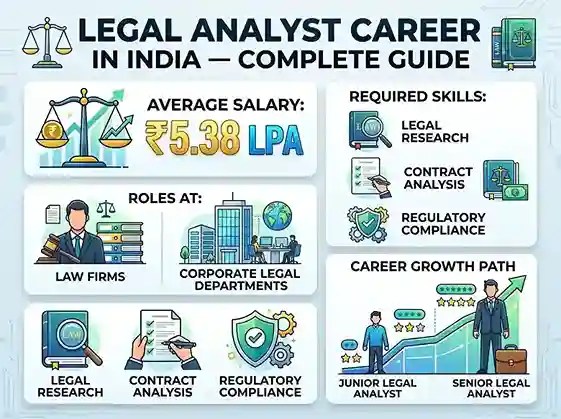
Legal Analyst | Career Guide 2026~15% Annual Job GrowthAvg. ₹5.38 LPA | Up to ₹13 LPA
Legal Analyst Career in India 2026 | Salary, Roles, Skills, Qualifications & Growth Path
A legal analyst is one of the fastest-growing and most sought-after roles in India's legal industry. Employed at law firms, corporate in-house departments, investment banks, Big 4 advisory firms, and government agencies | legal analysts are the analytical backbone of every legal team. This complete guide covers what legal analysts do, how much they earn, what skills employers look for, and exactly how to build this career from an LLB degree.
A legal analyst is a professional who provides research, analysis, document review, and advisory support to lawyers, legal departments, corporations, and financial institutions. They are the analytical engine behind every significant legal operation | from due diligence on multibillion-rupee mergers to monitoring regulatory changes that affect a company's compliance posture.
In India, the legal analyst role sits at the intersection of law and business. Unlike an advocate who represents clients in court, a legal analyst operates primarily behind the scenes | preparing the research, documentation, and analysis that allows lawyers and legal teams to make informed decisions faster. They are employed across every sector where legal risk exists: from global investment banks and Big 4 consulting firms to technology companies and government regulatory bodies.
The role has evolved significantly since 2020. The explosion of data privacy laws (DPDPA 2023), ESG regulation, fintech compliance requirements, and AI governance frameworks has created entirely new demand for legally trained analysts who can interpret complex regulatory environments. In 2026, legal analyst is one of the fastest-growing law-adjacent careers in India, with Glassdoor reporting 225+ active openings in Delhi-NCR alone in April 2026.
⚖️ Legal Analyst | Quick Facts 2026
Average Salary
₹5.38 LPA
Entry Salary
₹3.12–4.50 LPA
Senior Salary
₹8.97–13+ LPA
Minimum Qualification
LLB (3-yr or 5-yr)
Job Growth
~15% per year
Work Mode
Office / Hybrid / Remote
📊 Who Hires Legal Analysts?
Big 4 Advisory Firms (EY, Deloitte, KPMG, PwC)
Investment Banks (J.P. Morgan, Barclays, Deutsche Bank)
Top Indian Law Firms (SAM, AZB, CAM, Trilegal)
Legal Process Outsourcing (LPO) companies
Technology & IT Corporations (Accenture, Wipro)
Research & Ratings (S&P Global, Clarivate, Moody's)
In-House Corporate Legal Departments
Government Regulatory Bodies (SEBI, RBI, CCI)
2. Legal Analyst Job Responsibilities | Day-to-Day Work
The scope of a legal analyst's work varies significantly depending on the employer type and specialisation. A legal analyst at a Big 4 firm does very different work from one at a law firm or an investment bank. However, the following core responsibilities apply across most legal analyst roles in India:
Responsibility Area
What It Involves
Typical Employer
Legal Research
Researching statutes, regulations, case law, and legal precedents using databases like Manupatra, SCC Online, Westlaw, and LexisNexis
Law firms, corporate legal, government
Contract Review & Analysis
Reviewing, summarising, and flagging risk in commercial contracts, NDAs, employment agreements, vendor contracts, and licensing agreements
Corporates, LPOs, MNCs
Regulatory Monitoring
Tracking changes in law and regulation (SEBI, RBI, MCA, IT Act, DPDPA) that affect the organisation; preparing impact summaries
Financial institutions, fintechs, consulting
Due Diligence
Conducting legal due diligence for M&A transactions, investments, and corporate restructuring; reviewing title documents, IP filings, and litigation history
Law firms, PE funds, investment banks
Drafting Legal Memoranda
Writing concise legal memos, opinion notes, and research briefs that synthesise complex law into actionable recommendations
All employers
Compliance Support
Assisting compliance teams with policy drafting, internal audits, regulatory submissions, and ensuring adherence to applicable laws
Banks, NBFCs, pharma, tech
Litigation Support
Organising case files, researching precedents, summarising pleadings, managing court dates, and supporting advocates during trials
What a typical day looks like for a legal analyst at a Big 4 firm: Morning | review a regulatory circular from SEBI and prepare a 2-page impact note for the client. Afternoon | review 15 vendor contracts for a due diligence project using a contract review checklist. Evening | draft a compliance policy section on data processing obligations under DPDPA 2023. This mix of research, drafting, and document review is the daily reality for most corporate legal analysts.
3. Legal Analyst Salary in India 2026 | Experience-Wise & City-Wise
Legal analyst salaries in India vary widely based on experience, employer type, city, and specialisation. The data below is sourced from Glassdoor (October 2025 data, 116 salary reports) and PayScale salary surveys. At MNCs and Big 4 advisory firms, starting packages can be significantly higher than the industry average.
4. Types of Legal Analysts | 8 In-Demand Specialisations
Legal analysis is not a monolithic career | it branches into highly specialised roles, each demanding different legal knowledge and employer sectors. In 2026, compliance and data privacy specialisations command the highest premiums due to India's rapidly evolving regulatory landscape.
📋
Corporate Legal Analyst
Supports in-house legal teams on M&A transactions, corporate governance, board documentation, shareholder agreements, and regulatory filings with MCA and SEBI.
₹5–14 LPA | Corporates, Law Firms
🛡️
Compliance Analyst
Monitors and ensures adherence to applicable laws, regulations, and internal policies. In high demand at banks, NBFCs, insurance companies, and pharmaceutical firms under SEBI, RBI, IRDAI oversight.
₹5.50–16 LPA | Finance & Pharma
⚖️
Litigation Support Analyst
Assists advocates and litigation teams with case research, summarising pleadings, e-discovery management, court document organisation, and trial preparation.
₹3.50–9 LPA | Litigation Law Firms
💡
Intellectual Property (IP) Analyst
Conducts prior art searches, patent analysis, trademark watches, copyright assessments, and IP portfolio management. Especially in demand in pharma, tech, and consumer goods sectors.
₹5–13 LPA | Pharma, Tech, IP Boutiques
📊
Regulatory Analyst
Tracks legislation, regulatory guidance, and policy developments for specific industries (fintech, telecom, healthcare). Prepares regulatory impact assessments and submissions to regulatory bodies.
₹5.50–15 LPA | Fintechs, Consulting
🔒
Data Privacy & Cyber Law Analyst
The most in-demand specialisation in 2026. Advises on DPDPA 2023, GDPR, cross-border data transfers, privacy impact assessments, and AI governance. Works with tech companies, banks, and healthcare firms.
₹7–20 LPA | Tech, Banking ★ High Demand
🌿
ESG & Policy Analyst
Analyses environmental, social, and governance (ESG) legal frameworks, BRSR regulations, and sustainability-linked contracts. Increasingly demanded by listed companies and global investors.
₹6–16 LPA | Listed Cos, PE Funds
⚙️
Legal Operations Analyst
Focuses on the business side of legal departments | vendor management, matter management systems, legal spend analysis, and implementing legal technology tools including CLM and e-billing platforms.
₹5.50–14 LPA | Large Corporates, MNCs
5. Skills Required to Become a Legal Analyst
The skill set of a high-performing legal analyst spans three domains: core legal knowledge, technical tools, and soft skills. In 2026, with the rise of legal technology, proficiency in AI-assisted contract review and data privacy law has become a significant differentiator.
Analytical ThinkingAttention to DetailTime ManagementWritten CommunicationClient InteractionProject ManagementConfidentiality & Ethics
⭐ Trending Skills in 2026
Data Privacy Law (DPDPA 2023 / GDPR)AI & Legal Tech LiteracyESG / BRSR ComplianceFintech Regulation (RBI / SEBI)Competition Law (CCI)Cross-Border Transactions
6. Qualifications & Education Path
The minimum educational qualification for a legal analyst role in India is an LLB degree | either a 3-year LLB after graduation or a 5-year integrated BA/BBA/BCom LLB. However, the institution from which you graduate significantly affects your placement prospects, particularly for Big 4 and investment bank roles.
Qualification
Duration
Entry Route
Impact on Career
5-Year BA/BBA LLB (Hons)
5 Years
CLAT / LNAT / LSAT-India after Class 12
Best route | NLU graduates are preferred at Big 4, investment banks, and top law firms
3-Year LLB
3 Years
After any graduation degree
Widely accepted; good for mid-level entry especially in LPO, compliance, and in-house roles
LLM (Specialisation)
1–2 Years
After LLB via CLAT-PG / CUET-PG
Opens senior analyst, legal manager, and specialist roles; valued for IP, Tax, International Law
Diploma in Data Privacy / IP / Tax
3–12 Months
After LLB
High-value add-on for specific specialisations | boosts salary and shortlisting rate
Legal Research Certifications
Online courses
Anytime
Proficiency in Manupatra, Westlaw, or LexisNexis certification is a concrete resume differentiator
🏛 Does the Law College Matter for a Legal Analyst Career?
Yes | significantly. Graduates from NLUs (especially NLSIU, NALSAR, NUJS, GNLU) and top private institutions like JGLS consistently receive better placement offers and higher starting salaries at Big 4 firms, investment banks, and top-tier law firms. NLU graduates often start at ₹7–12 LPA in corporate roles, while graduates from non-NLU colleges may start at ₹3–5 LPA. However, strong internship experience, legal database certifications, and specialised skills can significantly bridge this gap.
7. How to Become a Legal Analyst in India | Step-by-Step
Becoming a legal analyst in India follows a clear path from law school to your first placement. Here is the step-by-step roadmap:
1
Complete LLB | Aim for a Top Institution
Qualify CLAT and enter a National Law University for the strongest career outcomes. If pursuing 3-year LLB after graduation, prioritise institutions with strong industry connections and placement cells. During your degree, focus on courses in Corporate Law, Contract Law, IP, and Compliance | these are the subjects most directly relevant to legal analyst roles.
Internships are the single most important differentiator for a fresher legal analyst. Target at least two corporate legal internships (at a law firm or in-house department), one compliance-focused internship (at a bank or NBFC), and one research-focused internship (at a think tank, government body, or LPO). Use platforms like Internshala, LinkedIn, and NLU placement portals. Every internship should produce a writing sample | memo, research note, or contract summary | that goes into your portfolio.
3
Master Legal Research Databases
Proficiency in Manupatra and SCC Online is mandatory for Indian legal analyst roles. Familiarity with Westlaw or LexisNexis adds significant value for MNC and LPO employers. Most universities provide access during the degree | use it to build genuine research skills. Take formal certification courses in legal research if available. Being able to demonstrate proficiency in these tools during interviews is a strong differentiator.
4
Choose a Specialisation Early
The most in-demand specialisations in 2026 are Data Privacy (DPDPA/GDPR), Compliance (financial services), IP (pharma/tech), and ESG. Picking a specialisation in your third or fourth year | and aligning your internships, electives, and certifications with it | significantly increases your salary negotiating power and interview success rate. Generalist legal analysts are in demand, but specialists command 20–40% higher starting packages.
5
Build a Legal Portfolio & Apply Strategically
Create a professional portfolio with 3–5 writing samples: a legal research memo, a contract review summary, a regulatory analysis note, and any published articles or case comments. Apply through campus placements (if at an NLU), LinkedIn, Internshala, and direct applications to law firms' career pages. Target Big 4 firms and investment banks for premium packages. For in-house roles, monitor corporate LinkedIn pages of Indian conglomerates.
8. Legal Analyst Career Progression & Growth Path
The legal analyst career path in India offers clear, well-defined progression with increasing specialisation and responsibility at each stage. Most candidates move through 4–5 distinct levels over a 10–15 year career, with a major fork between staying on the technical/specialist track and transitioning into legal management or partnership.
L10–2 yrs
Junior Legal Analyst / Legal Research Associate
₹3.12 – ₹4.50 LPA
Entry-level role focused on legal research, database searches, summarising judgments and statutes, supporting senior analysts with contract reviews, and maintaining documentation. Most learning happens here | this stage builds the foundational research and writing muscle that underpins the entire career.
L22–5 yrs
Legal Analyst
₹4.50 – ₹8.00 LPA
Independent contributor. Leads contract reviews, drafts legal memos, manages regulatory monitoring, and begins client-facing advisory work. At this stage, specialisation becomes important | analysts who develop expertise in compliance, data privacy, or IP command higher packages and faster promotions.
L35–8 yrs
Senior Legal Analyst
₹8.00 – ₹13 LPA
Manages complex due diligence projects, leads teams of junior analysts, interfaces with senior legal counsel and external law firms, and is the go-to specialist in their domain (compliance, IP, regulatory). Many senior legal analysts at Big 4 firms also handle client advisory independently at this level.
L48–12 yrs
Legal Manager / Deputy General Counsel
₹14 – ₹25 LPA
Oversees the legal operations of a team or practice area. Responsible for legal risk management, strategic compliance planning, budgeting for legal spend, and reporting to the General Counsel or Board. At law firms, this level corresponds to Senior Associate or Principal level. Career fork: management track vs deep specialist track.
L512+ yrs
General Counsel / Head of Legal / Partner
₹25 – ₹1 Crore+ LPA
Senior leadership. In-house GC at a large corporation or Partner at a law firm. Responsible for the entire legal strategy of the organisation, regulatory relationships, and legal risk at the board level. At Tier-1 law firms, partners earn ₹50 lakh to ₹2 crore per year. GCs at listed companies earn ₹30–80 LPA plus stock options.
9. Top Recruiters for Legal Analysts in India (2026)
Legal analysts in India are hired across multiple industry categories. The highest-paying recruiters are investment banks and Big 4 advisory firms, while law firms provide the deepest legal experience. The following are the most active and prestigious recruiters for legal analysts in India as of 2026:
EY IndiaDeloitteKPMGPwCJ.P. MorganBarclaysDeutsche BankOptum (UnitedHealth)S&P GlobalClarivateAccentureWiproInfosys BPMShardul Amarchand MangaldasAZB & PartnersCyril Amarchand MangaldasTrilegalTide (Legal Team)Oxane PartnersTata Group Legal
10. Sectors That Hire Legal Analysts in India
Legal analysts are in demand wherever there is legal complexity | which in 2026 means virtually every significant sector of the Indian economy. Here are the primary employment sectors, along with the specific legal needs that drive demand in each:
Regulatory advisory, tax law, M&A due diligence, compliance audits, ESG advisory, legal process consulting
EY, Deloitte, KPMG, PwC
₹7–20 LPA
Technology & IT
Data privacy (DPDPA/GDPR), IP protection, software licensing, cloud contracts, AI governance, cyber law compliance
Infosys, Wipro, Accenture, Google, Microsoft India
₹6–16 LPA
Pharmaceuticals & Life Sciences
Patent filing and prosecution, drug regulatory submissions (CDSCO), trademark protection, clinical trial agreements
Sun Pharma, Dr. Reddy's, Cipla, Biocon
₹5–14 LPA
Law Firms (Tier 1 & 2)
Research for litigation, contract drafting, due diligence reports, client advisory memoranda, cross-border transaction support
SAM, AZB, CAM, Trilegal, J Sagar Associates
₹5–15 LPA
Legal Process Outsourcing (LPO)
Contract review at scale, document coding, deposition summaries, patent research for US/UK clients, compliance workflows
Consilio, UnitedLex, Elevate, Integreon
₹4–12 LPA
Government & Regulators
Policy research, legislative drafting support, regulatory impact analysis, enforcement support for CCI, SEBI, TRAI
SEBI, RBI, CCI, Law Commission, Ministries
₹5–14 LPA (Grade Pay)
11. Legal Analyst vs Lawyer in India | Key Differences
This is one of the most commonly searched questions by law students planning their career. Understanding the distinction clarifies which career path fits your interests and strengths.
Aspect
Legal Analyst
Lawyer / Advocate
Core Function
Research, analysis, document review, advisory support
Legal representation, advocacy, and legal advice
Court Appearance
Not required (rarely, if ever)
Core function | appears in court
Bar Council Enrolment
Not required for most roles
Mandatory | must clear AIBE
Employer
Corporations, Big 4, banks, LPOs, law firms (back-office)
Law firms (as associate/partner), independent practice, in-house counsel
Work Hours
Standard office hours; deadline-driven peaks
Irregular | court schedules dictate; often long hours
Entry Salary
₹3.12–7 LPA (varies by employer)
₹3–8 LPA (litigation) to ₹18–22 LPA (Big Law)
Career Ceiling
Legal Manager / GC / Head of Legal / LPO Lead
Senior Advocate / Partner / Judge / GC
Best Suited For
Those who love research, writing, and analysis over courtroom advocacy
Those who want to advocate, argue, and practice law directly
12. Frequently Asked Questions | Legal Analyst Career 2026
Q1. What is the average salary of a legal analyst in India in 2026?
The average salary of a legal analyst in India is ₹5.38 LPA (Glassdoor, October 2025, 116 reports). Entry-level legal analysts earn ₹3.12–4.50 LPA. Mid-career professionals with 4–6 years of experience earn ₹6–9 LPA. Senior legal analysts earn ₹8.97–13+ LPA. At premium employers (Big 4 advisory firms, investment banks), starting packages range from ₹7–12 LPA even for freshers from top NLUs.
Q2. What degree do I need to become a legal analyst in India?
The minimum qualification is an LLB degree | either a 3-year LLB after graduation or a 5-year integrated BA/BBA/BCom LLB. NLU graduates are preferred at Big 4 and investment banks. An LLM adds value for senior analyst and specialist roles. No Bar Council of India enrolment is typically required for legal analyst positions, unlike litigation practice.
Q3. Is a legal analyst a good career in India?
Yes | legal analyst is one of the most consistently growing law careers in India, with approximately 15% annual job growth, which is higher than the national average. Key advantages: strong salary progression, exposure to multiple legal domains, clear career path to Legal Manager and GC, demand from diverse sectors (banking, tech, consulting, pharma), and growth in new specialisations like data privacy and ESG compliance. Barclays, J.P. Morgan, EY, and Deloitte are among the top hirers with consistently high packages.
Q4. What is the difference between a legal analyst and a paralegal?
In India, the terms are sometimes used interchangeably, but there is a meaningful distinction. A paralegal typically performs operational and procedural legal support tasks | filing documents, organising case files, scheduling, administrative work. A legal analyst is a more senior, analytical role requiring a law degree | focused on research, regulatory analysis, contract review, drafting, and strategic advisory support. Legal analysts are paid significantly more and are expected to produce original analysis, not just administrative support.
Q5. Which specialisation is best for a legal analyst in 2026?
The highest-demand and highest-paying specialisations for legal analysts in India in 2026 are: (1) Data Privacy & Cyber Law | DPDPA 2023 compliance demand has surged across tech and banking sectors; salaries reach ₹7–20 LPA. (2) ESG & BRSR Compliance | growing with SEBI mandates for listed companies. (3) Financial Regulatory Compliance | always in demand at banks and NBFCs. (4) Intellectual Property | essential in pharma, tech, and consumer goods. Data privacy specialists are currently the most sought-after, often commanding 30–40% premium over generalist analysts.
Q6. Can a science or commerce graduate become a legal analyst?
Yes | after completing a 3-year LLB following your Bachelor's degree in Science, Commerce, or any other stream. Many of the best compliance and IP analysts in India come from science backgrounds (pharma and tech IP roles especially value science + law combinations). A B.Sc./B.Tech + LLB combination is highly sought after for pharmaceutical patent analysis and legal tech roles. The legal analyst career is open to graduates of any undergraduate stream, as long as the LLB qualification is obtained.
Start Your Legal Analyst Career | Begin with the Right Law Degree
The fastest path to a high-paying legal analyst role starts with a strong LLB from an NLU or top private law school. Use our guides to prepare for CLAT, JSAT, and other law entrance exams.