1. CLAT Syllabus 2026 | Overview & What's New
The CLAT 2026 syllabus is prescribed by the Consortium of National Law Universities on its official website (consortiumofnlus.ac.in). The Consortium has confirmed no major changes to the CLAT syllabus or exam pattern for 2026. The format that has been in place since the 2020 overhaul | fully passage-based questions across all five sections | continues for CLAT 2026.
The single biggest structural change in recent CLAT history was implemented in 2022, when the total number of questions was reduced from 150 to 120. This change increased the relative importance of each question and rewarded accuracy over speed. Since 2020, CLAT no longer tests factual knowledge through direct questions | instead, every question is anchored to a 450–600 word reading passage that provides all the information you need to answer correctly.
Unlike competitive exams like JEE or NEET, CLAT does not test memorised facts | it tests your ability to read carefully, reason accurately, and apply given rules to new situations. A student with strong reading habits and analytical thinking can outperform a student who has memorised more legal knowledge. This fundamentally changes how you should prepare.
2. CLAT 2026 Exam Pattern | Questions, Marks, Duration & Format
| Parameter | Details |
|---|---|
| Conducting Body | Consortium of National Law Universities (NLUs) |
| Exam Full Name | Common Law Admission Test (CLAT) 2026 |
| Mode of Exam | Offline | Pen and Paper (OMR sheet) |
| Duration | 2 Hours (120 Minutes) |
| Total Questions | 120 Multiple Choice Questions (MCQs) |
| Total Marks | 120 Marks |
| Marking Scheme | +1 for correct answer; −0.25 for incorrect; 0 for unattempted |
| Question Format | Passage-based MCQs | all sections |
| Language | English only |
| Number of Sections | 5 sections |
| Expected Exam Date | December 2026 (1st or 2nd Sunday) |
| Official Website | consortiumofnlus.ac.in |
CLAT 2026 Section-Wise Question Distribution
| Section | Questions | Marks | Weightage | Passage Length |
|---|---|---|---|---|
| English Language | 28–32 | 28–32 | ~20% | 450–600 words |
| Current Affairs incl. GK | 35–39 | 35–39 | ~25% | 450 words |
| Legal Reasoning | 35–39 | 35–39 | ~25% | 450–600 words |
| Logical Reasoning | 28–32 | 28–32 | ~20% | 300–450 words |
| Quantitative Techniques | 13–17 | 13–17 | ~10% | Data sets + graphs |
| Total | 120 | 120 | 100% | | |
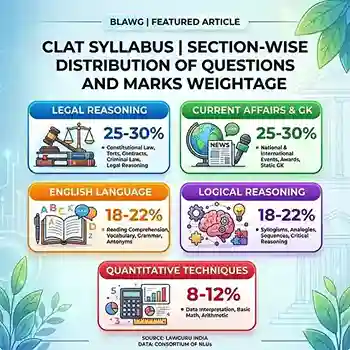
3. CLAT 2026 Section-Wise Weightage | Visual Overview
Understanding which sections carry the most marks is the foundation of smart CLAT preparation. Here is the visual breakdown of all five sections:
4. CLAT 2026 English Language Syllabus (20% Weightage)
The English Language section tests your ability to read and comprehend complex passages drawn from literary, journalistic, fictional, and non-fiction sources. Unlike pre-2020 CLAT, there are no grammar questions, no fill-in-the-blanks, and no direct vocabulary tests. Every question requires you to engage with a reading passage.
Key Skills Tested in CLAT English 2026
Detailed Topic Breakdown
| Topic | What is Tested | Approx. Questions |
|---|---|---|
| Main Idea / Central Theme | Identify the primary argument or message of the passage | 1–2 per passage |
| Inference & Implication | What can be logically concluded from the passage? | 2–3 per passage |
| Vocabulary in Context | Meaning of underlined word/phrase in context | 1–2 per passage |
| Author's Tone/Attitude | Is the author critical, neutral, appreciative, ironic? | 1 per passage |
| Passage Summary | Select the most accurate summary of the passage | 1 per passage |
| Analogy | Identify a situation analogous to one described in passage | 0–1 per passage |
5. CLAT 2026 Current Affairs & GK Syllabus (25% Weightage) | Highest Scoring Section
The Current Affairs & GK section is the highest-weightage section in CLAT 2026 | tied with Legal Reasoning at 25%. Passages are drawn from journalistic and non-fiction sources and cover events and developments from the previous 12–18 months. Questions test whether you can engage with contemporary issues in law, politics, economics, environment, science, and culture.
Static GK Topics for CLAT 2026
6. CLAT 2026 Legal Reasoning Syllabus (25% Weightage) | Most Decisive Section
Legal Reasoning is the most intellectually distinctive section of CLAT | it tests skills that are specifically required for legal practice. Importantly, the Consortium states that no prior knowledge of law is required for CLAT UG. Each passage presents a legal principle or rule, and your job is to apply it to the given set of facts. Think of it as learning mini legal rules and immediately using them.
The Consortium specifies three skills: (1) Identify and infer the rules and principles mentioned in the passage; (2) Apply such rules and principles to various fact situations; (3) Understand how changes to rules may alter their application. It is a test of rule-following and logical application | not legal encyclopaedia knowledge.
Legal Principles Commonly Tested in CLAT Legal Reasoning
Other Legal Areas Tested in CLAT Legal Reasoning
7. CLAT 2026 Logical Reasoning Syllabus (20% Weightage)
The CLAT 2026 Logical Reasoning section uses short analytical passages (approximately 300–450 words each) to test critical thinking. Unlike traditional LR sections in other exams, CLAT does NOT test puzzle-based reasoning (like seating arrangements or blood relations in the traditional sense). Instead, it tests critical reasoning | your ability to evaluate arguments, identify assumptions, and draw valid conclusions from written passages.
Logical Reasoning Question Types in CLAT 2026
| Question Type | What You Must Do | Frequency |
|---|---|---|
| Strengthen the Argument | Identify which answer choice makes the passage's conclusion more likely | Very High |
| Weaken the Argument | Identify which answer choice undermines the passage's reasoning | Very High |
| Identify the Assumption | Find the unstated premise the argument relies on | High |
| Draw an Inference | Identify what must be true if the passage is true | High |
| Identify the Conclusion | Which statement is the main point the author is arguing? | Medium |
| Identify the Flaw | What is the logical error in the argument? | Medium |
| Parallel Reasoning | Find another argument that uses the same logical structure | Low–Medium |
| Resolve the Paradox | Which answer explains an apparent contradiction? | Low |
8. CLAT 2026 Quantitative Techniques Syllabus (10% Weightage)
Quantitative Techniques is the smallest section in CLAT 2026 | carrying only 10% of the total marks. Questions are presented as data interpretation passages with graphs, tables, pie charts, or statistical data sets. The mathematics required is limited to Class 9–10 level | no advanced mathematics, no trigonometry, no calculus. The challenge is not the maths itself, but reading and interpreting data accurately under time pressure.
Quantitative Techniques Topics for CLAT 2026
9. CLAT PG Syllabus 2026 | LLM Admissions
The CLAT PG (Postgraduate) syllabus is entirely different from the UG syllabus. CLAT PG is for LLM admissions at all 24 NLUs. Unlike CLAT UG which tests general aptitude, CLAT PG tests your legal knowledge from LLB curriculum.
| Feature | CLAT UG (BA LLB) | CLAT PG (LLM) |
|---|---|---|
| Prior Law Knowledge Needed | No (passage provides all info) | Yes | essential |
| Duration | 2 hours | 2 hours |
| Questions | 120 | 120 |
| Sections | 5 sections | 1 section (law passages) |
| Topics | English, GK, Legal, Logical, Quant | Constitutional, Criminal, Civil, IPR, International Law |
| Eligibility | Class 12 pass, 45% | LLB with 55% |
CLAT PG 2026 Law Subject Areas
10. CLAT 2026 Preparation Strategy | Section-Wise Roadmap
Use the following section-wise time allocation and weekly strategy to prepare efficiently for CLAT 2026:
| Section | Weightage | Recommended Time Allocation | Daily Practice |
|---|---|---|---|
| Current Affairs & GK | 25% | 30–35% of prep time | 30 min newspaper reading + 10 min CA notes |
| Legal Reasoning | 25% | 30% of prep time | 2–3 Legal Reasoning passages daily |
| English Language | 20% | 15–20% of prep time | 2 editorials + 1–2 RC passages daily |
| Logical Reasoning | 20% | 15% of prep time | 2–3 critical reasoning passages daily |
| Quantitative Techniques | 10% | 5–10% of prep time | 10 DI questions every alternate day |
Month-by-Month CLAT 2026 Preparation Plan (12 Months)
11. Best Books for CLAT 2026 | Section-Wise Recommendations
| Section | Best Book / Resource | Author / Publisher | Why Recommended |
|---|---|---|---|
| English Language | Word Power Made Easy | Norman Lewis | Best vocabulary in context book; readable and engaging |
| English Language | How to Read Better & Faster | Norman Lewis | Builds reading speed and comprehension | essential for CLAT |
| Current Affairs | Manorama Yearbook 2026 | Manorama Publications | Annual GK reference; covers static GK + previous year events |
| Current Affairs | The Hindu (Daily Newspaper) | The Hindu Group | CLAT passages closely mirror The Hindu editorial style and sources |
| Legal Reasoning | Legal Aptitude for CLAT | A.P. Bhardwaj | Most comprehensive CLAT legal aptitude text; covers all key areas |
| Legal Reasoning | CLAT Previous Year Papers (2020–2025) | Universal / Official Consortium | Best source for authentic legal reasoning passage practice |
| Logical Reasoning | A Modern Approach to Logical Reasoning | R.S. Aggarwal | Covers critical reasoning types tested in CLAT |
| Logical Reasoning | Analytical Reasoning | M.K. Pandey (BSC Publication) | Strong coverage of argument analysis and inference questions |
| Quantitative Techniques | NCERT Mathematics Class 9 & 10 | NCERT | All arithmetic and data interpretation concepts in CLAT are Class 10 level |
| Full Mocks | Universal's CLAT Solved Papers | Universal Publications | 10+ years of previous papers with answer keys | essential |
12. CLAT Syllabus 2026 | Official PDF Download
Always download the CLAT 2026 syllabus PDF directly from consortiumofnlus.ac.in | the official Consortium website. Third-party PDFs may be outdated or inaccurate. LawGuru India is not the official source for the syllabus PDF, but we verify our content against the official document. If any discrepancy is found, the official document takes precedence.
13. CLAT Syllabus 2026 | Frequently Asked Questions
The CLAT 2026 syllabus has five sections: (1) English Language | 28–32 questions, 20% weightage; (2) Current Affairs including GK | 35–39 questions, 25% weightage; (3) Legal Reasoning | 35–39 questions, 25% weightage; (4) Logical Reasoning | 28–32 questions, 20% weightage; (5) Quantitative Techniques | 13–17 questions, 10% weightage. The entire paper is passage-based | 120 MCQs in 120 minutes with −0.25 negative marking. No prior legal knowledge is needed for UG.
Current Affairs & GK and Legal Reasoning are tied as the most important sections | both carry 25% weightage each, making them 50% of the total paper together. Focusing on these two sections first maximises your score impact. English (20%) and Logical Reasoning (20%) together form another 40%. Quantitative Techniques (10%) should not be over-invested in during preparation.
Yes. The CLAT 2026 syllabus is the same as CLAT 2025 | no changes have been announced by the Consortium. The same five-section passage-based format with 120 questions in 120 minutes continues. The syllabus structure has been stable since the 2020 overhaul and the 2022 reduction from 150 to 120 questions. Prepare using 2020–2025 CLAT papers as these are the most representative of what CLAT 2026 will look like.
For CLAT UG (undergraduate BA LLB): No | you do not need to study law textbooks. The Consortium explicitly states that no prior legal knowledge is required. All legal principles are provided in the passage. However, having a working familiarity with basic legal concepts (contracts, torts, criminal law basics, constitutional rights) helps you read Legal Reasoning passages faster. For CLAT PG (LLM): Yes | you need solid LLB curriculum knowledge across all major law subjects.
CLAT 2026 has approximately 25–30 passages across all five sections | English (4–5 passages), Current Affairs (4–6 passages), Legal Reasoning (4–6 passages), Logical Reasoning (3–4 passages), and Quantitative Techniques (2–3 data sets). Each passage is 300–600 words. You will read approximately 12,000–15,000 words in total in 120 minutes | meaning strong reading speed (at least 300 words per minute) is a genuine performance advantage.
The most frequently tested legal areas in CLAT Legal Reasoning are: Tort Law (negligence, nuisance, strict liability, defamation), Contract Law (offer-acceptance, consideration, breach, void agreements), Criminal Law (actus reus, mens rea, general exceptions, IPC/BNS offences), and Constitutional Law (fundamental rights, writs, separation of powers). Based on CLAT 2020–2025 analysis, Property Law, Consumer Protection, Environmental Law, and Family Law passages have also appeared. Remember | the rule will always be stated in the passage; focus on applying it correctly.
To score 100+ out of 120 in CLAT 2026 (top 100 rank range): (1) Master Current Affairs | read The Hindu daily for 12 months, maintain monthly CA notes; (2) Practice Legal Reasoning daily using 2020–2025 CLAT papers; (3) Build reading speed to 350+ words per minute through daily newspaper reading; (4) Take 20+ full mock tests under timed conditions; (5) Achieve 90%+ accuracy on attempted questions | skip doubtful ones rather than guess; (6) Manage time precisely | allocate ~8 minutes per passage, not per question. Most 95+ scorers attribute their performance to consistent newspaper reading and extensive Legal Reasoning practice, not coaching alone.