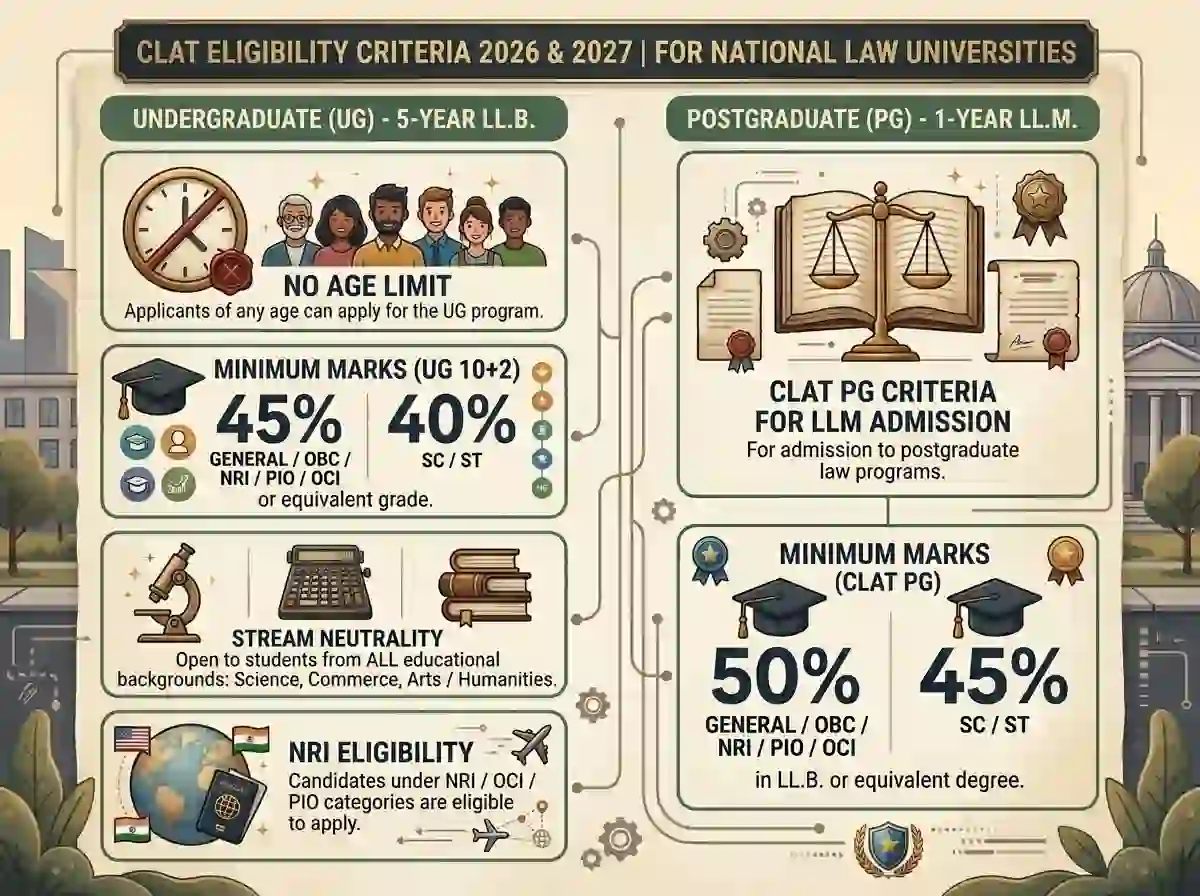
CLAT PG (LLM): Hold an LLB (3-yr or 5-yr) or equivalent law degree. Minimum 50% marks for General/OBC/PwD/NRI | Minimum 45% marks for SC/ST. Final-year LLB students may also apply. No age limit.
- CLAT UG Eligibility Criteria 2026 & 2027
- CLAT PG Eligibility Criteria 2026 & 2027
- Category-Wise Eligibility Table
- Nationality & NRI/OCI/PIO Rules
- Stream Neutrality | Any Subject Can Apply
- Appearing Candidates | Class 12 & Final-Year LLB
- Attempts & Age Limit Explained
- PwD (Persons with Disability) Eligibility
- Documents Required for CLAT 2027
- Domicile & State Quota Eligibility
- Common Myths About CLAT Eligibility | Busted
- Am I Eligible? Self-Check Checklist
- Frequently Asked Questions
1. CLAT UG Eligibility Criteria 2026 & 2027
CLAT UG (Undergraduate) admission leads to the prestigious 5-year integrated BA LLB (Hons.) program at the 24 National Law Universities (NLUs) across India. These are among the most sought-after law programs in the country, offering combined undergraduate and law education in a single integrated degree.
The Consortium of NLUs prescribes the official CLAT UG eligibility criteria. Here is the complete, official breakdown for CLAT 2026 and the expected criteria for CLAT 2027:
- Educational Qualification: Must have passed Class 12 (10+2) or equivalent from a recognized national or state board (CBSE, ICSE, any State Board, NIOS, or equivalent international board).
- Minimum Marks | General/OBC/PwD/NRI/PIO/OCI: At least 45% aggregate marks (or equivalent grade) in the 10+2 examination across all subjects.
- Minimum Marks | SC/ST: At least 40% aggregate marks (or equivalent grade) in the 10+2 examination across all subjects.
- Stream: Completely stream-neutral. Science, Commerce, Humanities, Fine Arts | all streams are eligible. No specific subject requirement.
- Age Limit: No upper or lower age limit. The Consortium has removed all age restrictions for CLAT UG.
- Attempts: Unlimited. No cap on the number of times you can appear for CLAT.
- Nationality: Indian Nationals, NRIs, OCIs, and PIOs are eligible. Foreign nationals may apply through specific NLU quotas.
- Appearing Candidates: Students appearing for Class 12 board exams in March/April 2026 (for CLAT 2026) may also apply. Admission will be provisional until they submit their marksheet with minimum required marks.
The Consortium of NLUs accepts any 10+2 examination equivalent recognized by the Association of Indian Universities (AIU) or a recognized State/Central Board. This includes International Baccalaureate (IB), Cambridge A-Levels (IGCSE Advanced), open school certificates (NIOS), state open boards, and madrasah certificates that are recognized by relevant education authorities. If you hold a non-standard qualification, verify with your prospective NLU directly or with the Consortium during the application process.
2. CLAT PG Eligibility Criteria 2026 & 2027
CLAT PG (Postgraduate) is conducted for admission to the LLM (Master of Laws) programs offered by NLUs. This is a 1-year or 2-year postgraduate law degree with various specializations | Constitutional Law, Corporate Law, Criminal Law, International Law, Human Rights Law, Intellectual Property Law, and more.
CLAT PG eligibility criteria are different from UG and require a law degree as the qualifying qualification:
- Educational Qualification: Must hold an LLB degree (3-year or 5-year) or equivalent law qualification from a recognized university in India or abroad.
- Minimum Marks | General/OBC/PwD/NRI/PIO/OCI: At least 50% marks in the LLB degree or equivalent.
- Minimum Marks | SC/ST: At least 45% marks in the LLB degree or equivalent.
- Age Limit: No upper age limit. Candidates of any age with an LLB can appear for CLAT PG.
- Attempts: Unlimited. There is no restriction on the number of attempts.
- Final-Year LLB Candidates: Students in their final year of LLB (expected to complete in April/May 2026) may also register and appear for CLAT PG. However, admission is provisional; they must submit final marksheets showing minimum required percentage at the time of NLU admission/document verification.
- Equivalence: Foreign law degrees are accepted if the university or degree is recognized by the Bar Council of India (BCI) or an equivalent authority, and marks/grades translate to the minimum percentage requirement.
Unlike CLAT UG where thousands of Class 12 students compete, CLAT PG is a more specialist examination. The total number of candidates is significantly lower, and the competition is concentrated among law graduates seeking advanced specialization. CLAT PG scores are used for LLM admissions at most NLUs, though a few NLUs conduct their own LLM entrance tests in addition.
3. CLAT Eligibility | Category-Wise Minimum Marks Table
The following table summarizes the minimum qualifying marks required for CLAT UG and CLAT PG across all reservation categories recognized by the Consortium of NLUs:
| Category | CLAT UG (Class 12 Marks) | CLAT PG (LLB Marks) | Age Limit | Attempts |
|---|---|---|---|---|
| General (UR) | 45% aggregate | 50% in LLB | None | Unlimited |
| OBC (NCL) | 45% aggregate | 50% in LLB | None | Unlimited |
| EWS | 45% aggregate | 50% in LLB | None | Unlimited |
| SC | 40% aggregate | 45% in LLB | None | Unlimited |
| ST | 40% aggregate | 45% in LLB | None | Unlimited |
| PwD (Horizontal) | 45% aggregate | 50% in LLB | None | Unlimited |
| NRI/OCI/PIO | 45% aggregate | 50% in LLB | None | Unlimited |
OBC (Non-Creamy Layer) eligibility requires a valid Non-Creamy Layer certificate issued by the competent authority (usually the Sub-Divisional Magistrate or equivalent). The income threshold and family income criteria for NCL status are set by the Government of India and updated periodically. Make sure your OBC-NCL certificate is current (typically valid for the current financial year) and issued as per the Central government list of OBCs | not the state list. Using an outdated or state-only OBC certificate may lead to disqualification during NLU document verification.
4. Nationality Eligibility | Indian, NRI, OCI, PIO & Foreign Nationals
CLAT has an inclusive nationality policy that allows candidates from multiple citizenship and residency backgrounds to apply. Here is the complete breakdown:
All Indian citizens are fully eligible for CLAT UG and CLAT PG. Standard eligibility criteria (marks and qualification) apply. Admission is through the main CLAT merit list and Consortium counselling system.
Indian citizens living abroad for employment, business, or other purposes. Eligible for CLAT. Must appear for the exam. After getting a CLAT score, must apply to individual NLUs separately under the NRI quota. Seat availability: 2–5 supernumerary seats per NLU (varies by university).
Foreign nationals of Indian origin with OCI card. Eligible for CLAT. Treated on par with NRI candidates. Must meet same academic eligibility. Apply to NLUs under NRI/OCI quota after CLAT. Valid OCI card is required documentation.
Foreign nationals with Indian ancestry (up to 4 generations). Eligible for CLAT. Apply under NRI/PIO quota at NLUs. PIO card or relevant documentary proof required. Admission procedures may vary by NLU | contact individual university for specifics.
Citizens of foreign countries (no Indian connection). Some NLUs have separate foreign national seats. May or may not require CLAT | policies vary by university. If foreign national seats are not filled, they are converted to NRI-sponsored seats. Must hold a valid passport. Contact individual NLU for admission procedures.
- Copy of valid Indian passport (student)
- Visa copies (last 12 months)
- Embassy certificate confirming NRI/OCI/PIO status, or PIO card
- Sponsor's valid Indian passport copy
- Affidavit from sponsor affirming financial responsibility
5. Stream Neutrality | Can Science or Commerce Students Apply for CLAT?
One of the most common misconceptions about CLAT is that it is only for Humanities students. This is entirely false. CLAT is 100% stream-neutral. The Consortium of NLUs does not prescribe any mandatory subject or stream requirement for CLAT UG eligibility.
This means that the following students are all equally eligible to appear for CLAT, provided they meet the minimum marks criteria:
Many top CLAT rankers come from a Science background. CLAT's English and Logical Reasoning sections reward analytical thinking skills that Science students develop naturally. If you are a Science student interested in a law career, CLAT is an excellent pathway | some NLUs even offer specialized programs like BBA LLB or BSc LLB that align with your background.
6. Appearing Candidates | Class 12 Students & Final-Year LLB Students
The Consortium of NLUs allows candidates who have not yet received their final results to register and appear for CLAT. This is a student-friendly provision that prevents delay in applying. Here is how it works for both UG and PG programs:
- Students currently in Class 12 (expected boards in March/April 2027) can register for CLAT 2027.
- No restriction on appearing in the exam even without final results.
- If allotted a seat in NLU counselling, admission is provisional.
- Final Class 12 marksheet must be submitted at NLU document verification.
- If board result shows marks below 45% (Gen) or 40% (SC/ST), provisional admission is cancelled immediately.
- Compartment or supplementary exam results are acceptable only if candidates ultimately pass before NLU admission deadline.
- Students in their final year of LLB (expected to complete in April/May 2026) can register and appear for CLAT PG 2026.
- If allotted an NLU seat, admission is provisional.
- Must submit final LLB marksheet at the time of NLU admission/document verification.
- If final LLB result shows marks below 50% (Gen) or 45% (SC/ST), provisional admission is cancelled.
- Late declaration of results by universities is not an excuse | candidates must meet the NLU's admission deadline.
7. CLAT Age Limit & Number of Attempts | Detailed Explanation
Two of the most commonly confused aspects of CLAT eligibility are the age limit and the number of permitted attempts. Here is the definitive clarification:
CLAT PG: There is also no upper age limit for the LLM program. However, the qualification requirement (LLB degree) means candidates are typically at least 20–21 years old in practice. This is not a prescribed age floor | it is simply a consequence of the minimum educational timeline.
Why Was the Age Limit Removed?
The Consortium of NLUs removed the earlier age restriction (which had capped CLAT UG applicants at 20 years for General and 22 years for SC/ST) following legal challenges and recommendations that an age cap for a professional entrance examination was arbitrary and violated the constitutional right to education. Post removal, CLAT became significantly more inclusive | allowing working professionals, gap-year students, and career-changers to pursue a law education at a National Law University.
Number of Attempts | No Restriction
Unlike JEE (3 attempts), NEET (unlimited with annual cap considerations), or UPSC Civil Services (6 attempts for General), CLAT has no cap on the number of attempts. A candidate who appeared for CLAT 2022, 2023, 2024, 2025, and 2026 without success can appear again for CLAT 2027 without any penalty or restriction, provided they still meet the educational eligibility. This policy recognizes that legal education is a serious career path and that students may need multiple attempts to crack a competitive exam with 75,000+ applicants.
8. PwD (Persons with Disability) Eligibility for CLAT
Persons with Disability (PwD) are recognized as a horizontal reservation category in CLAT admissions. The eligibility criteria and provisions for PwD candidates are as follows:
- Academic Eligibility: Same minimum marks as General category | 45% in Class 12 for UG; 50% in LLB for PG. There is no lower marks standard specifically for PwD.
- Disability Definition: As per the Rights of Persons with Disabilities Act, 2016. Benchmark disability of 40% or more qualifies for PwD reservation benefits in NLU admissions.
- Disability Certificate: Must submit a valid disability certificate issued by a government medical authority. The certificate must specify the nature and percentage of disability.
- Scribe/Compensatory Time: PwD candidates with writing/reading-related disabilities may be eligible for a scribe and/or additional examination time (typically 20 minutes extra per hour). Applications for scribe must be made during CLAT registration.
- Horizontal Reservation: PwD is a horizontal (cross-cutting) reservation. This means PwD seats are distributed within each vertical category (General-PwD, OBC-PwD, SC-PwD, ST-PwD).
- Reservation Percentage: 5% horizontal reservation for PwD candidates at NLUs, as per the RPwD Act 2016. Seat availability varies by NLU.
- Verify Individually: Each NLU may have slightly different physical infrastructure provisions. If you have specific accessibility requirements, contact the individual NLU directly before confirming your admission preference.
9. Documents Required for CLAT 2027 Registration & NLU Admission
Having the right documents ready before the CLAT 2027 registration window opens (expected July 2026) is critical. Missing or incorrectly formatted documents are one of the most common reasons for application rejection or NLU admission delays. Here is the complete checklist:
For CLAT UG 2027 | Registration Documents
For CLAT PG 2027 | Additional Documents
SC/ST/OBC-NCL and EWS certificates issued in the correct financial year and by the correct competent authority take time to obtain. Start the process at least 2–3 months before CLAT registration opens. EWS certificates in particular are issued annually and must reflect the current financial year's income. An outdated or incorrectly issued certificate will be rejected during NLU document verification | even if your CLAT score and rank are excellent.
10. Domicile & State Quota Eligibility at NLUs
Several National Law Universities reserve a significant portion of their seats for candidates who are domicile residents of the state where the university is located. This is a crucial but often overlooked aspect of CLAT eligibility that can significantly affect your chances of getting into a particular NLU.
| NLU | State Domicile Reservation | Local Quota % | Impact on Non-Domicile Candidates |
|---|---|---|---|
| NLSIU Bangalore | Karnataka | ~25% | Reduces open seats; higher competition |
| GNLU Gandhinagar | Gujarat | ~50% | Significant advantage for Gujarat domicile candidates |
| MNLU Mumbai | Maharashtra | ~50% | Maharashtra domicile candidates have significant edge |
| HNLU Raipur | Chhattisgarh | ~25% | Moderate impact |
| RMLNLU Lucknow | Uttar Pradesh | ~25% | Moderate impact |
| CNLU Patna | Bihar | ~25% | Moderate impact |
| NALSAR Hyderabad | Telangana | ~15% | Low impact; mostly merit-based |
| WBNUJS Kolkata | West Bengal | ~15% | Low impact; mostly merit-based |
* Domicile reservation percentages are approximate and vary by NLU internal policy. Verify with individual NLU brochures for exact figures. Some NLUs count supernumerary seats separately.
To claim state quota seats, you typically need a domicile certificate or residence proof issued by the local government authority of that state. This could be a voter ID showing the state address, a ration card, or a specific domicile certificate from the SDM or Tehsildar. Requirements vary by state and NLU.
11. Common CLAT Eligibility Myths | Busted
Misinformation about CLAT eligibility is widespread on social media, YouTube, and even some coaching institutes. Here are the most common myths and the accurate facts:
12. Am I Eligible for CLAT? | Self-Check Checklist
Use this practical self-assessment checklist to determine if you qualify for CLAT 2027 before starting your application:
- I have passed / am currently appearing for Class 12 or equivalent.
- My Class 12 marks are (or will be) at least 45% (if General/OBC/PwD/NRI) or 40% (if SC/ST).
- I am an Indian national, NRI, OCI, PIO, or eligible foreign national.
- I accept that this is a 5-year full-time residential program at an NLU.
- I have all required documents ready (marksheets, identity proof, category certificate if applicable).
- I hold (or will complete by April/May 2027) an LLB degree (3-year or 5-year) from a recognized university.
- My LLB aggregate is at least 50% (if General/OBC/PwD/NRI) or 45% (if SC/ST).
- I am an Indian national, NRI, OCI, PIO, or eligible foreign national.
- I want to pursue an LLM (specialized postgraduate law degree) at an NLU.
- I have all required documents: LLB marksheets, degree certificate, identity proof, category certificate.
How to Apply for CLAT 2027 | Step-by-Step Process
Once you have confirmed your eligibility, here is the process to successfully register for CLAT 2027:
What's New for CLAT 2027 | Eligibility Updates to Watch
While CLAT eligibility criteria have remained largely stable over recent years, here are the key things to watch for ahead of CLAT 2027:
13. CLAT Eligibility | Frequently Asked Questions
There is NO upper or lower age limit for CLAT UG (5-year integrated LLB) or CLAT PG (LLM). The Consortium of NLUs removed the earlier age cap. Candidates of any age can apply for CLAT provided they meet the educational qualification criteria: Class 12 with minimum marks for UG; LLB degree with minimum marks for PG. A 30-year-old professional who passed Class 12 a decade ago is just as eligible as a 17-year-old fresh graduate.
For CLAT UG 2027 (5-year LLB): General, OBC, PwD, NRI, PIO, OCI candidates need minimum 45% aggregate marks in Class 12. SC and ST candidates need minimum 40% aggregate marks in Class 12. For CLAT PG 2027 (LLM): General, OBC, PwD, NRI, PIO, OCI candidates need minimum 50% marks in LLB. SC/ST candidates need minimum 45% marks in LLB. These are aggregate marks across all subjects | there is no stream-specific subject requirement.
Yes, absolutely. CLAT is 100% stream-neutral. Science (PCM/PCB), Commerce, Humanities, Fine Arts, Vocational | students from all streams are equally eligible to apply for CLAT, as long as they meet the minimum percentage requirement. The CLAT paper does not include any subject-specific questions from Science, Commerce, or Humanities; it tests English Language, Legal Reasoning, Logical Reasoning, Quantitative Techniques, and Current Affairs | skills that are independent of board stream.
Yes. Students currently in Class 12 who will be taking their board exams in March/April 2027 are eligible to register and appear for CLAT 2027 (expected December 2026). If they are allotted an NLU seat, their admission will be provisional until they submit their final Class 12 marksheet showing the required minimum percentage (45% for General, 40% for SC/ST). If their result is below the minimum, the provisional admission is cancelled.
Yes. Non-Resident Indians (NRI), Overseas Citizens of India (OCI), and Persons of Indian Origin (PIO) are all explicitly eligible for CLAT. They must meet the same academic criteria (45% in Class 12 for UG; 50% in LLB for PG). After obtaining a CLAT score, they must apply separately to individual NLUs under the NRI quota. Each NLU has a limited number of supernumerary NRI seats (typically 2–5 per university). Required documents include: valid Indian passport, visa copies (last 12 months), embassy certificate confirming NRI/OCI/PIO status, and sponsor's passport and affidavit.
There is NO limit on the number of CLAT attempts. A candidate can appear for CLAT every year as many times as they wish, as long as they meet the educational eligibility criteria for that year's exam. Unlike JEE (3 attempts) or UPSC (6 attempts for General), CLAT imposes no attempt cap. This means if you did not achieve your target rank in CLAT 2026, you can appear again for CLAT 2027 without any restriction.
No. CLAT is NOT applicable or required for 3-year LLB admission. CLAT is conducted exclusively for: (1) 5-year integrated law programs (BA LLB / BBA LLB / BSc LLB / BCom LLB Hons.) at NLUs | this is CLAT UG; and (2) LLM programs at NLUs | this is CLAT PG. For 3-year LLB admission (after a bachelor's degree), candidates must apply through state-level law entrance exams like MH CET Law (Maharashtra), TS LAWCET (Telangana), AP LAWCET (Andhra Pradesh), SLAT (Symbiosis), LSAT India, or through individual university admission processes.
Students with a compartment in Class 12 can apply for and appear in CLAT as appearing candidates. However, for NLU admission, they must clear the compartment/supplementary examination and produce a final marksheet showing the minimum required percentage (45% General / 40% SC/ST) before the NLU admission/document verification deadline. If you appear for a supplementary exam and your final result still does not meet the minimum marks, your CLAT candidature and any provisional NLU admission will be cancelled. Always verify the exact deadline with the allotted NLU.