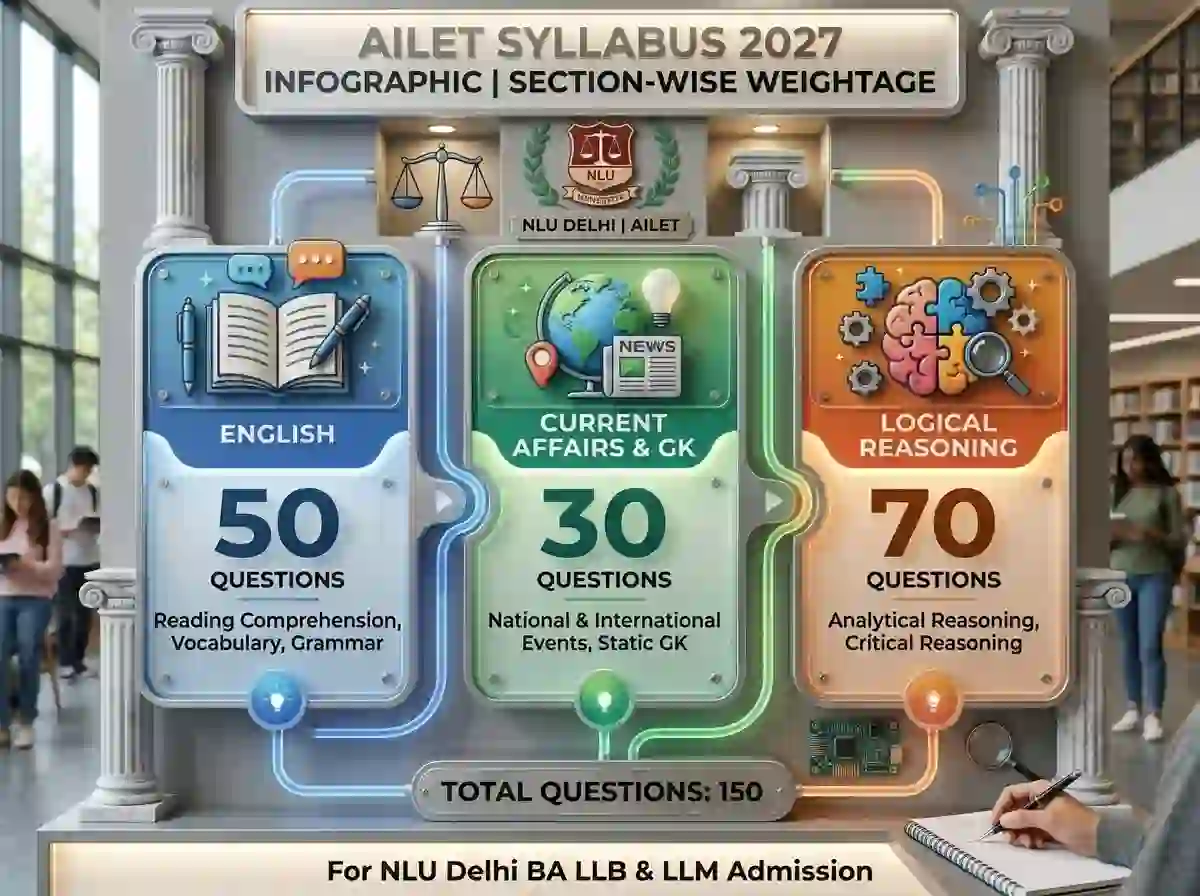
1. AILET Syllabus 2027 | Overview and Key Facts
The AILET 2027 syllabus (All India Law Entrance Test) is prescribed by the National Law University (NLU), Delhi for admission to its prestigious BA LLB (Hons.), LLM, and PhD programmes. AILET is the only entrance examination for NLU Delhi | the country's top-ranked law school | making it one of India's most competitive law admission tests despite its focused, three-section structure.
Unlike CLAT, which tests five subjects including Mathematics, AILET has no Mathematics or Quantitative section. The entire exam revolves around language comprehension, general awareness, and logical reasoning. This makes AILET simultaneously accessible and deeply demanding | the breadth of the GK section and the difficulty of the Logical Reasoning passages require sustained, strategic preparation.
2. AILET 2027 Exam Pattern | Structure and Marking Scheme
Before diving into the subject-wise syllabus, understanding the exact exam structure will help you plan your preparation and time management strategy on exam day.
| Section | No. of Questions | Total Marks | Weightage | Difficulty Level |
|---|---|---|---|---|
| English Language | 50 | 50 | 33.3% | Moderate to High |
| Current Affairs & GK | 30 | 30 | 20% | Moderate |
| Logical Reasoning | 70 | 70 | 46.7% | High |
| Total | 150 MCQs | 150 Marks | 100% | High (competitive) |
| Criteria | Detail |
|---|---|
| Exam Mode | Offline (Pen & Paper based) |
| Question Type | Multiple Choice Questions (MCQs) | 4 options each |
| Total Questions | 150 |
| Total Marks | 150 |
| Duration | 120 minutes (2 hours) |
| Marks per Correct Answer | +1 mark |
| Negative Marking | −0.25 marks per wrong answer |
| Unattempted Questions | 0 marks (no penalty) |
| Sectional Time Limit | None | candidates manage their own time |
| Tie-Breaker | Higher marks in Logical Reasoning → if still tied, older candidate preferred → then draw of lots |
| Medium | English only |
| Exam Date (AILET 2027) | December 13, 2026 (Sunday) | 2:00 PM – 4:00 PM |
With -0.25 negative marking, attempting 130 questions with 85% accuracy gives you 98.75 marks. Attempting all 150 with 75% accuracy gives you 75 marks. Aim for 120+ attempts with 88%+ accuracy | that's the topper strategy in AILET.
3. AILET 2027 Syllabus | Section-Wise Topics
Here is the comprehensive section-wise topic breakdown for AILET 2027, compiled from the official NLU Delhi notification and verified against 5+ years of previous year question papers:
3.1 AILET English Language Syllabus 2027
The English Language section in AILET is fundamentally different from other law entrance exams. Rather than isolated grammar questions, AILET tests your ability to engage analytically with long, complex passages. Most of the 50 questions are woven around 3–4 reading comprehension passages drawn from literary, journalistic, academic, and philosophical sources.
AILET RC passages are noticeably longer (600–900 words each) and more argumentative than CLAT passages. They frequently draw from philosophy, jurisprudence, and policy debates. Inference-based questions often have two "almost correct" options | the ability to distinguish nuanced differences is the key skill. Read 2–3 quality long-form articles daily from sources like The Hindu editorial, EPW, and Aeon to build this muscle.
3.2 AILET Current Affairs & GK Syllabus 2027
The Current Affairs and General Knowledge section in AILET is compact but high-stakes | each question in this section is faster to answer than Reasoning, so a well-prepared GK section can save you precious minutes. The section covers approximately the last 12–18 months of national and international events along with static GK (Indian Polity, History, Geography, Science) and legal developments.
| Topic Area | Expected Questions | Priority | Key Sub-Topics |
|---|---|---|---|
| National Current Affairs | 8–10 | High | Government schemes, Parliament legislation, Supreme Court verdicts, Union Budget, appointments |
| International Affairs | 4–6 | High | UN resolutions, bilateral summits, international organizations, geopolitical developments |
| Legal & Judicial Updates | 3–5 | High | Landmark Supreme Court & High Court judgments, Bar Council updates, legal reforms, new legislation |
| Indian Polity & Constitution | 3–4 | Medium | Constitutional amendments, fundamental rights cases, legislative process, electoral system |
| History & Culture | 2–3 | Medium | Modern Indian history, freedom movement, art & culture, UNESCO Heritage sites |
| Geography | 1–2 | Lower | Physical geography, states/capitals, rivers, mountains, natural disasters |
| Science & Technology | 2–3 | Medium | ISRO missions, defence technology, medical breakthroughs, climate science, AI & tech policy |
| Awards, Sports & Miscellaneous | 2–4 | Medium | Padma awards, Nobel prizes, Olympic results, Booker/literary prizes, Commonwealth Games |
Spend exactly 20–30 minutes daily on current affairs | not more. Use The Hindu or Indian Express (morning edition), and make brief notes for legal developments and Supreme Court verdicts, which are uniquely important for AILET. Compile a monthly one-page current affairs digest from August 2026 onwards as you approach the December 2026 exam.
3.3 AILET Logical Reasoning Syllabus 2027
The Logical Reasoning section is the heartbeat of AILET. With 70 out of 150 questions | and serving as the primary tie-breaker | your performance here directly determines your NLU Delhi rank. This section is also where AILET most significantly diverges from other law entrance exams: the questions are passage-based, test deep analytical reasoning, and many include legal principles to test rule-application without requiring prior legal knowledge.
| Topic Type | Expected Questions | Priority | Nature of Questions |
|---|---|---|---|
| Critical Reasoning (Passage-based) | 20–25 | Highest | Strengthen/weaken arguments, assumption, inference, conclusion, logical flaw identification |
| Legal Aptitude & Principle-Fact Reasoning | 15–20 | Very High | Legal principle given → apply to a factual situation → determine liability/outcome (no prior law knowledge needed) |
| Analytical Reasoning / Puzzles | 10–15 | High | Linear/circular arrangements, blood relations, direction sense, scheduling, floor puzzles |
| Syllogisms | 5–8 | High | Premise-conclusion validity, Venn diagram-based syllogisms, deductive logic |
| Number & Letter Series | 3–5 | Medium | Identify the pattern, find the missing term, odd-one-out |
| Analogies & Classification | 3–5 | Medium | Word analogies, number analogies, odd-one-out classification |
| Coding–Decoding | 3–5 | Medium | Letter substitution codes, number codes, symbol-based coding |
| Statement & Assumption / Conclusion | 5–8 | Medium | Implicit assumptions, valid conclusions, course of action questions |
AILET includes legal principle-based reasoning questions where a principle (e.g., "A person is not liable if they acted in self-defence proportionate to the threat") is given, followed by a factual scenario. You apply the principle to determine the correct legal outcome. No prior knowledge of law is required or useful here | it purely tests your ability to read rules carefully and apply them accurately. Practising Contract Law, Torts, and Criminal Law principles in previous year AILET papers is the most efficient preparation for this sub-type.
4. AILET LLM Syllabus 2027
The AILET LLM (Postgraduate) syllabus is entirely different from the undergraduate BA LLB exam. It tests core legal knowledge across multiple branches of law through 100 MCQs in 120 minutes. The descriptive/essay section that existed previously was removed from the LLM exam in 2025.
| Parameter | AILET BA LLB 2027 | AILET LLM 2027 |
|---|---|---|
| Total Questions | 150 MCQs | 100 MCQs |
| Duration | 120 minutes | 120 minutes |
| Sections | English, GK, Reasoning | All Law Subjects |
| Marks per Question | +1 | +1 |
| Negative Marking | −0.25 | −0.25 |
| Descriptive Section | None | Removed (2025 onwards) |
| Tie-Breaker | Higher LR marks → Age | Older candidate preferred |
| Seats at NLU Delhi | 120 (BA LLB) | ~81 (LLM) |
AILET LLM 2027: Core Law Subjects (Expected Topic Distribution)
| Law Subject | Expected Questions | Key Topics |
|---|---|---|
| Constitutional Law | 15–18 | Fundamental Rights, DPSP, Federalism, Constitutional amendments, Landmark judgments (Kesavananda, Maneka Gandhi, Vishaka, NJAC) |
| Jurisprudence | 12–15 | Schools of jurisprudence, natural law, positivism, realism, concepts of rights, obligation, ownership, possession, liability |
| Indian Penal Code / Criminal Law | 10–12 | General exceptions, specific offences, mens rea, actus reus, IPC provisions, CrPC key sections |
| Contract Law | 8–10 | Formation of contract, consideration, void/voidable contracts, breach, remedies, specific performance, Indian Contract Act 1872 |
| Law of Torts | 8–10 | Negligence, nuisance, defamation, vicarious liability, strict liability (Rylands v Fletcher), occupier's liability |
| Family Law | 7–9 | Hindu Marriage Act, Muslim Personal Law, Succession Acts, adoption, guardianship, maintenance |
| Property Law | 5–7 | Transfer of Property Act, easements, mortgages, leases, doctrine of lis pendens |
| Administrative Law | 5–7 | Delegated legislation, judicial review, natural justice, writs, tribunals, ombudsman |
| International Law | 5–7 | Sources, subjects, state responsibility, UN Charter, treaties, ICJ jurisdiction, international humanitarian law |
| Environmental Law | 4–6 | Precautionary principle, polluter pays, Environmental Protection Act, NGT, UNFCCC, major environment cases |
| Current Legal Developments | 3–5 | Recent Supreme Court judgments (last 18 months), legislative changes, BNS/BNSS, DPDP Act, legal policy updates |
NLU Delhi does not publish a separate topic-wise LLM syllabus PDF. The guidance is that "questions will be from various branches of law." Prioritize Constitutional Law, Jurisprudence, and Criminal Law | these three subjects alone account for 35–45% of LLM questions based on previous paper analysis. Always verify current updates at nationallawuniversitydelhi.in.
5. AILET Syllabus vs CLAT Syllabus | Key Differences
Many candidates preparing for law entrance exams simultaneously target both AILET and CLAT. While there is significant syllabus overlap, there are critical structural differences you must account for in your preparation:
Yes | approximately 70% of the syllabus overlaps. English RC, Current Affairs, and basic Logical Reasoning preparation serves both exams. The key differences: (1) AILET requires stronger analytical reasoning compared to CLAT's pattern-based questions; (2) CLAT has Legal Reasoning as a distinct section with legal principles to study, whereas AILET embeds legal aptitude within Reasoning; (3) CLAT requires Mathematics, which AILET does not. Allot specific weeks for AILET-specific deep reasoning practice alongside your CLAT preparation.
6. AILET 2027 Syllabus-Based Preparation Strategy
The following preparation strategy is calibrated to the official AILET 2027 syllabus and section weightages. Time allocation is based on what consistently produces top-100 ranks:
7. Best Books for AILET 2027 Syllabus Preparation
Based on toppers' recommendations and syllabus alignment, here are the most effective resources for each section of AILET 2027:
| Section | Book / Resource | Why It's Useful |
|---|---|---|
| English Language | Word Power Made Easy | Norman Lewis | Best vocabulary builder; contextual meaning approach matches AILET style |
| English Language | RC passages from Economist, The Atlantic, Aeon | AILET passages often mirror long-form analytical journalism style |
| English Grammar | Wren & Martin High School Grammar | Foundational grammar reference for error spotting and sentence correction |
| Current Affairs | The Hindu / Indian Express | daily reading | Primary source for legal news, SC verdicts, policy, and international affairs |
| Current Affairs | Lucent's General Knowledge | Comprehensive static GK | polity, history, geography, science in one volume |
| Logical Reasoning | A Modern Approach to Logical Reasoning | R.S. Aggarwal | Best for analytical puzzles, syllogisms, series, and classification |
| Logical Reasoning | AILET Previous Year Question Papers (2018–2024) | Most important resource | actual exam patterns, difficulty level, and question types |
| Legal Aptitude (in LR) | Legal Aptitude for CLAT/AILET | A.P. Bhardwaj | Principle-fact questions practice; no law background needed; directly relevant |
| Mock Tests | CLATapult / LegalEdge / PW Law / iQuanta Law | Full-length AILET-specific mocks with detailed solutions and rank predictors |
8. AILET Syllabus 2027 | Frequently Asked Questions
No. Unlike CLAT, AILET does not include Mathematics or Quantitative Techniques. The three sections are English Language (50Q), Current Affairs & GK (30Q), and Logical Reasoning (70Q). This has been consistent across AILET editions and is confirmed in the official NLU Delhi notification.
No. AILET does not have a dedicated Legal Reasoning section. Legal principle-based questions (where a principle is given and you apply it to a fact situation) appear within the Logical Reasoning section. These test your rule-application ability, not your prior legal knowledge. This is different from CLAT where Legal Reasoning is a standalone section worth ~28–32 marks.
AILET 2027 BA LLB has 150 multiple-choice questions to be answered in 120 minutes (2 hours). There is no sectional time limit | you can allocate your 120 minutes freely across all three sections. Each correct answer = +1 mark. Each wrong answer = −0.25 marks. Unattempted questions = 0 marks.
AILET 2027 is expected on December 13, 2026 (Sunday), 2:00 PM – 4:00 PM, as per NLU Delhi's academic calendar. NLU Delhi offers 120 seats for BA LLB (Hons.) and approximately 81 seats for LLM. Admission is exclusively through AILET | NLU Delhi does not participate in CLAT. The registration form is expected to open on the official website (nationallawuniversitydelhi.in) in September 2026.
AILET and CLAT test largely overlapping skills, but AILET is considered more intense for two reasons: (1) the Logical Reasoning section is significantly more analytical and passage-heavy, especially the critical reasoning and legal-aptitude sub-questions; and (2) the sheer competition | approximately 16,000 candidates compete for 120 seats (~133:1 ratio) versus CLAT's ~4,500 seats for 75,000 candidates (~17:1). The per-seat competition at NLU Delhi through AILET is substantially higher.
Yes. AILET is conducted solely by and for the National Law University, Delhi. It is not shared with any other institution. NLU Delhi is also one of only two NLUs (along with NLU Meghalaya) that do not participate in the Consortium of NLUs' CLAT. If your goal is NLU Delhi admission, AILET is the only route.
9. AILET 2027 Important Dates
| Event | Expected Date | Status |
|---|---|---|
| AILET 2027 Notification Release | August–September 2026 | Upcoming |
| Registration Opens | September 2026 | Upcoming |
| Application Form Last Date | November 2026 | Upcoming |
| Admit Card Release | December 2026 (1st week) | Upcoming |
| AILET 2027 Exam Date | December 13, 2026 (Sunday) | Upcoming |
| AILET 2027 Exam Time | 2:00 PM – 4:00 PM | Upcoming |
| Provisional Answer Key | December 2026 (3rd week) | Upcoming |
| Result Declaration | January 2027 | Upcoming |
| Counselling / Merit List | January–February 2027 | Upcoming |
| AILET 2026 (Previous Exam) | December 14, 2025 | 2:00 PM – 4:00 PM | Completed |
Dates above are based on historical patterns and NLU Delhi's stated academic calendar. Always check the official website nationallawuniversitydelhi.in for final confirmed dates. AILET dates can shift; the 2026 exam was held on December 14, 2025, and the 2027 exam is expected on December 13, 2026.
10. AILET 2027 Eligibility | Quick Summary
| Criterion | BA LLB (Hons.) | LLM |
|---|---|---|
| Qualifying Exam | Class 12 (10+2) | LLB / BL Degree |
| Minimum Marks | General | 45% in Class 12 | 50% in LLB |
| Minimum Marks | OBC (NCL) | 42% in Class 12 | 47.5% in LLB |
| Minimum Marks | SC/ST/PwD | 40% in Class 12 | 45% in LLB |
| Age Limit | No upper age limit | No upper age limit |
| Appearing Candidates | Eligible (must meet criteria by NLU Delhi cut-off date) | Eligible (must have result before admission) |
| Foreign Nationals (BA LLB) | 65% in Class 12 | exempt from AILET | 55% in LLB | interview + English test |
| Number of Attempts | No restriction | No restriction |
* Source: NLU Delhi official admission notification. Always check nationallawuniversitydelhi.in for the current year's eligibility criteria.