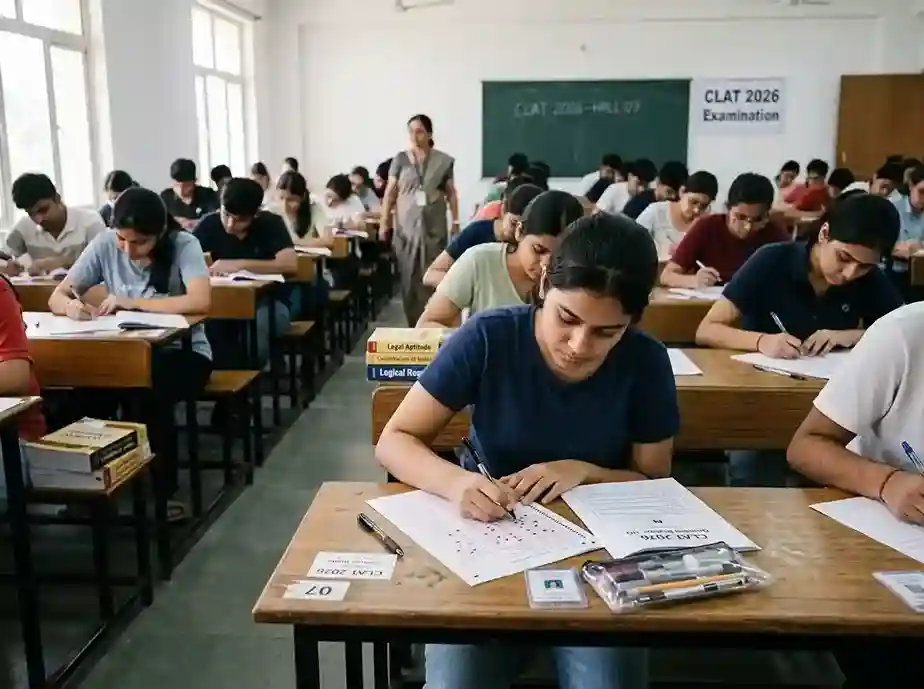
CLAT 2026 was conducted on December 7, 2025 across 156 centres in 25 states and 4 UTs. Results declared December 16, 2025. Final allotment round concluded May 25, 2026.
📋 CLAT 2026 Complete Guide | What's Inside
1. CLAT 2026 | Overview & Key Facts
The Common Law Admission Test (CLAT) is India's centralised national-level law entrance examination, conducted by the Consortium of National Law Universities (NLUs). CLAT 2026 was the gateway to undergraduate (5-year BA LLB / BBA LLB) and postgraduate (1-year LLM) programmes at 24 participating NLUs across India, along with 60+ affiliated private law colleges that accept CLAT scores.
🏛 CLAT 2026 | Snapshot
Conducting Body: Consortium of National Law Universities | Official Website: consortiumofnlus.ac.in
Exam Date: December 7, 2025 (Sunday), 2:00–4:00 PM | Mode: Offline (pen-and-paper)
Centres: 156 test centres in 25 States and 4 UTs | Total Applicants: 92,344 (UG: 75,009 | PG: 17,335)
Attendance: 96.01% | Result Date: December 16, 2025
UG Topper Score: 112.75 / 120 | PG Highest Score: 104.25
Participating NLUs: 24 NLUs + IIULER Goa | Total UG Seats: ~3,900+
Final Allotment Round: May 20, 2026 | Admission Deadline: May 25, 2026
Gender Split: 57% Female | 43% Male | 9 Transgender candidates
92,344
Total Registered Candidates
17,335
PG Registrations (LLM)
96.01%
Overall Attendance Rate
CLAT has been the dominant gateway to India's premier legal education since 2008. Unlike most competitive exams, CLAT is unique in that it is entirely passage-based | every section requires reading a short paragraph and answering comprehension, reasoning, or application questions from it. This makes CLAT fundamentally a test of reading speed, analytical comprehension, and contextual reasoning | not rote knowledge of legal facts.
2. CLAT 2026 Important Dates | Complete Timeline
Below is the complete chronological timeline of CLAT 2026 | from notification release through the final allotment round and admission deadline:
✅
COMPLETED
CLAT 2026 Notification Released
July 2025 | Official notice on consortiumofnlus.ac.in
✅
COMPLETED
Registration Opens
August 2025 | Online at consortiumofnlus.ac.in | Fee: ₹4,000 (General) / ₹3,500 (SC/ST/PwD)
✅
COMPLETED
Admit Card Released
Late November 2025 | Download via registered login at CLAT portal
✅
COMPLETED
CLAT 2026 Exam Conducted
December 7, 2025 (Sunday) | 2:00 PM – 4:00 PM | 156 centres across India
✅
COMPLETED
Provisional Answer Key + Objection Window
December 10, 2025 | Objection window: December 10–12, 2025
✅
COMPLETED
CLAT 2026 Result Declared + Final Answer Key
December 16, 2025 | Topper: 112.75/120 (UG) | Download at consortiumofnlus.ac.in
✅
COMPLETED
Round 1 Merit List + Seat Allotment
January 7, 2026 | First allotment list published | Acceptance window opened
✅
COMPLETED
Round 2 Merit List
January 22, 2026 | Vacated seats reallocated in Round 2
✅
COMPLETED
PG (LLM) Round 3 Merit List
February 5, 2026 | PG 3rd allotment; payment window Feb 5–12, 2026
✅
COMPLETED
Round 4 Merit List
May 9, 2026 (UG Round 4) | May 2, 2026 (PG Round 4)
✅
COMPLETED
Round 5 | FINAL Allotment List Released
May 20, 2026 (10:00 AM) | Last round | no further allotment
✅
COMPLETED
Final Seat Confirmation Deadline
May 25, 2026 (2:00 PM) | Accept seat + pay confirmation fee | CLAT 2026 admissions CLOSED
🔔
UPCOMING
CLAT 2027 Notification Expected
Last week of July 2026 | Per Consortium's April 11, 2026 communication
🔔
UPCOMING
CLAT 2027 Registration Opens
Expected August 1–3, 2026 | At consortiumofnlus.ac.in
🔔
UPCOMING
CLAT 2027 Exam Date
December 6, 2026 (tentative | first Sunday of December) | 26 NLUs participating
3. CLAT 2026 Exam Pattern | The Complete Breakdown
CLAT 2026 (and all CLAT exams from 2024 onwards) follows a standardised pattern that is fundamentally different from the pre-2021 format. Understanding this pattern is the single most important thing any CLAT aspirant must do before beginning preparation.
📊 CLAT 2026 Exam Pattern | At a Glance
Total Questions: 120 MCQs | Total Marks: 120 | Duration: 120 minutes (2 hours)
Mode: Offline (pen and paper) | OMR sheet | Marking: +1 correct, −0.25 wrong, 0 unattempted
Question Type: Passage-based MCQs (all sections) | no direct recall questions
Sectional Time Limit: None | candidates can attempt sections in any order
Language: English only | Session: Single session, 2:00 PM – 4:00 PM
Each set of questions is based on a passage of 450–500 words taken from contemporary writing, journalism, fiction, or non-fiction texts. Questions test: reading comprehension (main idea, tone, theme), inference and implication, vocabulary in context (synonyms, antonyms, idioms), grammar and sentence structure, paraphrasing and summarising, and identifying the author's argument or assumption. Strategy note: This is one of the most time-efficient sections for strong readers | 22–26 questions in a well-practised candidate's hands can take under 20 minutes. Never skip a passage entirely; even partial reading yields correct answers on inference questions.
The highest-weightage section alongside Legal Reasoning. Questions are based on passages about current events and GK topics | not direct factual recall. Topics covered: national & international affairs (government policy, elections, international relations, treaties), economic developments, science & technology (AI, space, environment), sports & cultural events, historical events of continuing significance, awards and honours, and important appointments. Strategy note: Reading one quality national newspaper daily (The Hindu or Indian Express) from June onward, plus monthly CLAT-focused current affairs magazines, is non-negotiable for scoring 90%+ in this section. The passage format means even partially unfamiliar topics can yield correct answers through careful reading.
The most critical differentiating section | Legal Reasoning separates top CLAT scores from average ones. Each question set presents a legal principle stated in the passage, followed by a factual scenario. Candidates must apply the stated principle to the scenario to reach a conclusion | no prior knowledge of law is required or rewarded. Key question types: principle-fact application, identify the correct legal conclusion, identify which principle applies to the given facts, and current legal issues discussed in passage context. Sub-topics covered: contracts, torts, criminal law, property, constitutional law, international law, and legal current events. Critical insight: The answer is always derivable from the passage | students who rely on what they "know" about law outside the passage consistently underperform those who read and apply only what the passage states.
Passages of ~450 words present arguments, propositions, or scenarios. Questions test critical reasoning abilities: identify the assumption underlying an argument, strengthen or weaken an argument, find the logical conclusion, identify the logical flaw, cause-and-effect analysis, analogy-based reasoning, and sequencing/ordering. Strategy note: This section rewards structured thinkers. Practice with formal argument mapping | identify premise, assumption, conclusion | before attempting CLAT-style questions. Time investment: 25–30 minutes for this section is typical for well-prepared candidates. Avoid over-reliance on intuition; every correct answer has a logically defensible basis in the passage.
The smallest section by weightage but often the most feared by humanities students. Questions are based on short numerical passages, charts, tables, or data sets. Topics: percentage and ratio, profit-loss and discount, time-speed-distance, time and work, data interpretation (bar charts, pie charts, line graphs, tables), basic statistics (mean, median, mode), and simple algebra (Class 10 standard). Strategy note: With 10–14 questions at Class 10 level, this section is a guaranteed 10–14 marks for any candidate who prepares even moderately. Do not sacrifice this section for fear of maths | targeted 4-week preparation covering DI and percentages is sufficient to score 80%+ here. Practise reading data tables under time pressure.
4. CLAT 2026 Syllabus | What the Consortium Tests
The CLAT syllabus has been deliberately designed to test aptitude and comprehension rather than domain knowledge. The Consortium of NLUs made a decisive pivot from knowledge-based testing (pre-2021) to the current comprehension-based format | a change that fundamentally rewards consistent readers and critical thinkers over rote memorisers. Here is what each section actually demands:
English Language | What the Syllabus Demands
The English section tests whether you can read a passage and understand what it actually says | not what you think it says. Specific skills: (a) identifying the central argument or main theme; (b) making inferences from stated information; (c) understanding the author's tone (critical, celebratory, neutral, ironic); (d) identifying the meaning of words and phrases in context (not in isolation); (e) summarising or paraphrasing a paragraph; (f) identifying which statement logically follows from the passage. The vocabulary component is context-dependent | a word you know in one sense may be used differently in the passage. The grammar component tests sentence completion, error spotting, and idiom usage at the Class 11–12 level.
Current Affairs & GK | What the Syllabus Demands
This is a current affairs comprehension section, not a static GK section. The passage gives you context about a current event; questions ask about details, implications, or background information connected to it. Static GK (polity fundamentals, Constitution basics, landmark judgments, important international organisations, award winners, sports records) does appear | but always embedded in a passage. Two distinct tracks: (a) Dynamic current affairs | news from the past 12 months (especially political, legal, economic, and international developments); (b) Legal current affairs | recent Supreme Court judgments, new legislation, major regulatory changes (this overlaps significantly with Legal Reasoning). The highest-scoring CLAT aspirants read The Hindu for both tracks simultaneously.
Legal Reasoning | What the Syllabus Demands
The Legal Reasoning section is not testing whether you know the law. It is testing whether you can apply a given rule to a given set of facts and reach the correct legal conclusion. This is the fundamental skill of a lawyer | and CLAT tests it from Class 12. The stated "principle" in each passage may be a fictional rule, a real legal rule, or a policy principle. Your job: apply it exactly as stated, without importing your own knowledge. Sub-topic coverage is broad: contracts (offer, acceptance, consideration), torts (negligence, nuisance, liability), criminal law (actus reus, mens rea, defences), constitutional law (fundamental rights, state action), property law, and international law. The passage also discusses current legal events | recent SC judgments, new laws, regulatory developments | which overlap with the GK section.
Logical Reasoning | What the Syllabus Demands
Logical Reasoning tests your ability to critically evaluate arguments. Every question presents a passage containing one or more arguments (claims supported by reasons). You must: (a) identify the explicit conclusion of the argument; (b) identify the implicit assumption (the unstated premise the argument requires to be valid); (c) determine which statement would strengthen or weaken the argument; (d) identify the logical flaw in the reasoning (ad hominem, false analogy, circular reasoning, correlation-causation error); (e) draw the most reasonable inference. This section has no "content syllabus" beyond formal logical reasoning | it is purely a skills test. Practice with formal argument mapping exercises and 100+ past CLAT logical reasoning passages before exam day.
Quantitative Techniques | What the Syllabus Demands
The QT section requires applying Class 10 mathematics to data presented in passages, tables, or charts. Specific topics: (a) percentage calculations (discounts, profit/loss, growth rates); (b) ratio and proportion; (c) time-speed-distance and time-work problems; (d) data interpretation | reading bar graphs, pie charts, line graphs, and tables accurately; (e) basic statistics | mean, median, mode from a data set; (f) simple algebra | solving for unknowns. The difficulty level is deliberately constrained to Class 10 | no calculus, no trigonometry, no complex algebra. Speed and accuracy with basic arithmetic, and the ability to extract numbers from a data table without misreading, are the key skills to develop.
5. CLAT 2026 Eligibility Criteria
| Criterion | CLAT UG (BA LLB) | CLAT PG (LLM) |
|---|
| Educational Qualification | Passed Class 12 (or equivalent) from a recognised board | LLB degree (3-year or 5-year) from a BCI-recognised institution |
| Minimum Percentage | 45% aggregate (40% for SC/ST/PwD) | 50% aggregate in LLB (45% for SC/ST) |
| Stream Restriction | None | Science, Commerce, Arts all eligible | Law degree only |
| Appearing Students | Class 12 appearing candidates eligible (provisional) | Final year LLB candidates eligible (provisional) |
| Age Limit | No upper age limit (Supreme Court ruling) | No upper age limit |
| Number of Attempts | Unlimited (no restriction) | Unlimited (no restriction) |
| Nationality | Indian national; NRI/OCI/PIO candidates also eligible (different fee) |
⚠️ No Age Limit | Supreme Court Ruling
The Supreme Court of India struck down the Bar Council of India's age restriction for LLB admissions | meaning there is no maximum age limit for appearing in CLAT or pursuing law. A 40-year-old IAS officer, a retired professional, or anyone who clears Class 12 can legally appear for CLAT and pursue an LLB. The NLUs themselves also do not impose age restrictions for CLAT UG admissions. This is a frequently misunderstood aspect | many candidates assume there is an age cap based on older BCI rules that have since been struck down.
6. CLAT 2026 Result & Paper Analysis
The CLAT 2026 results were declared on December 16, 2025 | nine days after the exam. The Consortium's score tabulation and verification process (December 14–15) and Governing Body approval (December 16) followed the standard timeline. Here is what the CLAT 2026 performance data tells us:
| CLAT 2026 Data Point | UG (BA LLB) | PG (LLM) |
|---|
| Total Registered | 75,009 | 17,335 |
| Appeared (approx.) | ~72,000 | ~16,026 |
| Attendance Rate | 96.01% overall |
| Highest Score | 112.75 / 120 | 104.25 / 120 |
| City with Most Top-100 Qualifiers | Bengaluru | 15 qualifiers in top 100 | | |
| Gender Split | 57% Female | 43% Male | 9 Transgender |
| Result Date | December 16, 2025 |
| Score Download | consortiumofnlus.ac.in (login with mobile + password) |
What CLAT 2026 Paper Difficulty Tells CLAT 2027 Aspirants
A CLAT 2026 UG topper score of 112.75/120 (93.96% of total marks) indicates a moderately difficult to moderate paper | not an extremely easy paper (which would push toppers above 115) and not an extremely hard one (which drags toppers below 108). This is consistent with the post-2024 pattern of stable passage-based difficulty. Key takeaway for CLAT 2027 aspirants: the exam consistently rewards candidates who can read fast, accurately, and without skipping passages. A score of 95–100 marks (79–83% of total) typically places a candidate in the top 500, which gets into all but the top 3 NLUs. A score of 105+ (87.5%+) is typically required for NLSIU Bangalore's top-100 cutoff.
7. CLAT 2026 Cutoff | NLU-Wise (All Categories, Round 1 & Round 5)
CLAT cutoff is the closing rank (not score) at which the last seat at a given NLU for a given category is filled in a given counselling round. Cutoffs shift with each round as candidates accept, decline, or upgrade seats. Below are the key cutoff figures from Round 1 (most competitive) and Round 5 (final):
⚠️ Critical Note: Cutoff Is a Rank, Not a Score
CLAT admission is rank-based, not marks-based. Even a 0.25-mark difference can separate hundreds of candidates. A candidate with 98 marks may be ranked 200, while one with 97.75 marks may be ranked 350 | and those 150 rank positions can mean the difference between NLSIU Bangalore and NLU Jodhpur. Always focus on rank, not score, when evaluating your NLU prospects.
NLU
Gen (R1 Close)
Gen (R5 Close)
EWS
SC
NLSIU Bangalore (NIRF #1)
AIR 102
AIR 108
~AIR 700
~AIR 3,100
NALSAR Hyderabad (NIRF #3)
AIR 167
AIR 189
~AIR 900
~AIR 3,500
NUJS Kolkata | BA LLB (NIRF #4)
AIR 277
AIR 310
~AIR 1,200
~AIR 4,200
NLU Jodhpur (NIRF #5)
AIR ~380
AIR ~430
~AIR 1,500
~AIR 5,000
HNLU Raipur (NIRF #6)
AIR ~490
AIR ~560
~AIR 1,800
~AIR 5,500
GNLU Gandhinagar (NIRF #8)
AIR ~550
AIR ~630
~AIR 2,000
~AIR 6,000
RMLNLU Lucknow (NIRF #9)
AIR ~600
AIR ~680
~AIR 2,200
~AIR 6,500
CNLU Patna / NLUO Cuttack / NUALS Kochi
AIR ~700–900
AIR ~800–1,050
Varies
Varies
Mid-Tier NLUs (Ranks 10–17)
AIR ~900–1,500
AIR ~1,100–1,800
Varies
Varies
Lower-Tier NLUs (Ranks 18–24)
AIR ~1,500–3,500
AIR ~2,000–4,500
Varies
Varies
What Rank Do You Need for Which NLU?
CLAT AIR Range (General)
Likely NLUs (Round 1)
Recommended Strategy
AIR 1 – 100
NLSIU Bangalore guaranteed (Round 1)
Select NLSIU, done
AIR 101 – 200
NALSAR Hyderabad (likely) / NUJS Kolkata
Float for NLSIU, accept NALSAR
AIR 201 – 400
NUJS Kolkata / NLU Jodhpur
Float for NALSAR, lock NLU Jodhpur
AIR 401 – 700
NLU Jodhpur / HNLU / GNLU
Choose by location preference
AIR 701 – 1,500
Mid-tier NLUs (CNLU, NLUO, etc.)
Evaluate location + placement data
AIR 1,501 – 4,000
Lower NLUs + SLS Pune / Jindal via SLAT
Consider top private law schools
AIR 4,001+
Non-NLU private/state law colleges
Reattempt CLAT 2027 or target SLAT
8. CLAT 2026 Counselling Process | 5 Rounds Explained
The CLAT counselling process is conducted entirely online by the Consortium of NLUs. Understanding how it works | particularly the float and freeze options | is critical to maximising your NLU allotment. CLAT 2026 had 5 counselling rounds (4 UG + 4 PG rounds with some overlap).
1
Result Declared + Scorecard Download
December 16, 2025 | consortiumofnlus.ac.in
After CLAT 2026 results were declared on December 16, 2025, all registered candidates could log in using their mobile number and password to download their official scorecard. The scorecard shows: total raw score, All India Rank (AIR), category rank, and qualification status (whether you have qualified for counselling). Important: Even candidates with AIR 10,000+ who want seats at non-NLU affiliated colleges (60+ private law colleges accepting CLAT scores) must register for counselling to use their scores. Many SLS Pune, Jindal, and private law college admissions also use CLAT scorecards.
2
Choice Filling | NLU Preference Order
Before Round 1 | Fill all 24 NLU preferences in ranked order
Before the first allotment round, all candidates must fill their NLU preference list | ranking all 24 participating NLUs in order of their choice. This is the single most consequential decision in the counselling process. Rules: (a) You can rank any number of NLUs; (b) Rank your absolute dream college first; (c) If allotted your Round 1 choice, you may "freeze" (accept permanently) or "float" (accept provisionally while remaining in the pool for better seats in the next round). Strategic tip: Always list all 24 NLUs | never leave the list at only 2–3 choices, as this eliminates you from consideration at remaining NLUs if your top choices fill up.
3
Round 1 Allotment + Freeze / Float Decision
January 7, 2026 | 48–72 hour acceptance window
The Consortium released Round 1 allotments on January 7, 2026. For each allotted seat, candidates have three choices within the acceptance window: Freeze (accept the seat permanently, pay confirmation fee | you are out of further rounds), Float (accept this seat provisionally, pay confirmation fee | you remain in the pool for higher-ranked NLUs in Round 2, and the Round 1 seat is held as your fallback), or Decline (reject the allotment | your CLAT score enters the next round's fresh pool but you lose the confirmed seat). Never decline without having a confirmed alternative. Float is almost always the right choice if you have a higher-ranked NLU preference unfulfilled.
4
Rounds 2–4 | Seat Upgrades & Vacancy Filling
January 22 (R2), May 2–9 (R3/R4) | Declining candidates' seats re-enter pool
After Round 1, seats that were declined, or held by floating candidates who later received better allotments, re-enter the pool in subsequent rounds. The cutoff for top NLUs typically increases slightly in later rounds as demand from floating candidates fills remaining seats. Mid and lower-tier NLU cutoffs may decrease in later rounds as seats remain unfilled. Candidates who float successfully and receive an upgrade in Round 2 or beyond should evaluate whether the upgrade is genuinely better | sometimes a Round 2 upgrade to a slightly better NLU isn't worth losing a Round 1 seat at a location you strongly prefer.
5
Round 5 (Final) | Last Chance, No Further Allotment
Released May 20, 2026 | Confirmation deadline May 25, 2026 (2:00 PM)
The 5th and final allotment list was released May 20, 2026. All candidates in Round 5 must accept their allotted seat and pay the confirmation fee by May 25, 2026 at 2:00 PM | no extensions are possible. After this deadline, all unconfirmed seats are released and the CLAT 2026 counselling cycle is officially closed. Candidates who did not confirm by this deadline forfeit their seat permanently. The academic year 2026–27 commences on July 1 at all NLUs.
9. CLAT 2026 | Participating NLUs & Seat Matrix
CLAT 2026 saw 24 NLUs + IIULER Goa participating in centralised counselling. NLU Delhi (NLU-D) does not participate in CLAT | it conducts its own AILET (All India Law Entrance Test) separately. Below are the key participating NLUs and approximate seat counts:
🏛 24 NLUs Participating in CLAT 2026 (UG Seats ~3,900+)
Tier 1 (Top 5): NLSIU Bangalore (~120 UG) · NALSAR Hyderabad (~120) · NUJS Kolkata (~174) · NLU Jodhpur (~180) · HNLU Raipur (~180)
Tier 2 (Ranks 6–12): RMLNLU Lucknow · GNLU Gandhinagar · CNLU Patna · NUALS Kochi · NLUO Cuttack · NLU Assam · NLIU Bhopal · TNNLU Tiruchirappalli
Tier 3 (Ranks 13–24): DNLU Jabalpur · MNLU Aurangabad · MNLU Mumbai · MNLU Nagpur · NUSRL Ranchi · HPNLU Shimla · DBRANLU Sonepat · NLUJA Guwahati · DSNLU Visakhapatnam · RPNLU Prayagraj + IIULER Goa
NOT in CLAT: NLU Delhi (AILET) · SLS Pune (SLAT) · Jindal (JSAT) · Christ University Law (own test)
60+ Private Colleges: Also accept CLAT scores | check each college's official cut-off separately. Most accept AIR up to 8,000–10,000.
🔔 CLAT 2027 Seat Update: 26 NLUs (2 New Added)
The Consortium's April 11, 2026 executive committee meeting confirmed two new additions for CLAT 2027: NLU Tripura (Agartala) and NLU Meghalaya (Shillong), each offering 60 UG seats from the 2027–28 academic session. Total CLAT 2027 NLU count: 26 NLUs (up from 24). Total UG seats for CLAT 2027: approximately 3,520 (the Consortium's figure | note this may differ from the "3,900+" in 2026 as seat matrices are recalibrated). If you're a 2027 aspirant, these two new NLUs represent the lowest CLAT cutoff options in the 2027 cycle | ideal safety NLUs for borderline candidates. NLU Tripura and NLU Meghalaya are in the Northeast | factor in location and placement data when considering them.
10. Preparation Strategy for CLAT 2027 | Based on CLAT 2026 Analysis
The best time to start CLAT 2027 preparation is right now | with the CLAT 2026 analysis fresh and the CLAT 2027 exam approximately 7 months away (December 6, 2026). Here is a targeted, data-driven preparation strategy for each section:
1
Build Your Daily Reading Habit (12+ Months Before Exam)
CLAT's passage-based format means reading speed and comprehension are your most fundamental skills. Every section | English, Current Affairs, Legal Reasoning, Logical Reasoning, and even QT data passages | requires reading a paragraph and extracting specific information under time pressure. Non-negotiable daily habit: Read one editorial from The Hindu or Indian Express (10–15 minutes), plus skim the front page for current affairs. Within 3 months of this habit, your English and GK scores will increase measurably. Strong readers consistently score 5–10 marks more than equal-knowledge candidates in CLAT because they read the passage correctly the first time and don't waste time re-reading.
2
Master Legal Reasoning | the Highest-Impact Section
Legal Reasoning and Current Affairs each carry 25% of CLAT marks | but Legal Reasoning is where most non-lawyer Class 12 students struggle most and where coaching adds the least value (because it tests reasoning, not law knowledge). Effective preparation: (a) Solve 10 Legal Reasoning passages daily from CLAT past papers (2021–2026 | only use post-2021 papers for pattern relevance); (b) Practice the discipline of reading the principle only, applying it strictly, and ignoring what you "know" about real law; (c) Track your error types | are you misreading the principle, misreading the facts, or making faulty application? Each has a different fix. Target: 85%+ accuracy in Legal Reasoning to reach the top 500 rank band.
3
Current Affairs | Build a CLAT-Specific Knowledge System
Current affairs for CLAT spans two tracks: (a) Legal current affairs | recent Supreme Court judgments (especially constitutional law and PIL matters), new Central legislation, and major regulatory/policy changes; (b) General current affairs | politics (state and national elections), international events (UN, G20, India's bilateral relations), economy (budget highlights, RBI policy, inflation), science and technology, and sports (major tournaments). Effective resources: dedicated CLAT monthly magazines (Legal Edge, Paramount, IMS CLAT monthly digest), daily 15-minute news review, and a running "CLAT GK notebook" where you note events with their dates, the parties involved, and potential CLAT angle. Cover 12 months of current affairs (September 2025 – November 2026 for CLAT 2027).
4
Logical Reasoning | Systematic Practice, Not Intuition
Logical Reasoning improvements are directly proportional to deliberate practice | unlike English, where the gains come from general reading. Practice matrix: Week 1–2: identify argument structure (premises, assumptions, conclusions) in 10 passages; Week 3–4: practice strengthen/weaken questions exclusively; Week 5–6: assumption questions; Week 7–8: logical flaw identification; Week 9–12: full-section timed practice. Error log: after every set, classify errors as "misread passage", "wrong inference type", or "picked similar-sounding distractor". The most common error type in LR is choosing an answer that sounds correct rather than one that logically follows from the passage. Eliminate by slowing down and mapping arguments explicitly before choosing.
5
Quantitative Techniques | 4-Week Targeted Blitz
Most humanities students dread QT but it needs no more than 4 targeted weeks of preparation. Week 1: Percentage, Ratio, Profit-Loss (the three most common DI calculation types). Week 2: Time-speed-distance, Time-work, Basic statistics. Week 3: Data Interpretation | reading tables, bar charts, pie charts (focus on accuracy under 2 minutes per chart). Week 4: Full QT section timed practice. Target: complete all 10–14 QT questions in under 15 minutes and score 90%+ accuracy. With only 10–14 marks at stake, every mark here is easy relative to the effort needed for the same mark in Legal Reasoning. Do not sacrifice QT.
6
Full-Length Mock Tests | The Most Under-Used Preparation Tool
Most CLAT aspirants under-invest in full-length mock tests. The target is a minimum of 25–30 full-length mocks (120 questions, 120 minutes, strictly timed) in the 4 months before the exam. Why so many? (a) Exam stamina | 2 hours of concentrated reading under pressure is physically and mentally demanding; (b) Time management | you must develop a personal section sequence and timing strategy based on your own speed; (c) Error pattern identification | each mock reveals 3–5 consistent error patterns that can be corrected through targeted practice; (d) Score benchmarking | mocks from reputed platforms (CLATapult, LegalEdge, IMS, CL, Career Launcher) have percentile data showing your approximate rank among thousands of concurrent test-takers. Best strategy: 1 mock per week from August, escalating to 2–3 per week in October–November 2026.
11. Best Books & Resources for CLAT 2027
📚 Section-Wise Recommended Books for CLAT 2027
📗
English Language
Word Power Made Easy | Norman Lewis (vocabulary foundation). High School English Grammar | Wren & Martin (grammar reference). For comprehension practice: Solve CLAT 2021–2026 English passages (best source | actual exam level). Supplement with The Hindu editorial reading daily.
📘
Current Affairs & GK
LegalEdge Monthly CLAT GK Magazine (CLAT-specific, widely used). Lucent's General Knowledge (static GK foundation | polity, geography, economy, history). The Hindu / Indian Express (daily newspaper | non-negotiable). Monthly CLAT current affairs booklet from Career Launcher or TIME. For legal GK: LiveLaw.in and BarandBench.com (free, daily).
⚖️
Legal Reasoning
Legal Aptitude for CLAT | A.P. Bhardwaj (most widely used; covers principle-application extensively). CLAT Legal Reasoning Module | PhysicsWallah (PW Law) (newer, passage-aligned). For practice: all CLAT past papers from 2021 onwards (post-pattern-change only). Reading: LiveLaw.in judgment summaries for legal current affairs integration.
🧠
Logical Reasoning
Analytical Reasoning | M.K. Pandey (BSC) (comprehensive argument analysis). CLAT Logical Reasoning Module Set | PhysicsWallah (PW Law). For advanced practice: LSAT India past papers (harder than CLAT, excellent for building LR muscle). Past CLAT 2021–2026 LR passages are the gold standard for exam-level practice.
📊
Quantitative Techniques
Quantitative Aptitude | R.S. Aggarwal (reference | use only the relevant chapters: percentage, ratio, time-speed-distance, DI). CLAT QT Module | Career Launcher / IMS. Practice: Data Interpretation sets from any CAT prep material (harder than CLAT, builds speed). Target: 90%+ accuracy in under 15 minutes.
📋
Full-Length Mock Tests & Online Platforms
CLATapult (passage-based mock tests, strong analysis). IMS CLAT (large test series, detailed percentile data). Career Launcher (CL) CLAT (CLAT-specific series). LegalEdge (CLAT + AILET combined prep). 12MinutesToCLAT (affordable, strong content). All platforms offer 25–50 full-length mocks | subscribe to one primary platform and take all available mocks.
12. CLAT 2027 | All Updates (May 2026)
With CLAT 2026 admissions concluded, every law aspirant's attention now turns to CLAT 2027. Here is everything confirmed as of May 2026:
| CLAT 2027 Parameter | Status & Details |
|---|
| Exam Date | December 6, 2026 (tentative | first Sunday of December) | No official confirmation yet |
| Notification Release | Last week of July 2026 (per Consortium's April 11, 2026 communication) |
| Registration Opens | Expected August 1–3, 2026 at consortiumofnlus.ac.in |
| Admit Card | Expected mid-to-late November 2026 |
| Participating NLUs | 26 NLUs (up from 24) | adding NLU Tripura and NLU Meghalaya (60 UG seats each) |
| Total UG Seats | ~3,520 (provisional | official seat matrix with CLAT 2027 notification) |
| Exam Pattern | Same as CLAT 2026 | 120 MCQs, 120 marks, 120 minutes, 5 sections, passage-based (no changes announced) |
| PG Pattern | Same revised pattern | 120 MCQs, no subjective questions (~1,470 LLM seats across 26 NLUs) |
| NLU Delhi | Still NOT participating | AILET conducts its own exam separately |
| EWS Reservation | 10% EWS reservation confirmed stable across all 26 NLUs |
| Key SC Ruling to Track | April 26, 2026 SC ruling on POW Act | likely in CLAT 2027 Legal Reasoning / Current Affairs |
🎯 CLAT 2027 Strategy: Start Now, Not in August
With the CLAT 2027 notification expected in late July 2026 and the exam in December 2026, you have approximately 7 months from today (May 2026). Candidates who start in August (when registration opens) have only 4 months | a tight window for first-time aspirants. The competitive bar is set by the topper scoring 112.75/120 | i.e., getting barely 7–8 questions wrong out of 120 at the very top. Securing a top-500 rank (for NLU Jodhpur and above) requires approximately 95–100 marks | meaning allowing 20–25 wrong/unattempted answers. That level of accuracy on a reading-speed exam requires months of consistent practice. Every month you start earlier is a month's worth of reading habit, mock tests, and error-correction cycles.
13. CLAT 2026 | Frequently Asked Questions
When was CLAT 2026 held?+
CLAT 2026 was held on Sunday, December 7, 2025, from 2:00 PM to 4:00 PM in offline (pen-and-paper) mode. The exam was conducted at 156 test centres across 25 states and 4 Union Territories. A total of 92,344 candidates had registered | 75,009 for UG and 17,335 for PG. The overall attendance rate was 96.01%.
What was the CLAT 2026 topper score?+
The CLAT 2026 UG topper scored 112.75 out of 120 marks. For PG (LLM), the highest score was 104.25. Bengaluru had the highest number of qualifiers in the top 100, with 15 toppers from the city. Results were declared on December 16, 2025 on the official CLAT portal (consortiumofnlus.ac.in).
What is the CLAT 2026 exam pattern?+
CLAT 2026 had 120 MCQs, 120 marks, 120 minutes across 5 sections: English Language (22–26 Qs, 20%), Current Affairs & GK (28–32 Qs, 25%), Legal Reasoning (28–32 Qs, 25%), Logical Reasoning (22–26 Qs, 20%), Quantitative Techniques (10–14 Qs, 10%). Marking: +1 correct, −0.25 wrong. All questions are passage-based | no direct factual questions. No sectional time limits. Mode: offline pen-and-paper.
What is the CLAT 2026 cutoff for NLSIU Bangalore?+
The CLAT 2026 cutoff for NLSIU Bangalore (General category) was AIR 1–102 in Round 1 and closed at approximately AIR 108 in the final round. NALSAR Hyderabad closed at AIR 167 (Round 1). NUJS Kolkata (BA LLB) closed between AIR 140–277 in Round 1. These are rank-based cutoffs, not score-based. A score of approximately 105+ out of 120 is typically required to achieve a top-100 rank under the General category.
How many NLUs are participating in CLAT 2026?+
24 NLUs + IIULER Goa participated in CLAT 2026 for centralised counselling. The total UG seats were approximately 3,900+. NLU Delhi (NLU-D) does NOT participate in CLAT | it has its own AILET. For CLAT 2027, the number will increase to 26 NLUs with the addition of NLU Tripura and NLU Meghalaya (60 UG seats each). Additionally, 60+ private and government law colleges across India also accept CLAT scores for admissions.
What is the age limit for CLAT 2026?+
There is no upper age limit for CLAT. The Supreme Court of India struck down the Bar Council of India's age restriction for LLB admissions, and the Consortium of NLUs has no age cap for CLAT UG or PG. Any candidate who has passed Class 12 with 45% marks (40% for SC/ST) can appear for CLAT UG regardless of age. For CLAT PG, any LLB graduate with 50% marks (45% for SC/ST) can appear. There is no minimum age requirement either | though practically, Class 12 completion implies a minimum age of approximately 17–18 years.
When is the CLAT 2027 notification?+
The CLAT 2027 notification is expected in the last week of July 2026, per the Consortium of NLUs' April 11, 2026 communication. Registration is expected to open around August 1–3, 2026. The CLAT 2027 exam is tentatively scheduled for December 6, 2026 (first Sunday of December). CLAT 2027 will have 26 participating NLUs (up from 24 in 2026) following the addition of NLU Tripura and NLU Meghalaya.
Is CLAT easier than JEE or UPSC?+
CLAT, JEE, and UPSC are incomparable | they test entirely different skills. CLAT tests reading comprehension, critical reasoning, and aptitude | not deep domain knowledge. JEE tests deep physics, chemistry, and maths. UPSC tests breadth across 26+ subjects plus essay and interview. In terms of competition intensity: JEE Advanced has ~1% selection rate; UPSC has ~0.1%; CLAT for top-3 NLUs has ~0.04% (AIR 1–100 from 75,000 UG applicants). In terms of preparation type, CLAT rewards consistent daily reading habits and reasoning practice | unlike JEE which requires years of technical skill-building. A strong reader who prepares seriously for 8–12 months can realistically target a top-500 CLAT rank; an equivalent JEE Advanced preparation timeline is 2–3 years minimum.
PS
Priya Kumari
Senior Law Education Editor, LawGuru India
Priya has covered CLAT, NLU admissions, and law education in India for 7+ years. She tracks every Consortium notification, counselling round, and NLU cutoff update in real-time, and her guides are cited by law students, parents, and coaching centres across India. All CLAT data in this guide is sourced from official Consortium notifications and verified secondary sources.