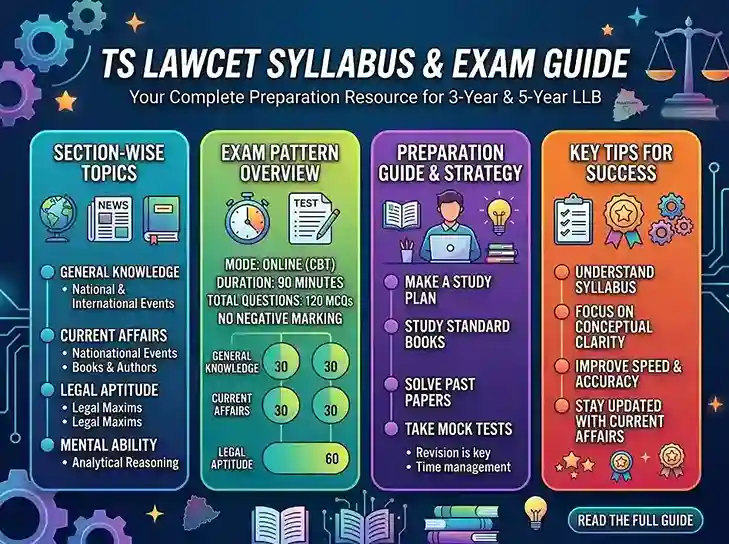
1. TS LAWCET 2026 Syllabus Overview — What Is It?
The TS LAWCET Syllabus 2026 is prescribed by the Telangana State Council of Higher Education (TGCHE) and is implemented by Osmania University, Hyderabad — the conducting body for the Telangana State Law Common Entrance Test. TS LAWCET, now also referred to as TG LAWCET (Telangana state), is one of the most important state-level law entrance examinations in South India, determining admission to 3-year LLB and 5-year integrated BA LLB programmes across all government, aided, and private law colleges in Telangana.
The TS LAWCET 2026 syllabus is structured to evaluate three core competency areas essential for legal education: general awareness and logical reasoning (Part A), awareness of recent national and international events (Part B), and fundamental aptitude for the study of law including constitutional knowledge and legal principles (Part C). Understanding the complete syllabus is the first and most critical step towards an effective preparation strategy.
| Particulars | Details |
|---|---|
| Exam Full Name | Telangana State Law Common Entrance Test (TS LAWCET / TG LAWCET) |
| Also Called | TG LAWCET 2026, Telangana LAWCET |
| Conducting Body | Osmania University, Hyderabad |
| Authority | Telangana State Council of Higher Education (TGCHE) |
| Official Website | lawcet.tgche.ac.in |
| Exam Level | State Level (Telangana) |
| Exam Mode | Online (Computer-Based Test — CBT) |
| Frequency | Once a Year |
| Programmes Covered | 3-Year LLB | 5-Year Integrated LLB |
| Medium of Exam | English, Telugu & Urdu |
| Total Questions | 120 MCQs |
| Total Marks | 120 Marks (1 mark per question) |
| Exam Duration | 90 Minutes (1 hour 30 minutes) |
| Negative Marking | No negative marking |
| Qualifying % | 35% for General | No minimum for SC/ST |
| Exam Date 2026 | May 18, 2026 |
The TS LAWCET is for admission to LLB (3-year and 5-year) programmes, while TSPGLCET (Telangana State Post Graduate Law Common Entrance Test) is a separate examination for admission to LLM (Master of Laws) programmes. Both are conducted by Osmania University for TGCHE, but have different syllabuses and eligibility criteria. If you are seeking admission to LLB, TS LAWCET is the exam you need to appear for.
2. TS LAWCET 2026 Exam Pattern — Structure & Marking Scheme
Before diving into the detailed syllabus, understanding the TS LAWCET 2026 exam pattern is essential. The exam pattern defines how questions are distributed, what marking scheme is used, and how much time you have. Here is the complete exam pattern for TS LAWCET 2026:
| Parameter | Details |
|---|---|
| Mode of Exam | Online / Computer-Based Test (CBT) |
| Type of Questions | Objective Type — Multiple Choice Questions (MCQs) |
| Total Number of Questions | 120 |
| Total Marks | 120 Marks |
| Duration | 90 Minutes (1 Hour 30 Minutes) |
| Marks per Correct Answer | +1 Mark |
| Marks for Wrong Answer | 0 (No negative marking) |
| Marks for Unattempted | 0 |
| Number of Sections | 3 (Part A, Part B, Part C) |
| Qualifying Marks (General) | 35% = 42 marks out of 120 |
| Qualifying Marks (SC/ST) | No minimum qualifying marks |
| Language Options | English, Telugu, Urdu |
| 3-Year LLB Difficulty | Graduation / Degree Level |
| 5-Year LLB Difficulty | Intermediate / 10+2 Level |
One of the most important aspects of the TS LAWCET 2026 exam pattern is the absence of negative marking. There is no penalty for wrong answers. This means you should always attempt all 120 questions — never leave any question blank. Even a random guess gives you a 25% chance of gaining a mark. Strategically, this means you should first answer all questions you are confident about, then go back and fill in the remaining ones — no matter what.
3. Section-Wise Weightage & Question Distribution
The TS LAWCET 2026 exam is divided into three parts. The Aptitude for Study of Law (Part C) carries the maximum weightage at 50% of the total marks, making it the most critical section to master. Here is the complete section-wise distribution:
| Section | Part | Questions | Marks | % Weightage | Difficulty (3-yr) |
|---|---|---|---|---|---|
| Part A | General Knowledge & Mental Ability | 30 | 30 | 25% | Moderate |
| Part B | Current Affairs | 30 | 30 | 25% | Easy–Moderate |
| Part C | Aptitude for Study of Law | 60 | 60 | 50% | Moderate–Hard |
| Total | All Sections | 120 | 120 | 100% | Moderate |
4. Part A Syllabus: General Knowledge & Mental Ability (30 Questions)
Part A of the TS LAWCET 2026 exam is divided into two sub-sections: General Knowledge (GK) and Mental Ability. This section tests a candidate's general awareness about the world and their logical reasoning and analytical thinking capabilities. With 30 questions carrying 30 marks, Part A accounts for 25% of the total score.
The General Knowledge sub-section evaluates candidates' awareness of historical events, geography, political science, economics, and science. Key topics include:
The Mental Ability sub-section assesses logical and analytical reasoning. Questions are designed to test how quickly and accurately you can solve problems. Key topics include:
5. Part B Syllabus: Current Affairs (30 Questions)
Part B focuses entirely on Current Affairs — events, appointments, and developments of national and international significance from the past 12–18 months. This section has 30 questions for 30 marks, contributing 25% to the total score. Being well-read on recent developments is key to scoring high in this section, as these questions cannot be answered through textbook study alone.
For TS LAWCET 2026, current affairs typically cover the past 12–18 months. Since the exam was held in May 2026, focus on events from January 2025 to May 2026. Pay special attention to events in the past 6 months (November 2025 – May 2026) as these are most likely to appear. Telangana-specific current affairs also carry notable weight.
6. Part C Syllabus: Aptitude for Study of Law (60 Questions)
Part C — Aptitude for Study of Law is the most important and high-weightage section of TS LAWCET 2026. It has 60 questions for 60 marks, accounting for exactly 50% of the total score. This section evaluates a candidate's elementary understanding of law, legal principles, the Constitution of India, and the ability to apply legal reasoning to factual scenarios. It also includes 10 questions based on legal comprehension passages.
Part C tests candidates across multiple branches of law. A strong performance in this section can make a decisive difference in your overall rank. Here is the complete topic-wise breakdown:
- Preamble, objectives, and basic structure of the Indian Constitution
- Fundamental Rights (Articles 12–35) — Right to Equality, Right to Freedom, Right against Exploitation
- Directive Principles of State Policy (Articles 36–51)
- Fundamental Duties (Article 51A)
- Constitutional Amendments — major amendments and their significance (42nd, 44th, 86th, 100th, 103rd)
- Parliament and State Legislatures — composition, powers, privileges
- President, Vice President, Prime Minister, Governor — powers and functions
- Supreme Court and High Courts — jurisdiction, powers
- Centre-State relations — federal structure, Article 356
- Emergency provisions — National, State, and Financial Emergency
- Schedules of the Constitution (1st to 12th Schedules)
- Organs of Government — Legislature, Executive, Judiciary
- Constitutional bodies — CAG, Election Commission, UPSC, Finance Commission
- Essentials of a valid contract — offer, acceptance, consideration, capacity, free consent
- Types of contracts — void, voidable, unenforceable, express, implied
- Free consent — coercion, undue influence, fraud, misrepresentation, mistake
- Discharge of contracts — performance, breach, agreement, impossibility
- Remedies for breach of contract — damages, specific performance, injunction
- Quasi-contracts and their types
- Contract of indemnity and guarantee
- Contract of bailment and pledge
- Contract of agency — duties and rights of agent and principal
- Definition and nature of tort — distinction from crime and contract
- General defences in tort — consent, plaintiff's fault, act of God, statutory authority
- Negligence — duty of care, breach, Donoghue v Stevenson principle
- Strict liability — Rylands v Fletcher rule
- Absolute liability — M.C. Mehta v Union of India
- Vicarious liability — employer-employee, master-servant
- Nuisance — public and private nuisance
- Defamation — libel and slander
- Trespass to person, land, and goods
- Remedies in tort — damages, injunction, restitution
- Indian Penal Code 1860 (now Bharatiya Nyaya Sanhita 2023) — general provisions
- General exceptions — mistake of fact, consent, private defence
- Offences against the State (Sections 121–130 IPC)
- Offences against the body — murder, culpable homicide, hurt, assault
- Offences against property — theft, extortion, robbery, dacoity, criminal misappropriation
- Offences against women — rape, kidnapping, cruelty under S. 498A
- Criminal conspiracy and abetment
- Code of Criminal Procedure (CrPC) — arrest, bail, cognizable vs non-cognizable offences, FIR
- New Criminal Laws 2023 — Bharatiya Nyaya Sanhita (BNS), BNSS, BSA
- Sources of international law — treaties, customs, general principles, judicial decisions
- State sovereignty and jurisdiction
- Recognition of states and governments
- United Nations — structure, Security Council, General Assembly, ICJ
- Universal Declaration of Human Rights (UDHR) 1948
- International Covenant on Civil and Political Rights (ICCPR)
- International humanitarian law — Geneva Conventions
- Law of treaties — Vienna Convention on Law of Treaties 1969
- Extradition and asylum
- Protection of diplomatic agents
- Copyright — ownership, duration, infringement, exceptions
- Trademark — registration, infringement, passing off
- Patents — patentability criteria, term, rights of patent holder
- Industrial Designs
- Geographical Indications (GI Tags) — Telangana GI tags
- TRIPS Agreement and WTO framework for IPR
- Trade secrets and confidential information
- Sale of Goods Act — conditions and warranties, transfer of property
- Negotiable Instruments Act — cheque, promissory note, bill of exchange
- Consumer Protection Act 2019 — rights of consumers, NCDRC, District Forums
- Competition Act 2002 — abuse of dominant position, anti-competitive agreements
- Companies Act 2013 — types of companies, incorporation, Memorandum, Articles
- Arbitration and Conciliation Act 1996 — ADR mechanisms
- Minimum Wages Act 1948
- Industrial Disputes Act 1947 — strike, lockout, layoff, retrenchment
- Factories Act 1948 — working hours, safety, welfare
- Hindu Marriage Act 1955 — valid marriages, divorce grounds
- Special Marriage Act 1954
- Hindu Succession Act 1956 (amended 2005 — daughters' equal rights)
- Muslim Personal Law — talaq, mehr, inheritance
- Guardians and Wards Act — custody of children
- Domestic Violence Act 2005
- Legal maxims — Actus Reus, Mens Rea, Stare Decisis, Ratio Decidendi, Obiter Dicta
- Principle-fact based legal reasoning (apply a stated principle to a given scenario)
- Jurisprudence — definition of law (Austin, Kelsen, Hart, Salmond)
- Rights and duties — Hohfeld's analysis
- Sources of law — legislation, precedent, custom
- Legal interpretation — literal rule, golden rule, mischief rule
- Legal comprehension passages — 10 questions based on an unseen passage
- Law of Evidence — relevancy, admissibility, burden of proof
- Case Laws — landmark Supreme Court judgments
Part C includes approximately 10 questions based on legal comprehension passages. These passages describe a legal situation or principle and ask you to apply it to given scenarios. You do NOT need prior knowledge of law to answer these — the principle is stated in the passage. These are typically the easiest questions in Part C if you read carefully. Never skip these. Practice legal reasoning passages from CLAT previous year papers, as the format is very similar.
7. Syllabus Difference: 3-Year LLB vs 5-Year LLB
One of the most commonly asked questions by TS LAWCET aspirants is whether the syllabus differs between the 3-year and 5-year LLB programmes. Here is the clear answer:
| Parameter | 3-Year LLB (TS LAWCET) | 5-Year LLB (TS LAWCET) |
|---|---|---|
| Sections | Same 3 sections (Part A, B, C) | Same 3 sections (Part A, B, C) |
| Topics | Same topics across all sections | Same topics across all sections |
| Number of Questions | 120 MCQs | 120 MCQs |
| Total Marks | 120 Marks | 120 Marks |
| Duration | 90 Minutes | 90 Minutes |
| Difficulty Level | Graduation (Degree) Level | Intermediate (10+2) Level |
| Question Standard | Higher — expects degree-level knowledge | Lower — expects 10+2 level knowledge |
| Eligibility | Bachelor's Degree (45% General) | Intermediate / Class 12 (45% General) |
| Counselling | Separate rank list for 3-year LLB | Separate rank list for 5-year LLB |
In summary, the syllabus and topics are identical for both programmes. The only significant difference is the difficulty level of questions — the 3-year LLB paper is set at the graduation level (deeper analysis expected), while the 5-year LLB paper is at the Intermediate level (conceptual but less complex). Separate rank lists are maintained for seat allotment in each programme.
8. Most Important Topics for TS LAWCET 2026 — Topic-Wise Priority
Based on analysis of previous year TS LAWCET question papers (2020–2025), certain topics appear repeatedly with high frequency. Prioritising these topics in your preparation can significantly boost your score. Here are the most important topics for TS LAWCET 2026:
| Priority | Topic | Section | Expected Questions | Difficulty |
|---|---|---|---|---|
| High | Constitution of India — Fundamental Rights, DPSPs, Amendments | Part C | 12–15 | Medium |
| High | Legal Reasoning (Principle-Fact) + Comprehension Passages | Part C | 10–12 | Easy |
| High | Current Affairs — Last 6 months (Awards, Appointments, Sports) | Part B | 25–30 | Easy |
| Medium | Torts — Strict Liability, Vicarious Liability, Negligence | Part C | 5–7 | Medium |
| Medium | Indian History (Modern — Freedom Struggle) | Part A | 4–6 | Easy |
| Medium | Syllogisms, Blood Relations, Number Series | Part A | 6–8 | Easy–Medium |
| Medium | IPC / BNS 2023 — Crimes against Body, Property, Women | Part C | 5–7 | Medium |
| Lower | IPR — Copyright, Trademark, Patents | Part C | 3–5 | Easy |
| Lower | Legal Maxims (Latin terms) | Part C | 3–4 | Easy |
9. Previous Year Question Paper Analysis
Analysing previous year TS LAWCET question papers is an invaluable preparation tool. Based on the papers from 2020 to 2025, here are the key patterns and trends that candidates should know:
10. TS LAWCET 2026 Preparation Strategy — Month-by-Month Plan
A well-structured preparation strategy tailored to the TS LAWCET 2026 syllabus is essential for achieving a high rank. Here is a comprehensive preparation roadmap based on the section-wise weightage and exam difficulty:
- Complete Constitution of India
- Basic Torts & Contracts
- Indian History (Modern Era)
- Start daily current affairs routine
- IPC / BNS 2023 (Criminal Law)
- IPR, International Law
- GK — Geography & Economy
- Legal Maxims + Reasoning
- 5 previous year papers (2021–2025)
- Daily mock tests
- Mental Ability — 30Q/day
- Current Affairs revision
- Rapid revision of all sections
- Current affairs — last 3 months
- Full-length mock tests
- Focus on weak areas only
11. Best Books for TS LAWCET 2026 Preparation
Selecting the right study material is critical for TS LAWCET preparation. Here are the best books recommended for TS LAWCET 2026, section-wise:
12. TS LAWCET 2026 Eligibility Criteria — Quick Recap
While this page focuses on the TS LAWCET syllabus, here is a quick recap of the eligibility criteria to ensure you are eligible to appear:
| Criterion | 3-Year LLB | 5-Year LLB |
|---|---|---|
| Qualifying Exam | Bachelor's Degree (BA/BSc/BCom or equivalent) | Intermediate / Class 12 (or equivalent) |
| Min. Marks — General/OBC | 45% aggregate | 45% aggregate |
| Min. Marks — SC/ST/PWD | 40% aggregate | 40% aggregate |
| Appearing Candidates | Final year students can apply provisionally | Final year 10+2 students can apply provisionally |
| Age Limit | No upper age limit (BCI ruling) | No upper age limit (BCI ruling) |
| Domicile | Telangana domicile preferred for local category seats | Telangana domicile preferred for local category seats |
| Qualifying % in TS LAWCET | 35% (General) | No minimum (SC/ST) | 35% (General) | No minimum (SC/ST) |
13. TS LAWCET vs AP LAWCET — Key Differences
Many students from Telangana and Andhra Pradesh appear confused about whether to appear for TS LAWCET or AP LAWCET. Here is a clear comparison:
| Parameter | TS LAWCET 2026 | AP LAWCET 2026 |
|---|---|---|
| Full Name | Telangana State Law Common Entrance Test | Andhra Pradesh Law Common Entrance Test |
| Conducting Body | Osmania University for TGCHE | Sri Krishna Devaraya University for APSCHE |
| State | Telangana | Andhra Pradesh |
| Syllabus | Part A (GK+MA), Part B (CA), Part C (Law) — Same | Same 3 sections — Nearly identical syllabus |
| Total Questions | 120 MCQs | 120 MCQs |
| Total Marks | 120 Marks | 120 Marks |
| Duration | 90 Minutes | 90 Minutes |
| Negative Marking | None | None |
| Language | English, Telugu, Urdu | English, Telugu |
| Seat Allotment | Only Telangana law colleges | Only Andhra Pradesh law colleges |
| Can One Appear in Both? | Yes — they are separate exams with separate applications and rank lists | |
Yes. TS LAWCET and AP LAWCET are completely separate examinations conducted by different state authorities. A candidate can apply for and appear in both exams independently. If you qualify in both, you can participate in counselling of both states. However, you must apply separately, pay separate fees, and appear on their respective exam dates. Candidates from both Telangana and Andhra Pradesh domicile can appear in either exam — domicile affects local/non-local seat category during counselling, not exam eligibility.
14. Frequently Asked Questions — TS LAWCET Syllabus 2026
The TS LAWCET 2026 syllabus covers three sections across 120 MCQs in 90 minutes: Part A — General Knowledge & Mental Ability (30 questions, 30 marks) covering History, Geography, Economics, Logical Reasoning, and Environmental Science; Part B — Current Affairs (30 questions, 30 marks) covering national/international events, awards, appointments, and sports from the past 12–18 months; Part C — Aptitude for Study of Law (60 questions, 60 marks) covering Constitutional Law, Torts, Contracts, Criminal Law (IPC/BNS), IPR, International Law, Legal Maxims, and Legal Reasoning Passages. There is no negative marking.
TS LAWCET 2026 has 120 objective-type MCQ questions, each carrying 1 mark. Total marks = 120. Duration = 90 minutes. There is no negative marking — wrong answers carry 0 marks. The three sections are: Part A (30Q/30M), Part B (30Q/30M), and Part C (60Q/60M). You must score at least 35% (42 marks) to qualify if you are in the General category. SC/ST candidates have no minimum qualifying marks.
The syllabus topics are identical for both 3-year LLB and 5-year LLB in TS LAWCET 2026. Both papers have the same three sections (Part A, B, C), the same number of questions (120), and the same total marks (120). The difference is only in difficulty level: the 3-year LLB paper is at the Graduation (Degree) level, while the 5-year LLB paper is at the Intermediate (10+2) level. Separate rank lists are prepared for each programme and counselling is conducted separately.
TS LAWCET 2026 is conducted by Osmania University, Hyderabad on behalf of the Telangana State Council of Higher Education (TGCHE). The exam is conducted once a year for admission to 3-year LLB and 5-year integrated LLB programmes in law colleges across Telangana. The official portal is lawcet.tgche.ac.in.
The qualifying percentage for TS LAWCET 2026 is 35% for General, OBC, and EWS category candidates — which means a minimum of 42 marks out of 120. For SC and ST category candidates, there are no minimum qualifying marks — they only need to appear in the exam. However, qualifying in TS LAWCET does not guarantee a seat; seat allotment depends on your rank relative to available seats and your category.
The TS LAWCET 2026 exam was conducted on May 18, 2026. The result was announced by TGCHE shortly after. For future editions (TS LAWCET 2027), the exam is typically conducted in May each year. Always verify official dates at lawcet.tgche.ac.in.
The TS LAWCET exam is generally considered moderate in difficulty. It is designed to assess fundamental knowledge rather than deep legal expertise. Part B (Current Affairs) and the legal comprehension passages in Part C are the easiest scoring areas. Part C's constitutional and criminal law questions are moderate. With 3–6 months of consistent preparation and regular mock tests, most candidates find the exam manageable. The absence of negative marking makes it even more candidate-friendly.
The best books for TS LAWCET 2026 are: TS LAWCET Guide by Sura/Arihant (all-in-one), D.D. Basu's Introduction to the Constitution of India (Part C — Constitution), R.K. Bangia's Law of Torts (Part C — Torts), K.D. Gaur's Indian Penal Code (Part C — Criminal Law), R.S. Aggarwal's Reasoning (Part A — Mental Ability), and monthly current affairs magazines like GKToday or AffairsCloud (Part B). Additionally, solve all TS LAWCET previous year papers from 2019 to 2025.
TS LAWCET is for admission to LLB programmes (3-year and 5-year) — it is the undergraduate law entrance test. TSPGLCET (Telangana State Post Graduate Law Common Entrance Test) is for admission to LLM (Master of Laws) programmes — it is the postgraduate law entrance test. Both are conducted by Osmania University for TGCHE, but they have completely different syllabuses, eligibility criteria, and participating colleges. LLB graduates are eligible for TSPGLCET, while graduation (any stream) is the eligibility for TS LAWCET.
Explore our complete TS LAWCET coverage: TS LAWCET 2026 Overview | Eligibility Criteria | Exam Pattern | Admit Card | Result & Merit List | Cutoff & Rank | Counselling Process | Participating Colleges