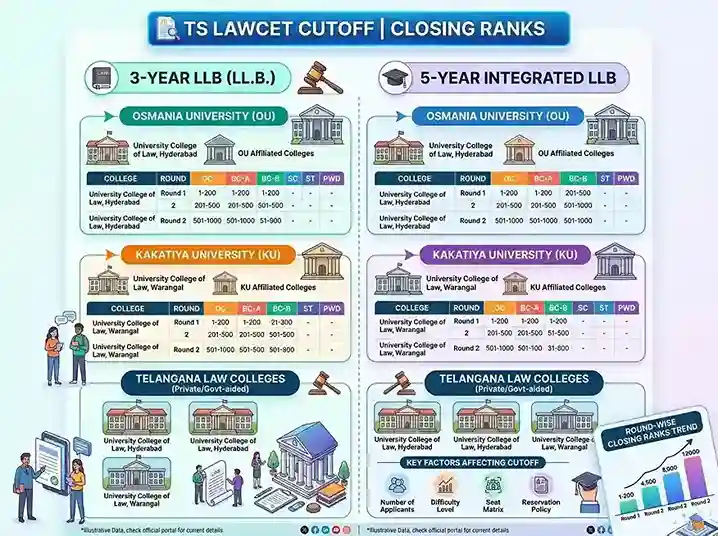
1. What is TS LAWCET Cutoff? Qualifying vs Admission Cutoff Explained
The TS LAWCET cutoff refers to the minimum marks or rank required either to qualify for counselling or to secure admission in a specific law college through the Telangana State Law Common Entrance Test. There are two distinct types of cutoff that every aspirant must understand before interpreting the data below.
This is the minimum score a candidate must achieve to receive a rank and become eligible for TS LAWCET counselling. For General and OBC categories: 42 marks out of 120 (35%). For SC and ST categories: no minimum marks — simply appearing for the exam is sufficient. This threshold is fixed by the Bar Council of India and does not change year to year.
This is the rank of the last candidate admitted to a specific college in a specific category during a specific counselling round. This varies significantly by college type (Government vs. Private), location, programme (3-Year vs. 5-Year LLB), and reservation category. Merely qualifying does not guarantee admission — your rank must fall within the admission cutoff of your target college.
Thousands of candidates score above the qualifying threshold (42/120) but still do not get admission to premier colleges. For example, in TS LAWCET 2025, candidates needed to score well above 70–80 marks to have a realistic chance at Osmania University's University College of Law. The cutoff data below focuses on admission cutoff ranks (the closing rank at which the last seat was filled), not qualifying marks.
2. Factors That Determine TS LAWCET Cutoff Each Year
The TS LAWCET admission cutoff shifts every year based on a combination of demand- and supply-side factors. Understanding these factors helps predict future cutoffs and assess your chances accurately:
3. TS LAWCET 2026 Qualifying Marks — Category-Wise Breakdown
The qualifying marks for TS LAWCET 2026 remain the same as previous years, as mandated by the Bar Council of India's minimum eligibility requirements. These are the marks you must score just to receive a rank — actual college admission requires a much stronger score.
| Category | Minimum Marks Required | Out of Total | Percentage Required | Note |
|---|---|---|---|---|
| General (OC — Open Category) | 42 marks | 120 | 35% | Mandatory minimum to receive rank |
| OBC (BC-A, BC-B, BC-C, BC-D, BC-E) | 42 marks | 120 | 35% | Same qualifying threshold as General |
| EWS (Economically Weaker Section) | 42 marks | 120 | 35% | Same qualifying threshold; 10% seats reserved |
| SC (Scheduled Caste) | No Minimum | 120 | 0% | Must appear for exam; any score gets a rank |
| ST (Scheduled Tribe) | No Minimum | 120 | 0% | Must appear for exam; any score gets a rank |
| PH / PwD (Persons with Disability) | 42 marks (or relaxed) | 120 | 35% or lower | Relaxed norms per individual disability category |
While the qualifying mark is 42/120, the practical minimum for any government college admission in Telangana through TS LAWCET is closer to 55–65 marks. For Osmania University's University College of Law (the top institution), you typically need 80+ marks to have a competitive chance. Even for private law colleges in Hyderabad, a score of 50+ is recommended to avoid being left without a seat after all counselling rounds.
TS LAWCET Tie-Breaking Rules for Rank Determination
When two or more candidates score the same total marks in TS LAWCET, the following sequential tie-breaking criteria are applied to assign ranks:
4. TS LAWCET 2025 Actual Cutoff — Phase 1 Data (Official)
The Telangana State Council of Higher Education (TSCHE/TGCHE) released the TS LAWCET 2025 Phase 1 cutoff in August 2025 after the first round of counselling. The data below is sourced from the official allotment list and covers both the 5-Year LLB and 3-Year LLB cutoffs for the top government colleges in Telangana. This is the most comprehensive and accurate publicly available data — use it as the baseline for 2026 expectations.
TS LAWCET 2026 cutoff is yet to be released (exam held May 18, 2026; result expected June 5, 2026; counselling expected late June 2026). The tables below show TS LAWCET 2025 actual Phase 1 cutoff data from official TGCHE allotment lists. TS LAWCET 2026 expected cutoffs are provided in Section 10. Always verify at lawcet.tgche.ac.in.
5. TS LAWCET 5-Year LLB College-Wise Cutoff 2025 — Phase 1 (Official Data)
The 5-Year Integrated LLB programme (requiring Class 12 qualification) is the most competitive track in TS LAWCET. Seats are fewer and demand is concentrated at government university colleges. The cutoff below reflects Phase 1 (Round 1) opening and closing ranks for key categories.
| College | Category | Sub-Type | Min Rank (Opening) | Max Rank (Closing) |
|---|---|---|---|---|
| UCL – Osmania University University College of Law, Hyderabad |
OC (Open) | Female (Unreserved) | AIR 1 | AIR 1 |
| OC (Open) | General (Unreserved) | AIR 2 | AIR 3 | |
| OC (OU Local) | Female (OU Area) | AIR 4 | AIR 17 | |
| OC (OU Local) | General (OU Area) | AIR 11 | AIR 33 | |
| EWS (OU Local) | General | AIR 15 | AIR 15 | |
| BC-B (OU Local) | General | AIR 45 | AIR 94 | |
| BC-B (OU Local) | Female | AIR 36 | AIR 51 | |
| SC (OU Local) | Female | AIR 39 | AIR 39 | |
| UCL – Kakatiya University University College of Law, Warangal |
OC (Open) | General | AIR 1 | AIR ~350 |
| OC (KU Local) | General | AIR 50 | AIR ~800 | |
| BC (KU Local) | General | AIR 200 | AIR ~2,000 | |
| SC / ST (KU Local) | General | AIR 500 | AIR ~4,000 |
* Osmania UCL Phase 1 data sourced from official TS LAWCET 2025 allotment list (Careers360 / TGCHE). Kakatiya University estimates based on 2024 trends. OU = Osmania University local area; KU = Kakatiya University local area. Unreserved = All-Telangana candidates.
| College Name | Location | OC General (Approx.) | BC General (Approx.) | SC/ST (Approx.) | Annual Fee |
|---|---|---|---|---|---|
| Pendekanti Law College | Hyderabad | AIR 1 – 1,200 | AIR 500 – 2,500 | AIR 2,000 – 5,000 | ~₹50,000/yr |
| Keshav Reddy College of Law | Hyderabad | AIR 1 – 1,000 | AIR 600 – 2,200 | AIR 1,800 – 4,500 | ~₹45,000/yr |
| K.V. Ranga Reddy Law College | Hyderabad | AIR 500 – 2,000 | AIR 1,000 – 3,500 | AIR 2,500 – 6,000 | ~₹40,000/yr |
| Dr. B.R. Ambedkar Law College | Hyderabad | AIR 800 – 3,000 | AIR 1,500 – 5,000 | AIR 3,000 – 8,000 | ~₹35,000/yr |
| Mahatma Gandhi Law College | Hyderabad | AIR 1,000 – 3,500 | AIR 2,000 – 6,000 | AIR 4,000 – 9,000 | ~₹38,000/yr |
| GITAM School of Law | Hyderabad | AIR 2,000 – 3,500 | AIR 3,000 – 6,000 | AIR 5,000 – 10,000 | ~₹1.8 L/yr |
| Bhaskar Law College | Moinabad | AIR 2,500 – 5,000 | AIR 4,000 – 8,000 | AIR 6,000 – 12,000 | ~₹30,000/yr |
| Padala Ramareddy Law College | Hyderabad | AIR 1,000 – 1,500 | AIR 1,500 – 3,500 | AIR 3,000 – 7,000 | ~₹42,000/yr |
* Private college cutoffs are estimates based on 2024–2025 trends. Actual 2026 cutoffs will be available after counselling at lawcet.tgche.ac.in.
6. TS LAWCET 3-Year LLB College-Wise Cutoff 2025 — Phase 1 & Phase 2
The 3-Year LLB programme (requiring graduation) has higher seat availability (~3,597 seats) and slightly lower competition compared to the 5-Year integrated course, making it accessible across a wider rank range. The cutoff differences between Phase 1 and Phase 2 are notable for mid-tier and private colleges.
| College | OC General Phase 1 | OC General Phase 2 | BC General (Phase 1) | SC (Phase 1) | ST (Phase 1) |
|---|---|---|---|---|---|
| UCL, Osmania University (Hyderabad) | AIR 1 – 50 | AIR 1 – 100 | AIR 50 – 300 | AIR 100 – 800 | AIR 200 – 1,500 |
| UCL, Kakatiya University (Warangal) | AIR 1 – 500 | AIR 1 – 1,500 | AIR 300 – 2,000 | AIR 800 – 4,000 | AIR 1,500 – 6,000 |
| UCL, Mahatma Gandhi University (Nalgonda) | AIR 500 – 2,000 | AIR 800 – 4,000 | AIR 1,000 – 4,500 | AIR 2,000 – 7,000 | AIR 3,000 – 9,000 |
| UCL, Palamuru University (Mahbubnagar) | AIR 800 – 3,000 | AIR 1,500 – 5,000 | AIR 1,500 – 5,500 | AIR 3,000 – 8,500 | AIR 4,000 – 11,000 |
| UCL, Satavahana University (Karimnagar) | AIR 600 – 2,500 | AIR 1,000 – 4,500 | AIR 1,200 – 5,000 | AIR 2,500 – 8,000 | AIR 4,000 – 12,000 |
| UCL, Telangana University (Nizamabad) | AIR 700 – 2,800 | AIR 1,200 – 5,500 | AIR 1,400 – 5,500 | AIR 2,800 – 8,500 | AIR 4,500 – 13,000 |
| College | Location | OC General (Opening – Closing) | BC (Approx.) | SC/ST (Approx.) |
|---|---|---|---|---|
| Pendekanti Law College | Hyderabad | AIR 1 – 1,500 | AIR 800 – 3,000 | AIR 2,000 – 6,000 |
| Keshav Reddy College of Law | Hyderabad | AIR 1 – 1,000 | AIR 600 – 2,500 | AIR 1,500 – 5,000 |
| Mahatma Gandhi Law College | Hyderabad | AIR 1,000 – 4,000 | AIR 2,000 – 7,000 | AIR 4,000 – 10,000 |
| Viswa Bharathi College of Law | Hyderabad | AIR 3,571 – 9,115 (BC-A) | AIR 4,000 – 10,000 | AIR 3,275 – 6,554 (SC) |
| GITAM School of Law | Hyderabad | AIR 2,000 – 3,500 | AIR 3,500 – 7,000 | AIR 6,000 – 12,000 |
| K.V. Ranga Reddy Law College | Hyderabad | AIR 500 – 2,200 | AIR 1,200 – 4,000 | AIR 2,500 – 7,000 |
| Vaagdevi College of Law | Warangal | AIR 2,000 – 6,000 | AIR 4,000 – 9,000 | AIR 5,000 – 12,000 |
| Sri Indu College of Law | Hyderabad | AIR 1,500 – 5,000 | AIR 3,000 – 8,000 | AIR 5,000 – 11,000 |
* Data compiled from TS LAWCET 2024–2025 official allotment lists. Actual 2026 cutoffs will be updated post-counselling. Estimates based on 2024–2025 trend analysis.
7. Category-Wise Cutoff Explained — OC, BC, SC, ST, EWS in TS LAWCET
Telangana follows a specific reservation policy for law college admissions through TS LAWCET. Understanding how reservation categories work helps you interpret cutoff data correctly:
| Reservation Category | Seat Reservation % | Expected Closing Rank Range (Top Govt. College) | Who Qualifies |
|---|---|---|---|
| OC (Open Category) | No specific reservation | AIR 1 – 500 (5-Year LLB) | AIR 1 – 1,500 (3-Year LLB) | All candidates, including General, compete for OC seats on merit |
| BC-A | ~7% | AIR 300 – 2,500 | Specific Backward Classes communities per Telangana BC list (Group A) |
| BC-B | ~10% | AIR 45 – 2,000 (Osmania) | Muslim OBCs and specific communities in BC Group B |
| BC-C | ~1% | AIR 500 – 4,000 | Christian converts from SC communities |
| BC-D | ~7% | AIR 63 – 3,000 (Osmania) | Various Other Backward Classes communities in Group D |
| BC-E | ~4% | AIR 600 – 5,000 | Socially and educationally backward Muslim communities |
| SC (Scheduled Caste) | ~15% | AIR 39 – 6,000 (varies by college) | Castes listed in the SC list of Telangana | No qualifying marks required |
| ST (Scheduled Tribe) | ~6% | AIR 200 – 8,000 (varies) | Tribes listed in the ST list of Telangana | No qualifying marks required |
| EWS (Economically Weaker Section) | ~10% | AIR 15 – 1,500 (top colleges) | General category candidates with family income below ₹8 lakh/year, with valid EWS certificate |
TS LAWCET additionally distinguishes between local area candidates (candidates who studied in the university's local area — e.g., OU area = Hyderabad + surrounding districts) and unreserved/non-local candidates. Local area candidates compete within local seats (typically 85% of seats), while non-local/all-Telangana candidates compete for the remaining 15%. This creates separate opening and closing ranks for local and non-local subcategories within each reservation category — making Osmania University tables appear more complex than a simple OC/BC/SC/ST split.
8. TS LAWCET Score vs Rank — Which College Can You Target?
Use this score-to-college mapping to understand realistically what a given TS LAWCET score translates to in terms of college options. Scores are out of 120; rank ranges are approximate for General (OC) category.
9. TS LAWCET Previous Year Cutoff Trends (2022–2025)
Analyzing multi-year cutoff patterns gives the most reliable basis for predicting your 2026 chances. The data below shows how competition and closing ranks have evolved at key colleges across recent cycles:
| College & Course | TS LAWCET 2025 (OC Closing Rank) |
TS LAWCET 2024 (OC Closing Rank) |
TS LAWCET 2023 (OC Closing Rank) |
TS LAWCET 2022 (OC Closing Rank) |
Trend |
|---|---|---|---|---|---|
| UCL Osmania — 5-Year LLB (OC Local) | AIR ~33 | AIR ~40 | AIR ~35 | AIR ~45 | ↑ Getting tighter |
| UCL Osmania — 3-Year LLB (OC Local) | AIR ~50 | AIR ~65 | AIR ~55 | AIR ~80 | ↑ Tightening |
| UCL Kakatiya — 5-Year LLB (OC) | AIR ~800 | AIR ~900 | AIR ~750 | AIR ~1,000 | → Stable |
| UCL Kakatiya — 3-Year LLB (OC) | AIR ~1,500 | AIR ~1,800 | AIR ~1,400 | AIR ~2,000 | ↓ Easing slightly |
| Pendekanti — 5-Year LLB (OC) | AIR ~1,200 | AIR ~1,400 | AIR ~1,100 | AIR ~1,500 | → Stable |
| Pendekanti — 3-Year LLB (OC) | AIR ~1,500 | AIR ~1,700 | AIR ~1,300 | AIR ~2,000 | ↓ More accessible |
| GITAM School of Law (OC) | AIR ~3,500 | AIR ~3,000 | AIR ~2,800 | AIR ~3,200 | ↑ Slightly tighter |
| Mahatma Gandhi LC — 3-Year LLB (OC) | AIR ~4,000 | AIR ~4,500 | AIR ~3,800 | AIR ~5,000 | → Broadly stable |
Competition for government university colleges (Osmania, Kakatiya) has intensified over the four-year period, with OC closing ranks at Osmania UCL becoming tighter each year. Private college cutoffs, however, have remained broadly stable or become slightly more accessible as more private law colleges participate in the TS LAWCET counselling process, effectively increasing total seat availability. The biggest factor influencing 2026 cutoffs will be total candidates appeared — which rose from ~38,000 in 2022 to ~45,609 in 2025.
10. TS LAWCET 2026 Expected Cutoff Prediction
The TS LAWCET 2026 exam was conducted on May 18, 2026. The result is expected by June 5, 2026, with Phase 1 counselling likely commencing in the last week of June 2026. Based on exam difficulty feedback, candidate registrations (~57,000+), and multi-year trend analysis, here are the LawGuru India projected cutoffs for 2026:
| College & Programme | OC General (Expected 2026) | BC (Expected 2026) | SC (Expected 2026) | Change vs. 2025 |
|---|---|---|---|---|
| UCL Osmania — 5-Year LLB | AIR 25–40 | AIR 80–150 | AIR 35–200 | ↑ Slightly tighter |
| UCL Osmania — 3-Year LLB | AIR 40–80 | AIR 150–400 | AIR 200 – 1,000 | ↑ Slightly tighter |
| UCL Kakatiya — 5-Year LLB | AIR 600–1,000 | AIR 1,500–2,500 | AIR 3,000–5,000 | → Stable |
| UCL Kakatiya — 3-Year LLB | AIR 1,200–2,000 | AIR 2,500–4,000 | AIR 5,000–8,000 | → Stable |
| Pendekanti — 5-Year LLB | AIR 1,000–1,500 | AIR 2,000–3,500 | AIR 4,000–7,000 | → Stable |
| Pendekanti — 3-Year LLB | AIR 1,200–2,000 | AIR 2,500–4,500 | AIR 5,000–9,000 | → Stable |
| GITAM School of Law | AIR 2,500–4,000 | AIR 4,000–7,000 | AIR 7,000–12,000 | ↑ Slightly tighter |
| Qualifying Score (General) | 76–84 marks expected for competitive government college admission | → Marginal increase | ||
11. How to Use TS LAWCET Cutoff Data for Smart College Selection
The cutoff data presented on this page is a powerful planning tool — but only if used intelligently. Here is a step-by-step approach to using it for your 2026 college selection strategy: