3
Counselling Phases
A complete, practical walkthrough of the TS LAWCET 2026 counselling process conducted by Osmania University on behalf of TGCHE: how to register, what happens at the Help Line Centre, how to fill web options wisely, how seat allotment rounds work, category-wise reservation, the exact documents you need and the mistakes that cost candidates a seat every year.
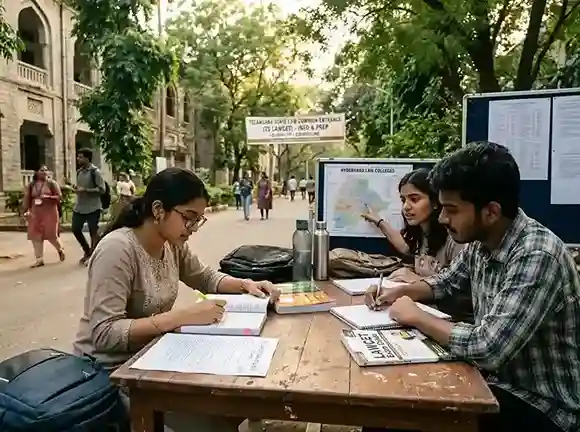
After the TS LAWCET result is declared, ranked candidates register for counselling at lawcet.tgche.ac.in, get their certificates verified in person at a Help Line Centre, submit web options ranking their preferred colleges and courses, and then receive a seat allotment based on rank, category and seat availability. Candidates who accept a seat pay the fee and report to the college; those who want a better option can float into the next round. The process runs across a Phase 1 round, a Phase 2 round and a final spot round.
TS LAWCET counselling, now administratively referred to alongside TG LAWCET, is the centralised seat allocation process that follows the Telangana State Law Common Entrance Test. It is conducted entirely by the Telangana State Council of Higher Education (TGCHE) through Osmania University at the official portal lawcet.tgche.ac.in. Only candidates who have qualified in the exam and hold a valid rank card are eligible to register.
Counselling is where the actual admission happens. Scoring well in the exam earns you a rank, but the rank only becomes a seat once you complete registration, certificate verification, web options entry and seat acceptance in the correct sequence and within the notified deadlines. Missing a single deadline in this process is one of the most common and most avoidable reasons candidates lose a seat they were otherwise eligible for.
This guide walks through the counselling journey in the order a candidate actually experiences it: registration, verification, web options, allotment, and finally reporting to college. Use the contents list above to jump to any stage, or read start to finish if this is your first time going through counselling.
Eligibility for counselling is separate from eligibility for the exam itself. To be called for TS LAWCET 2026 counselling, a candidate must meet all of the following conditions.
| Requirement | Detail |
|---|---|
| Valid Rank | Must have appeared for TS LAWCET 2026 and secured a rank in either the 3-Year LLB or 5-Year LLB merit list |
| Qualifying Marks | 42/120 or above for General/BC candidates; no minimum for SC/ST candidates, who receive a rank at any score |
| Basic Qualification | Graduation degree for 3-Year LLB, or Class 12 pass/appearing for 5-Year LLB, as per the exam eligibility criteria |
| Original Documents | Must possess original certificates for physical verification; provisional or photocopy-only documents are not accepted at the Help Line Centre |
| Registration Within Window | Must complete online counselling registration within the dates notified by TGCHE; late registration is generally not entertained |
Candidates who appeared but did not clear the qualifying marks (applicable to General and BC categories) do not receive a rank and cannot be called for counselling. See our TS LAWCET Result 2026 page to check your rank card status before proceeding.
TGCHE has not released the confirmed counselling calendar at the time of writing. Based on the pattern followed in previous counselling cycles, here is the expected sequence of events for 2026.
These dates are indicative, built from prior-year TGCHE counselling patterns. TGCHE can compress or extend the schedule depending on the volume of applications and any legal or administrative delays. Bookmark lawcet.tgche.ac.in and check it directly rather than relying on any secondary source, including this page, for the final confirmed dates.
Counselling registration is a separate process from exam registration and must be completed even if you already have an account on the TS LAWCET portal from the exam stage.
Save a PDF of every screen you submit during registration, and keep at least two printed copies of the confirmation slip. Portal downtime close to deadlines is common during high-traffic counselling windows across Indian state CET systems, and having your own copies avoids last-minute panic.
Unlike the fully online CLAT counselling process, TS LAWCET requires candidates to be physically present for document verification. A Help Line Centre (HLC) is usually a participating government law college designated by TGCHE for this purpose.
At the HLC, an official verifies your original certificates against the details you submitted online. This step confirms your academic eligibility, category, local area status and any special reservation claims (PWD, sports quota, NCC, and similar categories where applicable). Only candidates who clear verification are permitted to proceed to the web options stage.
Printed registration slip, rank card, hall ticket, and all original certificates listed in the documents checklist below, with one self-attested photocopy of each.
An official cross-checks your originals against your online application. Discrepancies must be resolved on the spot or verification is deferred.
A verification confirmation or acknowledgement slip, which you should retain until admission is fully complete.
The single most common reason candidates are turned away at HLC verification is an expired or mismatched income and caste certificate for BC/EWS claims, or a certificate issued after the cutoff date specified in the notification. Verify the validity date on your caste, income and local area certificates well before your HLC appointment, not on the day itself.
Once verified, you gain access to the web options module, where you rank your preferred college and course combinations in order of priority. This single step has the biggest influence on where you actually end up studying, and it deserves more time than most candidates give it.
The system checks your highest-ranked, still-available option first. If seats remain in that college and course for your category, you are allotted there. If not, the system checks your next option, and so on down your list. Your TS LAWCET rank determines your position in the queue relative to other candidates competing for the same option; it does not determine which specific option you are considered for first, your own ranking of options does that.
List every college and course combination you would genuinely accept, in true order of preference, from the beginning. A shorter or overly cautious list only restricts your own outcomes; it never improves your rank relative to other candidates.
Rank options by where you would actually want to study, not by perceived difficulty of getting in. The system already accounts for competition through your rank.
After your top choices, add mid-tier and safer government-aided or private colleges so a technical glitch or an unexpectedly high cutoff does not leave you with no allotment at all.
Use last year's closing ranks by college and category as a rough guide, understanding that cutoffs shift year to year. See the TS LAWCET Cutoff page for category-wise trends.
An incomplete list is the most common reason capable candidates end up with no seat in Phase 1 and have to wait for later rounds.
Options can usually be edited multiple times before the entry window closes. Save your list after every session and take a screenshot of your final submitted order as proof.
TS LAWCET counselling runs across up to three rounds. Understanding what changes between rounds helps you plan realistically rather than treating each round as a fresh lottery.
| Round | Who Participates | What Happens |
|---|---|---|
| Phase 1 | All verified candidates who submitted web options | Full allotment run based on rank, category and preference order. Most candidates receive their first meaningful allotment here. |
| Phase 2 | Candidates who floated, were unallotted, or want to improve on a Phase 1 seat | Vacant seats from Phase 1, including seats vacated by candidates who moved elsewhere, are reallotted. Cutoffs can move up or down depending on vacancies. |
| Spot Round | Candidates with a rank who remain unallotted after Phase 2, subject to notification | Any seats still vacant are offered, often with candidates reporting in person to a designated centre. This round typically has the lowest effective cutoff. |
After each round, check your allotment status on lawcet.tgche.ac.in using your registration credentials. The allotment order, the fee amount payable, and the exact deadline to act will be shown on your candidate dashboard.
After receiving an allotment, most state counselling systems, including TS LAWCET, ask you to choose one of a small set of options. Getting this choice wrong is the second most common way candidates lose a seat they had already secured.
You accept the allotted seat as final and pay the fee. You will not be considered in later rounds. Choose this once you are satisfied with the college and course.
You accept the current seat provisionally but remain in the running for a better option in the next round. If you get a better allotment, the earlier seat is released; if not, you keep the current one.
Where offered, this keeps you within the same college for a better course, or moves you up your list without exiting the process entirely.
You permanently withdraw from further counselling rounds. Any fee paid is typically non-refundable or refunded only as per the notified policy. Use this only if you are certain you will not join TS LAWCET colleges at all.
If a candidate takes no action within the deadline after an allotment, the system usually treats this as a default outcome specified in that year's notification, which in past cycles has meant the seat is treated as declined or forfeited. Set a personal reminder for every round's deadline; do not assume silence is a safe choice.
Seats in Telangana government and government-aided law colleges are distributed according to the state's standard reservation framework, applied on top of the local area (domicile-linked) quota.
| Category | Typical Reservation |
|---|---|
| SC | 15% |
| ST | 10% |
| BC-A | 7% |
| BC-B | 10% |
| BC-C | 1% |
| BC-D | 7% |
| BC-E | 4% |
| EWS | 10%, subject to eligibility norms |
| PWD / PH | Horizontal reservation across all categories, as per the notification |
| Open / Unreserved | Remaining seats after category-wise reservation is applied |
In addition to category reservation, Telangana government and government-aided law colleges apply a local area reservation, under which a large majority of seats, historically around 85%, are reserved for candidates satisfying Telangana local/resident status, with the remainder open to non-local candidates on an all-India basis. This is why out-of-state candidates generally find it easier to secure a seat in a private unaided college through TS LAWCET than in a government college, where local area rules apply strictly.
Exact percentages, category splits and any updates to the reservation policy are notified afresh each counselling cycle by TGCHE. Always confirm the current figures in the official counselling brochure rather than relying on historical percentages.
Prepare originals and self-attested photocopies of the following before your Help Line Centre appointment. Missing even one document is a common reason for a wasted trip to the HLC.
| Document | Purpose | Copies Needed |
|---|---|---|
| TS LAWCET 2026 Rank Card | Proof of qualification and rank | 2 copies |
| TS LAWCET Hall Ticket | Exam identity, required at HLC | 1 original + 1 copy |
| Counselling Registration Slip | Proof of counselling registration | 2 copies |
| SSC / Class 10 Certificate | Proof of date of birth | 1 original + 2 copies |
| Intermediate / Class 12 Marksheet | Eligibility for 5-Year LLB | 1 original + 2 copies |
| Graduation Marksheets and Degree | Eligibility for 3-Year LLB | 1 original + 2 copies |
| Transfer / Migration Certificate | Required by the allotted college | 1 original |
| Conduct / Character Certificate | From the last institution attended | 1 original |
| Caste / Category Certificate | For SC/ST/BC/EWS reservation benefit | 1 original + 2 copies |
| Income Certificate | For BC/EWS and fee concession claims | 1 original + 1 copy |
| Local Area / Residence Proof | Study certificate for local area reservation, if claimed | As applicable |
| Aadhaar Card or Photo ID | Identity verification | 1 original + 2 copies |
| Passport-Size Photographs | Admission forms and records | 6 to 10 recent copies |
| PWD Certificate | For PWD category benefit, if applicable | 1 original + 1 copy |
Arrange all originals and photocopies in the same order as this checklist, in one folder, well before your HLC date. Candidates who organise documents in advance typically clear verification in a fraction of the time of those sorting through loose papers on the spot.
Once a seat is allotted and you decide to accept it, two final actions remain.
Late counselling registration is rarely accepted. Set the registration window date as a hard calendar reminder the moment it is announced.
Verification is deferred or denied on the spot when a single required original or valid certificate is missing.
A short options list increases the risk of no allotment in Phase 1, forcing an unnecessary wait for later rounds.
Selecting exit by mistake when float was intended is not reversible in most counselling systems. Read the choice screen carefully before submitting.
Each round has its own fee payment and option-exercise deadline. Assuming the Phase 1 deadline applies to Phase 2 is a frequent and costly error.
Income and caste certificates typically need to be within a validity window specified in the notification. Renew these well ahead of counselling, not after receiving your rank card.
| Feature | TS LAWCET (Telangana) | Typical Pattern Elsewhere in India |
|---|---|---|
| Verification Mode | In-person at a Help Line Centre | Some states allow fully online document upload and verification |
| Options Entry | Fully online web options, editable before lock | Similar online options entry in most state CET systems |
| Rounds | Phase 1, Phase 2 and a spot round | Usually 2 to 4 rounds depending on the state |
| Domicile Weight | Significant local area reservation for government seats | Varies widely; some states have no domicile requirement at all |
| Best Suited For | Telangana residents and candidates targeting Telangana private law colleges | National-level exams like CLAT suit candidates targeting NLUs across India |
For a broader look at how Telangana's exam compares with the national entrance route, see our detailed TS LAWCET 2026 complete guide, which includes a full TS LAWCET versus CLAT comparison.
TS LAWCET Counselling 2026 is expected to begin in June or July 2026, shortly after the result and rank card are released. TGCHE has not announced the exact date at the time of writing; candidates should track lawcet.tgche.ac.in for the official counselling notification and avoid relying on unofficial sources for confirmed dates.
No. Registration, fee payment and web options entry are completed online at lawcet.tgche.ac.in, but certificate verification requires an in-person visit to a designated Help Line Centre, where an official checks your original documents.
Missing your verification slot without rescheduling within the notified window typically means you cannot proceed to web options entry for that round, and you may need to wait for a later round if the portal permits late verification. Contact the HLC or TGCHE helpline immediately if you cannot make your slot.
Yes. Candidates from outside Telangana can appear for TS LAWCET and take part in counselling, and are generally competitive for seats in private unaided law colleges. Government and government-aided college seats are largely governed by Telangana's local area reservation rules, which favour local candidates for the majority share of those seats.
TS LAWCET counselling is typically conducted across a Phase 1 round, a Phase 2 round, and a final spot round for any seats that remain vacant, following the pattern used by TGCHE in previous counselling cycles.
Freeze means you accept the allotted seat as final. Float means you keep the current seat provisionally while remaining eligible for a better option in the next round. Exit means you permanently withdraw from further counselling rounds. Choosing the wrong option, especially exit by mistake, is generally not reversible, so read each choice carefully before submitting.
Yes, in most counselling cycles candidates can edit their web options multiple times before the entry window officially closes. Once the window closes, the list is locked and used for that round's allotment.
At minimum, candidates must carry the rank card, hall ticket, counselling registration slip, SSC and Intermediate or graduation certificates as applicable, transfer certificate, caste and income certificates where relevant, Aadhaar or another photo ID, and recent passport-size photographs. See the full documents checklist above for copy requirements.
No. NALSAR University of Law, Hyderabad admits students exclusively through CLAT, conducted by the Consortium of National Law Universities. TS LAWCET counselling covers Osmania University-affiliated and other state law colleges in Telangana, not National Law Universities.
If you remain unallotted after Phase 1, you continue to be considered in Phase 2 based on your original web options, provided you completed registration and verification correctly. A further spot round is typically held for any seats still vacant after Phase 2.
Refund policies for the counselling registration and seat confirmation fee are set out in each year's official notification and can vary. In general, once you choose to exit the process or fail to report to an allotted college within the deadline, the fee is treated as per the rules stated in that year's brochure, which candidates should read carefully before paying.
Bookmark this guide, track lawcet.tgche.ac.in for official dates, and explore the complete TS LAWCET 2026 exam guide and free CLAT study material available on LawGuru India.
TS LAWCET Complete Guide → Explore CLAT 2027 →Related reading on LawGuru India:
Disclaimer: TS LAWCET 2026 counselling information on this page is based on publicly available patterns from prior TGCHE counselling cycles and official notifications where available. Counselling dates, fee amounts, reservation percentages and round structure are subject to change by TGCHE and Osmania University. Always verify current details at the official portal, lawcet.tgche.ac.in, before making admission decisions. LawGuru India is not affiliated with TGCHE, Osmania University or any government body.