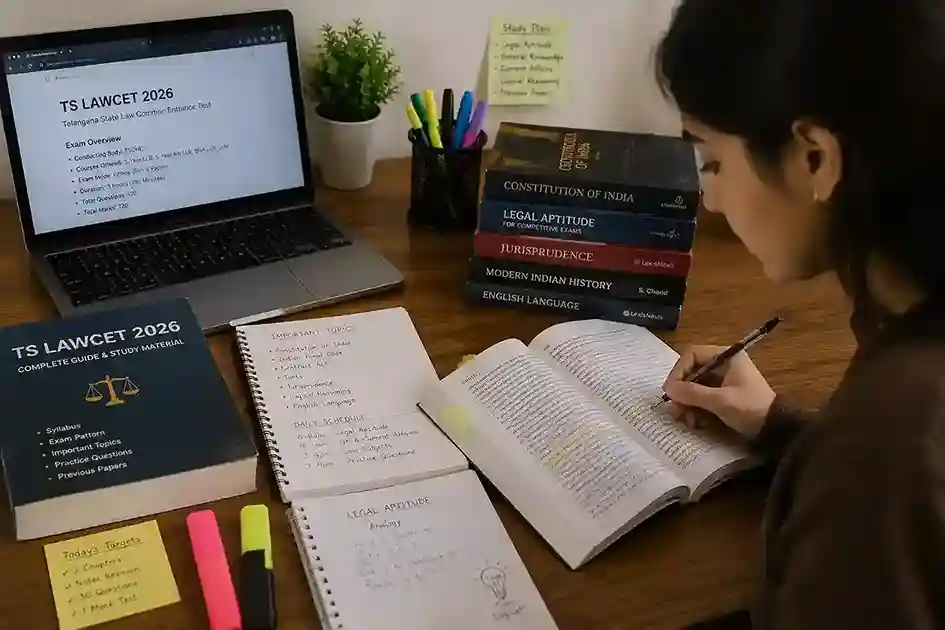
What is TS LAWCET?
TS LAWCET stands for Telangana State Law Common Entrance Test. The official name is now TG LAWCET after the Telangana government updated its exam branding. Most students still search for "TS LAWCET," so both names refer to the same exam.
Osmania University, Hyderabad, conducts this exam on behalf of the Telangana State Council of Higher Education (TGCHE). It is the gateway to 3-year LLB and 5-year integrated LLB programmes across approximately 60 law colleges in Telangana.
The exam runs in Computer-Based Test (CBT) mode. It tests three core areas: general knowledge, current affairs, and legal aptitude. There is no negative marking, which means you should attempt every question.
If you missed the 2026 cycle, this guide will fully prepare you for TS LAWCET 2027. Every strategy, resource, and tip here applies to the next cycle.
Exam Pattern at a Glance
Knowing the pattern before you open a book is non-negotiable. Here is what the TS LAWCET paper looks like:
| Section | Questions | Marks | Difficulty (5-year LLB) | Difficulty (3-year LLB) |
|---|---|---|---|---|
| General Knowledge & Mental Ability | 30 | 30 | Intermediate (10+2) | Degree Level |
| Current Affairs | 30 | 30 | Intermediate (10+2) | Degree Level |
| Aptitude for the Study of Law | 60 | 60 | Intermediate (10+2) | Degree Level |
| Total | 120 | 120 | Duration: 90 Minutes | Mode: CBT | No Negative Marking | |
Legal Aptitude carries half the marks. Prioritise it without ignoring the other two sections. A score of 80 to 90 marks is generally considered strong for securing a seat at top colleges like the University College of Law, Osmania University.
The qualifying mark for General/Open category is 42 out of 120 (35%). SC/ST and PwD candidates have no minimum qualifying mark.
Complete TS LAWCET Syllabus 2026
The official syllabus comes from Osmania University on behalf of TGCHE. Here is a clean section-wise breakdown.
Section 1: General Knowledge & Mental Ability
Section 2: Current Affairs
This section tests awareness of events from the past 12 months. Focus on:
- National and state government policies and schemes
- International relations, treaties, and summits
- Judicial appointments and landmark Supreme Court judgments
- Economic developments, budget highlights, and major bills passed
- Science, environment, and sports news
- Legal reforms, new laws enacted in India
Section 3: Aptitude for the Study of Law
This is the highest-weightage section. It has three sub-parts:
| Sub-Part | Key Topics |
|---|---|
| Legal Awareness | Indian Constitution (Preamble, Fundamental Rights, Directive Principles, Fundamental Duties, Amendments), organs of government, important acts |
| Legal Reasoning | Principle-fact based questions, case analysis, identifying legal issues, applying rules to hypothetical scenarios |
| Legal Principles | IPC 1860 (general principles, exceptions), Law of Torts, Contract Act, Consumer Protection Act 2019, Copyright Act 1957, RTI Act 2005, IT Act 2000, Patents Act, Arbitration and Conciliation Act 1996, Environment Protection Act 1986, Protection of Human Rights Act |
Section-Wise Preparation Strategy
A scattered approach wastes time. Use this focused strategy for each section.
General Knowledge & Mental Ability
Static GK changes slowly. Build this base first. Then revisit it weekly.
- Read one reliable GK book from cover to cover. Do not switch books mid-prep.
- Make short notes on constitutional articles, historical dates, and polity facts.
- Practise reasoning puzzles for 15 to 20 minutes daily. Speed matters here.
- Focus on India-specific geography, economics, and governance topics.
- Revise basic arithmetic skills. They appear under Mental Ability as data sets.
Current Affairs
This section has no fixed textbook. You build it over time.
- Read a national newspaper every day for 30 minutes. Focus on policy and judiciary pages.
- Use a monthly current affairs digest to consolidate what you read.
- Keep a running notes file. Add five to ten key facts every week.
- Pay special attention to new laws, Supreme Court orders, and Telangana state news.
- Start at least six months before the exam. You cannot cram current affairs.
Aptitude for the Study of Law
This section is the difference-maker. Treat it with the most focus.
- Understand each major law | IPC, Contract Act, Torts | in plain terms first.
- Learn legal maxims and their plain-English meanings.
- Practise principle-fact questions daily. Aim for 20 questions per session.
- Study landmark Supreme Court judgments. Know the issue, not just the outcome.
- Revise the Indian Constitution thoroughly. Fundamental Rights questions are frequent.
Check our section-by-section deep dives for TS LAWCET Legal Aptitude, GK prep, and current affairs trackers.
Best Books for TS LAWCET 2026
Pick one reliable book per section. More books create confusion, not clarity.
| Section | Book Title | Author / Publisher | Why It Helps |
|---|---|---|---|
| General Knowledge | Lucent's General Knowledge | Lucent Publications | Covers static GK comprehensively. Widely trusted for state-level exams. |
| Mental Ability | Verbal and Non-Verbal Reasoning | R.S. Aggarwal | Covers all reasoning types. Has abundant practice questions. |
| Mental Ability (alt) | A Fasttrack Course in Mental Ability | Arihant Experts | Concise, quick revision-friendly format for time-pressed students. |
| Legal Aptitude | Legal Aptitude for CLAT and Other Law Entrance Examinations | A.P. Bhardwaj | Standard reference for law entrance prep across India. Principle-fact practice is excellent. |
| Current Affairs | Monthly current affairs digest | Various publishers | No single book covers this. Use a monthly digest plus daily newspaper reading. |
Get the most recent edition of every book. Legal material | especially anything related to constitutional amendments and new acts | changes regularly. An old edition may have outdated content that hurts your score.
Mock Tests, PYQs, and Online Resources
Reading without practice is incomplete preparation. Mock tests reveal your weak spots before the exam does.
Why Mock Tests Matter
TS LAWCET is a timed, computer-based exam. Students who score poorly often do so because of slow speed | not lack of knowledge. Mock tests build the mental habit of answering quickly and accurately under pressure.
How to Use Previous Year Question Papers
- Download the official TS LAWCET PYQs from the TGCHE website or trusted exam prep portals.
- Attempt a full paper under real exam conditions: 90 minutes, no breaks, no phone.
- Mark every question you got wrong or guessed at. These are your study targets.
- Trace each wrong answer back to a concept. Fix the concept, then re-test on that topic.
- Track your score across papers. Aim to improve by 5 marks every two weeks.
Mock Test Schedule (Last 30 Days Before Exam)
| Week | Activity | Focus |
|---|---|---|
| Week 1 | 2 full mock tests + PYQ analysis | Identify weak sections |
| Week 2 | Section-wise timed mini tests daily | Target weak areas aggressively |
| Week 3 | 3 full mock tests + revision of notes | Build accuracy and speed together |
| Week 4 | 2 full mock tests + light revision only | Consolidate, rest, no new topics |
30-Day Study Plan for TS LAWCET
This plan works for students starting fresh. Adjust based on your current level.
| Days | Focus Area | Daily Target |
|---|---|---|
| Day 1–5 | Indian Constitution (all parts) | 30 pages + 20 legal aptitude questions |
| Day 6–10 | IPC, Law of Torts, Contract Act basics | 1 chapter per session + 20 practice questions |
| Day 11–15 | Other acts (RTI, IT Act, Consumer Protection) | 2 acts per day + current affairs reading |
| Day 16–20 | GK (History, Geography, Polity, Economy) | 2 topics per day + 30 GK practice questions |
| Day 21–25 | Mental Ability: Reasoning and logic | 20–30 reasoning questions daily |
| Day 26–30 | Full mock tests + revision of weak areas | 1 mock test every two days + note revision |
Daily time commitment: two to three hours is enough if you are consistent. Spread it | one hour in the morning and one to two hours in the evening works well for most students.
Revise your short notes every Sunday. This weekly refresh stops knowledge from fading before exam day.
TS LAWCET 2026 Key Dates Timeline
Here is the complete 2026 cycle for reference and future planning:
Eligibility Criteria (Quick Reference)
| Programme | Eligibility | Qualifying Marks |
|---|---|---|
| 5-Year Integrated LLB (BA/BBA/BCom/BSc LLB) | Passed 10+2 (Intermediate) from a recognised board | 42/120 (General) | None (SC/ST/PwD) |
| 3-Year LLB | Bachelor's degree (any discipline) from a recognised university. Minimum 45% marks (40% for SC/ST) | 42/120 (General) | None (SC/ST/PwD) |
There is no upper age limit for TS LAWCET. Candidates from outside Telangana are also eligible. There is no limit on the number of attempts.
Law Courses in India | A Clear Guide
TS LAWCET is your entry point into law education. But understanding the full range of law courses in India helps you plan a longer career path from day one.
Undergraduate Law Programmes
BA LLB (5 Years)
Combines arts subjects with law. Best for judiciary, civil services, and litigation careers. Entry after Class 12.
BBA LLB (5 Years)
Mixes business administration with law. Best path for corporate law, MNC legal teams, and compliance roles.
BCom LLB (5 Years)
Combines commerce and law. Useful for taxation law, banking law, and financial regulation careers.
BSc LLB (5 Years)
Merges science with law. Strong fit for forensic law, cyber law, and technology-related legal practice.
LLB | 3 Years
For graduates from any background. Direct professional law degree. Covers core law subjects across six semesters.
Postgraduate Law Programmes
After completing an LLB, you can pursue an LLM (Master of Laws). The standard duration is two years. LLM is not required to practise law, but it opens doors to academia, senior corporate roles, and specialised practice.
The most sought-after LLM specialisations in India in 2026 include:
LLM admission requires an LLB with a minimum of 50% to 55% marks. Most top universities admit through national exams like CLAT PG or AILET PG.
Diploma and Certificate Courses in Law
Short-term diploma programmes are available in cyber law, intellectual property, forensic law, corporate law, and labour law. These are useful for working professionals who want legal knowledge without a full degree.
Key Entrance Exams for Law Admissions in India
| Exam | For | Conducted By |
|---|---|---|
| CLAT | National Law Universities (24 NLUs), 5-year and 3-year LLB | Consortium of NLUs |
| AILET | National Law University, Delhi | NLU Delhi |
| TS LAWCET / TG LAWCET | Law colleges in Telangana | Osmania University / TGCHE |
| AP LAWCET | Law colleges in Andhra Pradesh | Sri Krishnadevaraya University |
| MH CET Law | Law colleges in Maharashtra | Maharashtra CET Cell |
| DU LLB | Delhi University Faculty of Law | Delhi University |
Check our scholarship guide for merit-based and government-funded financial aid for LLB aspirants.
Career Scope After LLB in India
A law degree opens more doors than most students realise. The legal sector in India is growing. Demand for lawyers in corporate, technology, and compliance roles is rising faster than ever.
Career Paths After LLB
| Career Path | What You Do | Next Step |
|---|---|---|
| Litigation (Advocate) | Represent clients in district courts, High Courts, Supreme Court | Register with Bar Council, appear for AIBE |
| Corporate Law | Handle contracts, mergers, compliance, and legal advisory for companies | Join a law firm or in-house legal team |
| Judicial Services | Become a Civil Judge or Magistrate via state judicial exams | Appear for state Public Service Commission judicial exam |
| Government Law | Work with Central or State government legal departments, PSUs | Apply for government law officer positions |
| Legal Research & Policy | Work with think tanks, NGOs, policy institutes | Consider LLM or PhD for senior research roles |
| Alternative Dispute Resolution | Work as arbitrator or mediator | a rapidly growing field | Specialised training or LLM in ADR |
| Legal Technology | Bridge law and tech for LegalTech firms, AI contract tools, compliance platforms | Build tech skills alongside legal knowledge |
Three trends are reshaping law careers in India right now. First, technology is automating contract review and legal research. Lawyers who understand both law and technology are in high demand. Second, India's data protection laws are tightening, creating new compliance and privacy law roles. Third, alternative dispute resolution is growing fast, with many businesses preferring arbitration to court litigation.
If you are unsure which path suits you, test your instincts during your LLB internships. Do two or three internships in different practice areas before you commit to a specialisation.
Law College Fees in India (2026)
| College Type | Annual Fees (Approx.) | Example Colleges |
|---|---|---|
| Government Law Colleges | Rs 1,000 – Rs 88,000 | University College of Law (Osmania), Government Law Colleges (state-run) |
| National Law Universities (NLUs) | Rs 1.5 – 4 Lakh per year | NLSIU Bangalore, NLU Delhi, GNLU Gandhinagar |
| Private Law Colleges | Rs 50,000 – Rs 4 Lakh per year | Symbiosis Law School, Jindal Global Law School |
India has over 1,200 law colleges offering approximately 80,000 seats annually. The 5-year integrated format now accounts for about half of all LLB seats. Government colleges remain the most affordable option for quality legal education.
Frequently Asked Questions
What is the difference between TS LAWCET and TG LAWCET?
They are the same exam. The Telangana government officially renamed it from TS LAWCET (Telangana State) to TG LAWCET (Telangana) as part of a broader state branding update. The syllabus, exam pattern, conducting body, and admission process remain unchanged.
How many questions are in TS LAWCET and how long is the exam?
TS LAWCET has 120 multiple-choice questions. The total duration is 90 minutes. There are three sections: GK and Mental Ability (30 questions), Current Affairs (30 questions), and Aptitude for the Study of Law (60 questions). Each correct answer gives 1 mark. There is no negative marking.
What marks do I need to qualify TS LAWCET?
General/Open category candidates need at least 42 marks out of 120 (35%) to qualify. SC, ST, and PwD candidates have no minimum qualifying mark requirement and can participate in counselling regardless of their score.
Can I apply for TS LAWCET from outside Telangana?
Yes. Candidates from any state in India can apply, as long as they meet the academic eligibility criteria. There is no domicile restriction for the exam itself. However, some colleges may have state-quota seats that favour Telangana residents during counselling.
Is coaching necessary for TS LAWCET?
No, coaching is not necessary. Many students crack the exam through self-study with the right books, regular mock tests, and consistent current affairs reading. Coaching can help if you struggle with structured planning or need guidance on legal concepts, but it is not a requirement.
Which is better | 3-year LLB or 5-year integrated LLB?
It depends on your situation. If you have already completed a bachelor's degree, the 3-year LLB gets you into legal practice sooner. If you are right after Class 12 and certain about law as a career, the 5-year integrated programme saves one year overall compared to doing a separate graduation followed by LLB. Both are equally recognised by the Bar Council of India.
What is the TS LAWCET counselling process?
After results are declared, qualified candidates register for counselling, pay the registration fee, and fill in their college and course preferences online (web options). Seat allotment happens in two phases based on rank, category, and preferences. Candidates whose names appear in the allotment list report to the allotted college and complete document verification to confirm their seat.
What documents do I need for TS LAWCET admission?
You will generally need: Class 10 and 12 mark sheets, bachelor's degree mark sheets (for 3-year LLB), a valid photo ID (Aadhaar, passport, or voter ID), caste/category certificate if applicable, a recent passport-size photograph, and payment receipts for the application and counselling fees. Always check the official notification for the exact updated document list.
How is the TS LAWCET rank calculated in case of a tie?
In case two candidates score the same total marks, the rank is determined by the marks scored in the Aptitude for the Study of Law section. The candidate with higher legal aptitude marks gets the better rank.
Check our preparation resources for AP LAWCET, CLAT, and law scholarship opportunities in India.