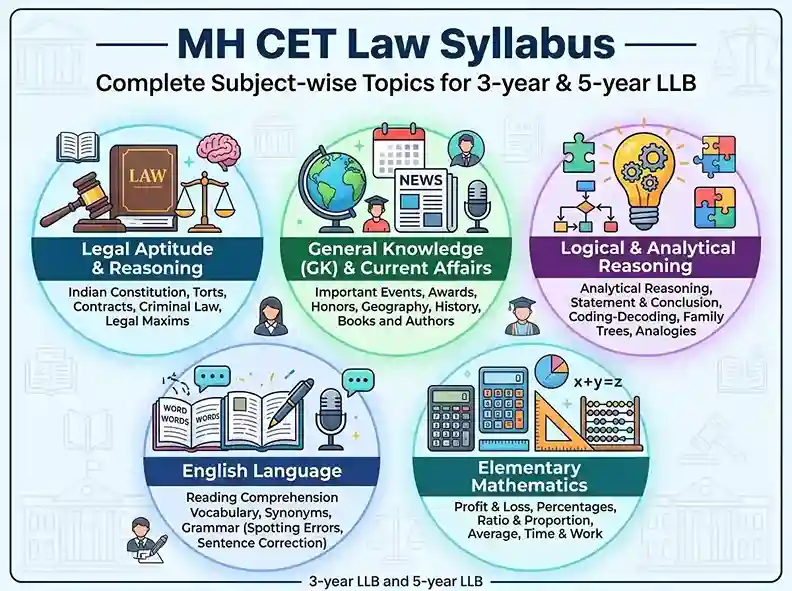
1. MH CET Law 2026 Syllabus Overview
The MH CET Law syllabus 2026 is officially prescribed by the State Common Entrance Test Cell, Maharashtra and covers the topics and subjects that candidates must prepare to secure admission to 3-year LLB and 5-year integrated LLB programmes across Maharashtra's law colleges.
Unlike CLAT — which shifted to entirely passage-based reading comprehension — MH CET Law retains a more traditional, direct-question format. This means topic-specific knowledge carries significant weight. Candidates are tested on their grasp of legal concepts, general awareness, reasoning ability, English language skills, and (for the 5-year LLB) basic mathematics. Understanding the precise syllabus is the single most important step before beginning your preparation, as it determines exactly where you should invest your study time.
MH CET Law asks direct, topic-specific questions — for example, "Which Article of the Constitution deals with Right to Equality?" or "What is the legal maxim for 'Let the buyer beware'?" This is fundamentally different from CLAT's passage-only format. This means subject-matter knowledge — especially of the Indian Constitution, IPC, Torts, and Legal Maxims — is tested more directly, and rote recall of key facts is more useful in MH CET Law than in CLAT.
2. MH CET Law 2026 Exam Pattern: 3-Year & 5-Year LLB Paper Pattern
The exam pattern for MH CET Law 2026 differs between the two programmes. Both are online (computer-based) tests lasting 120 minutes, with 120 objective multiple-choice questions worth 1 mark each and no negative marking. The key distinction is the sections tested.
📋 MH CET Law 2026 Paper Pattern — 5-Year LLB
| Section | No. of Questions | Total Marks | Approx. Weightage | Difficulty |
|---|---|---|---|---|
| Legal Aptitude & Legal Reasoning | 32 | 32 | 26.7% | High |
| General Knowledge & Current Affairs | 24 | 24 | 20% | Moderate |
| Logical & Analytical Reasoning | 32 | 32 | 26.7% | Moderate |
| English Language | 24 | 24 | 20% | Easy–Moderate |
| Mathematical Aptitude | 8 | 8 | 6.6% | Easy |
| Total | 120 | 120 | 100% | — |
📋 MH CET Law 2026 Paper Pattern — 3-Year LLB
| Section | No. of Questions | Total Marks | Approx. Weightage | Difficulty |
|---|---|---|---|---|
| Legal Aptitude & Legal Reasoning | 24 | 24 | 20% | High |
| General Knowledge & Current Affairs | 32 | 32 | 26.7% | Moderate |
| Logical & Analytical Reasoning | 24 | 24 | 20% | Moderate |
| English Language | 40 | 40 | 33.3% | Easy–Moderate |
| Mathematical Aptitude | ❌ Not included in 3-Year LLB paper | |||
| Total | 120 | 120 | 100% | — |
3. MH CET Law Syllabus 2026 for 5-Year LLB (Detailed Section-Wise Topics)
Below is the complete, detailed topic-wise syllabus for the MH CET Law 5-year LLB examination. Each section is broken down into the specific topics that appear most frequently based on analysis of previous years' papers (2019–2025).
This is the most critical section of MH CET Law. Unlike CLAT, MH CET Law tests both direct legal knowledge (legal maxims, IPC sections, constitutional articles) and principle-application questions. The section is designed to assess a candidate's interest in the legal field, their understanding of foundational law, and their ability to apply legal rules to factual scenarios.
Unlike CLAT, MH CET Law requires you to actually know articles, sections, and maxims — not just apply principles stated in a passage. Create a dedicated flashcard set for legal maxims (top 60), key constitutional articles (12–35, 52–78, 108–112, 352–360), and landmark judgments. Revise these three times in the 6 weeks before the exam. For principle-application questions, practise with A.P. Bhardwaj's book.
The GK section tests both static general knowledge and dynamic current affairs from the preceding 6–8 months. Questions are more direct than CLAT's passage-based GK format — you may be asked "Who won the Nobel Peace Prize in 2025?" or "In which year was the Right to Education Act passed?" Background knowledge of Indian history, polity, and economics is essential.
| Topic Area | Key Topics to Study | Weightage |
|---|---|---|
| Indian History | Ancient civilisations (Indus Valley, Vedic period), Delhi Sultanate, Mughal Empire, British colonial history, Freedom Movement (1857–1947), key leaders and movements | High |
| Indian Polity | Constitutional history, Fundamental Rights & Duties, Parliament, Judiciary, State governments, Local self-governance, major constitutional amendments | Very High |
| Geography | Indian physical geography (rivers, mountains, soil types), climate, natural resources, world geography highlights, important straits and passes | Moderate |
| Economy | RBI and its functions, five-year plans, budget concepts (fiscal deficit, GDP, inflation), economic reforms, banking sector basics, new economic policies | Moderate |
| Science & Technology | ISRO missions, space science, major inventions and discoveries, computer and internet basics, biotechnology breakthroughs, environmental science | Moderate |
| Current Affairs | National and international events from the last 6–8 months — elections, international summits, government schemes, sports awards, Nobel Prizes, Padma awardees | High |
| Sports & Awards | Olympic results, Commonwealth Games, national sports awards (Khel Ratna, Arjuna), Bharat Ratna, Nobel Prizes, Booker Prize, international recognition | Moderate |
| Books & Authors | Recently published notable books, particularly by Indian authors and public figures; classic Indian literature references | Low–Moderate |
Build your static GK base using Lucent's GK (cover Indian polity, history, and geography chapters). For current affairs, read a monthly CLAT/law-specific current affairs digest from October 2025 to April 2026, and track national news daily. Dedicate 30 minutes every morning to reading one quality newspaper. Do not memorise data tables — understand context and significance of events.
Unlike CLAT, MH CET Law Logical Reasoning includes traditional aptitude-style questions — coding-decoding, blood relations, seating arrangements, and series completion — in addition to argument-analysis. This means classical logical reasoning preparation is genuinely required, and books like R.S. Aggarwal can be used more broadly than for CLAT.
Unlike CLAT, you should practise the full range of reasoning topics for MH CET Law — including coding-decoding, blood relations, and series completion. R.S. Aggarwal's book is more directly applicable here. Prioritise syllogisms (highest frequency), seating arrangements, and series completion — these three topic types together typically account for 40–50% of reasoning questions in past MH CET Law papers.
The English section in MH CET Law tests a wide range of language skills — far more diverse than CLAT's pure reading comprehension focus. Vocabulary, grammar, idioms, sentence improvement, and comprehension passages all appear. The 3-year LLB paper has significantly higher English weightage (40 questions vs 24), making it the single most important section for that exam.
If you are targeting the 3-year LLB, English is your most important section at 40 marks. Build vocabulary daily using Word Power Made Easy (30 minutes per day). Practice grammar error-spotting using Wren & Martin's key chapters. Read one newspaper editorial daily for comprehension and idiom exposure. In the exam, attempt comprehension passages first (direct marks), then vocabulary, then grammar questions.
Mathematical Aptitude is only tested in the 5-year LLB paper, not in the 3-year LLB exam. With just 8 questions, it carries a relatively low weightage (6.6%). Questions are set at Class 10 level and test basic numerical ability. This is one of the easiest sections to score well in with targeted preparation.
With only 8 questions, target 7–8 correct. Spend no more than 2–3 weeks on focused maths preparation. Revise NCERT Maths Class 8–10 for core concepts. Practice 30 data interpretation questions and master percentage/ratio shortcuts. On exam day, spend no more than 10–12 minutes on this section — it is worth less than any other section per question.
4. MH CET Law Syllabus 2026 for 3-Year LLB
The 3-year LLB syllabus shares three sections with the 5-year LLB paper (Legal Aptitude, GK, and Logical Reasoning) but has some important differences. English carries 40 questions — the highest of any section — and Mathematics is not included.
| Section | Questions | Key Topics (Summary) |
|---|---|---|
| Legal Aptitude & Legal Reasoning | 24 | Constitution of India, IPC, Law of Torts, Law of Contracts, Legal Maxims, Landmark Judgments, Legal Propositions & Application, Legal Terminology, Legal Awareness |
| GK & Current Affairs | 32 | History (Ancient, Medieval, Modern), Indian Polity, Geography, Economy, Science & Technology, Current Events, Sports & Awards, Environment, Books & Authors |
| Logical & Analytical Reasoning | 24 | Verbal & Non-verbal reasoning, Syllogisms, Coding-Decoding, Blood Relations, Seating Arrangements, Direction Sense, Series Completion, Critical Reasoning |
| English Language | 40 | Vocabulary (synonyms, antonyms, analogies), Grammar errors, Idioms & Phrases, Reading Comprehension, Fill in the blanks, Sentence improvement, One-word substitution, Spelling errors |
The 3-year LLB syllabus includes a sub-topic called Legal Awareness & Aptitude within the Legal Aptitude section, which specifically covers: Fundamental Rights and Duties in the context of daily life, Salient features of the Indian Constitution, Landmark Judgments and their practical impact, and basic Legal Procedures and Terminology. This sub-topic often appears as 6–8 questions within the Legal Aptitude section of the 3-year LLB paper.
5. Key Differences: 3-Year LLB vs 5-Year LLB Syllabus
Before deciding which paper to appear for, understand the structural and strategic differences between the two MH CET Law programmes.
| Parameter | 5-Year LLB (BA LLB / BBA LLB) | 3-Year LLB (Post-Graduation) |
|---|---|---|
| Eligibility | 10+2 (any stream), minimum 45% marks | Graduation in any discipline, minimum 45% marks |
| Sections | 5 sections (includes Maths) | 4 sections (no Maths) |
| English Weightage | 24 questions (20%) | 40 questions (33.3%) — much higher |
| GK Weightage | 24 questions (20%) | 32 questions (26.7%) — higher |
| Legal Aptitude | 32 questions (26.7%) | 24 questions (20%) |
| Maths | 8 questions — included | Not included |
| Programme Duration | 5 years (integrated BA/BBA + LLB) | 3 years (standalone LLB after graduation) |
| Exam Date 2026 | May 8, 2026 | April 1–2, 2026 |
| Target Strategy | Focus on Legal Aptitude + Reasoning; Maths is bonus | Focus on English first (33%); GK and Legal Aptitude next |
6. Most Important Topics & High-Weightage Areas in MH CET Law 2026
Based on analysis of MH CET Law previous year question papers from 2019 to 2025, the following topics consistently carry the highest question frequency and should be prioritised in your preparation strategy.
| Topic | Section | Approx. Questions Per Paper | Priority |
|---|---|---|---|
| Constitution of India (Fundamental Rights, Parliament, Amendments) | Legal Aptitude | 8–12 | Must-Do |
| Legal Maxims (Latin + English) | Legal Aptitude | 4–6 | Must-Do |
| Syllogisms | Logical Reasoning | 5–8 | Must-Do |
| Current Affairs (last 6–8 months) | GK | 8–12 | Must-Do |
| Indian History (Freedom Movement) | GK | 4–6 | High |
| Vocabulary (Synonyms, Antonyms, Analogies) | English | 6–10 | Must-Do |
| Law of Torts (Negligence, Strict Liability) | Legal Aptitude | 3–5 | High |
| Coding-Decoding | Logical Reasoning | 3–5 | High |
| Seating Arrangements & Blood Relations | Logical Reasoning | 4–6 | High |
| Landmark Supreme Court Judgments | Legal Aptitude | 2–4 | High |
| Grammar Error-Spotting | English | 4–6 | High |
| Data Interpretation (Maths) | Mathematical Aptitude | 3–4 | Moderate |
7. Best Books for MH CET Law 2026 — Section-Wise Recommended List
Selecting the right books is critical — over-preparation with irrelevant material wastes time, and under-preparation with too few resources leaves gaps. Here are the expert-recommended books specifically suited to the MH CET Law 2026 syllabus and format.
⚖️ Legal Aptitude — Best Books
🌐 GK & Current Affairs — Best Books
🧩 Logical Reasoning — Best Books
📖 English Language — Best Books
8. 4-Month MH CET Law 2026 Preparation Plan (February–May 2026)
This schedule is designed for the 5-year LLB exam on May 8, 2026. Adapt accordingly for the 3-year LLB April exam. Allocate 4–5 focused hours daily. The plan assumes no prior formal preparation — if you are starting from a stronger base, accelerate accordingly.
Foundation Month
GK: Complete Lucent's Indian Polity and Modern Indian History chapters. Begin daily newspaper reading (30 min/day).
Reasoning: Complete RS Aggarwal coding-decoding, blood relations, direction sense, and analogy chapters.
English: Begin Word Power Made Easy (complete Sessions 1–20). Grammar: error-spotting and fill-in-the-blanks chapters from Wren & Martin.
Maths: Revise Class 10 arithmetic — percentages, ratios, profit/loss, time-work.
Building Month
GK: Complete Lucent Geography and Science chapters. Read Manorama Yearbook 2026 Part 1. Cover current affairs October 2025–February 2026.
Reasoning: Complete syllogisms, seating arrangements, series completion (verbal and non-verbal). Begin analytical puzzle practice.
English: Complete Word Power Made Easy Sessions 21–40. Practice 2 comprehension passages daily. Vocabulary: one-word substitutions and idioms.
Mocks: Begin first full-length mock test. Identify weak sections. Analyse every wrong answer.
Practice & Mock Month
GK: Cover March 2026 current affairs. Read Manorama Yearbook Part 2. Revise Indian Economy and Science.
Mocks: Take 1 full mock per week (4 in this month). Spend 90 minutes analysing each mock. Maintain error log. Adjust study plan based on weak areas identified.
Reasoning: Time-bound practice sets of 32 questions in 30 minutes. Focus on speed for coding-decoding and syllogisms.
English: Complete all Word Power Made Easy sessions. Daily vocabulary review of 20 words/day.
Final Lap
Mocks: 1 mock every 2 days. Focus on time management — aim to finish all 120 questions with 10 minutes to review.
April 2026 Current Affairs: Cover the final month's major events before the exam.
Exam Strategy: Attempt sequence — Legal Aptitude → Reasoning → GK → English → Maths. Mark and skip questions taking more than 90 seconds. Return at the end. Since there is no negative marking, attempt every single question.
9. Section-Wise Preparation Tips to Outperform the Competition
10. Top Law Colleges in Maharashtra Accepting MH CET Law 2026 Scores
MH CET Law scores are the gateway to over 400 law colleges across Maharashtra. Here are the most sought-after institutions to target with your preparation:
| College | Location | Programme | Type |
|---|---|---|---|
| Government Law College Mumbai | Mumbai | 3-Year LLB | Government |
| ILS Law College | Pune | 5-Year BA LLB, 3-Year LLB | Aided |
| Symbiosis Law School Pune | Pune | 5-Year BA LLB, BBA LLB | Private |
| K.C. Law College | Mumbai (Churchgate) | 3-Year LLB | Government-Aided |
| Manikchand Pahade Law College | Aurangabad | 3-Year LLB, 5-Year LLB | Government-Aided |
| Nagpur University Law Faculty | Nagpur | 3-Year LLB | Government |
| New Law College Pune | Pune | 3-Year LLB, 5-Year LLB | Private-Aided |
| Pune University Department of Law | Pune | 3-Year LLB | University Department |
| Maharashtra National Law University Mumbai | Mumbai | 5-Year BA LLB (via CLAT also) | National Law University |
| Nagpur University's VNIT Law School | Nagpur | 5-Year Integrated | Private |
11. Frequently Asked Questions — MH CET Law Syllabus 2026
The MH CET Law 2026 syllabus for the 5-year LLB covers five sections totalling 120 marks: Legal Aptitude & Legal Reasoning (32 Qs) — Constitution of India, IPC, Torts, Contracts, Legal Maxims, Landmark Judgments; General Knowledge & Current Affairs (24 Qs) — History, Polity, Geography, Economy, Science, current events; Logical & Analytical Reasoning (32 Qs) — Syllogisms, Coding-Decoding, Blood Relations, Seating Arrangements, Series Completion; English Language (24 Qs) — Vocabulary, Grammar, Comprehension, Idioms; and Mathematical Aptitude (8 Qs) — Class 10 level arithmetic, percentages, ratios, data interpretation.
No. MH CET Law 2026 has no negative marking. Every correct answer earns +1 mark, and incorrect or unattempted questions carry no penalty. This is a significant strategic advantage — candidates should attempt all 120 questions without hesitation, even when uncertain. Leaving questions blank is never advantageous in this exam.
The three main differences are: (1) Question format — CLAT is entirely passage-based reading comprehension; MH CET Law includes direct factual questions alongside application-based ones. (2) Negative marking — CLAT deducts 0.25 marks per wrong answer; MH CET Law has no negative marking. (3) Reasoning scope — CLAT focuses on critical argument analysis; MH CET Law includes traditional aptitude topics like coding-decoding and blood relations. MH CET Law is generally considered more accessible for first-time law entrance aspirants.
A focused preparation of 4–6 months is sufficient to score well in MH CET Law 2026. The syllabus is broader than CLAT in some ways (traditional reasoning, direct legal questions) but less deep in reading comprehension requirements. Dedicating 4–5 hours daily with consistent mock test practice and section-wise study should enable candidates to target 90+ marks. Candidates with strong GK or English backgrounds from previous academic preparation may need only 3 months.
Yes. The 5-year LLB (integrated BA LLB or BBA LLB) programme is open to candidates who have passed 10+2 or equivalent examination with a minimum of 45% marks (40% for SC/ST candidates). The 3-year LLB programme requires graduation with a minimum of 45% marks. Candidates appearing in their qualifying examination are also eligible to appear for MH CET Law 2026 provisionally.
For last-minute (2–3 weeks) focused preparation, prioritise: (1) Legal Maxims — high frequency, finite list, can score 4–6 marks with 3 days of focused study; (2) Constitutional Articles — Fundamental Rights (Art. 12–35) and Emergency Provisions; (3) Syllogisms — practising 50 questions builds pattern recognition for 5–8 guaranteed marks; (4) Coding-Decoding — high scoring and formula-based; (5) Current Affairs from last 4–6 months — read one consolidated monthly digest for quick coverage; (6) Vocabulary synonyms/antonyms — review top 300 word pairs from Norman Lewis.
The MH CET Law 2026 exam is conducted by the Maharashtra CET Cell for admission to 3-year and 5-year LLB programmes across 400+ colleges. Key points to remember:
- No negative marking — attempt all 120 questions
- 5-Year LLB: Legal Aptitude (32) + GK (24) + Reasoning (32) + English (24) + Maths (8) = 120
- 3-Year LLB: Legal Aptitude (24) + GK (32) + Reasoning (24) + English (40) = 120 — no Maths
- Constitution of India and Legal Maxims are the highest-yield topics in Legal Aptitude
- Syllogisms, Coding-Decoding are must-master topics in Reasoning
- Current Affairs from last 6–8 months drive the GK section significantly
- 4–6 months of focused preparation with regular mock tests is sufficient for a competitive score