The Law School Admission Council (LSAC) officially discontinued the LSAT | India examination from 2025. The last LSAT India exam was held in May 2024. LSAC cited the inability to achieve specific business objectives as the reason for discontinuation. Jindal Global Law School (JGLS) | previously the primary user of LSAT India scores | now uses the LNAT UK exam for 5-year BA LLB admissions and the JSAT Law exam for 3-year LLB, LLM, and BA in Law programmes. This page covers the complete LSAT India syllabus for students referencing past exam patterns, using existing LSAT India scores (valid for up to 5 years at some institutions), or preparing for similar skill-based law exams like LNAT.
1. What is the LSAT India Syllabus?
The LSAT India Syllabus is fundamentally different from every other Indian law entrance exam. While CLAT, AILET, SLAT, and MH CET Law test subject-specific knowledge (English grammar, General Knowledge, Legal Awareness, Mathematics), the LSAT India syllabus has no chapters, no topics to memorise, and no factual content to recall.
Instead, the LSAT India syllabus is a skills blueprint. It defines four types of thinking tasks a candidate must be able to perform under timed conditions. The Law School Admission Council (LSAC) designed the exam to reflect the kind of reasoning law students use daily | analysing complex arguments, identifying logical flaws, understanding dense written passages, and deducing conclusions from structured rule sets.
This makes LSAT India both easier and harder than other law entrance exams in different ways. Easier because you don't need to memorise dates, cases, or current affairs. Harder because you cannot cram for it | performance depends on deeply trained reasoning skills that must be developed through structured practice over weeks and months.
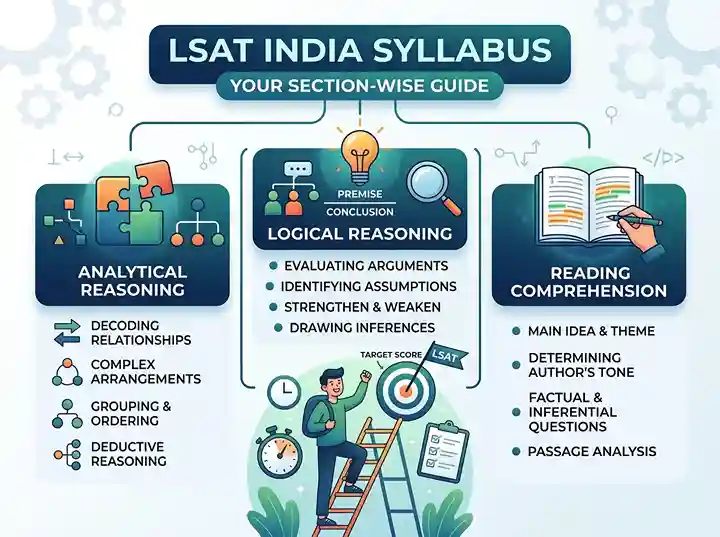
The syllabus divides into four sections: Analytical Reasoning (logic games), Logical Reasoning 1, Logical Reasoning 2, and Reading Comprehension. Each section is timed independently at 35 minutes, and the total paper runs for 140 minutes with 92 multiple-choice questions.
The official LSAC description of LSAT India states: the exam measures candidates' reasoning abilities that are essential for success in law school. There is no prescribed reading list. Preparation means training your mind to think in structured, logical patterns | not accumulating information. This is why LSAT India performance correlates more strongly with practice time and coaching quality than with academic background.
2. LSAT India Exam Pattern
The LSAT India exam pattern is consistent across all editions. Every candidate faces the same four sections in sequence, each independently timed, in an online remotely proctored format from their home.
| Parameter | Details |
|---|---|
| Exam Mode | Online | Remotely Proctored (from home) |
| Total Sections | 4 sections |
| Total Questions | 92 multiple-choice questions |
| Total Duration | 140 minutes (2 hours 20 minutes) |
| Time Per Section | 35 minutes each (strict sectional time limit) |
| Marking Scheme | +1 for each correct answer; 0 for wrong answers (no negative marking) |
| Question Type | Multiple-choice questions (MCQs) with 5 options (A–E) |
| Language | English only |
| Score Scale | 420 to 480 (scaled score) |
| Exam Frequency | Twice per year | January & May sessions |
| Sections Order | Analytical Reasoning → LR1 → LR2 → Reading Comprehension |
Note: Question counts vary slightly across sessions (±2 per section). Total is always 92.
3. LSAT India Section-Wise Syllabus & Topics
Section 1: Analytical Reasoning (AR) | "Logic Games"
Analytical Reasoning | commonly called "logic games" | is the most structurally unique section of LSAT India. Each set presents a scenario with a cast of characters, objects, or events that must be arranged according to a set of rules. The candidate reads the scenario and rules, then answers 5–7 questions about the possible and necessary arrangements. This section directly mirrors the type of structured rule-following analysis a law student performs when working through legal frameworks or transactional documents.
A typical logic game might say: "Seven students | A, B, C, D, E, F, G | are to be assigned to three groups. Group 1 has exactly 3 members; Group 2 has exactly 2. If A is in Group 1, then B cannot be in Group 2..." and then ask: "Which of the following could be a complete and accurate list of Group 2's members?"
Always diagram the game fully before attempting questions. Use pencil/symbols to represent rules. Most candidates who struggle with AR do so because they jump to questions without fully mapping the constraint network. AR is the most improvable section | consistent diagramming practice can dramatically raise scores.
Sections 2 & 3: Logical Reasoning 1 & 2 (LR1 and LR2)
Logical Reasoning is the largest portion of the LSAT India, comprising two independent sections (LR1 and LR2) with the same format. Together they account for approximately half of the total score. Each question presents a short passage (typically 2–5 sentences) containing an argument | a set of premises leading to a conclusion | followed by a question asking you to evaluate, strengthen, weaken, identify, or complete some element of that argument.
The passages deliberately cover a wide range of topics | science, history, ethics, social issues, arts | because the skill being tested is argument analysis, not subject knowledge. A passage about neuroscience tests the same logical skills as one about ancient Roman economics. Candidates who read widely and have developed intuition for how arguments are structured tend to perform significantly better.
Before reading the answer choices, always formulate your own expected answer (pre-phrasing). This prevents you from being misled by attractive-but-wrong choices. For Weaken questions, ask: "What is the conclusion? What assumption does it rest on? What fact would undermine that assumption?" Then read options. Eliminating clearly wrong answers is faster than searching for the perfect one.
Section 4: Reading Comprehension (RC)
The Reading Comprehension section presents four reading sets, each containing a long passage (or two shorter passages in the Comparative Reading set) followed by 5–8 questions. Passages are drawn from academic writing in law, humanities, natural sciences, and social sciences. They are deliberately dense, complex, and nuanced | designed to test whether candidates can extract precise meaning from professional-grade text.
The Comparative Reading set | unique to LSAT India among Indian law exams | presents two related short passages on the same broad topic, often with different or contrasting perspectives. Questions ask candidates to identify agreements, disagreements, the relationship between the passages, and how each author would respond to the other's arguments. This directly mirrors the kind of comparative legal analysis done in law school.
Don't try to master the content of every RC passage | you can't become an expert biologist or historian in 35 minutes. Instead, identify the structure: What is the author's main argument? What evidence do they use? What position do they critique? Make a brief mental or written "map" of each paragraph's function. 80% of RC questions can be answered by understanding passage structure + precise re-reading of specific lines.
4. Core Skills Tested in LSAT India
Rather than a topic list, the LSAT India syllabus is best understood as a skills framework. These are the core abilities measured:
| Skill | Measured In | What It Means |
|---|---|---|
| Deductive Reasoning | Analytical Reasoning | Draw certain conclusions from definite rules and conditions. No guessing | if the rules say it, it must be so. |
| Inductive Reasoning | Logical Reasoning | Draw probable conclusions from incomplete information; identify what is likely to be true given available evidence. |
| Argument Analysis | Logical Reasoning | Identify the premises, conclusions, and assumptions in an argument; evaluate argument strength and identify flaws. |
| Conditional Logic | Analytical Reasoning, LR | Understand and apply if-then relationships, including contrapositives and chain-reasoning from connected conditionals. |
| Reading Precision | Reading Comprehension | Extract precise meaning from dense, complex text without distorting, over-inferring, or under-reading the author's intent. |
| Comparative Analysis | Reading Comprehension (CRs) | Simultaneously hold two texts in mind, identify how they relate, and determine points of agreement and disagreement. |
| Time Management | All Sections | 35 minutes is tight for each section. The ability to correctly prioritise questions | skip hard ones, return later | determines performance. |
| Logical Flaw Identification | Logical Reasoning | Recognise named and unnamed fallacies: ad hominem, false analogy, circular reasoning, correlation/causation confusion, etc. |
5. LSAT India Score Scale (420–480)
LSAT India uses a scaled score from 420 to 480. This differs significantly from the international LSAT (120–180). The raw score (number of correct answers out of 92) is converted through an equating process that adjusts for difficulty across different test editions, ensuring that a 460 in January means the same as a 460 in May.
Note: LSAT India scores are valid for up to 5 years at some institutions. Candidates who took the exam in 2022–2024 may still be able to use their scores. Confirm directly with your target college.
6. LSAT India Syllabus vs CLAT | Key Differences
For students deciding between LSAT India and CLAT preparation, the syllabus difference is the most critical factor. They are entirely different tests requiring fundamentally different preparation approaches.
| Feature | LSAT India | CLAT 2026 |
|---|---|---|
| Syllabus Type | Skill-based (no chapters to memorise) | Subject-based (English, GK, Legal, Math, LR) |
| Sections | Analytical Reasoning, LR1, LR2, RC | English, Current Affairs & GK, Legal Reasoning, Logical Reasoning, Quantitative Techniques |
| General Knowledge | Not tested at all | Heavily tested | current affairs, static GK |
| Legal Knowledge | Not tested (pure reasoning) | Tested | legal principles, passage-based legal reasoning |
| Mathematics | Not tested | Basic arithmetic | 10% of paper (12 questions) |
| Logic Games | Major section (Analytical Reasoning) | Not a separate section |
| Questions | 92 | 120 |
| Duration | 140 minutes | 120 minutes |
| Negative Marking | None | −0.25 per wrong answer |
| Language | English only | English |
| Mode | Online (at home) | Offline (exam centre) |
| Admission to | 50+ private law colleges (now discontinued) | 24 NLUs across India |
| Status (2026) | Discontinued since 2025 | Active | next exam Dec 2026 |
| Prep Timeline | 3–6 months of skills training | 6–12 months with GK + subject study |
7. Why Was LSAT India Discontinued?
The Law School Admission Council (LSAC) officially announced the discontinuation of LSAT India in late 2024. The last LSAT India exam was conducted in May 2024. LSAC stated the decision was based on its inability to achieve specific business objectives in the Indian market.
Several factors are understood to have contributed to this decision:
| Factor | Impact |
|---|---|
| Low Adoption Rate | LSAT India never achieved the wide acceptance it had hoped for. While CLAT is accepted by 24 NLUs, LSAT India was used by a smaller pool of primarily private law colleges. |
| NLU Non-Participation | None of India's 25 National Law Universities ever accepted LSAT India scores, limiting the exam's prestige and utility for serious law aspirants. |
| Jindal's Switch to LNAT & JSAT | Jindal Global Law School | the most prominent LSAT India user | moved to LNAT UK and JSAT Law, removing the exam's most high-profile endorser. |
| CLAT's Dominance | CLAT's massive scale (24 NLUs, ~1 lakh candidates) and free preparation ecosystem made it the natural default for law aspirants, leaving LSAT India as an afterthought for most students. |
| Operational Challenges | Running a proctored online exam at scale in India, while maintaining international testing standards, presented logistical and commercial challenges. |
If you took LSAT India in 2022, 2023, or 2024, your scores may still be valid at certain colleges for up to 5 years (confirm with the institution directly). If you're a 2026 law aspirant, there is no new LSAT India exam to prepare for. Focus on CLAT, AILET, LNAT UK (for Jindal), or JSAT Law depending on your target college.
8. Best Alternatives to LSAT India in 2026
With LSAT India discontinued, here are the most relevant alternative law entrance exams for 2026 aspirants, depending on your target programme:
9. Preparation Strategy for LSAT-Style Exams (LNAT, JSAT)
Even though LSAT India is discontinued, the skills it tested | analytical reasoning, logical reasoning, and reading comprehension | are directly applicable to LNAT UK (used by JGLS) and to the reasoning sections of CLAT and AILET. Here is a structured preparation strategy for anyone targeting LSAT-style skill-based law exams.
Diagnose Your Starting Point with a Full Practice Test
Before studying, take a full-length LSAT India practice test under timed conditions. This tells you your current level on each section and identifies your weakest section. Most Indian students struggle most with Analytical Reasoning and find Reading Comprehension manageable. Your weakest section should receive the most preparation time | don't over-invest in your strongest section.
Master Analytical Reasoning First | It's the Most Improvable
Analytical Reasoning (logic games) is the most mechanical, and therefore the most learnable, section. Invest 3–4 weeks exclusively on AR. Learn the five major game types: linear sequencing, grouping, scheduling, mapping, and in/out selection. Practice standard diagramming methods for each. Target finishing each game in under 8.5 minutes to complete all four games within 35 minutes. Once mastered, AR becomes a consistent scoring section.
Learn Logical Reasoning Question Types Individually
Work through each LR question type one by one, not randomly. Start with the most common types | Weaken, Strengthen, Assumption, Flaw, and Inference | which together comprise 70–75% of all LR questions. For each type, learn the exact mental process: what you're looking for, how to evaluate answer choices, and common wrong answer patterns (irrelevant comparison, opposite answer, too extreme). Track your accuracy by question type and focus on your weakest.
Build Reading Speed for RC Without Sacrificing Comprehension
RC improvement comes primarily from two practices: (a) active reading of complex texts daily | academic journals, quality newspapers, legal texts | to build familiarity with dense argument-driven writing; and (b) learning to "passage map" | identify each paragraph's purpose in 1–2 words as you read. Students who know "P1 = background claim, P2 = author's counter, P3 = evidence, P4 = qualification" answer structure questions in seconds rather than hunting back through the text.
Practise Sectional Time Management Rigorously
Each LSAT India section is 35 minutes. This is tight. Never spend more than 2 minutes on any single question without moving on and marking it for review. The most common score-damaging mistake is spending 5–6 minutes on one difficult question and rushing the remaining 5–6 questions. A correct answer on an easy question is worth exactly the same as one on a hard question. Strategy: do all easy/medium questions first, return to hard ones in the final minutes.
Take 5+ Full-Length Timed Mock Tests in the Final Month
Full-length timed mocks (all 4 sections, 140 minutes, no breaks) build the mental stamina needed for exam day. Analyse every error afterward | not just "I got it wrong" but "why did I get it wrong?" and "which answer trap did I fall for?" Categorise errors: careless mistakes vs. conceptual gaps vs. time pressure. Only by understanding error patterns can you improve systematically. Your last mock score typically predicts your actual LSAT India score within ±5 points.
10. Best Books & Resources for LSAT India / LSAT-Style Preparation
| Resource | Best For | Publisher/Source |
|---|---|---|
| LSAC Official LSAT PrepTests | Authentic AR, LR, RC practice | Law School Admission Council (LSAC) |
| The LSAT Trainer | Comprehensive skill-building across all sections | Mike Kim |
| Manhattan Prep LSAT Strategy Guides | Section-by-section in-depth strategy | Manhattan Prep |
| PowerScore LSAT Bible Series | Analytical Reasoning Bible (AR-focused); Logical Reasoning Bible | PowerScore Test Preparation |
| LSAT India Official Sample Papers | Format familiarity; official question style | LSAC (via lsatindia.in archive) |
| 7Sage LSAT (Online) | Video explanations for every PrepTest question; free analytics | 7Sage.com |
| Khan Academy LSAT Prep | Free official LSAT prep with adaptive practice | Khan Academy + LSAC partnership |
| LNAT Practice Tests | Jindal JGLS aspirants now targeting LNAT UK | lnat.ac.uk official resource |
11. LSAT India Syllabus | Frequently Asked Questions
The LSAT India syllabus covers four skill-based sections: (1) Analytical Reasoning | logic games with sequencing, grouping, and scheduling (~22–24 questions, 35 min); (2) Logical Reasoning 1 | argument analysis questions including inference, assumption, strengthen, weaken, flaw (~24–26 questions, 35 min); (3) Logical Reasoning 2 | same format as LR1 (~24–26 questions, 35 min); (4) Reading Comprehension | complex passages with inference, detail, and structure questions (~24–27 questions, 35 min). Total: 92 MCQs in 140 minutes. There is no subject-based syllabus | no GK, no legal knowledge, no mathematics are tested.
No. LSAT India was officially discontinued by the Law School Admission Council (LSAC) and Pearson VUE from 2025. The last LSAT India exam was conducted in May 2024. LSAC cited inability to achieve specific business objectives in the Indian market. There is no LSAT India exam in 2025 or 2026. Aspirants should look at alternatives: CLAT 2026 (for NLUs), LNAT UK (for Jindal Global Law School's 5-year BA LLB), JSAT Law (for JGLS 3-year LLB/LLM), or SLAT/MH CET Law for private college admissions.
LSAT India has four sections: Analytical Reasoning, Logical Reasoning 1, Logical Reasoning 2, and Reading Comprehension. Each section is independently timed at 35 minutes, for a total exam duration of 140 minutes. Logical Reasoning appears twice (as LR1 and LR2) because it tests the widest range of critical thinking skills and accounts for the largest portion of the total score (~50%). All sections must be completed in order | there is no flexibility to skip sections.
LSAT India uses a scaled score of 420 to 480. A perfect score is 480. The scaling process converts raw marks (number correct out of 92) to a standardised score that accounts for variation in difficulty across different test sessions. There is no negative marking | all 92 questions should be attempted. Scores of 465 and above are generally considered competitive for the most selective LSAT India colleges, while 440–454 is considered a comfortable range for most participating institutions.
No. LSAT India does not test legal knowledge, GK, current affairs, or any subject-based content. The entire exam is skills-based | it tests how you reason, not what you know. This makes LSAT India preparation fundamentally different from CLAT or AILET. There are no chapters to memorise, no bare acts to read, and no news to follow. Preparation means training analytical reasoning, argument analysis, and reading comprehension skills through extensive structured practice.
At its peak, LSAT India scores were accepted by over 50 private law colleges in India, including Jindal Global Law School (O.P. Jindal Global University), Alliance University Bengaluru, UPES Dehradun, GD Goenka University, Bennett University, VIT School of Law, Asian Law College, and others. Importantly, none of India's 25 National Law Universities (NLUs) ever accepted LSAT India scores | those require CLAT. After discontinuation, JGLS now uses LNAT UK and JSAT Law for admissions.
LSAT India and CLAT test very different skills, making direct difficulty comparison complicated. CLAT requires breadth of preparation | English, GK, Current Affairs, Legal Reasoning, and Mathematics | and has negative marking. LSAT India tested pure reasoning skills and had no negative marking. Students strong in analytical thinking but weak in GK and current affairs typically found LSAT India easier than CLAT. However, LSAT India's Analytical Reasoning section (logic games) is widely considered the hardest section-type in any Indian law entrance exam for students encountering it for the first time.