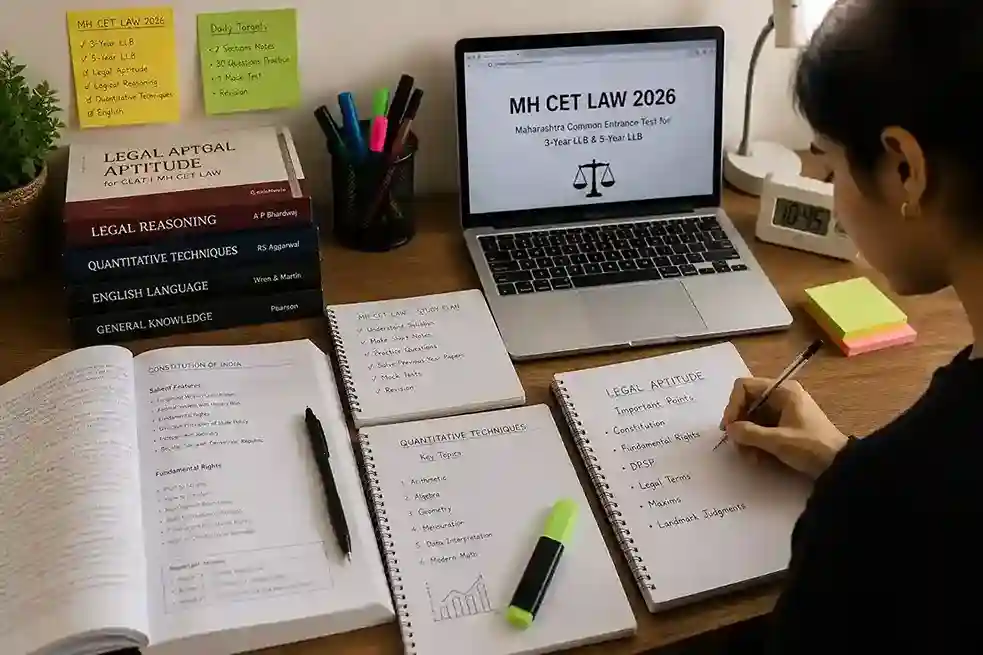
1. What MH CET Law Is | and Why It Matters
MH CET Law is Maharashtra's state-level law entrance test. The State Common Entrance Test Cell conducts it separately for 3-year LLB and 5-year integrated LLB programmes. Both use similar syllabuses. The main difference is that the 5-year exam includes a Mathematics section worth 10 marks.
Around 27,000 candidates appeared for the 5-year LLB in the 2026 cycle. The 3-year LLB had an even larger pool. These numbers reflect how competitive this exam has become.
Clearing MH CET Law gives you access to more than 150 participating law colleges. That includes government colleges, government-aided colleges, and private colleges across Maharashtra. The total seat count is roughly 10,000 for the 5-year LLB and about 16,000 for the 3-year LLB.
Some of the most sought-after institutions that accept MH CET Law scores include Government Law College Mumbai, University of Mumbai Law Academy, ILS Law College Pune, and Symbiosis Law School Pune. Each one has its own merit cutoff within the Centralised Admission Process.
CLAT sends you to National Law Universities across India. MH CET Law is specific to Maharashtra. Many students prepare for both at the same time since the syllabuses overlap on Legal Reasoning, GK, and English. If you are based in Maharashtra or want to study in the state, MH CET Law is the primary route.
2. MH CET Law 2026 Exam Pattern
The exam moved to computer-based mode. Both 3-year and 5-year LLB papers run for 2 hours. There are 150 questions worth 150 marks. Every question carries 1 mark. There is no negative marking.
The question type is always multiple choice with four options. You select one answer per question. The medium is English, though you can switch between English and Marathi during the test.
| Section | Marks (5yr LLB) | Marks (3yr LLB) | Topic Focus |
|---|---|---|---|
| Legal Aptitude and Legal Reasoning | 40 | 40 | Constitutional law, legal propositions, basic legal principles |
| Logical and Analytical Reasoning | 40 | 40 | Syllogisms, sequences, analogies, critical thinking |
| English Language | 30 | 30 | Grammar, vocabulary, reading comprehension, error detection |
| General Knowledge and Current Affairs | 30 | 30 | India GK, law-related news, government schemes, world affairs |
| Basic Mathematics | 10 | Not included | Class 10 level arithmetic and data interpretation |
| Total | 150 | 150 | | |
Most competitive law entrance exams penalise wrong answers. MH CET Law does not. This means leaving any question blank is a wasted opportunity. Even a random guess on a question you don't know gives you a 25% chance of scoring. Always attempt every question before time runs out.
3. Who Can Apply
Eligibility differs for the two programmes. It's worth checking both before you register on the official portal at cetcell.mahacet.org.
5-Year Integrated LLB
You need to have passed Class 12 or an equivalent exam from any recognised board. The minimum marks are 45% for the Open category, 42% for OBC, SBC, and EWS, and 40% for SC, ST, and persons with disabilities. Candidates appearing in Class 12 boards are also eligible, subject to submitting final marksheets during document verification.
3-Year LLB
You need a graduation degree from a recognised university. The minimum percentage rules follow the same structure: 45% for Open, 42% for OBC and EWS, and 40% for SC and ST. There is no domicile restriction on applying, but reservation benefits apply specifically to Maharashtra domicile holders.
You don't need a Maharashtra domicile to appear in MH CET Law. But domicile affects which reservation category applies to you during seat allotment. Candidates without a Maharashtra domicile fall under the Open category regardless of their caste certificate from another state. Confirm your category status before choosing colleges during the Centralised Admission Process.
4. The Five Sections | What Each One Actually Tests
Many candidates treat all five sections equally. That's a preparation mistake. Legal Aptitude and Logical Reasoning each carry 40 marks. Together they account for 80 marks | more than half the paper. English and GK add another 60 marks. Maths is only 10 marks in the 5-year LLB.
The distribution tells you where to spend most of your time. Doing well in just Legal Aptitude and Reasoning is enough to get a competitive score. The sections below explain what each one tests and how to build targeted knowledge for it.
5. Legal Aptitude and Legal Reasoning | 40 Marks
This is the most law-specific section. It tests how well you understand basic legal principles and whether you can apply them to factual situations. You don't need prior legal education to do well here. The questions give you a proposition | a legal rule | and then describe a situation. You pick the answer that best applies that rule.
The most common topics in this section include fundamental rights under the Constitution of India, the structure of the Indian judiciary, basic concepts in criminal law, property rights, and contract principles. You will also see questions on legal reasoning, where you identify whether a conclusion follows logically from a given rule.
Key topics to cover
- Preamble and fundamental rights under the Constitution
- Right to equality, right to freedom, and right to constitutional remedies
- Basic principles of criminal liability | mens rea, actus reus
- Offer and acceptance in contract law
- Ownership, possession, and transfer of property
- Torts | negligence, nuisance, defamation basics
- Legal reasoning | proposition-application method
- Landmark Supreme Court judgments that shaped Indian law
Practice is the most effective preparation for this section. Solve at least 200 legal reasoning questions from previous MH CET Law papers and from CLAT study material, since both exams use the same format. After each question, check your answer and trace why the correct option follows from the given rule.
6. General Knowledge and Current Affairs | 30 Marks
This section is broad and covers two types of content. Static GK refers to facts that don't change | the Indian Constitution, important laws, national institutions, geography, and history. Current Affairs refers to events and developments from roughly the past 12 months before the exam date.
MH CET Law has a pattern of asking law-related current affairs. These include major Supreme Court verdicts, new legislation passed by Parliament, appointments to constitutional positions, and law reform news. Generic current affairs | sports awards, science events, state elections | also appear but are secondary.
What to study in static GK
- Indian Constitution | articles, schedules, amendments
- Central and state government structure
- Major Indian laws and when they were enacted
- National commissions, regulatory bodies, and their functions
- Important historical events related to Indian law and independence
- India's geography, rivers, and neighbouring countries
What to study in current affairs
- Supreme Court and High Court judgments from the past year
- New laws passed in Parliament
- Government schemes launched in 2026 and 2027
- Appointments to positions like CJI, Attorney General, CEC
- International treaties India signed or ratified
- State-level developments in Maharashtra
Read one national newspaper for 20 minutes a day. Focus on the national affairs section and ignore lifestyle and sports unless a major award or event occurred. At the end of each week, write a short list of the five most important things that happened. Review those lists every Sunday. This gives you a compressed record of events without needing to memorise long articles.
7. Logical and Analytical Reasoning | 40 Marks
This section does not test legal knowledge. It tests how your mind works. Questions measure your ability to find patterns, identify logical connections, and draw conclusions from given sets of information.
The formats include number series, letter series, analogies, syllogisms, seating arrangements, blood relations, coding-decoding, and critical reasoning passages. Critical reasoning involves reading a short paragraph and answering questions about what can be concluded, what weakens the argument, or what the assumption behind a claim is.
Key topic areas
- Number and letter series
- Analogies and odd-one-out
- Coding and decoding
- Blood relations and direction sense
- Seating arrangements | linear and circular
- Syllogisms | two-premise and multi-premise formats
- Statement-conclusion and statement-assumption questions
- Critical reasoning | strengthen, weaken, and inference questions
This section rewards regular short practice sessions more than long study periods. Solve 20 to 30 reasoning questions every day for four weeks. Your speed and accuracy will improve noticeably after the first two weeks. Focus on accuracy first, then build speed.
Legal aptitude questions are really a form of applied reasoning. They ask you to apply a rule to a fact pattern | the same logic as syllogism questions. Students who score well in reasoning almost always do well in legal aptitude too. Prepare them together and look for the pattern they share.
8. English Language | 30 Marks
The English section tests vocabulary, grammar, comprehension, and writing structure. Questions come in several formats: reading comprehension passages with multiple questions, fill-in-the-blank grammar items, synonym and antonym pairs, sentence correction, and error detection.
The passages in MH CET Law are usually one to two paragraphs long. They test whether you understand the main point, can identify specific details, and can draw inferences from the text. The language is formal but not complex.
Topics to prepare
- Parts of speech | nouns, pronouns, verbs, adjectives, adverbs
- Tenses and subject-verb agreement
- Prepositions, articles, and conjunctions
- Common error types | dangling modifiers, parallel structure, wrong tense
- Vocabulary | synonyms, antonyms, words in context
- Reading comprehension | finding the main idea, inference, tone
- Sentence rearrangement and para-jumbles
Reading editorials in a quality national newspaper builds vocabulary in context faster than learning word lists. You see how words are used in sentences, which makes them stick better. Aim to note three to five unfamiliar words each day and look up their meanings. In four weeks, you add well over 100 words to your working vocabulary.
9. Basic Mathematics | 10 Marks (5-Year LLB Only)
Mathematics is only for the 5-year LLB exam. It carries 10 marks and covers Class 10 level topics. The difficulty is low. Candidates who study well for the other four sections should not neglect this section | 10 marks can make a meaningful difference in your percentile rank when competition is tight.
Topics to cover
- Basic arithmetic | percentages, ratios, fractions, averages
- Simple and compound interest
- Profit, loss, and discount calculations
- Speed, time, and distance
- Area and perimeter of basic shapes
- Data interpretation | bar charts, pie charts, tables
Ten days is enough time to cover these topics if you have a Class 10 background. Solve 30 to 40 practice problems from each topic. Pay attention to data interpretation since it often appears in 2 to 3 question sets that share one chart.
10. Best Books and Resources for MH CET Law 2026
The right material makes a real difference. Here are the resources most useful for MH CET Law preparation.
| Section | Recommended Books and Resources | Why It Works |
|---|---|---|
| Legal Aptitude | Universal's Guide to MH CET Law (latest edition); Pearson LegalEdge Legal Aptitude | Both follow the MH CET question format and include Maharashtra-specific legal questions |
| Logical Reasoning | R.S. Aggarwal's A Modern Approach to Verbal Reasoning; CLAT reasoning practice sets | Comprehensive coverage of all reasoning types tested in the exam |
| English | Wren and Martin's High School English Grammar; Word Power Made Easy by Norman Lewis | Grammar and vocabulary together; builds the foundation that reading comprehension needs |
| General Knowledge | Arihant General Knowledge (current edition); monthly current affairs digest from any reputed source | The GK book covers static facts; monthly digests fill in recent developments |
| Mathematics | R.S. Aggarwal's Quantitative Aptitude (Class 10 chapters only) | Clear explanations and plenty of practice problems at the right level |
| Full Mock Tests | Official CET Cell mock test window at cetcell.mahacet.org; previous year question papers | The official mock test matches the real interface. Previous year papers show actual question formats |
Previous year question papers from MH CET Law are your single most valuable resource. They show the exact difficulty level, question formats, and topic distribution. Solve every available paper under timed conditions before the exam. If you do only one thing after reading this guide, let it be this.
You can also find related preparation material through MH CET Law sample papers and our broader study material hub for law entrance exams.
11. Six-Week Preparation Plan
This plan is designed for students starting from the beginning. It assumes two to three hours of study per day. If you have more time, you can complete it in four weeks. If you have less time, focus on Legal Aptitude and Reasoning first since they carry the most marks.
The final week is about performance, not learning. Avoid reading new topics. Solve papers under real exam conditions | same timing, same setting. When you review mistakes, write down exactly which topic caught you. That list is your last-minute revision guide.
The highest scorers don't read every word of every question. They scan the question type first, decide how long it deserves, and move on if they're stuck. Spend less than one minute on questions you know well. Give two minutes to harder ones. If you can't solve it in two minutes, mark your best guess and move forward. With no negative marking, every unanswered question at the end of the paper is a missed mark.
12. Mistakes That Cost Marks in MH CET Law
Knowing what not to do saves as much time as knowing what to do.
- Skipping legal reasoning questions: Many students skip these because they feel unfamiliar. Legal reasoning carries 40 marks. Skipping it entirely means you need near-perfect scores in every other section.
- Reading news without noting it: Passive reading of current affairs doesn't stick. Write down the key facts. Review your notes weekly.
- Ignoring Mathematics for 5-year LLB: Ten marks seems small until you realise a few percentile points separate hundreds of candidates at the cutoff line. Ten easy marks from basic arithmetic can change your college option entirely.
- Practising without timing: Taking practice tests without tracking time creates a false picture of your readiness. Always time yourself from day one.
- Studying only from one book: Question formats in MH CET Law vary from year to year. Using two or three sources gives you a wider range of question types to recognise in the actual exam.
- Leaving questions blank: With no negative marking, every blank question is a lost mark. Guess when you must. The odds are in your favour.
13. What Happens After You Clear MH CET Law
Clearing MH CET Law gives you a percentile score. The CET Cell Maharashtra then runs the Centralised Admission Process. You register on the CAP portal, upload documents, pay the participation fee, and fill in your college and course preferences in order of priority.
Seats are allotted across multiple rounds based on your merit rank, your reservation category, the order of your choices, and seat availability. After each round, you decide whether to accept your allotted seat, wait for a better option in the next round, or exit the process.
Once you accept a seat, you pay the confirmation fee and report to the allotted college within the stated deadline. Vacant seats after all central rounds may go through institute-level admissions.
Both colleges receive the highest applications in Maharashtra. Candidates who want these colleges need very high percentile ranks. If your score is borderline, ranking these colleges very high in your preference list is still worth doing | a seat may open up in a later round if higher-ranked candidates move to other options.
You may also want to explore the best law colleges in Maharashtra and the broader MH CET Law exam guide to understand what to expect after results are declared.
14. Law Courses Available Through MH CET Law
The exam is the entry point to two distinct law programmes in Maharashtra. Each one suits a different stage of your education.
5-Year Integrated LLB (BA LLB, BBA LLB, BCom LLB, BSc LLB)
This programme is for students who just finished Class 12. It combines a bachelor's degree with the LLB. The degree you get depends on the college | some offer BA LLB, others offer BBA LLB or BCom LLB depending on the stream. The course takes five years.
Students who finish this programme can enrol with the Bar Council of India, appear in AIBE, and start practising law. They can also go on to do an LLM at any NLU or university that accepts their marks. Read more about law courses in India to understand how an integrated LLB compares to other pathways.
3-Year LLB
This programme is for graduates. It takes three years and focuses entirely on law subjects. Candidates who did BA, BCom, BSc, or any other undergraduate degree can take this route. The 3-year LLB has the largest number of available seats in Maharashtra | around 16,000 across participating colleges.
Students who already have a bachelor's degree in a field like commerce or economics often find that the 3-year LLB pairs well with their prior knowledge. Tax law, company law, and business law subjects feel familiar to them, which gives them a preparation advantage.
15. Common Questions About MH CET Law 2026
The 5-year LLB exam has 150 multiple-choice questions worth 150 marks, to be completed in 2 hours. The five sections are: Legal Aptitude and Legal Reasoning (40 marks), Logical and Analytical Reasoning (40 marks), English (30 marks), General Knowledge and Current Affairs (30 marks), and Basic Mathematics (10 marks). The exam is computer-based with no negative marking.
No. The 3-year LLB exam has four sections and excludes Mathematics. It covers Legal Aptitude and Legal Reasoning, Logical and Analytical Reasoning, English, and General Knowledge with Current Affairs. The total is still 150 questions for 150 marks.
No fixed minimum qualifying marks are prescribed. Any candidate who scores more than zero is eligible to participate in the Centralised Admission Process. The practical cutoff depends on how many candidates applied and how many seats are available in each college and category. Higher scores naturally improve your college options.
There is no cap on the number of attempts. You can appear every year until you secure a seat or choose not to continue. Each year, your previous score is not carried forward. You register and appear fresh each cycle.
Yes, and most Maharashtra-based candidates do exactly this. Legal Aptitude, Logical Reasoning, and English overlap almost completely. The main difference is that CLAT 2027 does not have a separate Mathematics section. CLAT is slightly harder on Legal Reasoning. If you prepare seriously for CLAT, MH CET Law preparation becomes much shorter. Start with CLAT study material as your foundation and then layer in MH CET-specific practice.