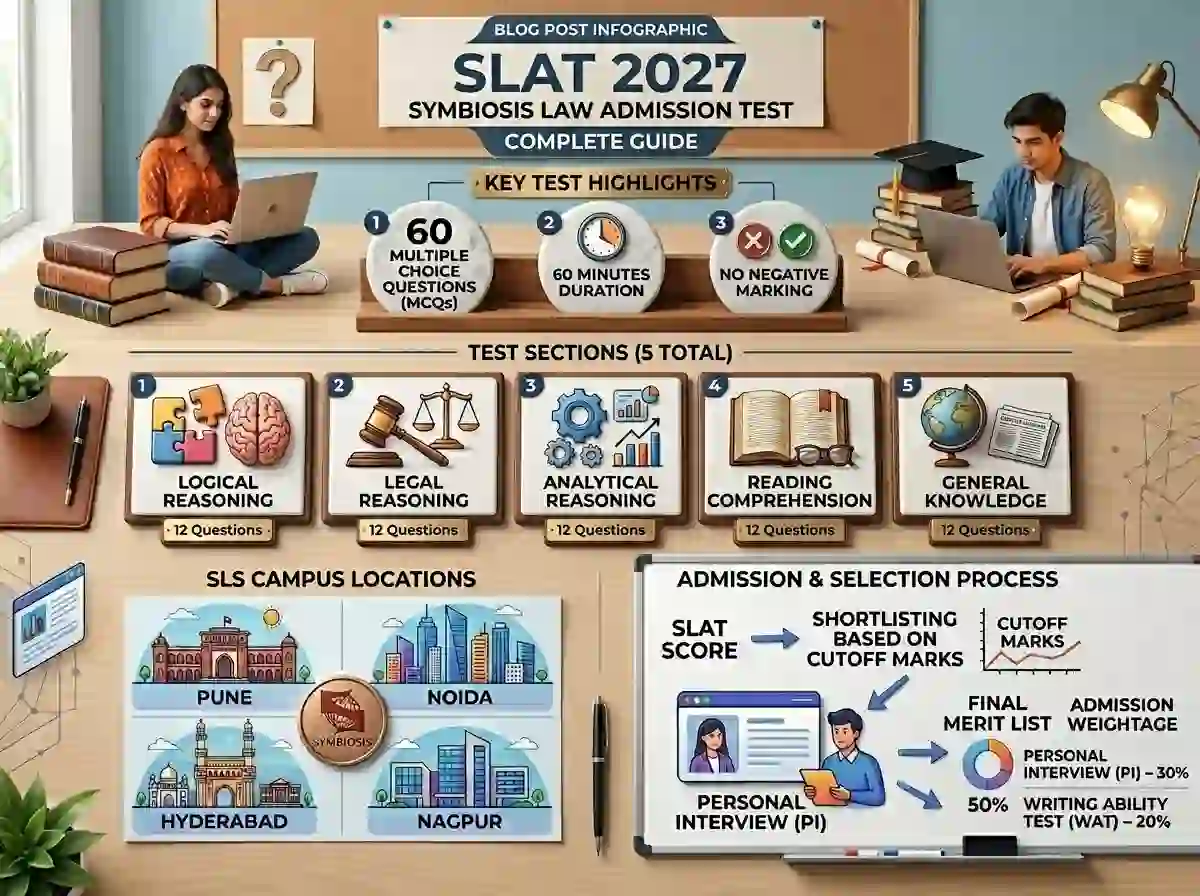
- What is SLAT? Overview & Highlights
- SLAT 2027 Exam Dates & Important Timeline
- SLAT 2027 Eligibility Criteria
- SLAT Exam Pattern 2027 | Sections, Marks & Duration
- SLAT Syllabus 2027 | Section-Wise Topics
- 4 SLS Campuses | Seats, Fees & Rankings
- SLAT Cutoff 2026 & 2027 | Campus-Wise
- Selection Process | SLAT + PI & Final Merit List
- How to Register for SLAT 2027
- SLAT vs CLAT | Which Exam is Right for You?
- SLAT Preparation Strategy 2027
- Frequently Asked Questions
1. What is SLAT? | Overview & Key Highlights
The Symbiosis Law Admission Test (SLAT) is a national-level entrance examination conducted annually by Symbiosis International (Deemed University) for admission to its prestigious undergraduate law programs. SLAT is the sole gateway to the four Symbiosis Law Schools (SLS) located in Pune, Noida, Hyderabad, and Nagpur | among India's top private law institutions.
Unlike CLAT (which is centralized for 24 government-funded National Law Universities), SLAT is a university-specific exam for Symbiosis International University's law schools. It is a computer-based test (CBT) conducted online in over 68 cities across India, making it one of the most accessible law entrance exams in the country.
| SLAT 2027 | Key Exam Highlights | |
|---|---|
| Exam Full Name | Symbiosis Law Admission Test (SLAT) |
| Conducting Body | Symbiosis International (Deemed University) / SET Authority |
| Official Website | slat-test.org |
| Exam Level | National Level (University-Specific) |
| Exam Mode | Online | Computer Based Test (CBT) |
| Exam Duration | 60 minutes (1 hour) |
| Total Questions | 60 MCQs |
| Total Marks | 60 marks |
| Sections | 5 (12 questions × 12 marks each) |
| Negative Marking | None | attempt all questions |
| Attempts Allowed | Two (best-of-two score considered) |
| Exam Cities | 68 cities across India |
| Courses Offered | BA LLB (Hons.) | BBA LLB (Hons.) |
| Participating Campuses | SLS Pune, SLS Noida, SLS Hyderabad, SLS Nagpur |
| Total Seats | 1,080 (across all 4 campuses) |
| Exam Fee | ₹2,250 per test + ₹1,000 per SLS campus applied |
| Language | English only |
| WAT (Written Ability Test) | Discontinued from SLAT 2026 onwards |
| PI Weightage | 30% of final merit score |
SLAT stands out among law entrance exams for several unique features: no negative marking (unlike CLAT which has -0.25 per wrong answer), a student-friendly 60-question-in-60-minutes format, and the dual-attempt system where candidates can appear for both Test 1 and Test 2 with only the higher score counted. The Written Ability Test (WAT) has been discontinued from SLAT 2026 onwards, making the selection process leaner: SLAT score (70% weight) + Personal Interview (30% weight).
2. SLAT 2027 Exam Dates & Important Timeline
The official SLAT 2027 exam dates will be announced by Symbiosis International University on slat-test.org. Based on the SLAT 2026 schedule and the university's consistent annual pattern, here are the expected SLAT 2027 key dates:
SLAT exam centres are allotted on a first-come, first-served basis from your chosen city preferences. Candidates who register early have significantly better chances of getting their preferred exam city and slot. Once the registration window opens in August 2026, do not wait until November | popular cities like Mumbai, Delhi, Bengaluru, Hyderabad, and Pune fill up quickly. Also note that city preferences cannot be changed after final submission.
3. SLAT 2027 Eligibility Criteria
SLAT eligibility criteria are straightforward and inclusive. Here is the complete official breakdown:
SLAT has a two-part fee structure that confuses many applicants. You pay: (1) ₹2,250 exam fee to appear for SLAT (per test attempt), and (2) ₹1,000 programme registration fee per SLS campus you wish to apply to. If you want to be considered for SLS Pune AND SLS Noida, you must pay ₹1,000 × 2 = ₹2,000 in programme fees in addition to the exam fee. Skipping the programme fee for any campus means that campus will not consider your SLAT score for admission, even if you have an excellent rank.
4. SLAT Exam Pattern 2027 | Sections, Marks & Duration
The SLAT exam pattern has been stable since 2020 when it moved to the 60-question, 60-minute format. Understanding the pattern is the first step to building a smart preparation strategy. Here is everything you need to know:
| # | Section | No. of Questions | Marks | Time (Indicative) |
|---|---|---|---|---|
| 1 | Logical Reasoning | 12 | 12 | ~12 min |
| 2 | Legal Reasoning | 12 | 12 | ~12 min |
| 3 | Analytical Reasoning | 12 | 12 | ~12 min |
| 4 | Reading Comprehension | 12 | 12 | ~12 min |
| 5 | General Knowledge | 12 | 12 | ~12 min |
| TOTAL | 60 | 60 | 60 minutes | |
Key Features of SLAT Exam Pattern
Every correct answer earns +1 mark. Wrong or skipped answers get 0. Attempt all 60 questions without fear | guessing is a valid strategy.
The full 60 minutes is yours to allocate across all sections as you see fit. Start with your strongest section to build confidence and momentum.
You can appear for both Test 1 (Dec 20) and Test 2 (Dec 28). If you attempted both, SIU uses the higher score for your admission consideration.
Computer-based test in 68 cities. Rough sheets provided. No devices allowed inside test center. Rough work must be returned at end of exam.
SLAT raw score (out of 60) is scaled to 70 for final merit calculation. Combined with PI score (out of 30), the final merit is out of 100.
The Written Ability Test (WAT/Studio Test) was discontinued from SLAT 2026. Selection is now: SLAT score (70%) + PI (30%). This simplifies the process significantly.
5. SLAT Syllabus 2027 | Section-Wise Topics & Question Types
Symbiosis International University does not release a detailed official syllabus for SLAT. However, based on official section descriptions and analysis of past SLAT papers, here is the comprehensive section-wise syllabus for SLAT 2027:
Tests your ability to identify patterns, draw conclusions, and evaluate arguments. Questions are based on provided information | no prior knowledge required. Topics typically include: Syllogisms and deductive reasoning; Series completion (number, letter, figure); Analogies; Coding-decoding; Blood relations; Seating arrangements; Direction sense; Statement-conclusion and statement-assumption; Critical reasoning passages.
The most distinctive section of SLAT | tests your ability to apply given legal principles to factual situations. No prior legal knowledge is needed | all questions are principle-fact based. A legal rule or principle is stated, followed by a set of facts. You must apply the principle to the facts and choose the correct outcome. Topics include: Tort law scenarios; Contract principles; Criminal law basics; Constitutional principles; Consumer protection; Property disputes. All principles are self-contained within each question.
Tests logical-mathematical thinking and data interpretation. Topics typically include: Puzzles and grid arrangements; Data sufficiency questions; Data interpretation (basic tables, pie charts, bar graphs); Logical venn diagrams; Series; Basic arithmetic | ratios, percentages, averages (no advanced mathematics). Questions are moderately complex but do not require high-level mathematical skills.
Tests your ability to read, understand, and analyze dense prose passages under time pressure. SLAT typically presents 2–3 passages of 200–400 words each, followed by 4–6 questions per passage. Passage topics include: Law, economics, society, environment, contemporary issues, philosophy, literature, and technology. Question types: Main idea and theme; Specific detail retrieval; Inference and implication; Tone and attitude of the author; Vocabulary in context; Critical evaluation of arguments.
Tests awareness of current affairs and static general knowledge. The GK section in SLAT is typically split between static knowledge and current events from the past 12 months. Topics include: National and international current events; Legal and constitutional developments; Supreme Court and High Court judgments (major ones); Government schemes and policies; Awards, sports, and personality news; History and geography basics; India's political and economic developments. Current affairs from the 6–12 months preceding the exam are particularly important.
6. Four SLS Campuses | Seats, Fees, Rankings & Programs
SLAT scores are accepted by four Symbiosis Law Schools (SLS) under Symbiosis International University. Each campus has a distinct profile, seat matrix, fee structure, and competitive demand. Here is the complete comparison:
Most serious SLAT aspirants apply to all four SLS campuses by paying the ₹1,000 programme fee for each (total ₹4,000). This maximizes your chances | if you score in the 38–43 range, you may not make SLS Pune but can still secure SLS Hyderabad or Nagpur. The Symbiosis brand is strong across all four campuses. SLS Pune is the most competitive but also the most rewarding in terms of placements and alumni network. SLS Noida is the preferred choice for candidates from North India targeting corporate law careers in Delhi-NCR.
7. SLAT Cutoff 2026 & 2027 | Campus-Wise Analysis
The SLAT cutoff is the minimum score required to be shortlisted for the Personal Interview (PI) round at each Symbiosis Law School. Cutoffs are not officially published in advance | they are declared by each SLS after results are announced. Below is the campus-wise cutoff data based on SLAT 2026 results and historical trends:
| Campus | SLAT 2026 Cutoff (Expected) | SLAT 2025 Cutoff | SLAT 2024 Cutoff | 2027 Target Score |
|---|---|---|---|---|
| SLS Pune | 48 – 52 / 60 | 46 – 49 | 45 – 48 | 50+ |
| SLS Noida | 43 – 48 / 60 | 41 – 45 | 40 – 44 | 46+ |
| SLS Hyderabad | 38 – 43 / 60 | 38 – 42 | 36 – 40 | 42+ |
| SLS Nagpur | 35 – 40 / 60 | 34 – 38 | 33 – 37 | 38+ |
* Expected cutoffs based on prior year trends. Actual SLAT 2026 official cutoffs are released by each SLS after PI shortlisting. Final merit also depends on PI performance. Source: LawGuru India analysis of previous years' allotment data.
Cutoff Trend Visualization
8. SLAT Selection Process | SLAT Score + PI & Final Merit List
SLAT admission is a two-stage process. Understanding both stages is critical for a complete preparation strategy:
The online CBT exam with 60 MCQs in 60 minutes. Raw score is out of 60, then scaled to 70 for final merit calculation. The written test is the primary screening tool | only candidates above the campus-specific cutoff are shortlisted for PI. If you appeared for both Test 1 and Test 2, the higher raw score is used.
Shortlisted candidates attend a PI conducted separately by each Symbiosis Law School campus. The PI is typically 10–15 minutes long and conducted by a panel of 2–3 faculty members or legal professionals. You are evaluated on: communication skills and articulation, legal awareness and current affairs knowledge, motivation for studying law, personality and confidence, critical thinking ability. Each campus conducts its own PI | if you're shortlisted for multiple campuses, you must appear at each one separately. PIs are typically conducted in January–February.
Final merit = SLAT scaled score (70) + PI score (30) = 100. Separate merit lists are published for BA LLB and BBA LLB at each campus. Multiple rounds of merit lists may be released (similar to CLAT counselling) to fill all seats. Candidates must respond to admission offers within the specified deadline and pay the seat acceptance fee to confirm their admission.
Many candidates focus entirely on the written exam and neglect PI preparation | a critical mistake when PI carries 30% of your final score. The PI at SLS Pune is known for asking about: "Why law?", current legal issues (like a recent Supreme Court judgment), your understanding of the chosen program (BA LLB vs BBA LLB), and your long-term career goals. Prepare 5–7 landmark Supreme Court judgments, practice speaking confidently about why you chose Symbiosis over CLAT NLUs, and have a clear answer about your specialization of interest. The panel values genuineness and legal curiosity over memorized answers.
9. How to Register for SLAT 2027 | Step-by-Step Guide
SLAT registration is done entirely online through the official Symbiosis Test Secretariat portal. Here is the complete step-by-step registration process:
Go to the official Symbiosis SLAT website. Click on "Register" or "New Registration". Do not use any third-party site for registration | only slat-test.org or set-test.org are official. Look for the SLAT 2027 registration link when it opens (expected August 2026).
Register with a valid, active email ID and mobile number | all future communications, admit card links, result alerts, and PI notices will come here. Fill in: full name (as in Class 10 certificate), date of birth, gender, category (General/SC/ST/OBC/PwD), nationality, parent details, and contact address.
Enter your Class 10 and Class 12 academic details (board, percentage). If you are an appearing candidate, mention expected year of result. Choose the law program(s) you want: BA LLB (Hons.), BBA LLB (Hons.), or both. You can apply to both programs | separate merit lists are maintained.
Select which Symbiosis Law School campus(es) you want to apply to: SLS Pune, SLS Noida, SLS Hyderabad, SLS Nagpur (one or multiple). Pay ₹1,000 per campus as programme registration fee. Also select up to three city preferences for your exam center. Early registrants have a higher chance of getting their preferred city. Cities change cannot be done after submission.
Upload: Passport-size color photograph (white/light background, taken within 6 months, 20–50 KB), and scanned signature on white paper. Some candidates also need to upload category certificates at the time of PI/admission verification.
SLAT Exam Fee: ₹2,250 per test attempt (so ₹4,500 if you register for both Test 1 and Test 2). Programme Registration Fee: ₹1,000 per SLS campus. Payment via Billdesk or EASEBUZZ payment gateway (credit/debit card, net banking, UPI), or offline via Demand Draft in favour of "Symbiosis Test Secretariat" payable at Pune. All fees are non-refundable.
Review all details carefully before final submission. After payment, download and save: SLAT Registration Confirmation page, Payment Receipt(s) for exam fee and programme fee. Your SLAT ID is your permanent reference number for all future communications including admit card, results, and PI notices.
10. SLAT vs CLAT | Which Exam is Right for You?
Most law aspirants in India appear for both SLAT and CLAT. Understanding the key differences helps you allocate preparation time wisely and set appropriate target scores.
| Parameter | SLAT | CLAT |
|---|---|---|
| Conducting Body | Symbiosis International University | Consortium of NLUs |
| Colleges Covered | 4 Symbiosis Law Schools | 24 National Law Universities |
| Mode | Online CBT | Offline (Pen & Paper OMR) |
| Duration | 60 minutes | 120 minutes |
| Total Questions | 60 | 120 |
| Negative Marking | None ✅ | -0.25 per wrong answer |
| Difficulty Level | Moderate (student-friendly) | High (more competitive) |
| Attempts per Year | Two (best-of-two counts) | One |
| Total Seats | 1,080 (4 campuses) | 4,500+ (24 NLUs) |
| Annual Fees | ₹3.5–5.5 Lakh (private) | ₹1–2 Lakh (govt-funded) |
| Selection Process | Written + PI (30% weight) | Written test only (merit) |
| Top Institution Rank | SLS Pune | NIRF #5 (Law) | NLSIU Bangalore | NIRF #1 (Law) |
| Corporate Law Focus | Stronger (BBA LLB, industry ties) | Strong but more diverse |
| Application Fee | ₹2,250 + ₹1,000/campus | ₹4,000 (covers all 24 NLUs) |
The standard advice from experienced law coaches is to appear for CLAT as your primary exam (targeting NLUs) and SLAT as a strong backup | or as a deliberate first choice if you prefer SLS Pune's corporate-oriented environment. Since the two exams have different patterns (SLAT: no negative marking, online, 60 questions; CLAT: negative marking, offline, 120 questions), you need specific preparation for each. Common overlapping sections are Legal Reasoning, Logical Reasoning, and Current Affairs/GK. English/RC and Analytical Reasoning also overlap significantly. Preparing for CLAT thoroughly will give you a strong foundation for SLAT as well.
11. SLAT 2027 Preparation Strategy | Section-Wise & Time Plan
With a 4–6 month focused preparation window (starting August–September 2026), you can realistically target SLS Pune cutoffs of 50+ if you follow a structured strategy. Here is the expert-recommended approach:
Section-Wise Preparation Tips
- Practice 20–30 puzzles daily (syllogisms, seating, coding)
- Use R.S. Aggarwal's Verbal & Non-Verbal Reasoning
- Focus on speed | each question should take under 60 seconds
- Attempt previous SLAT question papers for pattern familiarity
- Practice principle-fact based questions daily | this is the core SLAT skill
- Never use outside legal knowledge | apply only the given rule
- Read Legal Reasoning books by AP Bhardwaj or Pearson
- Cover tort, contract, criminal, and constitutional scenarios
- Practice basic DI (tables, bar charts, pie charts) weekly
- Revise ratios, percentages, and averages
- Solve 2–3 analytical puzzles daily
- Avoid advanced maths | SLAT AR is not JEE-level quantitative
- Read one quality editorial or analytical article daily
- Practice reading The Hindu, Indian Express, LiveLaw, Bar & Bench
- Time yourself | each passage should take 5–7 minutes max
- Focus on main idea, author's tone, and inference questions
- Read one national newspaper daily from Day 1 of preparation
- Maintain a weekly current affairs notebook | headline + 2-line context
- Cover national/international news, Supreme Court judgments, government schemes, and sports
- Use monthly current affairs magazines (Pratiyogita Darpan, AffairsCloud) for revision
- Study static GK | Indian Constitution basics, famous legal personalities, law commission reports
Recommended Mock Test Schedule
| Month | Focus | Mock Tests | Target |
|---|---|---|---|
| Month 1–2 (Aug–Sep 2026) | Concept building per section | No mocks yet | 0 full mocks | 2–3 sectional tests/week | Understand all 5 sections thoroughly |
| Month 3 (Oct 2026) | Mixed practice | Start timed tests | 1 full mock/week + sectionals | Score 35+ on practice mocks |
| Month 4 (Nov 2026) | Mock-heavy phase | Speed and accuracy | 2–3 full mocks/week | Score 45+ consistently |
| Final weeks (Dec 2026) | Revision + current affairs + PI prep | 1 mock every 2 days | Score 50+ target; PI practice daily |
12. SLAT 2027 | Frequently Asked Questions
SLAT stands for Symbiosis Law Admission Test. It is conducted by Symbiosis International (Deemed University) through its Symbiosis Entrance Test (SET) Authority. SLAT is the entrance exam for admission to 5-year integrated undergraduate law programs (BA LLB Hons. and BBA LLB Hons.) at four Symbiosis Law Schools located in Pune, Noida, Hyderabad, and Nagpur. The official website is slat-test.org.
The SLAT 2027 exam date has not been officially announced yet. Based on the SLAT 2026 pattern, the exam is expected to be conducted in December 2026 in two slots on different dates (approximately December 20 and December 28, 2026). Registration is expected to open in August 2026 and close by November 2026. Results are expected in mid-January 2027. Keep checking slat-test.org for official dates once they are announced.
No, there is no negative marking in SLAT. Every correct answer earns +1 mark. Wrong answers or skipped questions receive 0 marks | there is no deduction. This is one of SLAT's biggest advantages over CLAT (which has -0.25 per wrong answer) and means you should attempt all 60 questions in the exam. Guessing on uncertain questions is a valid strategy since there is no penalty for being wrong.
Yes. SLAT offers two test slots (Test 1 and Test 2) on different dates in December each year. You can register and appear for both. If you appear for both tests, Symbiosis International University considers only your higher score from either attempt for admission purposes. There is no penalty for attempting both tests | it is an advantage. You pay the exam fee of ₹2,250 separately for each test you wish to attempt.
SLAT has a two-part fee structure: (1) SLAT Exam Fee: ₹2,250 per test attempt | if you want to appear for both Test 1 and Test 2, you pay ₹4,500 total. (2) Programme Registration Fee: ₹1,000 per Symbiosis Law School campus you wish to apply to. If you apply to all four campuses (Pune, Noida, Hyderabad, Nagpur), the programme fee is ₹4,000. Skipping the programme fee for any campus means that campus will not shortlist you for PI, even if you have a high SLAT score. All fees are non-refundable.
The SLAT 2026 cutoff for SLS Pune (General category, PI shortlisting) is expected to be in the range of 48–52 marks out of 60. SLS Pune consistently has the highest cutoff among all four SLS campuses due to its NIRF #5 ranking and strong reputation. The SLAT 2025 cutoff for SLS Pune was approximately 46–49. For SLS Noida: 43–48; SLS Hyderabad: 38–43; SLS Nagpur: 35–40. These cutoffs are for PI shortlisting | final admission is based on SLAT (70%) + PI (30%) combined scores.
No. The Written Ability Test (WAT) was discontinued from SLAT 2026 onwards. The admission process now consists of only two stages: (1) SLAT written exam (CBT, 60 MCQs, 70% weightage in final merit), and (2) Personal Interview | PI (30% weightage in final merit). The Studio Test (ST) format, which some SLS campuses previously used as a creative/communication assessment, has also been replaced entirely by the PI. This simplification makes SLAT 2027 preparation more focused and the selection process more streamlined.
Generally, yes | SLAT is considered moderately easier than CLAT. Key reasons: SLAT has no negative marking (CLAT has -0.25); SLAT is shorter (60 min/60 questions vs 120 min/120 questions); SLAT allows two attempts with the best score counted; SLAT's Legal Reasoning is more predictable (principle-fact based only) whereas CLAT's legal section has evolved to be more passage-based and analytical. However, "easier" doesn't mean "easy" | with ~20,000 SLAT applicants competing for 1,080 seats, SLS Pune's effective acceptance rate is around 4–5%. CLAT has more total seats (4,500+) across 24 NLUs, making it statistically better coverage per rupee of exam fee.