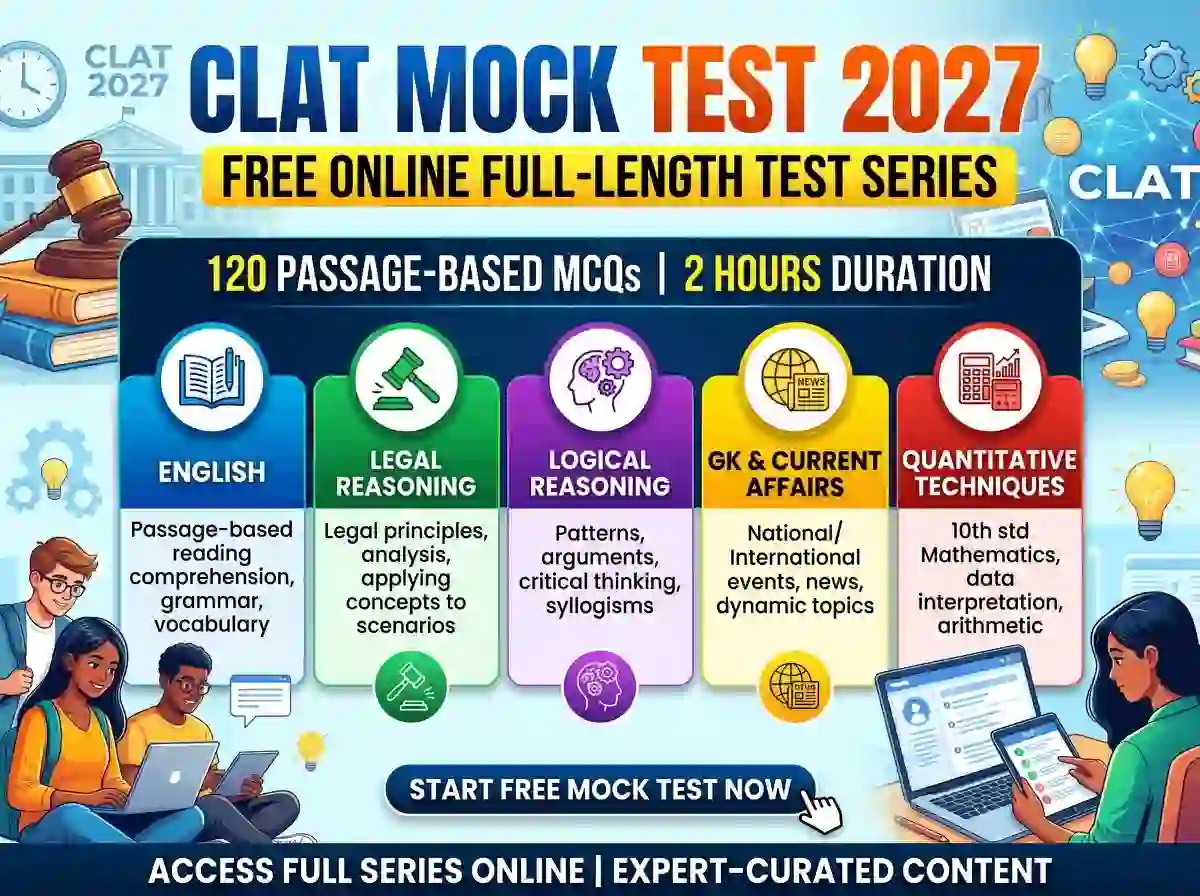
1. Free CLAT Mock Tests | Attempt Now (No Registration Required)
LawGuru India offers 5 free full-length CLAT mock tests that you can attempt directly without creating an account. Each test replicates the official CLAT 2027 exam pattern: 120 passage-based MCQs, 120 minutes, with negative marking. After completing your test, you receive instant results with section-wise scores and explanations for every answer.
Based on CLAT 2026 actual paper pattern. Passages from recent legal news, comprehension extracts, and logic passages. Full explanations provided.
Covers Constitutional principles, contract law passages, inferential reasoning, editorial comprehensions, and GK from the last 8 months.
Features advanced legal reasoning scenarios based on Supreme Court judgments from 2025–2026. Hard-level logical reasoning included.
Emphasis on current affairs (Jan–May 2026), environmental law passages, and analytical reasoning. Ideal for the final 3-month prep phase.
Mock Tests 5 through 30, including 10 previous year papers (2015–2025), 15 section-wise tests, and detailed performance dashboards are available in our CLAT Premium Test Series. Includes score benchmarking against 50,000+ live users, AIR predictor, and a personalised weak-area improvement plan.
2. CLAT 2027 Mock Test Pattern & Section-Wise Weightage
Every LawGuru India CLAT mock test is built precisely on the official CLAT 2027 exam pattern as established by the Consortium of NLUs. Understanding the pattern is the single most important step before you attempt your first mock | it tells you what to read, how to read, and how to manage 120 questions in exactly 120 minutes.
| Section | No. of Questions | Marks | Weightage | Passage Length | Key Skill Tested |
|---|---|---|---|---|---|
| English Language | 22–26 | 22–26 | ~20% | ~450 words/passage | Comprehension, inference, vocabulary in context |
| Current Affairs & GK | 28–32 | 28–32 | ~25% | ~250–300 words/passage | Static GK, news from past 12 months, national/international events |
| Legal Reasoning | 28–32 | 28–32 | ~25% | ~500–600 words/passage | Principle-fact application, legal propositions, case scenarios |
| Logical Reasoning | 22–26 | 22–26 | ~20% | ~300–400 words/passage | Argument analysis, pattern recognition, critical reasoning |
| Quantitative Techniques | 10–14 | 10–14 | ~10% | ~200–250 words/passage | Data interpretation, Class 10 arithmetic, percentage, ratio |
| TOTAL | 120 | 120 | 100% | ~20,000 words total | Reading speed + accuracy under time pressure |
The most important structural feature of CLAT 2027 is that every section is passage-based. Unlike competitive exams where you can solve isolated MCQs, CLAT requires you to read a passage first and then answer 3–7 questions from that passage. This means your raw reading speed directly determines your score | a candidate who reads at 250+ words per minute has a significant structural advantage.
3. Section-Wise Practice Tests for CLAT 2027
Before attempting full-length CLAT mock tests, it is crucial to build section-level competency. LawGuru India's section-wise tests allow you to practice each part of the CLAT paper in isolation | so you can focus your preparation precisely where it matters. Each section test is timed, passage-based, and mirrors the exact difficulty distribution of the actual CLAT exam.
3.1 English Language | What CLAT Tests and How to Practice
The English Language section in CLAT 2027 consists of 22–26 questions (20% weightage) based on reading passages of approximately 450 words each. Questions test your ability to identify the main theme, draw inferences, understand the author's tone, determine meaning from context, and complete or rearrange sentences from the passage.
Key passage types in recent CLAT papers include literary excerpts, newspaper editorials, environmental essays, and social commentary. In CLAT 2026, one passage was drawn from an editorial about the judicial appointment process | requiring candidates to infer the author's implicit critique from the text. This kind of nuanced reading is exactly what section-wise English practice builds.
Improvement strategy: Read one editorial daily from The Hindu, Indian Express, or Mint. Time yourself to finish 450 words in under 90 seconds. For each passage, note: (a) central argument, (b) author's tone, (c) one thing the author implies but does not state. After 3 weeks of this, your CLAT English accuracy typically jumps by 8–12 marks.
3.2 Legal Reasoning | The Highest-Weightage Section Explained
Legal Reasoning (28–32 questions, 25% weightage) is the section that most differentiates CLAT toppers from average scorers. It tests your ability to read a legal proposition or principle, understand how it applies (or does not apply) to a fact situation, and answer questions without relying on any prior knowledge of law. You are always given the principle | you must apply it.
Common question structures in CLAT Legal Reasoning include: (a) Principle-Fact Application | "Given Principle P, does it apply to Fact F?"; (b) Identifying whether the principle favours the plaintiff or defendant; (c) Modifying the fact to change the outcome. CLAT 2026 featured passages on the doctrine of promissory estoppel, vicarious liability in employment, and freedom of speech limitations | all stated as principles, not as law.
Improvement strategy: Do not study law textbooks for this section. Instead, practice 3 Legal Reasoning passages daily from CLAT PYQs. Focus on understanding the exact scope of the stated principle before attempting questions. If the principle says "A is liable if X happens," check every fact to see if X has happened | do not infer beyond what is stated.
3.3 Logical Reasoning | Patterns, Arguments, and Reading Between the Lines
Logical Reasoning (22–26 questions, 20% weightage) in CLAT is not about syllogisms or number puzzles. CLAT logical reasoning is passage-based | you read an argument and answer questions about its structure, strength, assumptions, and conclusions. Common question types include: identifying the conclusion of an argument, finding the assumption on which the argument rests, identifying what would weaken or strengthen the argument, and spotting logical fallacies.
Improvement strategy: Practice Critical Reasoning questions from GMAT prep books (they mirror CLAT's style closely). Also solve 2–3 CLAT Logical Reasoning passages from official PYQs daily. Focus on distinguishing between facts (what is stated), inferences (what follows logically), and assumptions (what must be true for the argument to work).
3.4 Current Affairs & General Knowledge | The Most Dynamic Section
The GK & Current Affairs section (28–32 questions, 25% weightage) tests both static GK and news from the past 12 months. All questions are passage-based | a short news summary is given, followed by 3–5 MCQs. Questions may ask for the year of a constitutional amendment, the country that hosted a summit, the name of an international treaty, or the significance of a Supreme Court ruling.
Static GK topics consistently covered in CLAT include: important constitutional provisions (Fundamental Rights, DPSPs, Schedule details), historical events and their dates, national and international organisations (UN, WTO, ICJ, SAARC), India's major awards, and significant Supreme Court and High Court cases. Current affairs from the last 12–18 months are equally important | covering political events, new laws, major judgments, international agreements, and economic policy changes.
Improvement strategy: Subscribe to a monthly current affairs PDF and complete it within the first week of each month. For static GK, maintain a running notes document. In the section-wise practice tests, analyse why you got each GK question wrong | it is usually one of three reasons: not reading the passage carefully enough, not knowing the fact, or confusing two similar facts. Target 80%+ accuracy in GK passages since these passages are shorter and less cognitively demanding.
3.5 Quantitative Techniques | Small Section, Easy Marks
Quantitative Techniques (10–14 questions, 10% weightage) is the smallest section but often the most stressful for humanities students. CLAT 2027 quantitative passages involve: data tables, bar graphs, pie charts, and numerical data about real-world scenarios (economic data, demographic statistics, election results). Questions require operations at Class 10 level | percentages, ratios, averages, profit-loss, and simple interest.
No complex formulas are needed. The challenge is interpreting the data correctly and performing calculations quickly. In timed mocks, many aspirants skip this section and return to it | a valid strategy only if you can afford the mental context-switching cost. In CLAT 2026, candidates who allocated 10–12 focused minutes to Quantitative scored 10–12 out of 12, making it the easiest high-return section for prepared candidates.
4. How to Use CLAT Mock Tests Effectively | Expert Strategy
Attempting mock tests without a structured strategy is one of the most common CLAT preparation mistakes. Most aspirants attempt 30+ mocks but improve by only 5–8 marks over the course of the year. The reason is almost always the same: they are attempting, not analysing. Here is the framework used by consistent CLAT toppers:
5. Mock Test Analysis | How to Review for Maximum Score Improvement
The analysis phase is where most CLAT aspirants lose their competitive edge. After spending 2 hours on a mock, many students glance at wrong answers and move on. CLAT toppers spend 90–120 minutes on post-mock analysis for every single test. Here is how to do it right:
Post-Mock Analysis Checklist
| Analysis Task | Time Required | What It Reveals |
|---|---|---|
| Review all wrong answers with explanations | 25–30 min | Conceptual gaps, misread passages, wrong application of principle |
| Review all correct answers you were unsure about | 10–15 min | Whether you got lucky or genuinely knew | crucial for reliability |
| Calculate section-wise accuracy (correct/attempted) | 5 min | Which sections need more sectional practice |
| Calculate section-wise attempt rate (attempted/total) | 5 min | Whether you are skipping too many questions in a section |
| Note 3 passages that cost you the most time | 10 min | Passage types you need more exposure to |
| Update your Mistake Log with specific error types | 10 min | Reveals recurring error patterns across multiple mocks |
| Set 2 specific targets for next mock | 5 min | Structured improvement rather than random practice |
6. 10-Week CLAT Mock Test Schedule for CLAT 2027 (Sep–Nov 2026)
This schedule is designed for aspirants starting their mock test phase in September 2026, with CLAT 2027 on December 6, 2026. It assumes you have already covered 70%+ of the CLAT syllabus through study and section-wise practice. If you are starting earlier (July–August 2026), use Weeks 1–4 for section-wise practice only.
7. CLAT Mock Test Score vs Expected NLU | Benchmarking Guide
One of the most important | and most misunderstood | aspects of CLAT preparation is interpreting your mock test scores. Your mock test score is not equal to your expected CLAT exam score. In most cases, students score 5–12 marks lower in actual CLAT than in their recent mocks (due to exam day pressure, unfamiliar passages, and OMR-based answering). Here is how to use your mock scores to estimate your target preparation level:
| Mock Test Score Range | Expected CLAT Score (Exam Day) | Likely AIR Range | NLU Expectation |
|---|---|---|---|
| 105–120 / 120 | 98–112 | AIR 1–150 | NLSIU Bangalore, NALSAR Hyderabad |
| 95–104 / 120 | 88–98 | AIR 150–400 | NALSAR, NUJS Kolkata, NLU Jodhpur, GNLU |
| 85–94 / 120 | 78–88 | AIR 400–1,000 | GNLU, MNLU Mumbai, HNLU Raipur, RMLNLU |
| 75–84 / 120 | 68–78 | AIR 1,000–3,000 | CNLU Patna, NLUO Cuttack, NUSRL Ranchi |
| 65–74 / 120 | 58–68 | AIR 3,000–8,000 | Tier-3 NLUs (RGNUL, DSNLU, TNNLS, NUALS) |
| Below 65 / 120 | Below 60 | AIR 8,000+ | Newer/remote NLUs or non-NLU law schools |
If your scores vary between 75 and 95 across different mocks, your preparation is not yet stable. Focus on achieving consistent 85+ scores across 10 consecutive mocks before assuming you are in the 85-mark bracket. CLAT rewards candidates with stable, reliable performance | not one-off highs.
8. Common Mistakes in CLAT Mock Tests and How to Fix Them
Based on analysis of over 5 lakh CLAT mock test attempts on LawGuru India, we have identified the 8 most common mistakes that hold aspirants back from their potential rank. These mistakes are fixable within 3–4 weeks of targeted practice:
9. CLAT Previous Year Question Papers | Free PDF Download (2015–2025)
Solving CLAT previous year question papers is non-negotiable for serious CLAT preparation. PYQs reveal the actual passage types, difficulty levels, question patterns, and GK topics that the Consortium of NLUs selects year after year. In particular, CLAT PYQs from 2020 onwards follow the current passage-based format and are directly representative of what you will face in CLAT 2027.
| Paper | Year | No. of Questions | Format | Difficulty | Download |
|---|---|---|---|---|---|
| CLAT 2025 | Dec 2024 | 120 | Passage-Based | Moderate | PDF + Solution → |
| CLAT 2024 | Dec 2023 | 120 | Passage-Based | Hard | PDF + Solution → |
| CLAT 2023 | Dec 2022 | 120 | Passage-Based | Moderate | PDF + Solution → |
| CLAT 2022 | Dec 2021 | 120 | Passage-Based | Easy-Mod | PDF + Solution → |
| CLAT 2021 | Aug 2021 | 120 | Passage-Based | Moderate | PDF + Solution → |
| CLAT 2020 | Sep 2020 | 150 | Passage-Based (transition year) | Moderate | PDF + Solution → |
| CLAT 2019 & Earlier | 2015–2019 | 200 | MCQ (old format) | Reference Only | Archive → |
📌 Note: For CLAT 2027 preparation, focus primarily on PYQs from 2020–2025. Papers from 2019 and earlier used a different (non-passage-based) format and are less relevant for current exam prep.
10. CLAT UG vs CLAT PG Mock Tests | Key Differences
The Consortium of NLUs conducts two separate CLAT examinations: CLAT UG for admission to 5-year integrated LLB programmes, and CLAT PG for admission to LLM programmes. Both use the same format (120 questions, 120 minutes, +1/−0.25 marking), but the content, difficulty, and target audience differ significantly.
| Aspect | CLAT UG Mock Test | CLAT PG Mock Test |
|---|---|---|
| Target Candidates | 12th-pass students (or appearing); no law background required | LLB graduates (or final year); legal knowledge expected |
| Sections Covered | English, GK/CA, Legal Reasoning, Logical Reasoning, Quantitative | Constitutional Law, Jurisprudence, Administrative Law, Criminal Law, Contract, Torts, International Law |
| Legal Knowledge Needed? | No | principles are always given in passages | Yes | passages assume working knowledge of legal doctrines |
| Difficulty Level | Moderate (reading-intensive, passage-based) | Hard (requires understanding of legal concepts to interpret passages) |
| Passage Length | 250–600 words per passage | 400–700 words per passage (legal texts, judgment excerpts) |
| Preparation Timeline | 12–18 months for a student starting from Class 11 | 6–9 months for an LLB graduate with strong academics |
| Mock Test Focus | Reading speed, passage comprehension, time management | Legal knowledge depth, judgment analysis, doctrinal application |
At LawGuru India, we provide separate mock test series for CLAT UG and CLAT PG. If you are an LLB student targeting an NLU LLM programme, do not attempt CLAT UG mocks as practice for CLAT PG | the skills tested are fundamentally different. Navigate to our CLAT PG Mock Test page for LLM-specific preparation resources.