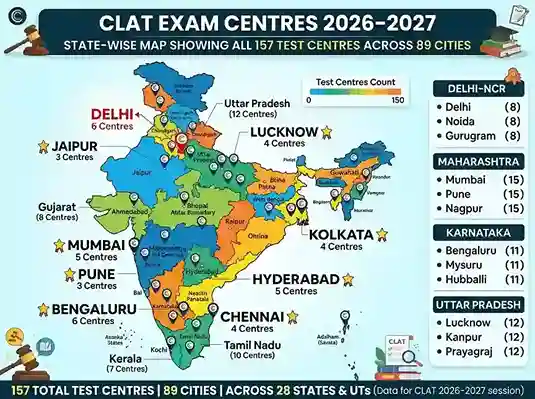
- CLAT Exam Centres | Overview & Key Facts
- How to Choose Your CLAT Exam Centre
- Complete State-Wise CLAT Exam Centres List
- Region-Wise Overview of CLAT Centres
- CLAT Exam Day Schedule & Reporting Time
- Documents Required at CLAT Exam Centre
- Dos and Don'ts at the CLAT Exam Centre
- How to Change CLAT Exam Centre
- PwD / SAP Candidates at CLAT Centres
- Expert Tips for CLAT Exam Day
- Frequently Asked Questions (FAQ)
1. CLAT Exam Centres | Overview & Key Facts
The CLAT exam centres are the designated test venues where the Common Law Admission Test (CLAT) is conducted every year, administered by the Consortium of National Law Universities (NLUs). Knowing your exam centre well in advance is one of the most overlooked, yet most important, aspects of CLAT preparation. A poorly chosen centre | far from your city, in an unfamiliar area | can cost you precious time and mental energy on exam day.
For CLAT 2026 (held on December 7, 2025), the Consortium announced 157 exam centre locations spread across 89 cities in 25 states and Union Territories. Two new cities | Diu and Silvassa | were added as test centres for CLAT 2026, expanding access for students in Union Territories. For CLAT 2027, the Consortium is expected to maintain a similar or expanded network of 130–157 centres, with registration opening in July 2026.
📌 Who Conducts CLAT?
The Consortium of National Law Universities (CNLU), comprising all 25 NLUs, conducts CLAT annually for admission to UG (BA LLB) and PG (LLM) programmes. The exam is held in a single 2-hour session, pen-and-paper mode, at designated centres across India.
📍 How Are Centres Allotted?
Candidates select up to 3 preferred city choices during registration. The Consortium allots a specific venue within the preferred city based on seat availability. The exact venue address is revealed only on the CLAT Admit Card, typically released 2–3 weeks before the exam.
🔄 Can Centres Change Year to Year?
Yes. The number of centres is not fixed. The Consortium may add or remove cities depending on the volume of registrations from each region. Cities with low registrations may lose their centre, while high-demand areas may get additional venues within the same city.
🎫 When Is Centre Revealed?
The specific exam centre address (building name, full address) is printed on the CLAT Admit Card, which is released approximately 2–3 weeks before the exam. Candidates must download and print this admit card and visit the centre a day before the exam.
2. How to Choose Your CLAT Exam Centre (Step-by-Step)
Selecting the right CLAT exam centre is a decision that can meaningfully affect your exam-day performance. Here is exactly how to make this choice and how the process works during registration.
Log in to your CLAT account on the official website. Navigate to the exam centre preference section of the application form. This section opens only after you complete your personal and academic details.
The application form displays a dropdown or searchable list of all available cities. Check if your home city or a nearby city is available. Prioritise cities where you are familiar with the geography and transport routes.
Choose up to 3 cities in order of preference. Your first preference has the highest priority. Most candidates are allotted a venue in their first preferred city. Always choose a city where you have accommodation options in case the venue is far from your home.
The best centre is the one closest to where you are staying on exam day. Avoid cities that require overnight train journeys or flights. If you are studying in a coaching city, use that city as your first preference if it is on the list.
After submitting your centre preferences, save a screenshot or PDF of your application. You cannot change your city preferences once the correction window closes. Always verify the form before final submission.
If you are from a small town without a CLAT centre, always use the nearest metro or tier-1 city as your first preference. Plan your travel and accommodation at least one week before the exam. Arriving in your exam city the evening before is strongly recommended | it lets you scout the venue and eliminates morning-rush anxiety.
3. Complete State-Wise CLAT Exam Centres List 2026–2027
The following list covers all states and Union Territories where CLAT exam centres have been available as of CLAT 2026, along with the expected cities for CLAT 2027. Cities marked in gold are state capitals or primary hubs with the highest centre availability.
DSNLU Visakhapatnam is the participating NLU from Andhra Pradesh. Candidates from the state often prefer Vijayawada or Visakhapatnam for easy connectivity.
Guwahati serves as the primary CLAT hub for the entire Northeast India. Candidates from Meghalaya, Manipur, Mizoram, Nagaland, Arunachal Pradesh, and Tripura can choose Guwahati as their preferred centre.
CNLU Patna is Bihar's NLU. Patna is the dominant centre. Muzaffarpur offers an alternative for North Bihar candidates.
HNLU Raipur is Chhattisgarh's NLU. Raipur is the best-connected city with rail and air connectivity.
Delhi has the highest number of CLAT applicants in India. Multiple venues are assigned within the city. NLU Delhi conducts its own exam (AILET), but many Delhi candidates appear for CLAT for other NLUs. Delhi is also a popular choice for candidates from Haryana, UP, and Rajasthan.
IIULER Goa (Goa Institute of International Law) is Goa's NLU. The exam centre is typically in Panaji or North Goa.
GNLU Gandhinagar is ranked #5 among NLUs. Ahmedabad is the most popular centre in Gujarat. Candidates targeting GNLU prefer Ahmedabad or Gandhinagar to be close to the NLU campus for counselling.
Note: In CLAT 2026, the Hisar centre was shifted from Government College, Rajgarh Road to CCS Haryana Agricultural University. Candidates with Hisar as their centre should always double-check the admit card for the venue address.
HNLU Shimla is Himachal Pradesh's NLU. Candidates from upper HP can use Shimla; candidates from lower HP near Punjab may prefer Chandigarh.
NUSRL Ranchi is Jharkhand's NLU. Ranchi has the primary centre, while Dhanbad serves candidates from the eastern coal belt region.
NLSIU Bengaluru | the #1 ranked NLU in India | is in Karnataka. Bengaluru has the largest pool of CLAT aspirants in South India, with multiple venue buildings across the city.
NUALS Kochi is Kerala's NLU. Kochi and Thiruvananthapuram are the most popular centres. Candidates from North Kerala prefer Kozhikode.
DNLU Jabalpur is Madhya Pradesh's NLU. MP is well-covered with five cities. Bhopal and Indore have the most coaching infrastructure for CLAT aspirants.
Maharashtra has three NLUs: MNLU Mumbai (#13), MNLU Nagpur, and MNLU Aurangabad. It is one of the best-covered states with 6+ cities. Mumbai and Pune have the highest centre capacity.
NE states have limited local centres. Candidates from these states often prefer Guwahati as an alternative given its better connectivity and infrastructure.
NLUO Cuttack is Odisha's NLU. Bhubaneswar, adjacent to Cuttack, is a major exam hub for South India's aspirants.
RGNUL Patiala is Punjab's NLU. Chandigarh serves as the prime centre for candidates from Punjab, Haryana, and Himachal Pradesh.
NLU Jodhpur (#6 NLU) is in Rajasthan. Kota | India's coaching capital | has a significant CLAT aspirant base. Jaipur and Jodhpur are the most popular centres.
TNNLS Tiruchirappalli is Tamil Nadu's NLU. Chennai is the primary hub for Tamil Nadu and Puducherry candidates. The state has shown growing CLAT participation in recent years.
NALSAR Hyderabad | ranked #2 in India | is in Telangana. Hyderabad is a major CLAT hub with multiple venue options. Candidates targeting NALSAR naturally prefer Hyderabad for familiarity with the area.
UP has two NLUs: RMLNLU Lucknow (#8) and RPNLU Prayagraj. UP has the highest number of CLAT exam cities in any state. Lucknow and Allahabad (Prayagraj) are the most popular centres.
Dehradun is the primary exam city for Uttarakhand candidates. Candidates from Kumaon region prefer Haldwani. Both cities are easily accessible from Delhi by road and rail.
WBNUJS Kolkata | ranked #4 in India | is one of the most prestigious NLUs. Kolkata is the dominant exam centre. Candidates from North Bengal prefer Siliguri.
Diu and Silvassa were newly added as CLAT 2026 exam centres, making it more accessible for aspirants in these Union Territories. J&K candidates can choose between Jammu and Srinagar based on proximity.
* Centre list is based on CLAT 2026 data. CLAT 2027 list will be released with the official notification. Cities marked ✱ were newly added in 2026. Always verify the final list at consortiumofnlus.ac.in before making your preference selection.
4. Region-Wise Overview of CLAT Exam Centres
For easier planning, here is a region-wise breakdown of CLAT exam cities. This helps candidates from different parts of India identify which major city serves as their nearest accessible hub.
| Region | States Covered | Primary Hubs | Approx. Cities | NLUs in Region |
|---|---|---|---|---|
| North India | Delhi, UP, Uttarakhand, Haryana | Delhi, Lucknow, Prayagraj, Dehradun | 15+ | NLU Delhi (AILET), RMLNLU, RPNLU |
| West India | Rajasthan, Gujarat, Maharashtra, Goa | Mumbai, Pune, Ahmedabad, Jaipur, Jodhpur | 20+ | NLU Jodhpur, GNLU, MNLU Mumbai, MNLU Nagpur, MNLU Aurangabad, IIULER Goa |
| South India | Karnataka, Telangana, Andhra Pradesh, Tamil Nadu, Kerala | Bengaluru, Hyderabad, Chennai, Kochi | 18+ | NLSIU, NALSAR, DSNLU, TNNLS, NUALS |
| East India | West Bengal, Odisha, Bihar, Jharkhand | Kolkata, Bhubaneswar, Patna, Ranchi | 10+ | WBNUJS, NLUO, CNLU, NUSRL |
| Central India | MP, Chhattisgarh | Bhopal, Indore, Raipur, Jabalpur | 8+ | DNLU Jabalpur, HNLU Raipur |
| Northwest India | Punjab, Haryana, HP, J&K, Chandigarh | Chandigarh, Amritsar, Patiala, Shimla | 8+ | RGNUL Patiala, HNLU Shimla |
| Northeast India | Assam, Manipur, Meghalaya, Mizoram, Others | Guwahati, Imphal, Shillong | 4+ | NLUJA Guwahati, NLU Mizoram |
| Union Territories | Diu, Silvassa, Puducherry, J&K | Diu, Silvassa, Puducherry, Jammu/Srinagar | 5 | | |
5. CLAT Exam Day Schedule & Reporting Time
CLAT is conducted in a single 2-hour session. The exam day schedule is strictly enforced | late entry is not permitted under any circumstances. Here is the complete exam day timeline for CLAT 2027 (based on CLAT 2026 schedule).
Reach the general vicinity of your exam centre. This gives you time to find the exact gate, parking, and waiting area without panic.
Entry into the exam centre begins. Candidates are frisked and their documents verified. This can take time at large centres | arriving at 1:00 PM sharp is advisable.
You must be in your assigned seat by 1:30 PM. The invigilator will begin distributing question booklets and OMR sheets around this time.
No candidate will be permitted entry into the exam hall after 2:15 PM under any circumstances | not even with the admit card and valid ID. This rule is strictly enforced.
The 2-hour exam starts at 2:00 PM sharp. Candidates get 120 minutes to attempt 120 questions across English, Legal Reasoning, Logical Reasoning, Quantitative Techniques, and Current Affairs/GK.
Candidates must stop writing when the invigilator announces the end of the exam. Submit the OMR sheet and rough sheet before leaving. Do not remove any paper from the exam hall.
6. Documents Required at the CLAT Exam Centre
Forgetting a document can result in denial of entry. Carry all the following documents on CLAT exam day | originals are mandatory; photocopies and soft copies on mobile are strictly not accepted.
Download from consortiumofnlus.ac.in and print in A4 size. Colour printout preferred. Ensure all details | name, roll number, exam centre address, photo | are clearly legible. Carry at least two copies.
Accepted IDs: Aadhaar Card, Passport, PAN Card, Voter ID Card, Driving Licence, School/College Photo ID Card issued by a recognised institution, Photo ID issued by a Gazetted Officer or People's Representative on official letterhead. All must be original and valid | expired IDs are not accepted.
Carry 2 recent passport-size photographs matching the one on your admit card. These may be required for attendance sheets or in case of admit card verification issues.
Candidates with disabilities claiming extra time or scribe must carry their original disability certificate as specified by the Consortium. This must have been declared during registration.
CLAT uses OMR sheets. Carry 2–3 ballpoint pens. Gel pens may smudge. No pencils are allowed for marking OMR answers (pencils may only be used on rough sheets if provided).
7. Dos and Don'ts at the CLAT Exam Centre
8. How to Change Your CLAT Exam Centre
Changing your CLAT exam centre after application submission is rarely granted and comes with strict conditions. Here is everything you need to know.
After the CLAT application correction window closes, changing your exam centre is not normally permitted. The Consortium's policy has historically been that once a centre is allotted on the admit card, it is final. Centre change requests post-admit card are considered only in exceptional, documented circumstances.
The Consortium opens a limited correction window after the application deadline. During this period, you can log in to your account and change your exam centre preference. Monitor the official website closely.
If you have a genuine medical or emergency reason, email the Consortium at their official contact email with documentation. Approval is discretionary and not guaranteed. Response times can be slow close to the exam.
The best strategy is choosing your centre preferences very carefully during initial registration. Think 6 months ahead | where will you be studying in December? Choose that city. Do not choose based on sentimental preference; choose based on logistics.
9. PwD / SAP Candidates at CLAT Exam Centres
The Consortium of NLUs provides specific accommodations for Specially Abled Persons (SAP) and Persons with Disabilities (PwD) at all CLAT exam centres. These provisions are set by the Consortium in alignment with the Rights of Persons with Disabilities Act, 2016.
⏱️ Extra Time
PwD and SAP candidates receive 40 extra minutes (20 minutes per hour of exam). This applies irrespective of whether the candidate uses a scribe or not. The extra time is added to the standard 2-hour exam duration.
✍️ Scribe Facility
Candidates who require a scribe must declare this at the time of CLAT registration. The Consortium or the exam centre may arrange a scribe, or candidates may bring their own scribe (subject to Consortium approval and eligibility criteria).
♿ Disability Categories
Eligible categories include: Visual Impairment, Hearing Impairment, Orthopedic Disability, Learning Disabilities, and other disabilities as defined under the RPwD Act 2016. Proof of disability must be submitted during registration.
📋 Documents Required
PwD candidates must carry their original Disability Certificate issued by a competent medical authority. This certificate must be valid and should clearly state the nature and percentage of disability.
10. Expert Tips for CLAT Exam Day | From LawGuru's Mentors
These tips come from CLAT toppers, NLSIU and NALSAR alumni, and law education experts who have guided thousands of CLAT aspirants over the years.
The most important exam day tip is to physically visit your exam centre the afternoon before the exam. Locate the building, identify entry and exit gates, check public transport stops or parking, and estimate travel time realistically. This eliminates a significant source of exam-day anxiety.
If your exam city is not your home city, book a budget hotel or a relative's place within 5 km of the venue. Arriving in the exam city the evening before the exam is far safer than attempting a same-day journey. Long train or bus journeys on the morning of the exam are a common reason for candidates arriving late or mentally exhausted.
CLAT exam day at large centres like Delhi, Mumbai, Bengaluru, Kolkata, and Hyderabad involves significant entry queues. Security frisking, document verification, and seating assignment all take time. Arriving at 1:00 PM instead of 1:30 PM can save you enormous stress.
Keep your admit card in a transparent document sleeve to protect it from sweat, rain, or accidental folding. The barcode and photograph on the admit card must be legible for scanning at the gate. A creased or partially damaged admit card can delay your entry.
Strictly carry a printed admit card. Many centres do not accept digital copies shown on mobile screens. Your phone will be confiscated outside the hall anyway. Always print on A4 paper, black or colour printout.
Eat a light meal roughly 90 minutes before the exam starts. Avoid heavy, oily, or unfamiliar food on exam day. Stay hydrated in the morning; you cannot carry water inside the hall. High-protein, easily digestible food is ideal | curd rice, a sandwich, or khichdi are popular choices among toppers.
Exam halls vary between freezing AC and stuffy heat. Wear comfortable layers. Avoid belts with large buckles, heavy jewellery, or metal accessories that could slow down frisking. Simple, comfortable clothing with minimal pockets reduces scrutiny and speeds up entry.
11. Frequently Asked Questions | CLAT Exam Centres
CLAT 2027 exam centres will be spread across 130–157 cities in 25 Indian states and 5 Union Territories. The exam is conducted in pen-and-paper (OMR) mode. Candidates can select up to 3 preferred exam cities during registration at consortiumofnlus.ac.in. The specific venue is revealed on the CLAT Admit Card, released 2–3 weeks before the exam. Entry gates open at 1:00 PM, all candidates must be seated by 1:30 PM, and the gate closes at 2:15 PM | no late entry is permitted. Carry printed admit card + original photo ID. No bags, mobile phones, or water bottles are allowed inside the hall. PwD/SAP candidates receive 40 extra minutes and scribe facilities. Always verify the latest centre list at consortiumofnlus.ac.in.