- What is a Corporate Lawyer? Role & Responsibilities
- How to Become a Corporate Lawyer in India | Step-by-Step Roadmap
- Key Specializations in Corporate Law
- Corporate Lawyer Salary in India 2026 | Experience & Firm-Wise
- Top Law Firms Hiring Corporate Lawyers in India 2026
- Law Firm vs In-House Counsel | Which Path is Right for You?
- Skills Required to Become a Successful Corporate Lawyer
- NLU vs Private Law College | Does College Matter?
- How to Get Corporate Law Internships in India
- Should You Pursue an LLM in Corporate Law?
- How AI is Reshaping Corporate Law in India 2026
- Frequently Asked Questions
1. What is a Corporate Lawyer? Role & Responsibilities
A corporate lawyer (also called a business lawyer or commercial lawyer) is a legal professional who advises companies, corporations, financial institutions, and individuals on legal matters arising from business operations. Unlike litigation lawyers who argue cases in court, corporate lawyers are primarily transactional | they structure deals, draft agreements, manage regulatory compliance, and advise on business risk.
In India, the role of a corporate lawyer has expanded dramatically over the past decade, driven by record foreign investment, the surge of startups, SEBI and RBI regulatory complexity, and cross-border transactions. Here is what corporate lawyers actually do day-to-day:
Advising buyer or seller in corporate transactions | structuring deals, conducting legal due diligence on target companies, drafting and negotiating Share Purchase Agreements (SPAs), reviewing warranties and indemnities, and managing regulatory approvals (CCI, RBI, SEBI, NCLT).
Drafting, reviewing, and negotiating a wide range of commercial contracts | Joint Venture agreements, shareholders' agreements, licensing contracts, employment agreements, vendor agreements, non-disclosure agreements (NDAs), and distribution contracts. Identifying risk provisions and negotiating favourable terms.
Advising companies on IPOs, QIPs, rights issues, FPOs, and other capital markets transactions. Liaising with SEBI, preparing offer documents (Red Herring Prospectus), drafting underwriting agreements, and ensuring compliance with SEBI LODR (Listing Obligations and Disclosure Requirements).
Structuring and documenting debt and equity financing | syndicated loans, project finance, structured finance, securitisation, and bond issuances. Advising lenders and borrowers on RBI regulations, reviewing security documentation, and advising on insolvency/restructuring under the IBC (Insolvency and Bankruptcy Code) 2016.
Advising boards and management on compliance with the Companies Act 2013, SEBI regulations, corporate governance codes, and stock exchange listing requirements. Preparing board resolutions, conducting company secretarial work, advising on CSR obligations, and managing regulatory filings with MCA, ROC, and SEBI.
Advising on compliance with India's Digital Personal Data Protection Act (DPDP Act) 2023, GDPR for European operations, IT Act 2000, and cybersecurity regulations. Reviewing data processing agreements, privacy policies, vendor contracts involving data sharing, and advising on data breach response protocols. High demand since 2023 DPDP Act.
2. How to Become a Corporate Lawyer in India | Step-by-Step Roadmap
The path to corporate law is structured but requires deliberate planning from early in your academic career. Here is the complete roadmap:
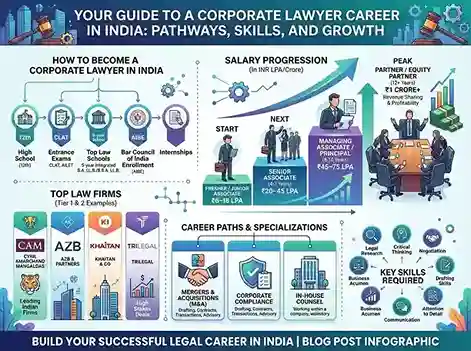
After Class 12 with minimum 45% marks in any stream, appear for CLAT (for NLUs | the gold standard for corporate law hiring), AILET (for NLU Delhi), or SLAT/LNAT (for Symbiosis, Jindal). Your target: a top-20 NLU or top private law school (JGLS, SLS Pune). The college you attend directly affects which tier of law firm you can access as a fresher. CLAT is conducted in December; begin preparation at least 6–8 months in advance.
The 5-year integrated law degree (BA LLB or BBA LLB) from an NLU or top private law school is the primary pathway into corporate law. During your degree: (a) Choose electives in corporate law, securities law, M&A, banking law, taxation, and IP. (b) Do 5–8 corporate law internships (see Section 9). (c) Participate in moot courts | top firms view mooting as evidence of research, drafting, and argumentation skills. (d) Publish at least 1–2 law review articles on corporate/commercial law topics. (e) Join your college's law review or student body council. Maintaining a strong CGPA (above 7.5/10) is important for Tier-1 firm eligibility.
Internships are the single most critical determinant of corporate law job placement. Tier-1 firms (CAM, AZB, Khaitan) hire 80–90% of their associates from candidates who have already interned with them. Strategy: Start with any reputable law firm or in-house legal team in Year 1–2 to build foundational skills. In Year 3–4, target Tier-2 firms in your city. In Year 4–5, target Tier-1 firms in Mumbai or Delhi for 2-month internships. A Pre-Placement Offer (PPO) from a Tier-1 firm in your penultimate year is the holy grail | it converts directly to an associate offer on graduation.
The AIBE (All India Bar Examination), conducted by the Bar Council of India, is mandatory for all law graduates to practice law in India | including in corporate law roles at law firms. It is an open-book examination with 100 MCQs covering various areas of law. It is not very difficult but is a mandatory credential. Enroll for AIBE immediately after your LLB graduation | you must clear it before joining a law firm or in-house legal team as a practicing lawyer.
With a strong internship record and AIBE cleared, you join either: (a) A law firm as a Junior Associate | your work will involve drafting, due diligence, research notes, and supporting senior lawyers on transactions. At Tier-1 firms, starting salary is ₹12–18 LPA. (b) An in-house legal team at a corporation, startup, or MNC as a Junior Legal Counsel | broader but less structured skill development. The first 2–3 years are crucial | work hard on drafting quality, transactional exposure, and client communication. This is where you decide your specialization.
Corporate lawyers who demonstrate strong drafting, client handling, and business development skills progress from Associate to Senior Associate (₹25–40 LPA) to Counsel/Principal Associate (₹40–60 LPA) and eventually to Partner (₹60 LPA – ₹1 Cr+) at major firms, typically in 7–12 years. Alternatively, experienced corporate lawyers (3–5 years) transition to in-house roles | General Counsel or VP Legal at startups (stock options + salary), or CLO/GC at listed companies (₹50 LPA – ₹1 Cr+).
3. Key Specializations in Corporate Law
Corporate law is not a monolith | it is a family of related practice areas. Choosing a specialization early (ideally by Year 3 of your LLB) helps you build deep expertise, which commands higher salaries and better opportunities.
| Specialization | What You Do | Key Regulators / Laws | Salary Premium | Best Entry Firms |
|---|---|---|---|---|
| Mergers & Acquisitions (M&A) | Deal structuring, due diligence, SPA/APA drafting, regulatory approvals | Companies Act 2013, CCI Act, SEBI (SAST), IBC | ★★★★★ Highest | AZB, CAM, SAM, Khaitan |
| Capital Markets | IPO, QIP, ESOP, bond issuances; SEBI filings | SEBI Act, Companies Act, FEMA, SEBI LODR | ★★★★☆ Very High | CAM, Cyril Amarchand, JSA |
| Private Equity & Venture Capital | Investment structuring, SHA negotiations, term sheet review | FEMA, SEBI (AIF), Companies Act | ★★★★☆ Very High | AZB, Trilegal, Khaitan |
| Banking & Finance | Loan documentation, IBC restructuring, bond structuring | RBI Act, IBC 2016, SARFAESI | ★★★★☆ High | CAM, Linklaters India desk, L&L |
| Data Privacy & Tech Law | DPDP compliance, data agreements, AI regulatory advisory | DPDP Act 2023, IT Act, GDPR | ★★★★☆ Fast-Rising | Trilegal, CAM, Nishith Desai |
| Competition Law | Merger notifications, cartel investigations, dominance advisory | Competition Act 2002, CCI Regulations | ★★★☆☆ High Niche | Khaitan, AZB, Vaish Associates |
| Intellectual Property (IP) | Patents, trademarks, licensing, IP due diligence in M&A | Patents Act, Trademarks Act, Copyright Act | ★★★☆☆ Moderate | Anand & Anand, Lakshmikumaran, K&S |
| Taxation & Transfer Pricing | Corporate tax advisory, cross-border tax structuring, litigation support | Income Tax Act, DTAA, GST Act | ★★★★☆ Stable High | AKM Global, Economic Laws Practice, Khaitan Tax |
4. Corporate Lawyer Salary in India 2026 | Experience & Firm-Wise
Corporate lawyer salaries in India have risen sharply over the last 3 years, driven by strong M&A deal flow, global law firm entries, and startup ecosystem growth. Here is the most detailed and accurate salary data available for 2026:
Tier-1 NLU Graduate
Tier-2/Private College
1–3 years
3–5 years
5–8 years
8–12 years
10–15+ years
* Salary ranges for Tier-1 and Tier-2 law firms. Includes base salary; excludes performance bonuses (which can add 10–20% additional compensation at Tier-1 firms). In-house corporate counsel salaries at MNCs can range ₹15–40 LPA for 3–7 years experience. Source: Lawctopus 2026, Glassdoor India, Internshala, FindMyCollege 2026.
| City | Fresher (0–3 yrs) | Mid-Level (3–7 yrs) | Senior (7+ yrs) | Why Higher/Lower |
|---|---|---|---|---|
| Mumbai | ₹10–18 LPA | ₹20–40 LPA | ₹40 LPA+ | India's financial capital; most Tier-1 firm HQs; highest BFSI deal flow |
| New Delhi / Gurgaon | ₹8–16 LPA | ₹18–35 LPA | ₹35 LPA+ | National regulatory hub; government advisory; PE/VC ecosystem |
| Bengaluru | ₹7–14 LPA | ₹15–28 LPA | ₹30 LPA+ | Tech startup ecosystem; in-house counsel boom; DPDP/tech law demand |
| Hyderabad | ₹6–10 LPA | ₹12–20 LPA | ₹25 LPA+ | Growing pharma, IT, and infra corporate law market |
| Chennai | ₹5–9 LPA | ₹10–18 LPA | ₹20 LPA+ | Traditional manufacturing and IT companies; emerging corporate hub |
| Tier-2 Cities | ₹3–6 LPA | ₹6–12 LPA | ₹12–20 LPA | Lower cost of living; fewer Tier-1 firm offices; strong in-house market |
5. Top Law Firms Hiring Corporate Lawyers in India 2026
India's top law firms are divided into tiers based on deal quality, client profile, and compensation. Here are the leading hirers for corporate lawyers, with verified 2026 salary data:
* Salary data is approximate and based on 2025–2026 campus placement records, Glassdoor India, and Quora reports from firm associates. Actual offers vary by campus (NLSIU, NALSAR, NLU-D typically attract highest packages), academic performance, and internship record. Tier-1 firms offer higher salaries to NLU Tier-1 graduates vs. Tier-2 or private law school graduates at the same firm.
6. Law Firm vs In-House Corporate Counsel | Which Path is Right for You?
The most important career decision for a corporate lawyer is whether to build your career at a law firm or go in-house at a company. Both offer strong futures | but very different day-to-day experiences. Here is the most honest comparison:
The most successful career path is a hybrid: 3–5 years at a Tier-1 or strong Tier-2 law firm to build deep transactional skills and credibility → then move in-house at a well-funded startup, PE-backed company, or MNC for better balance, broader exposure, and equity upside. Many who go in-house early (without firm experience) find themselves underdeveloped in drafting and transactional skills. The firm experience is the forge | the in-house role is where you use those skills strategically.
7. Skills Required to Become a Successful Corporate Lawyer
These are the foundational skills every corporate lawyer must possess. Of these, contract drafting and review is the most critical | a corporate lawyer who cannot draft a clean, tight, risk-aware agreement adds little value regardless of their other skills. Invest 12–18 months specifically in improving your drafting quality through deliberate practice and redlining exercises.
The gap between a ₹6 LPA and an ₹18 LPA corporate lawyer is often not legal knowledge | it is practical skills like commercial understanding, negotiation, and client-friendly communication. Corporate lawyers who can read a balance sheet, understand a business model, and translate legal risk into business language are dramatically more valuable. Take a finance or accounting course alongside your law degree | it pays dividends throughout your career.
In 2026, corporate lawyers with legal tech literacy command 30–40% higher salaries and are significantly more hireable. AI tools are automating routine due diligence review and first-draft contract generation | lawyers who know how to supervise and leverage these tools are indispensable; those who resist them are increasingly replaceable at the junior level. Learn at least one AI-powered legal research or contract review tool during your LLB.
8. NLU vs Private Law College | Does Your College Matter for Corporate Law?
The honest answer: Yes, significantly | but not absolutely. Here is what the data shows:
| Factor | Top NLU (NLSIU, NALSAR, NLU-D, GNLU) | Top Private (JGLS, SLS Pune) | Other Law Colleges |
|---|---|---|---|
| Tier-1 Firm Access | Very High (80–90% hires) | Moderate (8–12% hires) | Low (2–5% hires) |
| Fresher Salary Range | ₹12–18 LPA (Tier-1 firms) | ₹8–14 LPA | ₹4–8 LPA |
| Internship Opportunities | Highest | structured campus hiring | High | active career services | Lower | self-driven |
| Alumni Network Quality | Strongest in India | Growing | JGLS especially strong | Limited in Tier-1 sphere |
| In-House Role Access | High | High | Moderate to High (skills-based) |
| Long-Term Impact | Significant for first 5 years | Moderate | Diminishes after 5 yrs experience |
If you are studying at a non-NLU or lower-ranked private law school, your path to corporate law is harder but very real: (1) Build an extraordinary internship record | aim for 6–8 internships, targeting progressively better firms each year. (2) Publish corporate law articles on Manupatra, SCC Online, and reputable law reviews. (3) Win state-level moot courts. (4) Network actively on LinkedIn and at legal events. (5) Consider an LLM in Corporate Law from a top institution after your LLB | this can reset your career trajectory significantly. Many successful corporate lawyers at Tier-2 and boutique firms did not attend NLUs. Skills, hustle, and specialization ultimately matter more than your undergraduate college after 5 years of practice.
9. How to Get Corporate Law Internships in India
The single most impactful thing you can do for your corporate law career while studying is to build an exceptional internship record. Here is a proven strategy:
Where to find corporate law internships:
10. Should You Pursue an LLM in Corporate Law?
An LLM (Master of Laws) in Corporate Law is a powerful | but not universally necessary | career investment. Here is an honest assessment:
- You are from a non-NLU and want to reset your career trajectory
- You want to specialize deeply in a niche (Tax, IP, International Arbitration)
- You plan to work internationally or with global law firms
- You want to move from litigation to corporate law
- You are targeting academia or policy alongside practice
- You are from a top NLU with a strong internship record | firms don't require it
- The LLM college is not significantly better than your LLB college
- You cannot fund it without taking on significant debt
- You are delaying work experience just to have a degree
| LLM Option | Duration | Approx Cost | Career Impact |
|---|---|---|---|
| LLM India | NLU / NDA / JGLS | 1 year | ₹3–8 lakh | Strong for specialization; good for non-NLU reboot |
| LLM UK (Oxford, UCL, KCL, LSE) | 1 year | ₹25–40 lakh | Excellent for international law firms; arbitration; academia |
| LLM USA (Columbia, NYU, Harvard) | 1 year | ₹30–50 lakh | Top international credential; very high ROI if targeting Wall Street firms or IHL |
| LLM Singapore (NUS, SMU) | 1 year | ₹10–15 lakh | Growing in value; strong for Southeast Asia and arbitration |
11. How AI is Reshaping Corporate Law in India 2026
2026 is the year AI moves from hype to hard reality in Indian corporate law. Here is what is actually happening and what it means for your career:
- First-draft contract generation (Harvey AI, Luminance)
- Due diligence review (100s of documents in minutes)
- Legal research summarization (Kira, Relativity)
- Routine contract risk flagging
- Template-based legal opinions
- Strategic deal structuring and risk judgment
- Client relationship and negotiation
- Contextual regulatory interpretation
- Complex deal management under ambiguity
- Supervising and correcting AI output
The worst career mistake you can make in 2026 is to be the lawyer who ignores AI. The best career move is to become the lawyer who masters it. Law firms are actively reducing junior associate headcount for routine due diligence work | but simultaneously hiring for lawyers who can oversee AI-powered review, spot AI errors, and drive efficiency. If you are in law school now, learn at least one AI legal tool (start with Luminance or Harvey AI's free demos), take an online course in data privacy law (booming demand), and develop your technology regulatory knowledge | this is a gold mine of opportunity as India implements the DPDP Act 2023.
12. Corporate Lawyer Career | Frequently Asked Questions
Corporate lawyer salaries in India in 2026 vary significantly by experience and firm tier. Freshers at Tier-1 firms (CAM, AZB, Khaitan, SAM, Trilegal) with NLU degrees earn ₹12–18 LPA. Freshers at Tier-2 and private colleges earn ₹4–8 LPA. Mid-level associates (4–7 years) earn ₹15–30 LPA. Senior associates (7–10 years) earn ₹25–50 LPA. Partners earn ₹50 LPA to over ₹1 crore. The average across all experience levels and firm types is approximately ₹6–8 LPA in 2026. In-house corporate counsel at MNCs earn ₹15–40 LPA at mid-seniority. Mumbai pays the highest; Tier-2 cities pay 30–40% less.
To become a corporate lawyer in India after Class 12: (1) Appear for CLAT (for NLUs) or SLAT/LNAT (for SLS Pune/JGLS) with minimum 45% in Class 12. (2) Complete a 5-year BA LLB or BBA LLB programme at a top law school. (3) Do 5–8 internships in corporate law departments during your degree, targeting progressively better firms each year. (4) Clear the AIBE (All India Bar Examination) after graduation. (5) Join a law firm as a Junior Associate or an in-house legal team. Fresher salary at Tier-1 firms for NLU graduates is ₹12–18 LPA. Optionally, pursue an LLM for specialization after a few years of practice.
The best law firms for corporate law in India in 2026 are: (1) Cyril Amarchand Mangaldas (CAM) | India's largest full-service firm, M&A/Capital Markets leader, fresher salary ₹12–15 LPA; (2) Shardul Amarchand Mangaldas (SAM) | top corporate firm, strong PE/M&A practice, ₹12–18 LPA; (3) AZB & Partners | premier M&A and PE firm, ₹14–16 LPA fresher; (4) Khaitan & Co. | strong tax, M&A, employment, ₹12–20 LPA; (5) Trilegal | boutique excellence in tech, M&A, PE, ₹10–18 LPA; (6) JSA | strong infra, capital markets, ₹8–14 LPA; (7) Nishith Desai Associates | research-driven, international tax and FEMA, ₹8–14 LPA.
The scope of corporate law in India in 2026 is exceptional and growing. Key demand drivers include: India's M&A deal volume crossing ₹100 billion in 2025 with further growth expected; record FDI inflows requiring complex legal structuring; 5,500+ registered startups creating in-house counsel demand; SEBI/RBI/CCI regulatory enforcement increasing compliance advisory needs; the DPDP Act 2023 creating a new data privacy compliance vertical; India's growing role as a global arbitration hub; and ESG regulations requiring dedicated legal advisory. The Advocates (Amendment) Bill 2026 formally recognises corporate lawyers as legal practitioners. Demand for corporate lawyers is projected to grow 20–25% annually through 2028, making it India's fastest-growing legal career path.
CLAT is not legally required to become a corporate lawyer, but it is the most effective path to the highest-paying corporate law careers. CLAT gives access to top NLUs (NLSIU Bangalore, NALSAR Hyderabad, NLU Delhi, GNLU Gandhinagar etc.), from which 80–90% of Tier-1 law firm associates are recruited at salaries of ₹12–18 LPA. Without a top NLU degree, corporate law entry at Tier-1 firms is significantly harder. Alternatives: AILET (for NLU Delhi only), SLAT (for Symbiosis Law Schools), LNAT (for Jindal Global Law School). The bottom line: if corporate law is your ambition, CLAT is the exam you should prepare for with maximum effort.
The minimum time to become a practicing corporate lawyer in India after Class 12 is 5 years 6 months to 6 years: 5 years for the integrated BA LLB/BBA LLB degree, plus 3–6 months to clear the AIBE after graduation. If you pursue a 3-year LLB after a 3-year bachelor's degree, the total is 6 years after Class 12. Many corporate lawyers also pursue an LLM (1 year) for specialization, making the total 6–7 years. Career progression after joining: Junior Associate (0–3 yrs) → Senior Associate (4–7 yrs) → Counsel/Principal (8–12 yrs) → Partner (10–15 yrs at Tier-1 firms).