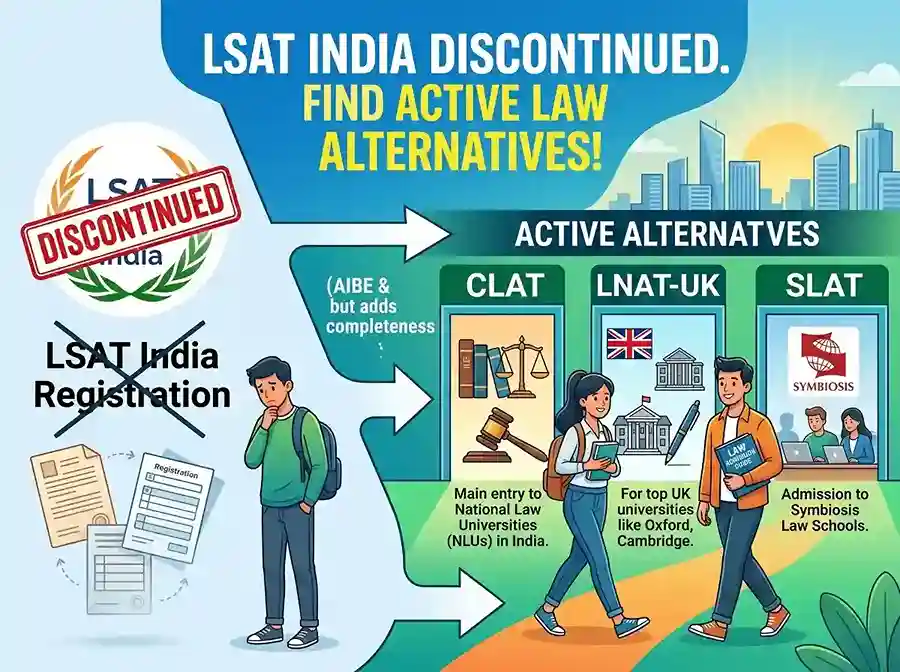
- Why Registration Is Permanently Closed
- Historical Registration Overview
- Step-by-Step Application Process
- Documents Required
- Application Fee Details
- Slot Booking Process
- Admit Card Download
- Common Registration Errors
- How to Register for Alternatives
- Registration Fee Comparison
- If You Have an Old LSAT India Score
- Frequently Asked Questions
1. Why Is LSAT India Registration Permanently Closed?
Many students visiting this page are searching for the LSAT India 2026 or 2026 application form | possibly because they found an old exam notification, a coaching centre advertisement, or a search result from a website that hasn't been updated. Let us be completely clear about what happened and why there is no LSAT India registration to complete:
The Law School Admission Council (LSAC), a US-based non-profit organisation that owns and administers the LSAT brand globally, and Pearson VUE, which conducted LSAT India on LSAC's behalf in India, jointly decided to discontinue the LSAT | India examination starting from the 2026 admission cycle. This decision was officially announced in 2024 and means:
The decision to discontinue was driven by multiple converging factors: JGLS's decision to switch to the internationally recognised LNAT-UK; LSAT India's limited uptake (only ~19 colleges); the competition from established exams like CLAT, SLAT, and university-specific tests; and LSAC's assessment of the Indian market. The full story of why LSAT India ended is covered in our LSAT India Complete Guide.
2. LSAT India Registration | Historical Overview (2010–2024)
For students, researchers, and educators who need a reference to how LSAT India registration worked during its active years, this section documents the complete process as it existed from 2010 to 2024. This information is also relevant for students preparing for LNAT-UK, which has a broadly similar online registration mechanism through Pearson VUE.
During its operational years, LSAT India was conducted in two sessions per year | a January session and a May session. The registration process was entirely online, conducted through the official portal lsatindia.in. Candidates could register for one or both sessions; each session had its own registration window, fee, and exam dates.
| Particulars | January Session | May Session |
|---|---|---|
| Registration Opening | Typically August–September (previous year) | Typically February–March |
| Registration Closing | Typically early January | Typically late April / early May |
| Slot Booking Window | October–January | March–May |
| Exam Dates | Typically 3rd–4th week of January | Typically 3rd–4th week of May |
| Result Declaration | Typically 2–3 weeks after exam | Typically early June |
| Application Fee | ₹3,999 per session | ₹3,999 per session |
| Mode of Exam | Remote Proctored (Home-based) | Remote Proctored (Home-based) |
LSAT India operated this two-session model from around 2019 onwards. Before 2019, it was typically a single annual exam. The remote proctored format was introduced during COVID-19 in 2020 and retained permanently thereafter, replacing the earlier test-centre-based format. The May 2024 session was the last LSAT India exam ever conducted.
3. LSAT India Registration: Complete Step-by-Step Process (Historical Reference)
The LSAT India application process was a 4-phase process: Online Registration → Application Form Filling → Document Upload & College Selection → Fee Payment. Below is the detailed breakdown of each phase as it worked in the exam's final years (2022–2024).
- Full name (as per Class 10 certificate)
- Email ID (to be used as login username)
- Mobile number (for OTP verification and alerts)
- Country, State, and City of residence
- Password (chosen by the candidate)
- Programme type (5-year LLB, 3-year LLB, or LLM)
- CAPTCHA code verification
- Personal Details: Full name, date of birth, gender, nationality, father's/mother's name, address, pincode
- Academic Background: Class 10 board and percentage, Class 12 board and percentage (or expected), college/university name for LLB/LLM applicants
- Communication Address: Permanent address and correspondence address
- Programme & Session Preference: Which session (January/May/both), which programme (UG/PG)
- College Preferences: Selection of participating colleges to which LSAT India scores should be sent | this was an important step as scores were directly reported to selected colleges
- Recent passport-size photograph (JPG/JPEG, max 80 KB)
- Scanned signature on white paper (JPG/JPEG, max 80 KB)
- Government-issued photo ID | Aadhaar card, PAN card, Passport, Voter ID, or Driving Licence (PDF, max 2 MB)
- Credit Card | Only MasterCard or VISA cards issued in India were accepted; international cards were not valid
- Debit Card | All major bank debit cards accepted
- Debit Card + ATM PIN mode
- Net Banking (NEFT)
- Digital Wallets and Cash Cards
- UPI (added in later years)
- Download a PDF copy of the submitted application form
- Download and save the fee payment receipt
- Note their LSAT India Registration Number for slot booking later
- Keep both documents safely for future reference
4. Documents Required for LSAT India Registration | Complete Checklist
One of the most common reasons for application rejection or complications during remote proctoring was incorrect or non-compliant document uploads. Below is the complete and specification-accurate document checklist that LSAT India required:
5. LSAT India Registration Fee | Complete Breakdown (Historical)
The LSAT India application fee structure was straightforward but had specific nuances that candidates frequently got wrong. Here is the complete fee breakdown as it existed in the exam's final years (2022–2024):
| Registration Type | Fee Amount | Who It Applied To | Notes |
|---|---|---|---|
| Single Session (January OR May) | ₹3,999 | Candidates appearing in only one session | Most common registration type |
| Both Sessions (January AND May) | ₹7,998 | Candidates registering for both sessions simultaneously | No combined discount; fee paid twice separately |
| Late Registration (if applicable) | ₹4,499+ | Candidates registering after the standard deadline (in some years) | Not consistently available every year |
| Reserved Category Discount | No discount | N/A | LSAT India had no category-based fee concession | unlike CLAT which offers ₹500 discount for SC/ST |
| Score Report (additional colleges) | Typically free | All registered participating colleges received scores | Unlike the US LSAT, Indian version sent scores to all participating colleges automatically |
6. LSAT India Slot Booking | How to Schedule the Exam (Historical)
A feature unique to LSAT India (compared to CLAT or AILET) was its personalised slot booking system. Because LSAT India was conducted in remote proctored mode with multiple daily exam slots spread over 3–4 days, candidates could choose their preferred date, day, and time slot after completing registration. Here's how slot booking worked:
Candidates who completed registration but forgot to book a slot could not appear for the exam. Slot booking was mandatory and was the final step before downloading the admit card. This is an important distinction from CLAT, where no slot booking is required | all candidates appear at the same time across exam centres.
7. LSAT India Admit Card Download Process (Historical)
Once slot booking was complete, the LSAT India admit card (technically a "confirmation letter" for the remote proctored exam) could be downloaded from the candidate portal. Here is how the process worked:
Unlike traditional admit cards for exam-hall-based tests, the LSAT India admit card was essentially a test booking confirmation that contained the candidate's registration number, exam date and time, candidate's photograph, and basic instructions for the remote proctored session. The admit card was released approximately 5–7 days before the exam date. Key details on the LSAT India admit card included:
| Information on Admit Card | Purpose |
|---|---|
| Candidate Name & Registration Number | Identity verification during proctoring |
| Exam Date, Session, and Time Slot | When to log into the remote proctoring system |
| Candidate Photograph | Visual identity verification by live proctor |
| System Requirements | What computer/internet setup was needed |
| Pre-Exam Checklist | Room setup, ID document to keep handy, etc. |
| Proctor Login Link/Instructions | How to start the exam session |
On exam day, candidates had to log into the remote proctoring system 15–30 minutes before their slot. A live proctor would verify identity (face check against photo, ID document check), conduct a 360° room scan via the webcam, check for unauthorised materials, and allow the exam to begin. Candidates needed: stable internet (minimum 1 Mbps), webcam, microphone, and a quiet room. Any technical failure on exam day was candidates' responsibility | LSAC/Pearson VUE did not automatically offer reschedule for technical issues unless formally applied for.
8. Common LSAT India Registration Errors (And How to Avoid Them in Current Exams)
Based on reported candidate experiences over the years, these were the most frequently occurring registration errors in LSAT India. These lessons remain directly applicable to registering for CLAT, LNAT-UK, SLAT, and other current exams:
The single most common and consequential error. If your name in the application form doesn't exactly match your Class 10 certificate (spelling, initials, or middle name inclusion), the proctor on exam day may refuse to verify your identity. Always copy the name character-by-character from your Class 10 certificate. This applies equally to CLAT and LNAT-UK registration.
Many candidates uploaded PNG images instead of JPG/JPEG, or files larger than 80 KB. The system either rejected the upload or compressed the image to an unacceptable quality. Always convert images to JPG/JPEG before uploading. Use Paint or a free online image converter to resize. The same requirement applies in CLAT and most other law entrance registrations.
Hundreds of candidates paid the ₹3,999 fee and filled the application form but forgot to complete the mandatory slot booking step. Without a confirmed slot, the admit card was not generated and the candidate could not appear. There was no refund in such cases. Always bookmark the slot booking portal and set a calendar reminder as soon as registration is complete.
Some candidates submitted 2–3 application forms (sometimes from different email IDs) as a "safety measure." LSAC's rules explicitly stated that duplicate applications from the same candidate would be rejected and could result in disqualification. For CLAT, the same rule applies | only one application per candidate is accepted.
LSAT India sent a verification link to the registered email ID immediately after the initial sign-up. Many candidates skipped this step thinking registration was complete. Without email verification, the application form was not accessible. The verification email frequently landed in the spam folder | always check spam immediately after signing up for any law exam.
LSAT India only accepted MasterCard and VISA credit cards issued by Indian banks. International credit cards | including cards issued abroad even if held by Indian nationals | were not accepted. Candidates who tried to pay with international cards faced payment failures. If your only credit card was international, you had to use a debit card, UPI, or net banking instead.
9. How to Register for Active Alternatives | Step-by-Step (2026-27)
This is the most actionable section of this page. Since LSAT India registration is permanently closed, here is exactly how to register for each of the active alternatives based on your target institution:
The NLU preference list filled during CLAT registration is used for counselling. Many students make the mistake of not researching NLUs before registration and filling preferences randomly. Use the cutoff data on our CLAT Cutoff 2026 page to set realistic preferences before you start filling the form.
For JGLS admission, only LNAT Section A (multiple-choice) scores are considered | you still write Section B (essay) at the test centre as it is part of the LNAT structure, but JGLS does not evaluate the essay. Book your LNAT slot early | Pearson VUE centre slots in major Indian cities fill up quickly between October and January.
10. Registration Fee Comparison | LSAT India vs Active Alternatives
One of the most practical questions for law aspirants is how the registration costs of active exams compare to what LSAT India charged. Here is a comprehensive fee comparison to help you budget for 2026-27:
| Exam | General Category Fee | SC/ST Fee | Status 2026 | Institutions Covered |
|---|---|---|---|---|
| LSAT India | ₹3,999/session | ₹3,999 (no concession) | ❌ Discontinued | ~19 private colleges (historical) |
| CLAT 2027 | ₹4,000 | ₹3,500 | ✅ Active | 24 NLUs + 65+ private colleges |
| LNAT-UK 2026 | ~₹4,500–₹6,500 (£50–75 equiv.) | No concession | ✅ Active | Jindal JGLS + 9 UK universities |
| SLAT 2026 | ₹1,750 – ₹2,500 | Same (no concession) | ✅ Active | 4 Symbiosis Law School campuses |
| AILET 2027 | ₹3,000 | ₹1,000 | ✅ Active | NLU Delhi only |
| CUET Law 2026 | ₹750 – ₹1,500 (domain + language) | ₹375 – ₹750 | ✅ Active | DU, BHU, Jamia + central unis |
| MH CET Law 2026 | ₹800 | ₹600 | ✅ Active | Maharashtra state law colleges (GLC, ILS Pune) |
The total cost of registering for CLAT + SLAT + AILET is approximately ₹8,750 | barely more than two LSAT India sessions used to cost. By registering for all three, you cover 24 NLUs, NLU Delhi, Symbiosis Law Schools, and access to 65+ private law colleges | far broader than LSAT India ever offered. Add LNAT-UK if Jindal Global is specifically your target.
11. If You Have an Old LSAT India Score | Practical Guidance for 2026-27
A significant number of students who appeared in LSAT India 2023 or 2024 (the last sessions) are wondering whether their old scores can be used for 2026-26 or 2026-27 admissions. Here is the complete picture:
| Old Score Year | Score Technically Valid Until | Practical Usability for 2026-27 | Recommended Action |
|---|---|---|---|
| LSAT India Jan 2024 | January 2029 (5-yr validity) | Very Limited | Do not rely on it; register for active alternatives |
| LSAT India May 2024 | May 2029 (5-yr validity) | Very Limited | Contact individual colleges; do not rely on it |
| LSAT India 2022 / 2023 | 2027 / 2028 (5-yr validity) | Minimal | Almost certainly not accepted; switch to active exams |
| LSAT India pre-2022 | Expired or expiring | Not accepted | Register for CLAT/LNAT-UK immediately |
The critical point is that O.P. Jindal Global Law School | the most prestigious college that accepted LSAT India | has permanently moved to LNAT-UK. Jindal will not accept any LSAT India score, regardless of its validity period, for any admission cycle from 2026-26 onwards. For all other colleges that previously accepted LSAT India, the situation varies:
- Most have either switched to their own entrance tests or now accept CLAT scores
- A small number may still consider old LSAT India scores on a case-by-case basis | contact the specific college's admissions office directly
- Alliance University, UPES, and Christ University have their own current admission processes that do not depend on LSAT India
- Do not make admissions decisions based on an old LSAT India score without confirmed written acceptance from the target institution
12. LSAT India Registration | Frequently Asked Questions
No. The LSAT India 2026 registration form does not exist and was never made available. LSAC and Pearson VUE discontinued the exam before any 2026 registration window could open. Any website claiming to offer an LSAT India 2026 application form link is either operating on severely outdated information or is fraudulent. The official lsatindia.in website is defunct. Do not submit any personal information or payment to third-party sites claiming to facilitate LSAT India registration.
For the LSAT India May 2024 session (the last session ever conducted), the registration deadline was May 5, 2024 (revised from the initially announced May 2, 2024). The exam was held from May 16–19, 2024. For the January 2024 session, the registration closed in early January 2024 with the exam held on January 20–21, 2024. There have been no registration windows after May 2024 as the exam was subsequently discontinued.
LSAC and Pearson VUE's official policy stated that the LSAT India registration fee was strictly non-refundable under any circumstances. This policy applied even in cases of exam cancellation or rescheduling. If you paid the fee for a 2024 session and appeared in that exam, no refund is applicable since the service (the exam) was delivered. If you believe you were charged for a 2026 session that was never officially opened (which would be unusual given the timing of the discontinuation announcement), you should contact your bank or card issuer about disputing the charge, as the exam authority no longer operates in India.
LSAT India was offered twice a year | January and May sessions. Candidates could register for one or both sessions, paying ₹3,999 per session. There was no limit on the number of years a candidate could attempt LSAT India. Scores were valid for up to 5 years, so a candidate could theoretically have multiple scores on record. When applying to colleges, candidates typically submitted their best score. Unlike the US LSAT (which had restrictions on number of attempts), LSAT India placed no annual or lifetime attempt limit.
Yes, one of LSAT India's notable features was that both Indian nationals and foreign nationals were eligible to register and appear. There was no age limit and no nationality restriction set by LSAC for LSAT India registration. However, individual colleges had their own policies regarding admission of foreign nationals | some accepted them freely while others had restrictions. The openness to foreign nationals was a differentiating feature of LSAT India compared to CLAT, which is primarily designed for Indian nationals.
This is a critical warning: Several websites appear in search results for "LSAT India registration 2026" but are either: (1) Outdated informational pages from coaching centres that haven't updated their content; (2) Clickbait sites that use LSAT India keywords but actually direct you to other exams; or (3) Fraudulent sites that may attempt to collect registration fees or personal data. LSAT India 2026 registration is NOT possible | the exam does not exist. Do not provide your credit card details, Aadhaar number, or mobile OTP to any such site. The only legitimate LSAT India registration ever existed on lsatindia.in, which is now defunct.