LSAC (Law School Admission Council) officially withdrew the LSAT | India exam as part of its broader business strategy. The January 2025 and May 2025 sessions were the final editions of LSAT India. From 2026 onwards, LSAC is no longer conducting LSAT India and has no plans to replace it with another exam.
✅ If you hold a valid LSAT India 2025 scorecard, you may still submit it to participating colleges for the 2025–26 admission cycle. ✅ For 2026–27 admissions, prepare for CLAT 2027, AILET 2027, or the college's own entrance test (e.g., JSAT-Law for Jindal). This page covers full LSAT India cutoff history for reference and score-to-percentile decoding for candidates with active 2025 scorecards.
1. What Is LSAT India Cutoff? How It Works
The LSAT India cutoff is the minimum score or percentile required to be considered for admission to a specific law college that accepts LSAT India scores. Unlike CLAT (which has a centralized cutoff published by the Consortium of NLUs), LSAT India does not have a single centralized cutoff. Each participating college sets its own minimum threshold independently.
Here is how the LSAT India cutoff system worked in practice:
These three terms are often confused. Your scaled score (420–480) is the absolute number on LSAC's scale. Your percentile (0–99.99) shows how you rank relative to all test-takers. The cutoff is the minimum score/percentile a specific college requires for shortlisting. A score of 455 might be the 75th percentile in a year with many high-performing candidates but the 80th percentile in a year with more average scores. Colleges that published cutoffs usually stated them in percentile terms for this reason.
2. LSAT India Score Scale 420–480 | Score vs Percentile Table
LSAT India scores were reported on a scale of 420 to 480, where 420 is the minimum possible scaled score and 480 is the maximum. This scale was designed to account for variations in difficulty across different test sessions through a process called equating. Your raw score (number of correct answers out of 92 questions) was converted to this scaled score.
The LSAT India scale (420–480) is entirely different from the US LSAT scale (120–180). Do not confuse the two. A score of 450 on LSAT India is approximately the 50th percentile | a mid-range score. A score of 150 on the US LSAT is also approximately the 50th percentile. These are two separate exams with two separate scoring systems.
* Score-to-percentile mapping is approximate and varies year to year based on candidate pool performance. Data compiled from LSAC score reports and historical LSAT India data 2019–2025.
- 480 (Max): Scored better than ~99.9% of all test-takers. Top of the cohort.
- 465+ (88%+): "Excellent" | qualifies for JGLS with strong scholarship potential.
- 455–464 (75–87%): "Very Good" | comfortably clears JGLS and most LSAT India college cutoffs.
- 450 (70%): Generally considered the benchmark for top-tier LSAT India admissions.
- 440–450 (50–70%): Mid-range | qualifies for several colleges but not the most competitive.
- 420 (Min): Scored at the bottom of the LSAT India scale. Very limited admission options.
3. LSAT India Cutoff 2025 | College-Wise Score & Percentile
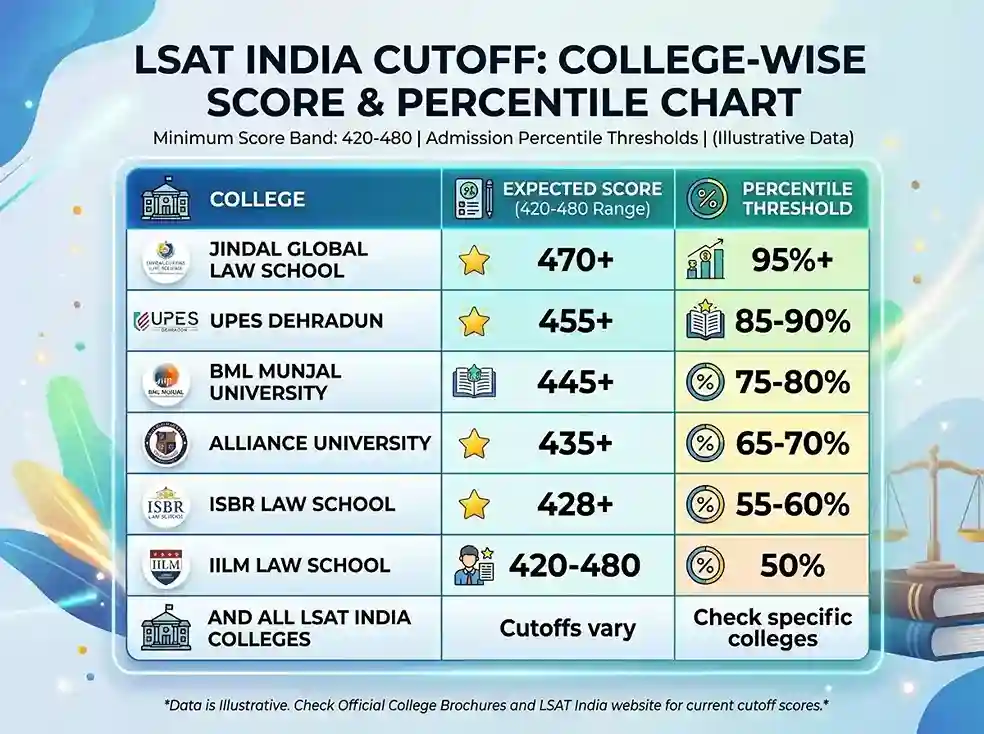
The following table is the most comprehensive publicly available compilation of LSAT India college-wise cutoffs based on historical data, college disclosures, and admission trend analysis from 2020 to 2025. Since LSAT India colleges do not publish official cutoffs centrally, these figures reflect the minimum percentile/score at which the last admitted student was typically shortlisted.
LSAT India cutoffs below are compiled from college admission office communications, student reports, and historical data (2020–2025). No single centralized LSAT India cutoff source exists. Always verify with the specific college's admissions office. Some colleges may have varying cutoffs by programme (BA LLB vs LLB 3-yr vs LLM) and by category (General vs SC/ST/OBC).
| College | Location | 5-Yr LLB Cutoff | Score ~(420–480) | LLM Cutoff | Scholarship Threshold |
|---|---|---|---|---|---|
| Jindal Global Law School (JGLS) | Sonepat, Haryana | 75–80 Percentile | ~455–465 | 60 Percentile | 90+ Percentile (merit award) |
| UPES School of Law | Dehradun, Uttarakhand | 65–75 Percentile | ~450–458 | 55 Percentile | 80+ Percentile |
| Kirit P. Mehta School of Law (SVKM) | Mumbai, Maharashtra | 65–72 Percentile | ~449–455 | 55 Percentile | 75+ Percentile |
| College | Location | 5-Yr LLB Cutoff | Score ~(420–480) | LLM Cutoff |
|---|---|---|---|---|
| BML Munjal University, School of Law | Gurgaon, Haryana | 60–70 Percentile | ~447–453 | 50 Percentile |
| Alliance School of Law | Bangalore, Karnataka | 60–68 Percentile | ~446–452 | 50 Percentile |
| VIT Law School (VITSOL) | Chennai / Vellore, Tamil Nadu | 55–65 Percentile | ~444–450 | 45 Percentile |
| ITM Law School | Navi Mumbai, Maharashtra | 55–65 Percentile | ~444–450 | 45 Percentile |
| Amity Law School (select campuses) | Noida / Delhi, UP | 55–65 Percentile | ~444–450 | 45 Percentile |
| School of Law, NorthCap University | Gurgaon, Haryana | 50–60 Percentile | ~442–447 | 40 Percentile |
| Gitam University School of Law | Hyderabad / Vishakhapatnam, AP | 50–60 Percentile | ~442–447 | 40 Percentile |
| Galgotias University School of Law | Greater Noida, UP | 45–55 Percentile | ~440–445 | 35 Percentile |
| College | Location | Minimum Percentile | Approx Score |
|---|---|---|---|
| JSS Law College | Mysore, Karnataka | 40–50 Percentile | ~438–443 |
| School of Law, MATS University | Raipur, Chhattisgarh | 35–45 Percentile | ~436–441 |
| KLE Society Law College | Bangalore, Karnataka | 35–45 Percentile | ~436–441 |
| AURO University School of Law | Surat, Gujarat | 30–42 Percentile | ~434–440 |
| Ansal University School of Law | Gurgaon, Haryana | 30–40 Percentile | ~433–438 |
| Rajiv Gandhi School of Intellectual Property Law (IIT Kharagpur) | Kharagpur, West Bengal | 45–55 Percentile | ~440–445 |
* All cutoff data is indicative and based on historical trends 2020–2025. Final cutoffs vary per year and programme. Contact individual colleges for confirmed admission requirements.
4. JGLS Cutoff | Jindal Global Law School Deep Dive
Jindal Global Law School (JGLS), part of O.P. Jindal Global University in Sonepat, Haryana, was consistently the most competitive LSAT India-accepting college in India. Ranked #1 in India and South Asia by QS World University Rankings for law, JGLS attracted the best LSAT India scorers and drove the highest cutoffs among all participating institutions.
Jindal Global Law School introduced its own entrance test | JSAT-Law | from the 2025 admission cycle, replacing LSAT India for the 5-year BA LLB programme. From 2026 admissions, LSAT India scores are not accepted at JGLS. Candidates targeting JGLS for 2027 admissions must appear for JSAT-Law, or submit CLAT / AILET scores. The historical cutoff data on this page applies to the LSAT India era (2015–2025) only.
5. What Is a Good LSAT India Score?
The definition of a "good" LSAT India score depends entirely on which college you are targeting. There is no universal threshold. Here is a practical breakdown:
6. Factors That Determine LSAT India Cutoff Each Year
LSAT India cutoffs were not fixed | they shifted year to year based on several variables. Understanding these factors helps you interpret historical data and calibrate your score expectations:
| Factor | Effect on Cutoff | LSAT India Context |
|---|---|---|
| Total Number of Test-Takers | More candidates → higher competition → cutoffs rise | LSAT India saw rising participation from ~15,000 (2018) to ~35,000+ (2025) |
| Exam Difficulty Level | Harder exam → lower average scores → cutoffs fall slightly | LSAT India difficulty was consistent across years; section mix varied |
| College Seat Availability | More seats → cutoff falls; fewer seats → cutoff rises | JGLS BA LLB seats limited (~400/yr); creates high competition even with large applicant pool |
| Candidate Preferences | High demand for specific college → that college's cutoff rises | JGLS consistently the first choice; its cutoff highest every year |
| May vs January Session Performance | Best of two attempts used; May scores typically higher → colleges adjust expectations | May session candidates generally more prepared; raises overall performance distribution |
| Category (General vs Reserved) | Reserved category cutoffs are lower than General by 5–15 percentile typically | SC/ST candidates typically need 10–15 percentile less; OBC ~5 percentile less |
| Alternative Exam Availability | Strong CLAT/AILET results → candidates with high LSAT may opt for NLUs → LSAT India cutoffs soften | Post-2022 rising CLAT awareness diverted some high scorers, slightly easing LSAT India top-tier cutoffs |
7. LSAT India Previous Year Cutoff Trends (2020–2025)
The following table shows how LSAT India cutoffs at Jindal Global Law School (JGLS) | the benchmark institution | evolved from 2020 to 2025. These figures are based on the minimum percentile/score of admitted students in the General category for the 5-year BA LLB programme.
| Year | JGLS 5-Yr BA LLB (General) | Approx Score (420–480) | Trend vs Previous Year | Total LSAT India Applicants (Est.) |
|---|---|---|---|---|
| 2020 | 60–65 Percentile | ~447–450 | → Baseline | ~15,000 |
| 2021 | 65–70 Percentile | ~450–453 | ↑ Rising (online exam; more takers) | ~18,000 |
| 2022 | 68–72 Percentile | ~452–455 | ↑ Rising (awareness grew) | ~22,000 |
| 2023 | 72–76 Percentile | ~454–458 | ↑ Significant rise (JGLS reputation + LSAC promotion) | ~28,000 |
| 2024 | 74–79 Percentile | ~455–462 | ↑ Continued rise; scholarship bar also moved up | ~32,000 |
| 2025 (Final) | 75–80 Percentile | ~456–465 | ↑ Highest ever (final year effect; record applicants) | ~35,000+ |
JGLS LSAT India cutoff rose steadily from ~60 percentile in 2020 to ~80 percentile in 2025 | a 20 percentile point increase over five years. This was driven primarily by (1) rapidly rising LSAT India applicant pool, (2) JGLS's growing QS ranking and placement record, and (3) the "LSAT India final year effect" in 2025 where record numbers appeared knowing it was the last edition. The 2025 cutoff represents the all-time peak for LSAT India at JGLS.
Previous Year LSAT India Cutoff | Multi-College Trend Table
| College | 2021 | 2022 | 2023 | 2024 | 2025 | Trend |
|---|---|---|---|---|---|---|
| JGLS (5-yr BA LLB) | 65–70% | 68–72% | 72–76% | 74–79% | 75–80% | ↑ Consistently Rising |
| UPES School of Law | 55–62% | 58–65% | 62–68% | 63–70% | 65–75% | ↑ Rising |
| BML Munjal University | 50–58% | 52–60% | 55–63% | 58–66% | 60–70% | ↑ Rising Steadily |
| Alliance School of Law | 48–55% | 50–58% | 52–60% | 55–63% | 60–68% | ↑ Rising |
| VIT Law School | 45–52% | 48–55% | 50–58% | 52–60% | 55–65% | ↑ Rising |
| JSS Law College | 35–42% | 36–44% | 38–46% | 40–48% | 40–50% | → Gradual Rise |
8. LSAT India Cutoff | Category-Wise (General, OBC, SC/ST)
LSAT India participating colleges, particularly those with government recognition and reservation requirements under UGC guidelines, applied category-wise cutoffs. The actual reduction in percentile requirement varies by college and specific reservation policy. Based on historical data and college disclosures, here are the typical category-wise adjustments:
| Category | Typical Percentile Reduction vs General | JGLS Approx. Cutoff (2025) | UPES Approx. Cutoff (2025) | Notes |
|---|---|---|---|---|
| General (UR) | Baseline | 75–80 percentile | 65–75 percentile | Most competitive category |
| OBC (Non-Creamy Layer) | ~5 percentile lower | ~70–75 percentile | ~60–70 percentile | Some private colleges apply no OBC relaxation |
| EWS (Economically Weaker Section) | ~5–8 percentile lower | ~68–74 percentile | ~58–67 percentile | Reservation varies by college; confirm with institution |
| SC (Scheduled Caste) | ~10–15 percentile lower | ~60–68 percentile | ~50–62 percentile | Reservation mandatory at UGC-recognized colleges |
| ST (Scheduled Tribe) | ~10–15 percentile lower | ~60–68 percentile | ~50–62 percentile | Reservation applies; same as SC typically |
| PwD (Persons with Disability) | ~10–15 percentile lower | ~60–68 percentile | ~50–62 percentile | 5% horizontal reservation at most colleges |
LSAT India participating colleges are predominantly private institutions and are not legally bound to follow the same reservation framework as government-funded colleges (NLUs). Many purely private LSAT India colleges had no formal category-based reservation and admitted on open merit alone. Colleges like JGLS, as a deemed university, set their own reservation policies. Always confirm the specific category-wise cutoff with the college's admissions office before applying.
9. LSAT India Score Band Explained | What Your Score Means
Understanding the LSAT India score band is essential for correctly interpreting your scorecard. Many candidates confuse the scaled score (420–480) with percentage or with the US LSAT score (120–180). Here is a complete breakdown:
* Approximate conversions; actual scaling varies by year and test session difficulty.
10. LSAT India Discontinued | What to Do Now
LSAC's discontinuation of LSAT India from 2026 represents a significant change for law aspirants in India who were preparing for private law school admissions through this route. Here is a comprehensive guide on what this means and what steps to take:
According to LSAC's communication, the LSAT | India exam was withdrawn due to "business reasons." LSAC has confirmed it is not planning to introduce a replacement exam in India. LSAC will continue to accept applications from Indian students for the US/global LSAT exam (120–180 scale) for those targeting international law schools, but this is a different exam from LSAT India.
| Your Situation | What You Should Do | Timeline |
|---|---|---|
| Have a valid LSAT India 2025 scorecard | Submit to colleges accepting 2025 LSAT India scores for 2025–26 admission. Check if your target college still accepts 2025 scores | Act in 2025–26 admission cycle |
| Targeting JGLS for 2027 admissions | Register and prepare for JSAT-Law (JGLS's own test). LSAT India no longer accepted at JGLS from 2025 admission cycle | Prepare now; JSAT-Law details at admissions.jgls@jgu.edu.in |
| Targeting other LSAT India colleges (UPES, BML, Alliance) for 2027 | Prepare for CLAT 2027 | most private law schools now accept CLAT scores as primary alternative to LSAT India | CLAT 2027 Registration opens July 2026 |
| Targeting top NLUs (NLSIU, NALSAR, NUJS, GNLU) | Prepare for CLAT 2027 (for all NLUs except NLU Delhi) or AILET 2027 (for NLU Delhi only) | CLAT July 2026; AILET August 2026 |
| Undecided on law school path | CLAT is now the single most important law entrance exam in India | covers 24 NLUs + many private colleges. Start CLAT preparation | Begin preparation immediately |
11. Best Alternatives to LSAT India for Private Law Schools
With LSAT India discontinued, here are the best alternative entrance exams and pathways for candidates targeting the private law colleges that previously accepted LSAT India scores:
12. LSAT India Cutoff | Frequently Asked Questions
The LSAT India cutoff for Jindal Global Law School (JGLS) for the 5-year BA LLB (Hons.) programme was approximately 75–80 percentile (scaled score ~455–465 on the 420–480 range) for General category candidates. This was the cutoff as of the last LSAT India session (2025). For merit scholarships at JGLS, candidates typically needed 90+ percentile. For the 3-year LLB programme, the cutoff was lower at ~60 percentile. From 2025 admissions cycle, JGLS replaced LSAT India with its own test, JSAT-Law, so this data applies only to 2015–2025 admission cycles.
Yes, LSAT India has been officially discontinued by LSAC (Law School Admission Council). The January 2025 and May 2025 sessions were the final editions of LSAT India. LSAC has withdrawn the exam due to business reasons and has no plans to introduce a replacement exam in India. Candidates holding valid LSAT India 2025 scorecards may still submit these to participating colleges for the 2025–26 admission cycle. From the 2026–27 admissions cycle onwards, former LSAT India colleges are using CLAT, JSAT-Law, or other alternatives for admissions.
On the LSAT India 420–480 scale, a score of 450 or above is broadly considered competitive for most LSAT India colleges. Specifically: 465–480 is exceptional (85–99 percentile); 455–464 is excellent (75–85 percentile, qualifies for JGLS); 450–454 is good (65–74 percentile, qualifies for UPES, BML Munjal, Alliance); 440–449 is average (45–64 percentile, mid-tier colleges accessible); below 440 limits options significantly. The midpoint of the scale is 450, which corresponds to approximately the 50th–60th percentile.
LSAT India was scored as follows: (1) Raw Score | one mark for every correct answer; no negative marking. Total 92 questions across three sections: Analytical Reasoning (~24 questions), Logical Reasoning (~26 questions), and Reading Comprehension (~24 questions) plus an unscored experimental section. (2) Scaled Score (420–480) | raw score converted to the 420–480 scale through LSAC's equating process to account for difficulty variations. (3) Percentile Rank | shows your relative performance against all test-takers. Your scorecard from LSAC showed all three | raw score, scaled score, and percentile.
Yes, significantly. The cutoff for the 5-year BA LLB programme (the primary LSAT India programme) was consistently the highest | at JGLS, it was 75–80 percentile. The 3-year LLB cutoff was lower at ~60 percentile, and other tests like CLAT/AILET were also accepted. The LLM programme cutoff was even lower at ~55–60 percentile, and many colleges accepted CLAT PG or institution tests for LLM. Always check the specific programme's cutoff with the college | the 5-year BA LLB has the most competition.
The usability of LSAT India 2025 scores depends on the specific college's admission policy. LSAT India scores were generally valid for one admission cycle (one year). Candidates with LSAT India May 2025 or January 2025 scores should contact their target colleges directly to confirm whether the 2025 score is still accepted for 2025–26 admissions. Note that JGLS has moved to JSAT-Law and no longer accepts LSAT India scores. Other colleges like UPES, BML Munjal, and Alliance may have transition policies | verify directly with each institution's admissions office.
CLAT 2027 is the best and most recommended alternative to LSAT India for private law school admissions in India. Here is why: (1) CLAT is accepted by all 24 NLUs plus many top private law schools; (2) CLAT syllabus (Logical Reasoning, English, General Knowledge) has ~70% overlap with LSAT India; (3) CLAT is a single exam that gives access to a much wider range of colleges than LSAT India ever did; (4) Most former LSAT India colleges are now adopting CLAT scores. For JGLS specifically, prepare for JSAT-Law. For Symbiosis Law Schools, prepare for SLAT.
Yes, 88 percentile is an excellent score on LSAT India. A score at the 88th percentile corresponds to approximately 462–466 on the 420–480 scale. This comfortably clears the cutoff at every LSAT India college, including Jindal Global Law School's 5-year BA LLB programme (cutoff 75–80 percentile). At 88 percentile, you would also be in the running for merit scholarships at JGLS and UPES. This score level puts you in the top 12% of all LSAT India test-takers | a genuinely strong result.