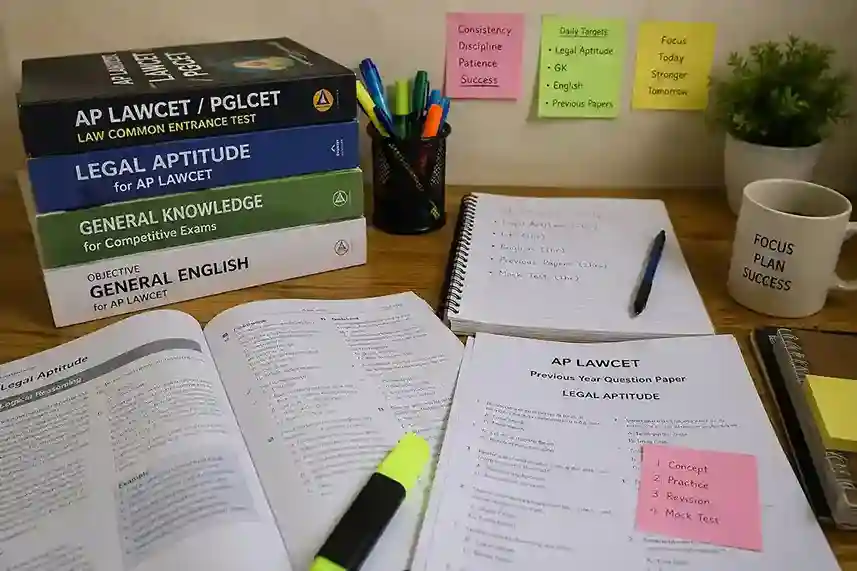
What Is AP LAWCET and Who Should Take It?
AP LAWCET stands for Andhra Pradesh Law Common Entrance Test. Acharya Nagarjuna University, Guntur, conducts the exam every year on behalf of the Andhra Pradesh State Council of Higher Education (APSCHE).
The exam decides admission to law degree programmes in government and private law colleges across Andhra Pradesh. Three types of five-year integrated programmes | BA LLB, B.Com LLB, and BBA LLB | and the standalone three-year LLB all use AP LAWCET scores for admission.
A separate but related exam, AP PGLCET, handles admissions for the two-year LLM (Master of Laws) programme. Both exams are run by the same body but have different syllabuses and question distributions.
If you want to study law in Andhra Pradesh | whether after Class 12 or after graduation | AP LAWCET is your entry point. Your rank in this exam determines which college and which course you get.
AP LAWCET Eligibility Criteria
The eligibility rules differ based on which programme you want to join. Read both carefully before applying.
For 5-Year Integrated BA LLB / B.Com LLB / BBA LLB
You must have passed Class 12 from a recognised board. Most colleges require a minimum of 45% in the qualifying exam. The difficulty level of the AP LAWCET question paper for this route is set at Class 12 level.
For 3-Year LLB
You must hold a bachelor's degree in any discipline from a recognised university. A minimum of 45% aggregate is the standard requirement for general category candidates. The question difficulty for this route is set at degree (undergraduate) level.
Age Limit
There is no upper age limit for law admissions in India. The Supreme Court clarified this in 2017. Career changers, working professionals, and older graduates can all apply without age restrictions.
Domicile
AP LAWCET is a state-level exam. Candidates must meet Andhra Pradesh domicile requirements as specified in the official APSCHE notification for each year. Local area reservations and category seats follow state government rules.
Distance education law degrees are not recognised for Bar Council of India enrolment. You must study in a regular full-time mode to qualify as an advocate. Keep this in mind when choosing between regular and distance-mode programmes.
AP LAWCET Exam Pattern: Sections, Marks, and Duration
The AP LAWCET question paper has 120 MCQ questions worth one mark each. The exam runs for 90 minutes. There is no negative marking, which means a wrong answer costs you nothing.
| Section | No. of Questions | Marks | Weightage |
|---|---|---|---|
| Part A | General Knowledge & Mental Ability | 30 | 30 | 25% |
| Part B | Current Affairs | 30 | 30 | 25% |
| Part C | Aptitude for the Study of Law | 60 | 60 | 50% |
| Total | 120 | 120 | 100% |
Qualifying Marks
| Category | Minimum Marks Required | Percentage |
|---|---|---|
| General / OBC / BC | 42 out of 120 | 35% |
| SC / ST | No minimum | Any score qualifies for ranking |
| AP PGLCET (LLM) | 30 out of 120 | 25% |
AP LAWCET does not penalise wrong answers. You should attempt every single question. Even guessing gives you a chance at earning one mark. Never leave a question blank.
AP LAWCET vs AP PGLCET: Key Differences
Both exams have 120 MCQs and run for 90 minutes. But the subject distribution is different. AP LAWCET covers General Knowledge, Current Affairs, and Legal Aptitude. AP PGLCET, which is for LLM admission, tests Jurisprudence, Constitutional Law, Public International Law, Mercantile Law, Labour Law, Crimes and Torts, and IPR. PGLCET is conducted in English only. LAWCET offers Telugu as an option.
AP LAWCET Syllabus 2026–27: Topic-by-Topic Breakdown
APSCHE releases the official AP LAWCET syllabus along with the annual notification on its website. The syllabus below reflects the current prescribed structure. The three sections and their topics are covered here in full.
Part A | General Knowledge and Mental Ability (30 Marks)
This section tests your awareness of the world and your ability to reason quickly. Questions come from static GK and basic reasoning. The difficulty level aligns with Class 12 for five-year programme aspirants and graduation level for three-year LLB aspirants.
General Knowledge Topics
Mental Ability Topics
The Indian Constitution appears in both Part A (GK) and Part C (Legal Aptitude). Time spent learning the Preamble, Fundamental Rights (Part III), Directive Principles (Part IV), and key amendments pays double dividends across both sections. Do not treat them separately.
Part B | Current Affairs (30 Marks)
Current Affairs tests your awareness of events from the past year. Questions focus on legally and socially relevant news | not sports scores or entertainment. This section changes completely each year, so static notes do not help. Only regular reading does.
Key Current Affairs Topics
For AP LAWCET 2026–27, understanding the three new criminal laws | Bharatiya Nyaya Sanhita (BNS), Bharatiya Nagarik Suraksha Sanhita (BNSS), and Bharatiya Sakshya Adhiniyam (BSA) | is especially important. These replaced the IPC, CrPC, and Indian Evidence Act in 2024 and are likely to appear in both the current affairs and legal aptitude sections.
Part C | Aptitude for the Study of Law (60 Marks)
This is the most important section. It carries 60 out of 120 marks | exactly half the paper. You cannot qualify without doing reasonably well here. Questions test your legal reasoning and basic knowledge of key Indian laws.
Indian Constitution
Criminal Law (BNS / IPC)
Law of Torts
Contract Law
Family Law
Legal Terms, Maxims, and Concepts
Other Legal Areas Tested
This section does not just ask you to state what the law is. Many questions give you a fact pattern and ask you to apply a legal principle to it. Read each question fully before answering. Understand the scenario first, then apply the rule. Avoid jumping to conclusions from keywords alone.
Study Material for AP LAWCET: Books, Notes, and Practice Tests
Good study material is the foundation of effective preparation. The right books cover the exact syllabus, use clear language, and include practice questions. Here is a subject-wise guide to trusted resources.
Books for General Knowledge and Mental Ability
One of the most widely used GK books for competitive exams in India. Covers Indian History, Geography, Economy, Polity, Science, and current affairs sections. Clear, concise language. Good for building a static GK base.
A revised annual edition covering current affairs alongside static general knowledge. Includes graphics, tables, and figures for better retention. The built-in current affairs section makes it useful for both Part A and Part B.
The standard reference for reasoning-based competitive exams across India. Covers analogies, series, classifications, alphabet tests, visual problems, and logical puzzles. Work through it chapter by chapter and solve every exercise.
Builds a strong base in verbal reasoning, especially for candidates who find logic questions challenging. Structured approach with progressive difficulty levels.
Books for Current Affairs
A monthly magazine that covers national and international events relevant to competitive exams. Includes legal news, government scheme updates, and judiciary developments. Read the edition published three to six months before your exam date.
A popular capsule-format book for competitive exam candidates. Summarises monthly events in a structured, exam-oriented way. Good for rapid revision in the last four weeks before the exam.
Books for Aptitude for the Study of Law
Specifically written for AP LAWCET aspirants. Covers the legal aptitude syllabus with explanations and previous year solved papers. Available at most bookstores in Andhra Pradesh. Recommended as the primary subject text for this section.
A workbook format that explains legal concepts and tests them through exercises. Works well for building the habit of applying principles to fact patterns rather than memorising definitions.
A regularly updated guide covering study material, previous year solved papers, and the latest exam patterns across multiple law entrance tests including AP LAWCET. Useful for broader coverage and cross-referencing.
The clearest, most accessible text on the Indian Constitution for entry-level law students. Explains each article in plain language with examples. This is worth reading even at the entrance exam stage.
Using Online Resources
APSCHE runs official online mock tests for AP LAWCET candidates. These tests use the same interface as the real exam. Taking them helps you get used to the CBT format and timer pressure. Attempt these before sitting for any third-party mock test.
Previous year question papers are among the best study tools available. Solving them shows you exactly how questions are framed, which topics repeat, and how legal reasoning scenarios are structured. Aim to solve at least five years of previous papers before exam day.
Month-by-Month Study Plan for AP LAWCET
A focused, structured study schedule makes the biggest difference in competitive exam preparation. Three months is a realistic timeframe if you study consistently. Here is a practical plan built around the actual weightage of each section.
| Month | Focus Areas | Weekly Tasks |
|---|---|---|
| Month 1 |
Indian Constitution (full) Contract Law Legal Maxims & Terms Static GK Base |
Read 2 chapters daily Make flashcards for legal maxims Solve 30 GK questions daily One reasoning practice set per week |
| Month 2 |
Criminal Law (BNS/IPC) Law of Torts Family Law Mental Ability intensive |
Apply-based practice questions daily Solve 1 full reasoning paper weekly Start reading daily newspaper First full mock test at end of Month 2 |
| Month 3 |
Current Affairs revision Legal Reasoning practice Previous Year Papers (5 years) Weak area focus |
Two full mock tests per week Analyse each mock in detail Revise legal maxims daily Final revision of Constitution notes |
You have 90 minutes for 120 questions. A sensible split: spend 20 minutes on Part A (GK and Mental Ability), 20 minutes on Part B (Current Affairs), and 50 minutes on Part C (Legal Aptitude). The legal aptitude section has 60 questions and includes reasoning-based passages that take longer to read. Budget your time before you begin.
Section-by-Section Preparation Tips
How to Prepare Part A: General Knowledge and Mental Ability
- 1Start with the Indian Constitution. It appears in both Part A and Part C. Cover it once and benefit twice across the paper.
- 2Build static GK through a reliable book. Do not try to memorise everything at once. Read and revise in cycles.
- 3Practice reasoning daily. Mental ability is a skill, not just knowledge. Consistent daily practice builds speed and accuracy faster than any other method.
- 4Make notes on new appointments, national symbols, and amendment history. These are frequently tested and easy to score on.
- 5Use flashcards for difficult facts. Review them every three to four days to move information into long-term memory.
How to Prepare Part B: Current Affairs
- 1Read a national newspaper every day. The Hindu and The Indian Express are strong choices for law-relevant coverage.
- 2Keep a small notebook for current affairs. Write down key events, dates, and names. Review it weekly.
- 3Focus on legal reforms, Supreme Court judgments, government policy, and international law developments. These topics connect directly with the legal aptitude section.
- 4Cover the last 12 months of events before the exam. In the final month, use a monthly current affairs capsule for rapid revision.
- 5Practise online current affairs quizzes. They simulate the MCQ format and help you recall events under time pressure.
How to Prepare Part C: Aptitude for the Study of Law
- 1Learn the principles of each legal area first, then practise applying them to factual scenarios. Understanding beats memorisation here.
- 2Master legal maxims. Make a dedicated list of commonly tested Latin phrases | their meaning and the legal context in which they apply.
- 3Focus your deepest study on the Indian Constitution, criminal law, torts, and contracts. These four areas contribute the largest share of questions.
- 4Read questions fully before answering. Many students lose marks by reacting to keywords instead of understanding the complete scenario presented.
- 5Solve case-based questions during practice. They train your brain to match facts to legal rules | which is exactly what the exam demands.
- 6Understand the new criminal laws (BNS, BNSS, BSA). These replaced the IPC, CrPC, and Evidence Act in 2024. Examiners are testing them now.
Mock Tests and Previous Year Papers: Your Most Important Study Tool
Most candidates who score well in AP LAWCET will tell you the same thing. Mock tests made the difference. Here is why they work | and how to use them properly.
Why Mock Tests Work
Reading and understanding concepts is necessary. But you also need to retrieve that knowledge under time pressure and in an MCQ format. That is a separate skill. Mock tests build it. They reveal which topics you actually understand versus which ones you only think you know.
The APSCHE official website offers free online mock tests. Take these first. They reflect the exact interface, navigation, and question format of the real exam. Familiarity with the interface prevents wasted time on exam day.
How to Use Previous Year Papers
Solve each paper in full, under real exam conditions. Set a 90-minute timer. Do not pause. Afterwards, review every question you got wrong | not just the ones you guessed. Understand why the correct answer is correct and why the wrong options are wrong.
Track which topics keep appearing. The Indian Constitution, criminal law basics, and contract law show up across multiple years. Certain legal maxims reappear almost every year. Previous papers tell you where to concentrate your final revision.
Building Your Mock Test Routine
In the first two months of preparation, focus on learning. Take one mock test at the end of each month to benchmark your progress. In the final month, increase to two or three mocks per week. Each mock should be followed by a thorough review session. A mock test you never review is a missed learning opportunity.
After each test, calculate your section-wise score. If your Legal Aptitude score is consistently below 35 out of 60, spend more time on that section. If Current Affairs is weak, increase your newspaper reading. Use mock data to direct your revision | not just your gut feeling.
Start with the section you find easiest. Build confidence and momentum early. Move to the harder sections with a clear mind and remaining time. Since there is no negative marking, answer all 120 questions before time runs out | even if some are educated guesses.
Common Mistakes in AP LAWCET Preparation
These are the patterns that cause otherwise prepared students to underperform. Recognising them early lets you avoid them.
Many students start studying topics without first understanding which section carries how many marks. Part C carries half the paper. Not knowing this leads to unbalanced preparation.
Some candidates focus only on definition-based questions and neglect application-based reasoning. AP LAWCET tests how you use legal principles, not just whether you know them.
Current affairs requires consistent daily reading over months. Starting current affairs preparation two weeks before the exam is not enough. Start from the very first day.
Reading notes and practising under exam conditions are completely different experiences. Students who skip mock tests are often surprised by the time pressure on exam day.
Legal aptitude questions require applying principles, not reciting them. Rote learning alone fails when the question changes the fact pattern slightly. Focus on understanding the rule and its purpose.
The BNS, BNSS, and BSA replaced the IPC, CrPC, and Evidence Act in July 2024. Studying only the old texts without bridging to the new laws risks losing marks on questions that test the updated framework.
Counselling, Admission, and What Comes Next
Clearing AP LAWCET is the first step. The admission process has more stages after your result.
Result and Rank Card
APSCHE announces the AP LAWCET result on the official website. Along with your marks, you receive a rank card. Your rank | not just your raw score | determines which colleges you can apply to. Category-wise rankings are published separately.
Counselling Process
APSCHE conducts centralised web counselling. You register, submit your preferences, and receive seat allotments based on your rank, category, and available seats. There are multiple counselling rounds. If you do not get your preferred college in Round 1, stay active for subsequent rounds.
Documents Required
Keep these ready before counselling begins: Hall ticket, rank card, Class 10 and 12 certificates, graduation certificate (for three-year LLB), category certificate (if applicable), domicile certificate, and passport-size photographs. Missing documents delay the admission process.
After Admission: What the Degree Involves
Once admitted, you enter a full-time law programme. The Bar Council of India regulates the curriculum. Core subjects, practical training through moot courts and internships, and the final All India Bar Examination (AIBE) after graduation are all part of the journey. Visit our Law Course Syllabus page for a detailed breakdown of what you will study after getting admission.
Several state government and private scholarship programmes support law students in Andhra Pradesh and neighbouring states. Eligible candidates should explore these early. Check our Law Scholarships page for updated opportunities available for the 2026–27 academic year.
Frequently Asked Questions About AP LAWCET
What is AP LAWCET and what programmes does it cover?
AP LAWCET is the Andhra Pradesh Law Common Entrance Test. Acharya Nagarjuna University conducts it on behalf of APSCHE. It grants admission to 3-year LLB and 5-year integrated BA LLB, B.Com LLB, and BBA LLB programmes in government and private law colleges across Andhra Pradesh.
How many questions and marks does AP LAWCET have?
AP LAWCET has 120 multiple-choice questions worth 120 marks in total. Each correct answer gets one mark. There is no negative marking for wrong or unanswered questions. The exam runs for 90 minutes in computer-based test (CBT) mode.
Which section of AP LAWCET carries the most marks?
Aptitude for the Study of Law (Part C) carries 60 out of 120 marks | exactly half the total. It is the most important section. General Knowledge and Mental Ability (Part A) and Current Affairs (Part B) each carry 30 marks.
What is the qualifying mark for AP LAWCET?
General category candidates must score at least 35% | which means 42 marks out of 120. SC and ST candidates do not have a minimum qualifying mark. Any score qualifies them for the ranking process. For AP PGLCET (LLM admission), the qualifying mark is 25%, which is 30 out of 120.
Is AP LAWCET conducted in Telugu?
Yes. AP LAWCET is available in both English and Telugu. Candidates choose their preferred language at the time of application. The AP PGLCET exam, which is for LLM admissions, is conducted in English only.
What are the new criminal laws I need to know for AP LAWCET?
Three new criminal laws replaced older acts and came into effect from July 1, 2024. Bharatiya Nyaya Sanhita (BNS) replaced the Indian Penal Code (IPC). Bharatiya Nagarik Suraksha Sanhita (BNSS) replaced the Code of Criminal Procedure (CrPC). Bharatiya Sakshya Adhiniyam (BSA) replaced the Indian Evidence Act, 1872. These are now testable in both the legal aptitude and current affairs sections.
What is the difference between AP LAWCET and TS LAWCET?
AP LAWCET is for law college admissions in Andhra Pradesh. TS LAWCET is the equivalent exam for Telangana. Both states were part of the undivided Andhra Pradesh before bifurcation in 2014. They now conduct separate state-level law entrance exams. Scores from one exam are not interchangeable for admissions in the other state.
How do I get the official AP LAWCET syllabus?
The official syllabus is available on the APSCHE official website at cets.apsche.ap.gov.in. It is released along with the annual AP LAWCET notification. Download the syllabus PDF from there and use it as your primary reference for what to study. Always cross-check against the official source before finalising your preparation plan.
How many law colleges accept AP LAWCET scores?
More than 20 law colleges in Andhra Pradesh accept AP LAWCET scores for admission. This includes government law colleges and private institutions. The exact list of participating colleges is published in the APSCHE notification and counselling brochure each year.
Start Here. Clear AP LAWCET. Build a Legal Career.
AP LAWCET is a manageable exam. The question paper is structured and predictable. The syllabus is defined. The pattern stays largely consistent from year to year.
What separates candidates who clear it from those who do not is consistent, focused preparation over three to four months. No shortcut replaces that.
Use the syllabus as your guide. Build your legal aptitude from the ground up | starting with the Constitution, then criminal law, torts, and contracts. Keep current with legal news. Practise daily. Take mock tests seriously. Review every mistake.
The exam tests your readiness for law school | not just your ability to memorise definitions. Develop the mindset of a law student: read carefully, reason logically, and apply rules to facts.
Every advocate, judge, and corporate lawyer in Andhra Pradesh once sat where you are sitting. They took the same exam. The syllabus you are studying today is the foundation of the legal career you are building.
Download the official AP LAWCET notification from the APSCHE website for exact exam dates and application deadlines. Then visit our Admissions Guide for a step-by-step walkthrough of the full process | from registration to counselling and seat allotment.