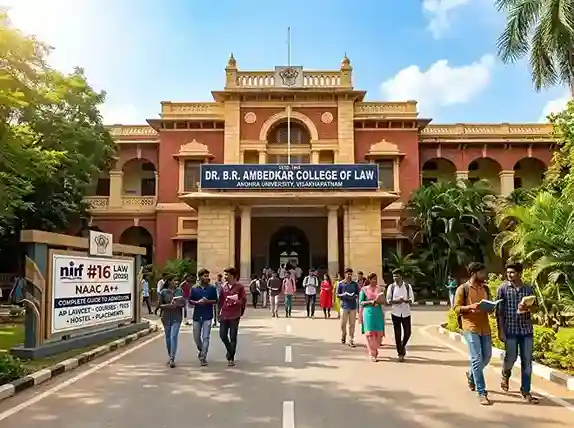
1. About the College | History & Institutional Context
The Dr. B.R. Ambedkar College of Law (DBRACL) is a constituent college of Andhra University | one of India's oldest and most accomplished universities, established in 1926 under the Andhra University Act. The College of Law itself was established in 1945, giving it over eight decades of legal education heritage. The college is named after Dr. Bhimrao Ramji Ambedkar | India's foremost jurist, the principal architect of the Constitution of India, and a towering figure in Indian legal and social history.
Andhra University occupies a magnificent 800+ acre campus in the Waltair area of Visakhapatnam | a naturally beautiful location between the Eastern Ghats and the Bay of Bengal. The campus houses over 60 departments across disciplines including science, humanities, engineering, and law. The University was accredited with the prestigious NAAC A++ grade | placing it among an elite tier of Indian universities. The College of Law sits as a constituent college within this sprawling, resource-rich university campus, giving law students access to inter-disciplinary facilities, a massive central library, sports facilities, and the broader university community.
DBRACL is approved by the Bar Council of India (BCI) and recognised by the University Grants Commission (UGC). Graduates from DBRACL can enrol with the State Bar Council of Andhra Pradesh, clear AIBE, and practise as advocates in any court in India. The college is particularly renowned for expertise in Constitutional Law, International Trade Law, and Business/Corporate Law | areas relevant to Visakhapatnam's growing port, industrial, and technology sectors.
DBRACL holds a special significance in Andhra Pradesh's legal ecosystem. The Andhra Pradesh High Court (which now has a bench in Amaravati following bifurcation, with the Visakhapatnam bench remaining active) provides DBRACL students with unparalleled access to High Court proceedings for internships, moot court observations, and advocacy training. The presence of a major port, steel plant (Rashtriya Ispat Nigam Ltd.), and growing IT sector in Visakhapatnam also means significant placement opportunities in corporate legal departments.
2. Courses Offered at Andhra University Law College
DBRACL offers four main programmes spanning undergraduate, postgraduate, and doctoral levels:
The flagship programme at DBRACL. The 3-year LLB is designed for graduates from any discipline who wish to pursue law as a second degree. Given the extraordinarily low total fee of ₹60,000 for three years (₹20,000 per year), this is one of the most affordable quality law degrees in India. The curriculum covers all major areas of substantive and procedural law across 6 semesters with practical training through moot court and internships.
The 5-year BA LLB (Hons.) is the integrated law programme for students entering directly from Class 12. It combines arts subjects | Political Science, Sociology, Economics, History | in the first two years with core law subjects from the third year onwards. Students who choose the BA LLB path spend five years building both a humanities foundation and comprehensive legal expertise, emerging with two concurrent degrees. The higher total fee (₹8.07 lakh) reflects the longer duration.
The LLM at DBRACL is a prestigious postgraduate programme attracting students from across Andhra Pradesh and Telangana. Specialisations reflect the faculty's areas of research excellence | Constitutional Law, Criminal Law, International Law and Trade, and Corporate and Commercial Law. Admission is through the AP PGLCET (Post Graduate Law Common Entrance Test). At approximately ₹45,000 per year, it remains extraordinarily affordable compared to private LLM programmes (₹3–6 lakh/yr at premium private institutions).
The PhD programme at DBRACL follows Andhra University's research framework. Research scholars work under the guidance of senior faculty members in designated areas of specialisation. The PhD programme has produced scholars who now serve as faculty at law schools across Andhra Pradesh and Telangana, as well as professionals in governmental and judicial roles. Admissions are conducted as per UGC guidelines for research programmes.
3. Admission Process 2026 | AP LAWCET & AP PGLCET
Admission to Dr. B.R. Ambedkar College of Law is primarily through state-level entrance examinations conducted by the Andhra Pradesh State Council of Higher Education (APSCHE). The process is entirely centralised | no separate college-level application or interview is required for UG or PG programmes.
LLB (3-Year) Admission | AP LAWCET 2026
| Step | Details | Timeline 2026 |
|---|---|---|
| 1. Eligibility Check | Graduation in any stream with minimum 45% aggregate (40% for SC/ST/PwD). Final year graduation students can apply provisionally. | Before applying |
| 2. AP LAWCET Registration | Register online at the official AP LAWCET portal. Pay application fee. Upload documents (marksheets, ID, photo). | March–April 2026 |
| 3. AP LAWCET Examination | Online exam with sections on General Knowledge, Mental Ability, and Legal Aptitude. No negative marking. | May 2026 (Conducted) |
| 4. Result Declaration | AP LAWCET rank card released on official portal. Check rank and category rank. | June–July 2026 |
| 5. Web Counselling Phase 1 | Online web-based centralised counselling through APSCHE. Enter options in preference order | include DBRACL Andhra University as a high-preference option. | September 2026 |
| 6. Seat Allotment & Reporting | Download allotment letter. Report to DBRACL with original certificates. Pay first-year fees. Complete enrolment formalities. | October 2026 |
BA LLB (5-Year) Admission | AP LAWCET (Integrated)
The 5-year BA LLB admission also uses AP LAWCET | but the integrated programme section. Class 12 students (minimum 45% marks) must apply for the 5-year integrated LLB entrance under AP LAWCET. Seats for BA LLB are fewer and competition is typically higher than for the 3-year LLB programme. Follow the same web counselling process, but select the appropriate integrated programme option during preference entry.
LLM Admission | AP PGLCET
The LLM at DBRACL uses AP PGLCET (Andhra Pradesh Post Graduate Law Common Entrance Test), a separate state-level test for postgraduate law programmes. LLB graduates with a minimum 55% aggregate (50% for SC/ST) are eligible. The AP PGLCET is conducted annually, with counselling following results. Specialisation preferences are submitted during web counselling | popular specialisations at DBRACL include Constitutional Law and International Trade Law.
4. AP LAWCET Cutoff 2025–26 | Category-Wise
The AP LAWCET cutoff for Dr. B.R. Ambedkar College of Law, Andhra University represents the last rank at which seats were allotted in each category during the counselling process. Based on the 2025 (for 2025–26 admission) data, the following cutoffs apply:
AP LAWCET Cutoff | 3-Year LLB Programme
| Category | AP LAWCET Cutoff Rank 2025 | Safe Target Rank (2026) | Approx. Score Needed |
|---|---|---|---|
| General (Unreserved) | ~90 | Within Top 90 | Score in top percentile |
| SC (Scheduled Caste) | ~149 | Within 150 | Competitive SC rank |
| ST (Scheduled Tribe) | ~708 | Within 750 | Good ST category rank |
| OBC / BC (Backward Classes) | ~100–200 (estimated) | Within 200 | Strong OBC rank |
| EWS (Economically Weaker Section) | Check official counselling portal | Varies by batch | Verify at official AP LAWCET portal |
AP LAWCET Cutoff | 5-Year BA LLB Programme
| Category | Cutoff Trend | Notes |
|---|---|---|
| General | More competitive than 3-yr LLB (fewer seats) | Top 50–70 expected |
| SC | Within top 100–150 | Check official portal |
| ST | More accessible for ST category | Verify at APSCHE |
5. Fee Structure 2026 | All Programmes
One of the most compelling aspects of DBRACL is its extraordinarily affordable fee structure compared to the quality of education offered. As a constituent college of a government university, fees are heavily subsidised:
| Programme | Annual Fee | Total Programme Fee | Additional Charges |
|---|---|---|---|
| LLB (3-Year) | ~₹20,000/yr | ₹60,000 (total) | Exam fee, library fee separately |
| BA LLB (5-Year) | ~₹1.5–1.8 lakh/yr (varies by year) | ₹8.07 lakh (total) | Arts component + law component fees included |
| LLM (1 Year) | ~₹45,000/yr | ~₹45,000–90,000 (1–2 yr) | Research/seminar fees separately |
| PhD in Law | As per AU norms | Varies by duration | Research fees + lab/library |
Fee Concessions & Scholarships
As a government institution under Andhra University, DBRACL students are eligible for multiple fee concessions and scholarship schemes:
| Scholarship / Concession | Beneficiary | Benefit |
|---|---|---|
| AP Fee Reimbursement Scheme | SC/ST/BC/EWS students from AP (family income < ₹2.5 lakh) | Full tuition fee reimbursed by Andhra Pradesh Government |
| Post-Matric Scholarship (Central Govt.) | SC/ST students; OBC students (separate) | Maintenance allowance + tuition fee support |
| Merit-cum-Means Scholarship | All category students; merit-based selection | Annual scholarship; amount varies |
| Disability Concession | PwD (Persons with Disabilities) | Fee waiver as per UGC and Andhra University norms |
| Andhra University Merit Scholarship | Top-ranked AU admission students | Partial tuition fee waiver |
6. Syllabus | Semester-Wise Subject Breakdown
The DBRACL curriculum follows the BCI-mandated core law syllabus with Andhra University's additional compulsory subjects and electives. The 3-year LLB (6 semesters) and 5-year BA LLB (10 semesters) share the law subjects from Year 3 onwards in the integrated programme. Below is the subject structure for the 3-year LLB:
📘 Year 1 | Foundation Year
📗 Year 2 | Procedural Laws & Specialised Subjects
📙 Year 3 | Advanced Law, Professional Skills & Electives
7. Faculty | Strength, Specialisations & Teaching Style
| Faculty Parameter | Details |
|---|---|
| Faculty-to-Student Ratio | Approximately 1:12 (one teacher for every 12 students) | among the best in AP law colleges |
| Faculty Designation Mix | Professors, Associate Professors, and Assistant Professors. Senior faculty members hold LL.M. and Ph.D. qualifications from Andhra University and other recognised universities. |
| Areas of Specialisation | Constitutional Law, Criminal Law, International Trade Law, Business/Corporate Law, Environmental Law, Intellectual Property Rights, Family Law |
| Guest Faculty & Practitioners | Regular guest lectures by retired High Court judges, sitting advocates, government counsels, and corporate lawyers | students benefit from practical insights alongside academic instruction |
| Teaching Style | Lecture-based with case discussions; Socratic questioning introduced in senior years. Moot court training compulsory from Year 1. Live sessions from retired HC and SC judges cited positively in student reviews. |
| Research Activity | Faculty publish in national law journals; Andhra University's broad research infrastructure supports interdisciplinary legal research |
Student reviews on verified platforms consistently rate faculty at DBRACL highly | 4.9 out of 5 for faculty quality based on aggregated student feedback. Comments highlight the accessibility of faculty for academic queries, the depth of knowledge particularly in constitutional and criminal law, and the regular exposure to practitioners through guest lectures. The 1:12 faculty-to-student ratio is notably favourable compared to most private law colleges where ratios can be 1:30 or worse.
8. Hostel & Campus Facilities
Andhra University's 800+ acre Waltair campus provides comprehensive residential and academic infrastructure for law students. DBRACL students have access to the university's full facility ecosystem | not just the law college-specific facilities.
9. Placements | Salary, Recruiters & Career Paths
DBRACL placements reflect the nature of a government law college in a mid-sized coastal city. The placement record is improving year-on-year but is not yet comparable to NLU-level placements. However, the extremely low fees make even modest placement outcomes deliver exceptional ROI.
| Placement Parameter | Data |
|---|---|
| Median Placement Package | ₹7.5 LPA (NIRF 2025 data) |
| Highest Package (Student Reviews) | ₹4.2 LPA (on-campus) |
| Lowest Package (Student Reviews) | ₹2.5 LPA (on-campus) |
| Companies Visiting (per year) | ~5 consistent campus recruiters annually |
| Placement Rating (LawGuru) | 4.2 / 5 |
| Common Career Tracks | Andhra HC bar, district courts, corporate legal departments, government legal service, UPSC, AP state judiciary |
Top Recruiting Companies & Sectors
Career Paths After DBRACL
10. Rankings & Accreditations | NIRF, NAAC, BCI
| Ranking / Accreditation | Year | Rank / Grade | Notes |
|---|---|---|---|
| NIRF | Law Category | 2025 | #16 (India) | Highest-ranked law college in Andhra Pradesh; above many private colleges and mid-tier NLUs |
| India Today Law Rankings | 2025 | #20 | Out of 76 institutions ranked nationally |
| NIRF Rankings | 2026 | #29 | National ranking; placed among top 30 |
| NAAC Accreditation (Andhra University) | Current | A++ | Highest NAAC grade; among India's elite accredited universities |
| BCI Recognition | Active | ✅ Approved | Degree valid for AIBE, State Bar Council enrolment, and legal practice |
| UGC Recognition | Active | ✅ Recognised u/s 2(f) & 12(B) | Eligible for UGC grants; degree recognised nationally |
11. Campus Life | Culture, Events & Student Activities
Campus life at DBRACL combines the intimacy of a law college community with access to the resources of a large central university. Student reviews consistently rate the academic atmosphere positively (4.5/5) and the social life as active (4.3/5).
Academic life at DBRACL is characterised by regular NSS (National Service Scheme) and NCC (National Cadet Corps) activities alongside core academic work. The college organises national law seminars, inviting retired High Court and Supreme Court judges for guest lectures | an experience students describe as one of the most valuable aspects of their education. Moot court competitions are taken seriously, with both internal rounds and inter-university competitions.
The student community is a mix of AP state students with a smaller number from neighbouring Telangana, Odisha, and Chhattisgarh. The diverse linguistic and cultural composition of the student body | enriched by Visakhapatnam's cosmopolitan character as a port city | creates a lively and inclusive campus environment. The university's annual cultural festivals and sports events involve law students alongside engineering, science, and arts students, creating a broader inter-disciplinary social experience.
Visakhapatnam city itself is a significant asset | known as the "Jewel of the East Coast" and "Vizag," it offers students a beautiful coastal city with beaches, hill stations (Araku Valley is accessible), growing IT and pharma sectors, and a high quality of life at lower costs than Chennai, Hyderabad, or Bengaluru. Students consistently mention the city as a major reason for choosing DBRACL.
12. Honest Pros & Cons | Is This College Right for You?
- NIRF #16 (2025) | only AP law college in national top 20; outranks many private colleges and NLUs
- NAAC A++ (Andhra University) | highest possible institutional accreditation
- Extraordinary affordability | ₹60,000 total for 3-year LLB; highest ROI of any top-ranked law college
- Government institution security | no arbitrary fee hikes; scholarship access for SC/ST/OBC/EWS
- Andhra HC access | Visakhapatnam bench provides internship & advocacy opportunities
- Strong faculty | 4.9/5 rating; 1:12 ratio; retired HC/SC judges as guest faculty
- University ecosystem | 800+ acre campus; 60+ departments; sports, library, cultural life
- Visakhapatnam advantage | port city legal ecosystem (maritime law, corporate, IT, pharma)
- BCI + UGC approved | degree valid nationwide for legal practice
- International Trade Law specialisation | unique strength given Visakhapatnam's port context
- On-campus placement limited | 5 companies/year; ₹2.5–4.2 LPA range; not comparable to NLUs
- Hostel food concerns | multiple student reviews note limited daily variety in mess
- Less national law firm exposure | Visakhapatnam location means less direct access to Delhi/Mumbai Tier-1 firm networks
- AP LAWCET competitive | Rank 90 (General) means strong entrance prep needed
- Limited international exposure compared to JGLS or SLS Pune
- Faculty vacancies | some reviews note occasional vacancies in junior faculty positions; affects consistency
- Infrastructure vs old NLUs | campus shared with entire AU; law-specific facilities are good but not dedicated like NLU campuses
13. Frequently Asked Questions | Andhra University Law College
The AP LAWCET 2025 cutoff rank for the 3-year LLB programme at Dr. B.R. Ambedkar College of Law, Andhra University was approximately Rank 90 for General category. SC cutoff was approximately Rank 149; ST cutoff was approximately Rank 708. For the 5-year BA LLB, cutoffs are more competitive. For 2026, aim for a rank within the top 90 (General) for LLB and top 50–70 for BA LLB to safely secure a seat. Official cutoff data is published on the AP LAWCET official portal after each round of web counselling.
The total fee for the 3-year LLB programme at Dr. B.R. Ambedkar College of Law, Andhra University is approximately ₹60,000 for the complete 3-year course (approximately ₹20,000 per year). For the 5-year BA LLB programme, the total fee is approximately ₹8.07 lakh. LLM costs approximately ₹45,000 per year. These are among the lowest fees for a NIRF-ranked (top 20) law institution anywhere in India. SC/ST and OBC students are eligible for the AP Fee Reimbursement Scheme, which can cover the full tuition fee.
Dr. B.R. Ambedkar College of Law, Andhra University is ranked #16 in the Law category in NIRF 2025 (released September 4, 2025). This makes it the highest-ranked law institution in Andhra Pradesh and one of the top 20 law colleges in India across all institution types. Andhra University itself holds the NAAC A++ accreditation | the highest NAAC grade available. In India Today Law Rankings 2025, the college is ranked #20.
Admission to DBRACL for LLB (3-year) and BA LLB (5-year) is through AP LAWCET (Andhra Pradesh Law Common Entrance Test), conducted by APSCHE. After AP LAWCET results, candidates participate in centralised web-based counselling at the official AP LAWCET portal. Seats are allotted based on rank, category, and preference order. For LLM admission, the process uses AP PGLCET. PhD admissions follow Andhra University's own research entrance test and interview. There is no separate college-level exam or interview for UG/PG admission.
According to NIRF 2025 data, the median placement package for DBRACL graduates is approximately ₹7.5 LPA. Student reviews indicate on-campus placements range from approximately ₹2.5 LPA to ₹4.2 LPA for direct campus recruitment, with approximately 5 companies visiting consistently each year. Recruiters include Tech Mahindra, Tata groups, Reliance, and Andhra Pradesh government legal departments. Many students self-place through the Andhra HC bar, district courts, or government legal service. Given the extremely low fees (₹60,000 total for LLB), even a ₹3 LPA placement delivers exceptional ROI | full cost recovered in approximately 2.5 months.
Yes. Andhra University provides hostel accommodation for law students through its campus residential system. Separate boys' and girls' hostels are available on the 800+ acre Waltair campus. Rooms accommodate 3–4 students. Registration is done through the college principal's office after admission | submit a demand draft plus required documents. Andhra-style meals are provided through the university mess. Student reviews rate hostel accommodation at approximately 4.0/5, with food receiving mixed reviews (good taste but limited daily variety). Apply early as allocation is subject to availability.
Yes | DBRACL is an excellent choice for students targeting the AP Judicial Services Examination (PCS-J). The college's strong curriculum in CPC, CrPC/BNSS, Evidence/BSA, Constitutional Law, and Civil Procedure directly aligns with the subjects tested in the AP Judicial Services exam. Regular interactions with retired High Court judges and access to the Andhra HC Visakhapatnam bench for observation and internships also provide practical exposure that strengthens judicial aspirants. The affordable fee structure allows students to invest their resources in judiciary exam coaching alongside their degree rather than on education loan repayments.