What is the AP LAWCET Syllabus?
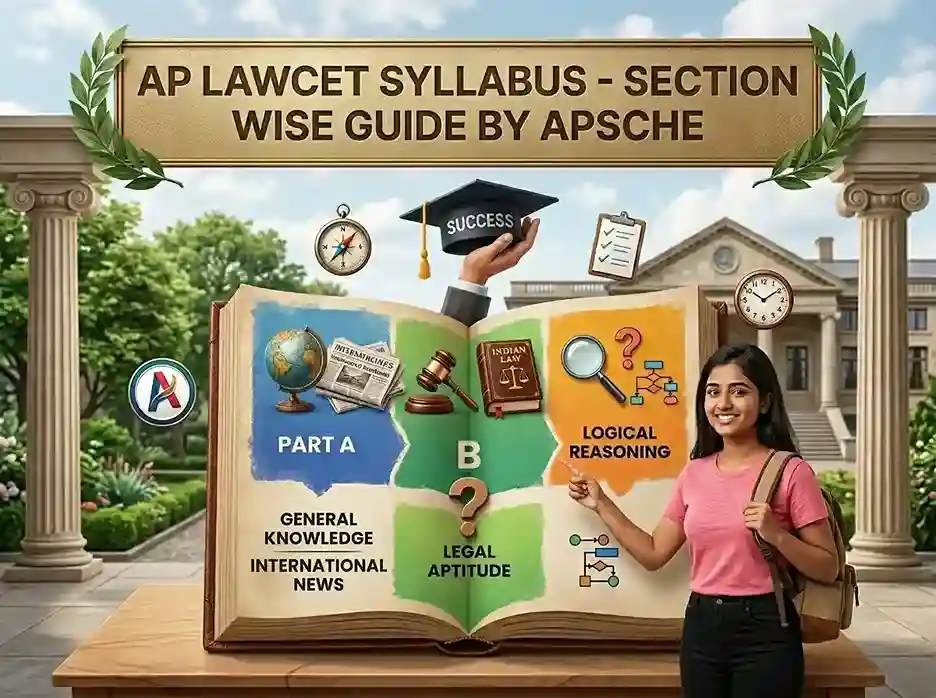
The AP LAWCET Syllabus 2026 is the official list of topics prescribed by the Andhra Pradesh State Council of Higher Education (APSCHE) for the Andhra Pradesh Law Common Entrance Test. It defines everything a candidate must study to earn admission into 3-year LLB and 5-year integrated LLB programmes at law colleges across Andhra Pradesh.
The syllabus is intentionally broad: it combines general awareness, analytical reasoning, current affairs awareness, and foundational legal knowledge. This approach ensures that only candidates with a well-rounded aptitude for legal studies | not just rote memorisers | qualify for admission to the state's law colleges.
Understanding the AP LAWCET syllabus in depth is the single most important step in your preparation strategy. Candidates who map their study schedule to the weightage of each section consistently outperform those who prepare without a syllabus-based plan.
AP LAWCET 2026 Exam Pattern at a Glance
Before diving into section-by-section topics, familiarise yourself with the overall exam structure:
| Section | Part | No. of Questions | Marks | Difficulty Level |
|---|---|---|---|---|
| General Knowledge & Mental Ability | Part A | 30 | 30 | Intermediate / Graduation |
| Current Affairs | Part B | 30 | 30 | Intermediate / Graduation |
| Aptitude for the Study of Law | Part C | 60 | 60 | Intermediate / Graduation |
| Total | – | 120 | 120 | 90 minutes |
Section-wise Marks Weightage
Visual breakdown of how marks are distributed across the three sections:
Part C (Aptitude for the Study of Law) accounts for 50% of the total score. Allocate at least half of your total preparation time to this section. However, do not ignore Parts A and B | a single mark can separate ranks in this competitive exam.
Detailed Section-wise AP LAWCET Syllabus 2026
Below is the complete, topic-by-topic breakdown of each section as prescribed by APSCHE:
This section evaluates a candidate's general awareness and logical/analytical reasoning abilities. Questions cover historical, geographical, political, scientific, and economic topics alongside mental ability puzzles.
General Knowledge Topics
- History of India & Indian National Movement
- Indian Polity & Governance
- Indian Geography & Physical Features
- Indian Economy & Economic Development
- Science & Technology Basics
- Environment & Ecology
- Art, Culture & Literature of India
- Sports & Awards (National & International)
- Famous Personalities & Landmark Events
- Constitutional Amendments Overview
Mental Ability Topics
- Number Series & Analogies
- Coding-Decoding
- Direction Sense
- Blood Relations
- Logical Venn Diagrams
- Syllogisms
- Clocks & Calendars
- Statement & Conclusions
- Data Interpretation (Basic)
- Odd One Out / Classification
This section tests how well candidates track recent events in India and globally, with special emphasis on legal and constitutional developments, government policies, and significant judicial pronouncements.
- Recent Supreme Court & High Court Judgements (last 12–18 months)
- New Laws, Ordinances & Legislative Developments
- Central & State Government Schemes & Policies
- National & International Political Developments
- Economic Events | Union Budget highlights, RBI policy changes
- Sports Events | National & International Championships
- Science & Technology | Recent Discoveries, Space Missions (ISRO)
- Environmental & Climate Change Developments
- Awards, Honours & Recognitions (National & International)
- Bilateral Relations, Treaties & International Summits
- Andhra Pradesh State Current Affairs
- Appointments | Governors, CJI, Cabinet Ministers, CEOs of PSUs
This is the most critical section, carrying 50% of the total marks. It tests candidates' understanding of legal principles, constitutional provisions, landmark judgements, and their ability to apply legal reasoning to factual situations. The official AP LAWCET instruction booklet confirms questions are at an elementary legal level.
- Schools of Jurisprudence (Natural Law, Positivism, Sociological)
- Sources of Law | Legislation, Custom, Precedent
- Rights & Duties | Concepts & Classification
- Ownership and Possession
- Legal Persons & Personality
- Obligation, Property & Liability
- Legal Sanctions
- Salmond's & Austin's Theory of Law
- Nature & Features of the Indian Constitution
- Preamble & Basic Structure Doctrine
- Fundamental Rights (Arts. 12–35)
- Directive Principles of State Policy (Arts. 36–51)
- Fundamental Duties
- Executive: President, PM & Council of Ministers
- Parliament: Lok Sabha & Rajya Sabha
- Judiciary: SC, HC, Independence of Judiciary
- Centre–State Relations (Legislative, Administrative, Financial)
- Emergency Provisions (Arts. 352, 356, 360)
- Constitutional Amendments | Key Amendments
- Writ Jurisdiction (Habeas Corpus, Mandamus, etc.)
- Indian Contract Act, 1872 | Essential Elements
- Offer, Acceptance & Consideration
- Capacity to Contract
- Free Consent | Coercion, Undue Influence, Fraud
- Void, Voidable & Illegal Contracts
- Performance & Breach of Contract
- Law of Torts | General Principles
- Negligence, Nuisance & Defamation
- Strict & Absolute Liability (Rylands v. Fletcher; M.C. Mehta case)
- Remoteness of Damage
- Indian Penal Code, 1860 | General Principles
- Bharatiya Nyaya Sanhita (BNS), 2023
- General Exceptions (Chapters IV & V IPC)
- Offences Against the State & Public Tranquillity
- Offences Against Person | Murder, Culpable Homicide, Assault
- Offences Against Property | Theft, Extortion, Robbery
- Criminal Procedure | Arrest, Bail, Trial Procedure (BNSS, 2023)
- Evidence | Indian Evidence Act / BSA, 2023 Basics
- Industrial Disputes Act, 1947 | Key Provisions
- Factories Act & Minimum Wages Act
- Hindu Law | Sources, Marriage & Divorce (Hindu Marriage Act)
- Muslim Personal Law | Marriage, Mehr, Divorce
- Succession | Hindu Succession Act, 1956
- Domestic Violence Act, 2005
- Copyright Act, 1957 | Key Provisions
- Patents Act, 2005 | Patentability & Rights
- Environmental Protection Act, 1986
- Protection of Human Rights Act, 1993
- Information Technology Act, 2000 (Salient Features)
- Right to Information Act, 2005
- Consumer Protection Act, 2019
- Research Methodology (Definition & Kinds)
- Latin Legal Maxims (Audi alteram partem, Nemo judex in sua causa, etc.)
- Legal Terminology & Definitions
- Comprehension of Legal Passages
- Principle-Application Questions
- Analytical Reasoning on Legal Facts
- Landmark Supreme Court Cases
APSCHE does not release a detailed official syllabus document for Parts A and B. The topics listed above are drawn from the official instruction booklet, previous years' question papers, and guidelines issued by the conducting university. Part C (Legal Aptitude) has an outline in the official notification focusing on constitutional law, contracts, torts, criminal law, labour law, and IPR.
AP PGLCET (LLM) Syllabus | A Quick Note
The AP PGLCET is the postgraduate counterpart conducted alongside AP LAWCET for admission to LLM programmes. Its syllabus is significantly more detailed and technical, covering subjects like Constitutional Law (advanced), Administrative Law, International Law, and Procedural Law. If you are preparing for LLM admission, refer to the separate AP PGLCET syllabus page.
Section-wise Preparation Strategy for AP LAWCET 2026
A structured approach tailored to the AP LAWCET syllabus is more effective than generic law preparation. Here is a proven strategy for each section:
📚 Part A: GK & Mental Ability
Use NCERT textbooks (Classes 9–12) for History, Geography, Polity, and Economics. Solve at least 30 reasoning questions daily from Arihant or RS Aggarwal. Devote 45–60 minutes per day.
📰 Part B: Current Affairs
Read The Hindu or Indian Express daily. Maintain a current affairs notebook. Subscribe to monthly current affairs PDFs. Pay special attention to legal developments, SC judgements, and AP state news.
⚖️ Part C: Legal Aptitude
Start with the Indian Constitution. Read bare acts alongside standard law books. Solve previous year question papers section-wise. Focus on principle-based application questions | these test reasoning, not memory.
🕐 Time Management in Exam
90 minutes for 120 questions = 45 seconds per question. Spend ~20 min on Part A, ~18 min on Part B, and ~52 min on Part C. Do not leave any question unanswered | no negative marking.
Study Plan: 3-Month AP LAWCET Preparation Schedule
| Month | Focus Area | Daily Hours | Key Activity |
|---|---|---|---|
| Month 1 | Constitutional Law & GK Foundation | 4–5 hrs | Read Constitution & NCERT books; start current affairs habit |
| Month 2 | Contracts, Torts, Criminal Law & Mental Ability | 5–6 hrs | Bare acts study; daily reasoning practice; mock tests begin |
| Month 3 | Revision, Mock Tests & Current Affairs Catch-up | 6 hrs | 2 full-length mock tests weekly; revise legal maxims & GK |
Best Books for AP LAWCET Preparation
These books are specifically recommended based on the AP LAWCET syllabus structure:
AP LAWCET vs TS LAWCET Syllabus: Key Differences
Many students from the combined AP–Telangana region appear for both exams. Here is a quick comparison to help you prepare for both:
| Parameter | AP LAWCET | TS LAWCET |
|---|---|---|
| Conducting Body | SPMV Tirupati / APSCHE | Osmania University / TSCHE |
| Total Questions | 120 | 120 |
| Sections | GK & Mental Ability, Current Affairs, Legal Aptitude | General Knowledge, Current Affairs, Legal Aptitude |
| Legal Aptitude Qs | 60 | 60 |
| Duration | 90 minutes | 90 minutes |
| Negative Marking | None | None |
| Language | English & Telugu | English & Telugu |
| State Focus | Andhra Pradesh | Telangana |
Frequently Asked Questions (FAQs)
Conclusion: Making the Most of the AP LAWCET Syllabus
The AP LAWCET syllabus is your roadmap to securing a seat in one of Andhra Pradesh's premier law colleges. With 120 questions spread across three clearly defined sections, the exam rewards candidates who combine foundational legal knowledge, analytical reasoning, and current awareness.
Part C – Aptitude for the Study of Law demands the deepest preparation, but do not underestimate the 60 marks available from Parts A and B. A candidate who scores 85+ in Part C but ignores Parts A and B will still lose rank to a well-rounded competitor.
Use this syllabus guide to build your study schedule, map out the topics, and track your coverage. Combine it with previous year question papers, standard reference books, and regular mock tests. Success in AP LAWCET opens the door to some of Andhra Pradesh's finest law institutions | a strong start to a promising legal career.
Sources: APSCHE Official Notification, Sri Padmavati Mahila Visvavidyalayam (SPMV), IndCareer AP LAWCET 2026 Syllabus, AglaSem Admissions, PW Live Law, Testbook.com. Last reviewed: May 2026.