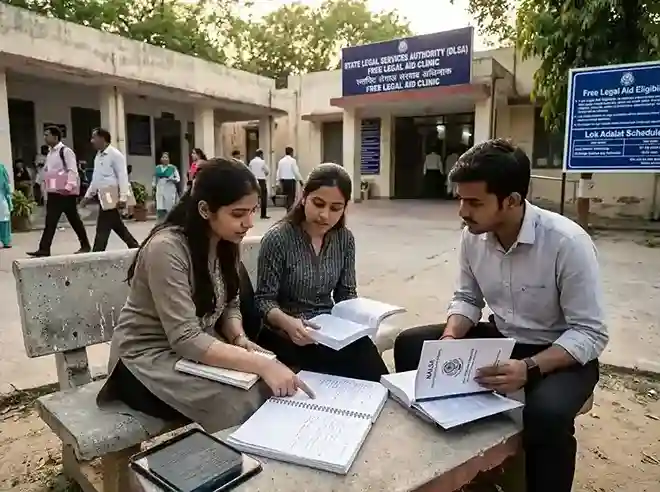
Legal Aid | Government Exams 2026NALSA | DLSA | SLSA | Lok AdalatUpdated: May 2026
Legal Aid Government Exams 2026 | NALSA Jobs, DLSA Recruitment, Free Legal Aid Eligibility, Lok Adalat & UPSC GS2 Notes
India's legal aid ecosystem | built on Article 39A of the Constitution and operationalised by the Legal Services Authorities Act, 1987 | offers a wide spectrum of government career opportunities and is one of the most frequently tested topics in UPSC GS2 and state PCS exams. This complete guide covers NALSA structure, DLSA/SLSA recruitment, all eligibility categories, Lok Adalat mechanism, landmark judgments, and step-by-step job application guidance.
1987
Legal Services Authorities Act
Article 39A
Constitutional Mandate (DPSP)
664+
DLSAs Across India
15100
NALSA National Helpline
₹5 Lakh
Income Limit (SC Level)
📅 Updated: May 27, 2026 | Legal Aid Government Exams Guide | India 2026
✍️ By Priya Kumari, LLM NALSAR | Senior Law Education Editor
📊 Data: Legal Services Authorities Act 1987, NALSA Official Website, Ministry of Law & Justice, NAAC
Legal Aid in India 2026 | NALSA structure, DLSA/SLSA recruitment, free legal aid eligibility, Lok Adalats, Article 39A | LawGuru India
⚡ Quick Answer: Legal Aid in India | What You Need to Know
Legal Aid in India is the constitutional right of every citizen to receive free legal services, guaranteed under Article 39A (DPSP, 42nd Amendment 1976) and implemented through the Legal Services Authorities Act, 1987. The apex body is NALSA (National Legal Services Authority), headed by the Chief Justice of India. Free legal aid covers advocate fees, court fees, and document preparation | from trial courts to the Supreme Court. Persons eligible include SC/ST, women, children, undertrials, persons with disabilities, and those with income below ₹1 lakh (state courts) or ₹5 lakh (Supreme Court). Government jobs in legal aid span NALSA, SLSAs, DLSAs, and Legal Aid Defence Counsel offices.
📜 Article 39A | Constitutional Basis🏛 NALSA | Apex Legal Aid Body⚖️ Lok Adalat | ADR Mechanism💼 664+ DLSAs Across India
1. Constitutional Basis of Legal Aid | Article 39A Explained
India's legal aid framework is rooted in the Constitution of India | specifically in the Directive Principles of State Policy, which impose a constitutional obligation on the State to make legal assistance accessible to every citizen regardless of economic status.
📜 Article 39A | Equal Justice and Free Legal Aid (DPSP)
Article 39A was inserted into the Constitution of India by the 42nd Constitutional Amendment Act, 1976. It reads: "The State shall secure that the operation of the legal system promotes justice, on a basis of equal opportunity, and shall, in particular, provide free legal aid, by suitable legislation or schemes or in any other way, to ensure that opportunities for securing justice are not denied to any citizen by reason of economic or other disabilities."
This provision recognises that justice cannot be merely theoretical | a person who cannot afford a lawyer is effectively denied access to justice even if the law is theoretically on their side. Article 39A mandates the State to eliminate this gap between formal legal rights and practical access to courts.
📜 Article 21 | Right to Life and Legal Aid
The Supreme Court of India in the landmark Hussainara Khatoon v State of Bihar (1979) held that the right to free legal aid for an accused person unable to afford counsel is an essential element of Article 21 (Right to Life and Personal Liberty). This made free legal aid a fundamental right | not merely a directive principle | in the context of criminal proceedings where life or liberty is at stake. The Court held that a trial conducted without providing legal aid to an indigent accused is invalid. This judgment transformed legal aid from a state charity into a state obligation.
🔑 Key Constitutional Provisions on Legal Aid
Article 14: Equality before law | the basis for equal access to legal processes Article 21: Right to Life | includes right to fair trial and legal representation (Hussainara Khatoon) Article 22(1): Right to be represented by a lawyer of one's choice upon arrest Article 39A: Directive Principle | State shall provide free legal aid (42nd Amendment, 1976) Article 142: Supreme Court's power to pass any order necessary for complete justice | invoked in several legal aid contexts
2. Legal Services Authorities Act, 1987 | The Statutory Framework
To give concrete form to Article 39A's mandate, Parliament enacted the Legal Services Authorities Act, 1987. The Act was passed in 1987 but came into force on November 9, 1995 following amendments in 1994 that restructured its institutional architecture.
Feature
Details
Full Name
Legal Services Authorities Act, 1987
Enacted by
Parliament of India
Came Into Force
November 9, 1995 (after 1994 amendment)
Constitutional Basis
Article 39A (DPSP) of the Constitution
Apex Body Created
National Legal Services Authority (NALSA)
Key Sections
Section 12 (eligibility), Section 13 (right to services), Section 22A–22D (Permanent Lok Adalat)
Administered By
Ministry of Law & Justice, Government of India
National Legal Services Day
November 9 (commemorating the Act coming into force)
Free legal services to weaker sections + organisation of Lok Adalats
The Act creates a three-pronged mandate for legal services institutions: (1) providing free and competent legal services to eligible persons; (2) organising Lok Adalats for expeditious and amicable dispute resolution; and (3) undertaking preventive and strategic legal aid programmes | including legal awareness, legal literacy, and social action litigation. The Act has been amended multiple times to strengthen the Permanent Lok Adalat mechanism for public utility service disputes (Section 22A–22D), to add new categories of beneficiaries, and to enhance the income eligibility ceilings.
3. NALSA Structure | The Five-Tier Legal Aid Hierarchy
The Legal Services Authorities Act creates a five-tier institutional hierarchy to deliver legal aid across all levels of the Indian justice system | from the Supreme Court down to the taluk (sub-divisional) level:
National Legal Services Authority (NALSA) Apex Body
Patron-in-Chief: Chief Justice of IndiaExecutive Chairman: Second Senior-Most SC JudgeEstablished: November 9, 1995Headquarters: Jaisalmer House, 26 Man Singh Road, New Delhi
NALSA is the apex body for implementing and monitoring the legal aid programme across India. It sets the national policy direction, allocates funds to State Legal Services Authorities, issues regulations and guidelines (such as the NALSA Free and Competent Legal Services Regulations 2010), and undertakes nationwide legal literacy campaigns and Lok Adalat programmes. The Supreme Court Legal Services Committee functions alongside NALSA for Supreme Court-level legal aid. NALSA's national helpline is 15100.
Supreme Court Legal Services Committee SC Level
Section 3A of the ActFor Cases Before the Supreme CourtIncome Limit: Annual Income < ₹5 Lakh
The Supreme Court Legal Services Committee is constituted under Section 3A of the Legal Services Authorities Act, 1987 to provide free legal services to eligible persons in cases before the Supreme Court of India. The income ceiling for this Committee is higher than state-level thresholds | persons with annual income below ₹5 lakh are eligible for SC-level legal aid. Dedicated panel advocates are maintained at the Supreme Court for this purpose.
State Legal Services Authority (SLSA) State Level
One in Every State / UTPatron-in-Chief: Chief Justice of the High CourtExecutive Chairman: Senior HC Judge (nominated)Section 6 of the Act
State Legal Services Authorities (SLSAs) are constituted in every state and Union Territory under Section 6 of the Act. The Chief Justice of the respective High Court is the Patron-in-Chief, and a serving or retired High Court Judge is the Executive Chairman. The SLSA implements NALSA's policies at the state level, conducts state-level Lok Adalats, allocates funds to DLSAs, and manages state-level legal aid programmes. Each state has its own SLSA | e.g., MPSLSA (Madhya Pradesh), KSLSA (Karnataka), DSLSA (Delhi).
High Court Legal Services Committee (HCLSC) HC Level
One in Every High CourtFor Cases Before the High CourtSection 8A of the Act
The High Court Legal Services Committee is constituted for each High Court under Section 8A of the Act to provide free legal services to eligible persons in cases pending before the High Court. It is chaired by a sitting High Court Judge nominated by the Chief Justice and manages a panel of Senior Advocates and advocates empanelled for High Court-level legal aid. The HCLSC also organises High Court-level Lok Adalats.
District Legal Services Authority (DLSA) District Level
664+ DLSAs Across India (2024)Chairman: District & Sessions JudgeSecretary: Civil Judge (Judicial Officer)Section 9 of the Act
District Legal Services Authorities (DLSAs) are the workhorses of the legal aid delivery system | the level where most citizens actually receive free legal aid. The DLSA is headed by the District and Sessions Judge and has a Civil Judge as its Secretary. The DLSA office is typically located in the district court complex. DLSAs process legal aid applications, maintain a panel of advocate-volunteers, organise district-level Lok Adalats, manage Legal Aid Defence Counsel offices, and run legal aid clinics. As of 2024, there are 664+ DLSAs constituted across India, though DLSAs are yet to be established in some judicial districts of states including Tripura, West Bengal, Telangana, Chhattisgarh, Gujarat, and Uttar Pradesh.
254+ Taluk/Sub-Divisional Committees (2024)Sections 11A & 11B of the ActThe "Last Mile" of Legal Aid Delivery
Taluk Legal Services Committees (TLSCs) are constituted by the State Authority for each Taluk or Mandal (sub-district) under Sections 11A and 11B of the Act. They represent the cutting edge of legal aid delivery | bringing legal services directly to the village and sub-district level. TLSCs are chaired by senior Civil Judges or CJMs at the taluk level. Para-Legal Volunteers (PLVs), who are trained community members, work primarily at the TLSC level to create legal awareness and connect citizens to DLSAs. As of 2024, approximately 254 sub-divisional/taluka legal services committees have been constituted across India.
4. Who Can Get Free Legal Aid? | Section 12 of the Legal Services Authorities Act
Section 12 of the Legal Services Authorities Act, 1987 defines the specific categories of persons entitled to receive free legal aid. The list covers a broad spectrum of India's most vulnerable and marginalised populations. Importantly, there is no bar on the type of case | all kinds of cases are eligible as long as the person satisfies Section 12 and the Legal Services Authority is satisfied that the case is genuine.
1
Members of Scheduled Castes (SC) and Scheduled Tribes (ST)
Any person who is a member of a Scheduled Caste or Scheduled Tribe as defined under the Constitution of India is automatically entitled to free legal aid | regardless of their income level. This is an absolute right and no income test applies. The legal services institution cannot deny free legal aid to an SC/ST person on the grounds of income.
2
Victims of Trafficking in Human Beings or Begar (Forced Labour)
Persons who are victims of trafficking in human beings | including women and children trafficked for sexual exploitation, domestic servitude, or bonded labour | and persons subjected to begar (forced/unpaid labour) are entitled to free legal aid. This category reflects the Legislature's recognition that trafficking victims are often unable to seek legal redress without external assistance.
3
Women and Children
All women and children | regardless of income | are entitled to free legal aid in matters relating to their rights or welfare. This is a broad category that covers women facing domestic violence, divorce proceedings, maintenance claims, custody disputes, property rights, workplace harassment, and criminal matters where they are complainants. Children are entitled for any matter affecting their rights or interests | custody, adoption, welfare, or criminal proceedings where a minor is an accused.
4
Persons with Disabilities (Mental or Physical)
Persons with any mental or physical disability | including those with visual impairment, hearing impairment, locomotor disability, intellectual disability, or psychiatric conditions | are entitled to free legal aid without an income test. This includes persons in psychiatric hospitals or nursing homes under the Mental Health Act.
5
Persons in Custody (Undertrials and Convicts)
Any person in custody | including undertrials in jail, persons in remand homes, detention centres, or police custody | is entitled to free legal aid. This is directly connected to Article 21 (right to fair trial). The Hussainara Khatoon case highlighted that thousands of undertrial prisoners in Bihar were languishing in jail beyond the maximum sentence for their alleged offence simply because they had no lawyer | a violation of their fundamental rights that was directly addressed by expanding legal aid to all persons in custody.
6
Persons Affected by Mass Disaster, Violence, or Atrocity
Persons affected by mass disasters (flood, drought, earthquake, epidemic, industrial disaster), ethnic violence, communal riots, caste atrocities, or any similar situation of large-scale victimisation are entitled to free legal aid. This category ensures that victims of events that overwhelm individual legal coping capacity | natural disasters, communal riots, caste violence | receive legal assistance for compensation claims, FIRs, and rehabilitation entitlements.
7
Industrial Workmen
Industrial workmen | persons employed in factories, mines, plantations, construction, and other organised sector industries | are entitled to free legal aid in matters arising from their employment, including disputes about wages, wrongful termination, working conditions, occupational safety, and industrial injury compensation.
8
Persons Below the Prescribed Income Limit
Persons whose annual income is below the prescribed limit are entitled to free legal aid regardless of other criteria. The income thresholds are: For cases before courts other than the Supreme Court | annual income less than the limit prescribed by the respective State Government (typically ₹1 lakh for most states, though states may prescribe a higher amount). For cases before the Supreme Court | annual income less than ₹5 lakh. The income ceiling limit varies across states and UTs | always check the specific state's legal services regulations. An affidavit of income may be required under Section 13(2) of the Act.
9
Senior Citizens
Senior citizens' eligibility depends on state-specific rules. In Delhi, for example, senior citizens are eligible for free legal aid subject to a prescribed income ceiling of ₹4 lakh per annum. Any individual above the age of 60 can apply. Always check the state-specific regulation as it varies.
💡 Important: Free Legal Aid is NOT Limited to Court Cases
Free legal services under the Act include: (a) legal advice and consultation; (b) representation before courts, tribunals, arbitrators, and authorities; (c) payment of court fees, process fees, and all legal costs; (d) preparation, drafting, and filing of legal documents; (e) obtaining certified copies of court orders and documents; (f) access to benefits under government schemes and welfare legislation. A person who does not qualify under Section 12 can still receive free legal advice (as distinct from representation) from the legal services institution.
5. What Does Free Legal Aid Cover?
One of the most common misconceptions about free legal aid is that it only covers court representation. In reality, the scope is far broader:
⚖️ Scope of Free Legal Services | What Is Included
Legal Advice & Consultation: Legal advice on any legal matter | before a case is filed, during proceedings, or for understanding one's rights under any statute or government scheme.
Court/Tribunal Representation: Assignment of a qualified advocate to represent the eligible person before any court or tribunal | from the Munsiff Court or Magistrate's Court all the way up to the Supreme Court of India.
All Court Fees & Process Fees: The legal aid institution pays all court fees, process fees, and other charges associated with filing and pursuing the case | the beneficiary pays nothing.
Document Preparation & Drafting: Drafting of plaints, written statements, petitions, applications, affidavits, bail applications, appeals, and any other legal document required in the proceedings.
Certified Copies: Obtaining certified copies of court orders, judgments, FIR copies, and other official documents required for the case.
Appeals & Revision Petitions: Filing of appeals against adverse orders | at every level from the trial court to the High Court and Supreme Court.
Access to Government Scheme Benefits: Assistance in accessing entitlements under Central and State government welfare schemes, poverty alleviation programmes, and social security legislation.
Lok Adalat Participation: Representation in pre-litigation Lok Adalat proceedings for amicable settlement of disputes without formal court filing.
6. How to Apply for Free Legal Aid | Step-by-Step
1
Identify the Appropriate Legal Services Authority
Determine which legal services institution to approach based on where your case is filed or will be filed: for Supreme Court matters, approach the Supreme Court Legal Services Committee; for High Court matters, approach the High Court Legal Services Committee (HCLSC); for district court and below, approach the nearest District Legal Services Authority (DLSA). The DLSA office is almost always located in the district court complex. For pre-litigation advice, you can also approach the nearest Taluk Legal Services Committee or the NALSA legal aid clinic if one is operational in your area. The NALSA helpline (15100) can also direct you to the right institution.
2
Obtain and Fill the Legal Aid Application Form
Application forms for free legal aid are available free of cost at all DLSA/SLSA/HCLSC offices, and most state legal services authorities also make them available for download on their official websites. The form requires: applicant's name, address, contact details, nature of legal problem or case details (brief description), the court or authority where the matter is pending or will be filed, the category under Section 12 under which you qualify (e.g., SC/ST, woman, undertrial, income below limit), and income details (annual income and occupation). There is no fee for submitting the application.
3
Submit an Income Affidavit (If Applying on Income Grounds)
If you are applying for free legal aid under Section 12(h) | on the grounds that your annual income is below the prescribed limit | you must submit an affidavit before a Notary or Magistrate stating your annual income and the sources of income. Under Section 13(2) of the Legal Services Authorities Act, 1987, this affidavit is treated as sufficient proof of income. The legal services authority cannot require additional documentation beyond what Section 13 prescribes. For persons applying on grounds other than income (e.g., SC/ST, women, undertrials), a caste certificate, gender identification, or custody record serves as the eligibility document.
4
Eligibility Verification by the Legal Services Authority
The DLSA (or relevant authority) verifies your eligibility under Section 12 and assesses whether the case is genuine | i.e., whether there is a reasonable ground for prosecution or defence. The authority has the power to reject applications where the case is found to be frivolous, vexatious, or where the applicant does not qualify under Section 12. The verification process is typically completed quickly | most DLSAs aim to dispose of legal aid applications within a few days of submission.
5
Advocate Assignment and Commencement of Representation
Upon approval, the DLSA assigns a panel advocate to represent you. Under the NALSA (Free and Competent Legal Services) Regulations, 2010, you have the right to request a change of advocate if you are dissatisfied | though the legal services authority must approve such a change. The panel advocate is paid by the DLSA from the Legal Aid Fund and provides the same quality of legal services that a fee-paid advocate would. All subsequent court appearances, document filings, and legal work in your case are conducted by the assigned advocate at no cost to you.
6
Online Route | Tele-Law & NALSA Portal
Citizens can also access free legal aid online through two channels: (a) Tele-Law Service | facilitated through Common Service Centres (CSCs) located in Gram Panchayats across India. Beneficiaries can access free legal advice from empanelled lawyers via video conferencing at their nearest CSC. This was a game-changing initiative for rural citizens who cannot travel to DLSA offices. (b) NALSA Portal (nalsa.gov.in) | allows online submission of legal aid applications and access to legal services information. State authority websites also have online application portals. Contact NALSA's national helpline 15100 for guidance on the online application process.
7. Lok Adalat | Mechanism, Types & Significance
The Lok Adalat (People's Court) is one of the most significant alternative dispute resolution mechanisms in Indian legal history | and a central pillar of NALSA's mandate. It is governed by Chapter VI (Sections 19–22D) of the Legal Services Authorities Act, 1987.
⚖️ What Is a Lok Adalat?
A Lok Adalat is a forum where disputes pending before a court | or disputes that have not yet been filed | are settled amicably through conciliation and compromise between the parties, facilitated by a panel of persons including a sitting or retired judicial officer and two other members (advocates or social workers). The key features are: (a) proceedings are informal | no strict procedural rules or Evidence Act requirements; (b) the settlement is by consent of both parties | no award can be imposed; (c) awards passed by Lok Adalat are deemed to be decrees of a civil court and are final and binding | not appealable; (d) no court fee is payable, and if the case was pending in court, all court fees previously paid are refunded upon settlement; (e) there is no cost of litigation for the parties.
Types of Lok Adalat
National Lok Adalat NALSA-Organised
Held Monthly at All Levels SimultaneouslyAll Courts & Tribunals across India
National Lok Adalats are organised by NALSA on a monthly basis | simultaneously at all levels: Supreme Court, High Courts, District Courts, and Tribunals across India on the same day. This creates a massive nationwide settlement drive that processes thousands of cases in a single day. In a single National Lok Adalat, lakhs of cases are typically settled across India | making it one of the most impactful access-to-justice initiatives in the world.
Permanent Lok Adalat (PLA) | Public Utility Services Sections 22A–22D
Sections 22A–22D (Inserted 2002)Transport, Insurance, Public Health, etc.
Permanent Lok Adalats (PLAs) are constituted under Sections 22A–22D (inserted by the 2002 amendment) for disputes involving public utility services | transport, insurance, supply of power, water, sanitation, hospitals, educational institutions, and similar services. Unlike regular Lok Adalats, PLAs have the power to pass awards even without the consent of one party in cases other than those related to an offence. PLAs sit continuously and are not periodic.
State / District Lok Adalats Periodic
Organised by SLSAs and DLSAsPending + Pre-Litigation Cases
SLSAs and DLSAs organise Lok Adalats at the state and district level on a regular basis for settlement of cases pending before the High Court and district courts respectively. Motor accident claim cases, matrimonial disputes, labour disputes, revenue cases, and compoundable criminal offences are among the most commonly settled categories at state and district Lok Adalats.
📊 Types of Cases Commonly Settled at Lok Adalats
Motor accident compensation claims (most common) · Matrimonial disputes (except divorce) · Labour disputes · Land acquisition matters · Disputes relating to public utility services (electricity, water, telecom) · Compoundable criminal offences (cheque bounce, minor assault) · Pre-litigation settlement of insurance claims · Bank recovery matters · Revenue and land record disputes · Consumer disputes
Note: Cases involving non-compoundable offences (murder, rape, dacoity) cannot be settled at Lok Adalats. The consent of both parties is required for cases other than those before PLAs.
8. Government Jobs in the Legal Aid Sector | All Posts & Roles
The legal aid ecosystem in India creates a significant number of government employment opportunities for law graduates and others. These range from senior gazetted officer posts (requiring LLB and judicial service experience) to community-level para-legal volunteer positions (requiring basic education and training). Here is a comprehensive breakdown:
NALSA Posts | National Level (New Delhi)
Central Government Posts7th Pay Commission ScaleMinistry of Law & Justice
NALSA headquarters at New Delhi recruits for several posts primarily through deputation from Central/State governments and direct recruitment. Key posts include: Under Secretary (Legal) | LLB + 3 years experience, Level 10 Pay Matrix; Assistant Legal Aid Advisor | LLB from recognised university; Superintendent (Legal) | legal background required; Law Researcher | LLB, research-oriented; Consultant | domain expertise required; Senior Secretariat Assistant (SSA) | any graduate + typing; Junior Secretariat Assistant (JSA) | 10+2 + typing + computer knowledge; Stenographer | shorthand and typing skills; Accountant | commerce graduate or equivalent; Staff Car Driver | driving licence. Recruitment is through NALSA's own mechanism | not IBPS, SSC, or GATE. Pay is per 7th CPC.
State Legal Services Authority (SLSA) Posts | State Level
State Government PostsOne Per State / UTState Pay Commission Scale
State Legal Services Authorities recruit clerical, administrative, and technical staff for their secretariat functions. The Secretary of the SLSA is always a judicial officer on deputation from the state's judicial service. Administrative support posts | Section Officers, Senior Clerks, Typists, Accountants, and Computer Operators | are recruited through the respective state's legal services authority or the state PSC. The MPSLSA (Madhya Pradesh) has also run examinations for District Legal Aid Officer posts (entry level, Class II Gazetted), which is among the most sought-after legal aid-specific government exams in India. Notifications are released on the official SLSA website of each state.
District Legal Services Authority (DLSA) Posts | District Level
Each of India's 664+ DLSAs has a secretariat that requires administrative support staff. The Secretary of the DLSA is a Civil Judge drawn from the state judicial service | not a separately recruited post. Support posts recruited for DLSAs include: District Legal Aid Officer (some states recruit this separately as a Class II gazetted post); Clerk / Senior Clerk (Class III); Typist / Data Entry Operator; Office Peon / Class IV. Notifications are released by the respective DLSA or the state's High Court administration. Given the large number of DLSAs across India, this is one of the more numerous categories of legal aid government jobs.
Full-Time Legal Aid Lawyer | Legal Aid Defence Counsel (LADC) System
The Legal Aid Defence Counsel (LADC) System was introduced to address the quality problem in legal aid representation | instead of empanelling private advocates who treat legal aid cases as a side commitment, the LADC system creates dedicated, full-time legal aid lawyers who exclusively represent legal aid beneficiaries (primarily undertrials and accused persons in criminal cases) in specific districts. LADC lawyers receive a fixed monthly honorarium / remuneration and work exclusively on legal aid cases. Eligibility: LLB from a BCI-recognised institution + enrolment with Bar Council + some advocacy experience (varies by state). Recruitment is through the respective DLSA / SLSA. Several states | including Madhya Pradesh, Maharashtra, UP, Karnataka, and Gujarat | have launched LADC systems in identified districts.
Para-Legal Volunteer (PLV) | Community-Level Legal Aid
10+2 Minimum EducationTraining Programme by NALSAPer-Session HonorariumVillage / Panchayat Level
Para-Legal Volunteers (PLVs) are community members trained by the legal services authorities to create legal awareness, identify persons in need of legal aid, assist in filling application forms, and connect citizens to the DLSA. PLVs are not lawyers | they are community representatives with basic legal literacy training. The minimum educational qualification is typically Class 12 (10+2). PLVs receive a per-session or per-case honorarium (not a salary) from the DLSA. Training is provided by NALSA under a standardised curriculum. PLVs are crucial for the "last-mile" delivery of legal aid in rural and tribal areas where citizens are unaware of their entitlements. As per NALSA data, women PLVs play a particularly important role in reaching women beneficiaries in conservative communities.
9. Salary & Pay Scale | Legal Aid Government Jobs
Post / Role
Pay Level (7th CPC)
Approx. Monthly (₹)
Employer
Under Secretary (Legal) | NALSA
Level 11 (Pay Matrix)
₹67,700–₹2,08,700
NALSA / Deputation
Asst. Legal Aid Advisor / Superintendent (Legal)
Level 10
₹56,100–₹1,77,500
NALSA / SLSA
District Legal Aid Officer (Class II Gazetted)
Level 9 / 10
₹53,100–₹1,67,800
SLSA (State)
Law Researcher / Consultant
Consolidated / Level 8
₹40,000–₹80,000 (approx.)
NALSA
Senior Secretariat Assistant (SSA)
Level 7
₹44,900–₹1,42,400
NALSA
Stenographer Grade D
Level 4
₹25,500–₹81,100
NALSA
Junior Secretariat Assistant (JSA)
Level 2
₹19,900–₹63,200
NALSA
Full-Time LADC Lawyer
Consolidated Honorarium
₹15,000–₹35,000/month (varies by state)
DLSA
Para-Legal Volunteer (PLV)
Honorarium (per session)
₹500–₹2,500 per session / case
DLSA / TLSC
💡 Salary Note
NALSA employees are compensated under the 7th Central Pay Commission (CPC) scale | same as Central Government employees. State-level posts (SLSA, DLSA) follow the respective state's pay commission recommendations. LADC lawyer remuneration varies significantly by state | some states offer ₹15,000/month while others offer up to ₹35,000–₹40,000/month for experienced LADC lawyers. PLV honorarium is not a salary but a per-session/per-case payment that supplements the PLV's primary income. Always refer to the official recruitment notification for the exact pay structure.
10. Selection Process & Eligibility | How to Get a Legal Aid Government Job
1
Check Official Notification
NALSA official website (nalsa.gov.in) | State SLSA websites | Employment News | State government portals
Unlike centralised exams like SSC or IBPS, legal aid sector recruitment is decentralised | each NALSA, SLSA, and DLSA recruits independently and releases its own notifications. Monitoring the NALSA official website, the respective state's SLSA website, the state High Court's recruitment page, and the Employment News is essential to catch notifications when released. Some states (notably Madhya Pradesh for the District Legal Aid Officer exam) have conducted specific examinations through the state PSC. Watch for notifications for: NALSA Secretariat posts, SLSA administrative posts, DLSA clerical posts, LADC recruitment, and PLV enrolment.
2
Verify Eligibility | Education & Experience
Varies by post | LLB required for legal posts; graduate for admin posts; 10+2 for PLV
Eligibility requirements vary significantly by post. For legal posts (Under Secretary Legal, Asst. Legal Aid Advisor, LADC lawyer, Law Researcher): LLB from a BCI-recognised institution + enrolment with Bar Council + relevant experience (3 years for deputation-basis senior posts). For administrative posts (SSA, JSA, Stenographer, Accountant): graduate degree in relevant subject + computer skills + typing proficiency. For PLV: minimum Class 12 + community engagement + willingness to complete NALSA's PLV training programme. Always verify the specific eligibility criteria from the official notification.
3
Apply Online / Offline per Notification Instructions
Online on NALSA portal or state authority website | Offline by post to DLSA/SLSA/NALSA address
Most NALSA and SLSA notifications now accept online applications through the respective portal. DLSA-level posts may require offline applications submitted in person or by post. The application must be accompanied by self-attested copies of: educational qualification certificates, LLB degree certificate, Bar Council enrolment certificate (for legal posts), experience certificate (if required), caste certificate (if applying under reserved category), PwD certificate (if applicable), and passport-sized photographs. Pay the application fee (if any) as specified in the notification. Retain a copy of the submitted application.
4
Written Test (Where Applicable)
Applicable for: District Legal Aid Officer exam, SSA, JSA, Steno posts
For posts requiring written tests (particularly clerical and technical posts), the examination typically covers: General Knowledge (national and state current affairs), General Hindi or English (comprehension and grammar), Quantitative Aptitude (basic maths), Computer Knowledge, and for legal posts | Law and Legal Awareness (Constitution, Legal Services Authorities Act, Lok Adalat, NALSA schemes, basic law). The Madhya Pradesh District Legal Aid Officer (Class II) exam conducted through MPSLSA had a specific examination covering law, current affairs, and general knowledge. Written test details are specified in the official notification.
5
Interview / Viva Voce (Essential for Most Legal Posts)
Personal interview before selection committee | Domain knowledge + communication + legal aid principles
Shortlisted candidates appear for a personal interview before a selection committee convened by NALSA / SLSA / DLSA. The interview assesses: domain knowledge of legal aid law and the Legal Services Authorities Act 1987, understanding of NALSA's structure and programmes, communication and interpersonal skills, knowledge of the state's legal aid ecosystem, and general awareness of the judicial system. For LADC lawyer posts, the interview also tests courtroom confidence, criminal law knowledge, and understanding of undertrial rights. Note: NALSA does not use GATE, IBPS, or SSC scores | its recruitment relies entirely on its own selection mechanism.
6
Document Verification & Appointment
Original documents verified | Medical examination | Appointment order issued
Selected candidates undergo document verification where original certificates are checked against copies submitted with the application. For most posts, a medical fitness certificate is required. Upon clearance, the appointment order is issued by the competent authority (NALSA Secretary-General, SLSA Member Secretary, or District Judge as the case may be). For deputation posts (Under Secretary, Asst. Legal Aid Advisor), the parent cadre department's concurrence is also required before formal deployment.
11. Key NALSA Schemes & Programmes
NALSA has launched several targeted schemes and programmes to address specific categories of vulnerable persons and to bridge the gap between legal rights and practical access to justice. These are also important for UPSC GS2 and state PCS exam preparation:
📋 NALSA (Free and Competent Legal Services) Regulations, 2010
This is the primary regulatory framework governing how free legal aid is delivered. It covers: (a) the process for empanelling and removing panel advocates; (b) advocate remuneration rates; (c) the right of the beneficiary to request a change of advocate; (d) monitoring of legal aid cases; (e) the maintenance of Legal Aid Fund. All SLSAs and DLSAs function in accordance with these Regulations.
📋 NALSA (Victims of Trafficking and Commercial Sexual Exploitation) Scheme, 2015
This scheme provides comprehensive legal aid | including rescue, rehabilitation, compensation, and representation | to victims of human trafficking and commercial sexual exploitation. It mandates that NALSA and SLSAs coordinate with law enforcement, NGOs, and shelter homes to ensure that trafficking victims receive immediate legal representation and are connected to government rehabilitation schemes under the Ujjwala Scheme of the Ministry of Women and Child Development.
📋 Tele-Law Programme (DISHA Scheme)
Launched under the DISHA (Designing Innovative Solutions for Holistic Access to Justice) Programme 2021–2026 by the Department of Justice, the Tele-Law programme connects citizens in rural areas with panel lawyers via video conferencing at Common Service Centres (CSCs) | the BharatNet-connected kiosks in Gram Panchayats. By 2026, Tele-Law has been extended to over 1,00,000+ CSCs across India, allowing citizens to receive free legal advice without travelling to a DLSA office. This is particularly significant for women, tribal communities, and persons in remote areas who faced access barriers.
📋 "Haq Hamara Bhi Toh Hai" Campaign
A nationwide legal awareness campaign launched by NALSA focused on the rights of prisoners and undertrials. The campaign aims to inform prisoners of their right to free legal aid, their right to speedy trial, their right to bail in bailable offences, and other rights available to persons in custody. It is conducted through visits to jails and detention centres by Para-Legal Volunteers and legal aid lawyers.
📋 Legal Aid Clinics at Law Schools
NALSA has partnered with law schools and NLUs across India to establish Legal Aid Clinics | where law students, under the supervision of faculty and panel advocates, provide free legal assistance to walk-in clients. This serves dual purposes: providing legal aid at the grassroots level while also training law students in clinical legal education. NLS Bangalore, NALSAR, NUJS, and most NLUs have active NALSA-supported Legal Aid Clinics as part of their mandatory clinical curriculum.
12. Landmark Judgments on Legal Aid in India
Hussainara Khatoon v State of Bihar
1979 | Supreme Court of India
The foundational legal aid judgment. The Supreme Court held that the right to free legal aid is an essential ingredient of the right to life and personal liberty under Article 21. Thousands of undertrial prisoners in Bihar who had been incarcerated for periods exceeding the maximum punishment for their alleged offences were released. The case established that an undertrial unable to afford a lawyer must be provided one by the State at its expense | a trial without this facility is invalid. This judgment directly led to the expansion and formalisation of legal aid in India and paved the way for the Legal Services Authorities Act 1987.
Khatri v State of Bihar (Bhagalpur Blinding Case)
1981 | Supreme Court of India
The Supreme Court extended the Hussainara Khatoon principle, holding that the right to free legal aid must be afforded to an accused at the time of first production before the Magistrate | not merely at the commencement of trial. The state cannot escape its obligation to provide free legal aid by claiming financial constraints or administrative difficulties. The Court mandated that Magistrates must inform every accused brought before them of their right to free legal aid.
NALSA v Union of India (Transgender Rights Judgment)
2014 | Supreme Court of India
The Supreme Court, on a PIL filed by NALSA under Section 4(d) of the Legal Services Authorities Act (which empowers NALSA to litigate for social justice), recognised transgender persons as a "third gender" and declared their right to self-identify their gender. The Court held that transgender persons are entitled to all fundamental rights guaranteed under the Constitution and directed the Central and State Governments to frame welfare schemes for transgender persons. This landmark judgment exemplifies NALSA's role as a litigant for social justice | not merely a provider of individual legal services.
M.H. Hoskot v State of Maharashtra
1978 | Supreme Court of India
The Supreme Court held that the right to appeal is part of the right to life under Article 21 and that an indigent prisoner must be provided with free legal aid for pursuing appeals. The State is obligated to provide free legal services even at the appellate stage | not only at trial. This extended the constitutional guarantee of legal aid beyond the trial level to all stages of the criminal justice process.
Suk Das v Union Territory of Arunachal Pradesh
1986 | Supreme Court of India
The Supreme Court held that failure to provide free legal aid to an indigent accused vitiates the trial. It is not the responsibility of the accused to ask for legal aid | the court and the state have a proactive duty to ensure that the accused is informed of and provided with free legal representation where required. Ignorance of the right to free legal aid cannot be used to deny it.
13. UPSC GS2 Notes | Legal Aid in India (Complete)
Legal Aid is a high-frequency topic in UPSC Mains GS2 (Social Justice, Government Policy, Statutory Bodies) and UPSC Prelims. Here is a structured, exam-ready summary:
Court fee: nil; previously paid fee refunded on settlement
Permanent Lok Adalat: Sections 22A–22D (2002 amendment)
PLA jurisdiction: Public Utility Services disputes
National Lok Adalats: organised monthly by NALSA
Settlement method: conciliation and compromise by consent
Cannot hear: non-compoundable criminal offences
📜 Constitutional Articles | Legal Aid
Article 14 | Equality before law (access foundation)
Article 21 | Right to life includes fair trial + legal aid
Article 22(1) | Right to consult chosen advocate on arrest
Article 39A | Free legal aid mandate (DPSP, 42nd Amend.)
Article 142 | SC's power for complete justice
Section 12 LSA Act | 9 categories of eligible persons
Section 13 | Right to legal services, affidavit sufficiency
Section 22A | Permanent Lok Adalat definition
Section 4(d) | NALSA's power to litigate for social justice
⚠️ Challenges in Legal Aid Delivery
Awareness gap | many eligible persons unaware of entitlements
Quality of panel advocates | inconsistency in legal service quality
DLSAs not yet constituted in all judicial districts
Low women representation among panel advocates (~18%)
Inadequate funding at DLSA and TLSC level
Rural-urban access gap | TLSCs often underfunded
Language barriers in legal aid delivery
Undertrial prisoners | poor information dissemination in jails
PLVs need better training and higher honorarium
📝 Frequently Asked UPSC Questions on Legal Aid
UPSC Mains GS2 2023: "Who are entitled to receive free legal aid? Assess the role of NALSA in rendering free legal aid in India." (150 words) GS2 Previous Themes: Legal aid and access to justice | NALSA structure | Lok Adalat mechanism | Hussainara Khatoon judgment | NALSA v UoI 2014 (transgender) Prelims Fact-Types: Which authority constituted NALSA? | Who is the Patron-in-Chief of NALSA? | Under which Act are Lok Adalats established? | What is the income limit for SC legal aid? | Which constitutional article mandates free legal aid? Essay/Interview: "Access to justice" as a fundamental right | Reforms needed in legal aid delivery | Technology and legal aid (Tele-Law) | Role of PLVs in rural legal aid
14. FAQs | Legal Aid Government Exams India
NALSA (National Legal Services Authority) is a statutory body constituted under the Legal Services Authorities Act, 1987 to provide free legal services to weaker sections and to organise Lok Adalats. It came into force on November 9, 1995. The Chief Justice of India is the Patron-in-Chief; the second senior-most Supreme Court judge is the Executive Chairman. NALSA operates through a five-tier hierarchy: NALSA → SLSA (state) → HCLSC (High Court) → DLSA (district) → TLSC (taluk). Its national helpline is 15100.
Under Section 12 of the Legal Services Authorities Act, 1987, the following are eligible: (1) SC/ST members; (2) trafficking victims or persons subjected to begar; (3) women and children; (4) persons with disabilities; (5) persons in custody (undertrials); (6) persons in psychiatric institutions; (7) victims of mass disaster, ethnic violence, caste atrocity; (8) industrial workmen; (9) persons with annual income below ₹1 lakh (state courts) or ₹5 lakh (Supreme Court); (10) senior citizens (state-specific rules). Free legal aid covers advocate fees, court fees, document preparation, and representation from trial court to the Supreme Court.
Article 39A is a Directive Principle of State Policy (DPSP) inserted by the 42nd Constitutional Amendment, 1976. It directs the State to ensure the legal system promotes justice on equal opportunity and to provide free legal aid through suitable legislation or schemes so that access to justice is not denied due to economic or other disabilities. It is the constitutional basis for NALSA and the entire legal aid framework in India.
A Lok Adalat is an alternative dispute resolution forum under the Legal Services Authorities Act, 1987 where disputes are settled through conciliation and compromise. Awards passed by Lok Adalats are deemed to be civil court decrees | final and binding, not appealable in any court. No court fee is payable, and previously paid court fees are refunded on settlement. NALSA organises National Lok Adalats monthly at all court levels simultaneously. Permanent Lok Adalats (under Sections 22A–22D) handle public utility service disputes.
Government jobs in the legal aid sector include: (1) NALSA posts (Under Secretary Legal, Asst. Legal Aid Advisor, Law Researcher, SSA, JSA, Stenographer, Accountant); (2) SLSA administrative and secretarial posts (state level); (3) DLSA posts (District Legal Aid Officer, Clerk, Typist); (4) Full-time Legal Aid Defence Counsel (LADC) lawyers in district courts; (5) Para-Legal Volunteers (PLVs) | community-level, per-session honorarium. Salary is per 7th Pay Commission for NALSA posts. Recruitment is through independent NALSA/SLSA/DLSA notifications, not SSC or IBPS.
The NALSA national helpline is 15100. It is operational during office hours on all working days. Citizens can call 15100 for free legal advice, information about the nearest DLSA, guidance on applying for legal aid, and information about NALSA schemes. The Tele-Law programme (facilitated through Common Service Centres) also provides free legal advice via video conferencing across India. NALSA's office is at Jaisalmer House, 26 Man Singh Road, New Delhi.
The income limits for free legal aid under Section 12(h) of the Legal Services Authorities Act, 1987 are: For cases before courts other than the Supreme Court: Annual income less than the amount prescribed by the respective State Government (typically ₹1 lakh, though states may prescribe a higher amount). For cases before the Supreme Court: Annual income less than ₹5 lakh. In Delhi, senior citizens are eligible with annual income below ₹4 lakh. Proof of income is through a simple affidavit under Section 13(2) of the Act | no additional documents required.
Yes | legal services provided by Legal Services Institutions are completely free of cost to the eligible beneficiary. There are no hidden charges. The legal services institution pays: the advocate's fees, all court fees, process fees, documentation costs, stamp charges, and any other expenses related to the litigation. The beneficiary pays nothing. Under Section 13(2) of the Act, an affidavit of income is all that is required to establish income-based eligibility | no other documents can be demanded as a condition for providing legal services.
Priya has covered India's legal aid ecosystem, government law exams, and judicial career pathways for over 7 years. This guide is based on the Legal Services Authorities Act 1987 (as amended), the NALSA official website (nalsa.gov.in), Ministry of Law & Justice publications, official SLSA and DLSA notifications, and UPSC exam analysis. No external third-party sources have been directly cited | all factual content traces to official government sources.
Preparing for UPSC GS2 or a Government Law Career? LawGuru India Has You Covered.
Legal Aid | NALSA, Lok Adalat, Article 39A, Hussainara Khatoon | is one of UPSC GS2's most frequently tested themes. Whether you are targeting the judicial services exam, a government law officer post, or the UPSC Civil Services | LawGuru India's free study material, career guides, and law college resources help you prepare comprehensively.