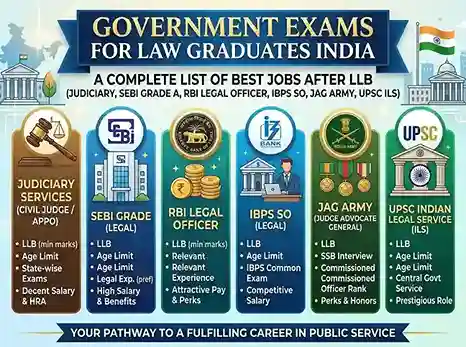
1. Why Government Jobs for Law Graduates? Key Advantages
A law degree from a BCI-recognised institution is one of the most versatile qualifications in India's government job ecosystem. Unlike engineering or medical graduates who are largely confined to technical departments, law graduates are eligible for a uniquely wide range of government posts | spanning the judiciary, regulatory bodies, defence, banking, corporate governance, and the civil services.
Government legal positions offer a combination of advantages that is hard to match in private practice, especially at the early career stage. Job security, pension, housing, medical benefits, structured promotion timelines, and the social prestige of serving in a constitutional or regulatory role make government jobs a highly attractive path after LLB.
- Job security with constitutional protection
- Defined pension (NPS / OPS depending on post)
- Government housing or HRA allowance
- Medical benefits for self and family
- Structured promotion ladder (no political uncertainty)
- Prestige and authority in constitutional offices
- Work-life balance vs private law firm grind
- Leave Travel Concession (LTC) & other perks
- Civil Judge / Munsiff (Judicial Services)
- SEBI Grade A Legal Officer
- RBI Grade B Legal Officer
- IBPS SO Law Officer (Banking)
- Indian Legal Service Officer (UPSC)
- Indian Corporate Law Service (ICLS)
- JAG Officer | Indian Army
- Public Prosecutor / Assistant DA
- PSU Legal Advisor (Coal India, ONGC, BHEL)
- IAS / IPS (via UPSC CSE | any graduate)
2. Two Types of Government Exams for LLB Graduates
Government exams for law graduates fall into two broad categories. Understanding the distinction helps you decide where to focus your preparation energy.
| Type | Description | Examples | LLB Mandatory? |
|---|---|---|---|
| Category A | Law Exclusive | Only LLB / law graduates can apply. Posts require legal expertise and are reserved for law degree holders. | Judiciary, SEBI Legal, RBI Legal Officer, IBPS SO Law Officer, JAG, Indian Legal Service, Public Prosecutor | Yes | LLB Mandatory |
| Category B | Open to All Graduates | Any graduate (including law graduates) can apply. Law graduates have an advantage in posts with legal components. | UPSC CSE (IAS/IPS), SSC CGL, State PSC Civil Services, Bank PO (SBI/IBPS), RBI Grade B (General) | LLB Not Required |
Category A exams give law graduates a structural advantage | your competition is limited to other law graduates and the syllabus directly leverages your LLB knowledge. Category B exams (like UPSC CSE) are open to all graduates and require broader preparation. Most law graduates should begin with Category A exams (SEBI, IBPS SO, Judiciary) while simultaneously preparing for UPSC CSE if interested in IAS/IPS.
3. Judicial Services Examination | Civil Judge / Munsiff
The Judicial Services Examination | the path to becoming a Civil Judge (Junior Division), Munsiff, or Judicial Magistrate | is widely considered the most prestigious government career for law graduates in India. Judicial officers are constitutional functionaries who dispense justice at the grassroots level, and their authority comes directly from Articles 233–235 of the Constitution of India.
Each state conducts its own Judicial Services Examination, either through the respective High Court or the State Public Service Commission. States like Maharashtra, Uttar Pradesh, Rajasthan, Delhi, and Tamil Nadu conduct highly competitive exams with thousands of applicants competing for a limited number of posts. The career path can ultimately lead a dedicated officer all the way to the High Court or Supreme Court bench.
Conducted by State Public Service Commissions (MP, UP, Raj, Mah) or directly by High Courts (Delhi, Karnataka, Bombay). Selection is through a Preliminary (objective), Mains (descriptive law papers), and viva voce. Most states require minimum 45% in LLB and enrolment with a State Bar Council. Mandatory interview shortlisting after clearing mains.
| State | Exam Conducted By | Approx. Vacancies |
|---|---|---|
| Uttar Pradesh | UP Higher Judicial Service / UPPSC | 350–600/year |
| Maharashtra | Maharashtra PSC | 100–200/year |
| Rajasthan | Rajasthan PSC | 100–180/year |
| Delhi | Delhi High Court | 40–80/year |
| Karnataka | Karnataka High Court | 60–100/year |
| Tamil Nadu | Tamil Nadu PSC | 80–120/year |
Judicial Services Exam Pattern (General Structure)
| Stage | Mode | Papers / Sections | Key Subjects |
|---|---|---|---|
| Preliminary Exam | Objective MCQ | 1–2 papers (100–200 marks) | General Studies, Law (Criminal Procedure, Civil Procedure, Constitution, IPC, Evidence Act) |
| Mains Examination | Descriptive | 4–6 law papers + Language paper | Constitutional Law, CrPC, CPC, Indian Evidence Act, IPC, Property Law, Contract Law, Transfer of Property Act, Hindu/Muslim Personal Law |
| Viva Voce / Interview | Oral | 25–50 marks (varies by state) | Legal aptitude, general awareness, personality, comprehension of law concepts |
4. UPSC Indian Legal Service (ILS)
The Indian Legal Service (ILS) is one of India's most prestigious government postings for law graduates. ILS officers serve as legal advisers and law officers to various ministries, departments, and statutory bodies of the Central Government under the Ministry of Law and Justice. The pinnacle of the ILS | the Law Secretary of India | is the highest-ranking legal officer in the Government of India.
- General English
- General Studies
- Law Paper I | Constitutional & Administrative Law
- Law Paper II | International Law & Treaties
- Law Paper III | Contract, Property & Torts
- Law Paper IV | Criminal Law & Procedure
- Viva Voce Interview
- Legal adviser to Central Ministries
- Drafting & vetting of Union legislation
- Representing Govt of India in legal disputes
- International treaty drafting and interpretation
- Legal scrutiny of executive actions
- Career peak: Law Secretary of India
5. UPSC Civil Services Exam (IAS/IPS) | Law Graduates' Advantage
The UPSC Civil Services Examination (CSE) | India's most competitive exam | is open to any graduate, including LLB holders. Law graduates have a specific strategic advantage: Law is a popular optional subject in UPSC Mains, and a solid LLB foundation provides a ready-made preparation base for Law Papers I and II.
Additionally, through UPSC CSE, law graduates can be selected for the Indian Corporate Law Service (ICLS) | a Group A Central Service under the Ministry of Corporate Affairs. ICLS officers are the government regulators who enforce the Companies Act, handle corporate governance, and oversee SEBI-MCA regulatory coordination.
| Aspect | UPSC CSE Details |
|---|---|
| Exam Date 2026 | Prelims: May 24, 2026 | Mains: August 21, 2026 |
| Application Period 2026 | February 4 – 27, 2026 at upsc.gov.in / upsconline.nic.in |
| Total Vacancies 2026 | 933 posts (IAS, IPS, IFS, IRS, ICLS + other services) |
| Age Limit | 21–32 years (General) | OBC: 35 | SC/ST: 37 | PwBD: 42 |
| Maximum Attempts | General: 6 | OBC: 9 | SC/ST: Unlimited (till age limit) |
| Law Optional Advantage | LLB graduates can use Law (Papers I & II) as UPSC Mains optional; Constitutional Law, Administrative Law, IPC, CrPC, Evidence directly tested |
| Starting Pay (IAS Level 10) | ₹56,100/month basic + DA (~45%) + HRA + other allowances; total in-hand ~₹80,000–1,00,000/month |
6. Indian Corporate Law Service (ICLS)
The Indian Corporate Law Service (ICLS) is a Group A Central Service under the Ministry of Corporate Affairs. ICLS officers are responsible for enforcing the Companies Act, 2013, regulating corporate governance, investigating corporate frauds, administering MCA21 portal, and advising the government on company law matters.
ICLS officers investigate corporate frauds, process company registrations, conduct inspections under the Companies Act, liaise with SEBI and RBI on corporate regulation, and handle company winding-up proceedings. IICA (Indian Institute of Corporate Affairs) provides 10-month induction training to probationary ICLS officers. Career peak: Director General of Corporate Affairs.
7. SEBI Grade A Legal Officer | Securities Market Regulator
The Securities and Exchange Board of India (SEBI) Grade A Legal Officer is the most financially rewarding government exam exclusively for law graduates. SEBI is India's securities market regulator, and its legal officers handle enforcement actions, market manipulation cases, insider trading investigations, securities law drafting, and investor protection.
- Phase 1 (Prelims): MCQ | GK/GS, English, Legal
- Phase 2 | Paper 1: GS + English descriptive (60 min)
- Phase 2 | Paper 2: Law specialisation MCQ + Descriptive (120 min)
- Cut-off: Paper 1 = 30% | Paper 2 = 40% | Aggregate = 50%
- Interview: Final stage | personality + legal knowledge
- Securities Law (SEBI Act, SCRA, Depositories Act)
- Corporate Law (Companies Act 2013, FEMA)
- Contract Law & Tort Law
- Constitutional & Administrative Law
- Banking Regulation & Financial Laws
- Current Affairs & Financial Regulatory Framework
8. RBI Grade B Legal Officer | Reserve Bank of India
The Reserve Bank of India (RBI) Grade B Legal Officer is among the most coveted government banking sector jobs for law graduates. RBI's legal officers handle Central Bank litigation, draft banking regulations, interpret foreign exchange laws, advise on monetary policy legality, and manage the legal aspects of bank regulation and supervision.
RBI Legal Officers advise the Reserve Bank on regulatory actions, prepare legal opinions on banking legislation, handle court matters involving RBI, draft regulations under the Banking Regulation Act, FEMA, RBI Act, and Payment & Settlement Systems Act. The RBI Grade B Legal Officer selection process consists of an Online Examination, Offline Written Test, and Personal Interview. The application started from February 6, 2026.
9. IBPS SO Law Officer | Nationalised Banks
The IBPS Specialist Officer (SO) Law Officer examination is the most accessible and structured government exam pathway for fresh LLB graduates into the banking sector. IBPS recruits Law Officers (Scale I) for nationalized banks including Bank of Baroda, Canara Bank, Punjab National Bank, Indian Bank, Central Bank of India, and others.
Law Officers in banks are responsible for ensuring all banking operations comply with the Banking Regulation Act, RBI guidelines, recovery laws (SARFAESI Act, DRT Act), loan documentation review, and court representation in recovery matters.
Three-stage selection: Prelims (English Language, Reasoning, GK | 125 MCQs, 135 min); Mains (Professional Knowledge in Law | 60 MCQs, 45 min); and Interview. Negative marking of 0.25 marks per wrong answer in both stages. Sectional and overall cut-offs apply.
SBI Law Officers are recruited through SBI's own specialist officer recruitment process | separate from IBPS. They handle litigation, legal advisory, contract drafting, and regulatory compliance for India's largest bank. Selection includes written test and interview. Notification is released independently by SBI. SBI Law Officers can rise to Deputy General Manager (Legal) level.
10. JAG Entry | Indian Army Judge Advocate General Branch
The Judge Advocate General (JAG) Entry is the route through which law graduates join the Indian Army as commissioned officers in the JAG Branch. JAG officers are the legal arm of the Indian Army | they advise commanding officers on military law, conduct court-martial proceedings, handle the legal aspects of defence procurement, and manage operational law during military operations. It is one of the most unique and adventurous government law careers available.
- Indian / eligible foreign nationality
- Age: 21–27 years as on October 1, 2026
- LLB from BCI-recognised institution
- Minimum 55% aggregate in LLB
- Both men and women can apply
- Medically fit as per Army standards
- Written Examination (Objective)
- Shortlisting based on written score
- SSB Interview (5 days) | Intelligence, Personality, Group Tasks
- Medical Examination (Army Medical Standards)
- Merit list and final selection
11. Public Prosecutor / Assistant District Attorney (State Govt)
The post of Public Prosecutor (PP) or Assistant District Attorney (ADA) is a direct government job for law graduates | one that involves actual courtroom practice as a state-employed advocate. PPs represent the State in criminal courts, arguing cases on behalf of the prosecution. It is both a government job and a substantive legal practice role.
| Appointed By | State Government / District Magistrate |
| Eligibility | LLB + 7 years' practice at Bar (for PP) |
| For ADA/APP | LLB + 3–5 years' practice (state-wise) |
| Legal Basis | Section 24–25 of CrPC 1973 |
| Salary (State-wise) | ₹15,000–55,000/month (state-wise) |
| Key Role | Represent State in criminal prosecution |
- Maharashtra: APP | ₹47,000–52,000/month
- Tamil Nadu: Assistant PP | ₹35,400–67,000/month
- Gujarat: Government Pleader | ₹40,000–50,000/month
- UP: District Government Counsel | ₹25,000–40,000/month
- Delhi: APP | ₹56,100–1,77,500 (Grade Pay 4600)
- Karnataka: State PP | ₹38,000–45,000/month
12. PSU Legal Officer | Coal India, ONGC, DMRC, BHEL & More
Public Sector Undertakings (PSUs) are among the biggest employers of legal graduates in the government sector. India's large PSUs | Coal India Limited, ONGC, BHEL, NTPC, DMRC, HPCL, IOCL, and others | all maintain in-house legal departments that regularly recruit law graduates through notification-based exams or via CLAT PG scores in some cases.
13. Other Notable Government Exams for Law Graduates
NABARD recruits legal officers for its legal department to handle rural banking law, agricultural credit regulation, and development finance laws. LLB required, age up to 30 years. Selection via Phase 1 (Prelims), Phase 2 (Mains), and Interview. Starting pay ~₹44,500/month basic.
IRDAI recruits legal officers for the insurance regulatory body handling insurance law enforcement, policy drafting, and regulatory compliance. LLB required. Selection: Phase 1 (MCQ) + Phase 2 (Descriptive + Interview). Salary ~₹44,500/month basic.
SSC CGL is open to all graduates. Law graduates can target posts like Tax Assistant (CBDT/CBEC), Inspector (Income Tax/Central Excise), Junior Legal Assistant, and other legal-adjacent roles. LLB not mandatory but advantageous. Selection via Tier 1, Tier 2 (CBT), and Skill Test.
Government insurance companies (New India Assurance, National Insurance, Oriental Insurance, United India) recruit Administrative Officer (Legal) / Law Officer. Handles insurance-related litigation and legal matters. LLB required. Notification-based recruitment.
The Ministry of Law and Justice recruits Junior Legal Officers, Law Researchers, and Senior Research Assistants for the Legislative Department and Department of Legal Affairs. LLM preferred, LLB minimum. Research on legislation, constitutional amendments, treaty interpretation.
Central Bureau of Investigation (CBI), Enforcement Directorate (ED), and National Investigation Agency (NIA) recruit Public Prosecutors, Company Prosecutors, and Legal Officers for handling their complex litigation. These are among the most challenging and high-profile government law roles. LLB with experience required.
14. Government Law Job Salary Comparison 2026
Here is a comprehensive salary comparison of all major government law positions in India, based on 7th Pay Commission data, official recruitments, and publicly available pay scales (as of May 2026).
| Government Post | Organisation | Basic Pay/Month | In-Hand (Approx) | CTC (Approx) | LLB Mandatory? |
|---|---|---|---|---|---|
| SEBI Grade A Legal Officer | SEBI | ₹62,500 | ₹1,00,000+ | ₹20–25 LPA | Yes |
| JAG Army Officer (Captain) | Indian Army | ₹61,300 + ₹15,500 MSP | ₹80,000–1,10,000 | ₹16–20 LPA | Yes |
| Indian Legal Service (ILS) | Min. of Law & Justice | ₹56,100 (Level 10) | ₹80,000–90,000 | ₹15–18 LPA | Yes |
| Indian Corporate Law Service | MCA | ₹56,100 (Level 10) | ₹80,000–90,000 | ₹15–18 LPA | LLB Preferred |
| RBI Grade B Legal Officer | Reserve Bank of India | ₹35,150 | ₹75,000–85,000 | ₹15–18 LPA | Yes |
| NABARD Grade A Legal Officer | NABARD | ₹44,500 | ₹70,000–80,000 | ₹14–16 LPA | Yes |
| IBPS SO Law Officer (Scale I) | Nationalised Banks | ₹36,000 | ₹55,000–65,000 | ₹10–14 LPA | Yes |
| Civil Judge / Munsiff | State Judiciary | ₹27,700–44,770 | ₹50,000–70,000 | ₹8–14 LPA | Yes |
| Public Prosecutor / ADA | State Government | ₹15,000–56,100 | ₹25,000–70,000 | ₹5–12 LPA | Yes |
| PSU Legal Officer (Coal India/NTPC) | PSUs | ₹40,000–60,000 | ₹55,000–80,000 | ₹12–18 LPA | Yes |
Salary Bar Chart | Government Law Jobs 2026 (Basic Pay)
15. How to Prepare for Government Law Exams | Strategy Guide 2026
Government law exam preparation requires a structured, subject-specific approach. The good news: most government law exams test overlapping subjects | Constitutional Law, CrPC, IPC, Contract Law, Evidence Act, and General Studies | so a consolidated preparation strategy works across multiple exams simultaneously.
Core Subjects Tested Across All Government Law Exams
Step-by-Step Preparation Strategy
-
Map Your Target Exams (Month 1)
Choose 2–3 exams to target simultaneously. Recommended first batch: IBPS SO Law Officer + SEBI Grade A Legal. Then add Judicial Services if interested in judiciary. UPSC CSE as a long-term parallel goal.
-
Master 5 Core Law Subjects First (Months 1–3)
Constitution of India, IPC, CrPC, CPC, and Indian Evidence Act appear in virtually every government law exam. Build deep conceptual clarity in these before moving to specialised topics. Use bare acts + standard reference books (Ratanlal & Dhirajlal for CrPC, Bare Acts with commentary).
-
Add Specialisation Subjects Based on Target Exam (Months 3–5)
SEBI Grade A: Securities Law, SEBI Act, SCRA, Companies Act. | RBI Legal: Banking Regulation Act, FEMA, RBI Act, Payment & Settlement Systems Act. | IBPS SO: SARFAESI Act, DRT Act, Banking Documentation, NI Act. | Judiciary: Personal Laws, Transfer of Property, Specific Relief Act, Limitation Act.
-
Practice Previous Year Papers (Months 4–6)
Solve 5+ years of previous question papers for each target exam. Identify recurring question patterns, frequently tested sections, and your weak areas. For objective papers (IBPS SO, SEBI Phase 1), speed and accuracy matter | practice under timed conditions.
-
General Studies & Current Affairs (Throughout Preparation)
Most government law exams include GS/GK sections. Read The Hindu or Indian Express daily for current affairs, with a focus on legal and regulatory news (Supreme Court judgments, new legislation, SEBI/RBI circulars). This also helps with UPSC CSE Prelims if you pursue it.
-
Mock Tests & Full-Length Practice (Month 5–Exam)
Take full-length mock tests in timed exam conditions at least 2–3 times per week in the final 4–6 weeks before the exam. Analyse each mock for accuracy rate, time per question, and section-wise weak points. Online test series for SEBI Grade A and IBPS SO are widely available.
-
Interview & Personality Preparation (Final Stage)
For exams with interviews (SEBI Grade A, RBI, Judiciary, ILS), prepare for: current legal affairs, your LLB specialisation topics, moot court / internship experience articulation, and standard interview questions on career motivation. Mock interviews with seniors or coaching institutes help significantly.
Bare Acts (Constitution, IPC, CrPC, CPC, Evidence Act) | always use the latest editions. For Judiciary: MP Jain's Indian Constitutional Law; Ratanlal & Dhirajlal's The Code of Criminal Procedure; Mulla's Code of Civil Procedure; Sarkar on Evidence. For SEBI: SEBI Act with Bare Act, SC Sharma's Securities Laws; for IBPS SO: IBPS Specialist Officer Law Officer Study Material by EduGorilla or Mockbank; for ILS: Universal's Indian Legal Service Guide; for current affairs: The Hindu + PIB (Press Information Bureau) daily.
16. Frequently Asked Questions | Government Exams for Law Graduates
The best government exams for law graduates in India 2026 are: Judicial Services Examination (most prestigious); SEBI Grade A Legal Officer (highest paying at ₹62,500/month); RBI Grade B Legal Officer (21 vacancies in 2026); IBPS SO Law Officer (most accessible, 56+ vacancies); UPSC Indian Legal Service (ILS) (Central Government law officer); Indian Corporate Law Service (ICLS) via UPSC CSE; and JAG Entry for Indian Army. Each has different difficulty levels, vacancy numbers, and career trajectories.
Yes, absolutely. An LLB degree fully qualifies you for the UPSC Civil Services Examination (IAS, IPS, IFS). Law is also a popular optional subject in UPSC Mains where LLB graduates have a built-in advantage. Additionally, through UPSC CSE, law graduates can specifically target the Indian Legal Service (ILS) and Indian Corporate Law Service (ICLS) | both of which are law-exclusive Group A Central Services.
The starting basic pay of a SEBI Grade A Legal Officer is ₹62,500/month. The pay scale progresses from ₹62,500 to ₹1,26,100 over 17 years. In addition to basic pay, SEBI officers receive DA, HRA, travel allowance, medical coverage, education support, book allowance, and NPS contribution. The total in-hand salary at the start is approximately ₹1,00,000/month and the total CTC is approximately ₹20–25 LPA.
In terms of raw vacancy numbers in 2026: Judicial Services (state-level) has the largest total vacancies | UP Judiciary alone releases 350–600 posts per year. For national-level exams, IBPS SO Law Officer had 56 vacancies in the 2025–26 cycle | the highest among regulatory/banking law exams. SEBI Grade A Legal posts only 20–30 vacancies annually, but the salary and prestige are highest. RBI Grade B Legal had 21 vacancies in 2026.
No | there are two types. Category A exams (Judiciary, SEBI Grade A Legal, RBI Grade B Legal, IBPS SO Law Officer, Indian Legal Service, JAG Army) require an LLB degree mandatorily. Category B exams (UPSC CSE for IAS/IPS, SSC CGL for Tax/Inspector posts) are open to any graduate | LLB holders are eligible but it is not a prerequisite. Law graduates should primarily focus on Category A exams where their legal education gives a direct competitive advantage.
Core subjects common to almost all government law exams: Constitution of India, Indian Penal Code (IPC), Code of Criminal Procedure (CrPC), Code of Civil Procedure (CPC), Indian Evidence Act, Contract Act, Transfer of Property Act, and General Studies/Current Affairs. For specialised exams: SEBI | Securities Law, SEBI Act, SCRA; RBI/IBPS | Banking Regulation Act, FEMA, SARFAESI Act, NI Act; ILS | International Law, Administrative Law, Property Law; Judiciary | Personal Laws, Limitation Act, Specific Relief Act.
Yes, fresh LLB graduates can apply for SEBI Grade A Legal Officer. The minimum educational qualification is an LLB degree from a recognised university. While post-qualification experience is "preferred" or "desirable" in some notifications, it is typically not a mandatory minimum for fresh applicants. The SEBI Grade A Legal exam is open to candidates up to 30 years of age (General category), making it accessible to recent law graduates. SEBI itself provides comprehensive orientation and training to selected candidates after joining.
The Indian Legal Service (ILS) is a Group A Central Service under the Ministry of Law and Justice, Government of India. ILS officers serve as legal advisers to Central Government ministries and departments, draft legislation, vet legal matters, represent the government in court proceedings, and handle international treaty obligations. The exam is conducted by UPSC and tests Constitutional Law, Administrative Law, International Law, Contract, Property, Criminal Law papers plus General Studies. Eligibility: LLB, age 21–30 years. Starting pay Level 10 (₹56,100/month). The pinnacle of ILS career is the post of Law Secretary of India.
LLB from GNLU Gandhinagar and LLM (Corporate & Commercial Law) from NUJS Kolkata. 8+ years covering law careers, government legal services, UPSC law, SEBI and judiciary recruitment in India. Data in this guide sourced from official UPSC, SEBI, RBI, IBPS, and Indian Army notifications. Last updated: May 28, 2026.