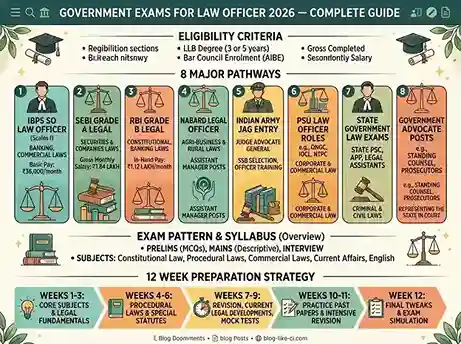
🏛 Government Law Officer Exams 2026 | IBPS SO Prelims: Aug 29 | SEBI Grade A (Legal): Phase I Jan, Phase II Feb 2026 | RBI Grade B Legal: Multiple rounds💰 Salary Highlights | SEBI Grade A: ₹1.84L/month gross | RBI Grade B: ₹1.08–1.12L in-hand | IBPS SO: ₹60–90K in-hand | Army JAG: ₹7 LPA+📋 Eligibility | LLB + Bar Council Enrolment (IBPS SO, PSU) | LLB degree (RBI, SEBI, JAG) | Age: 21–30 years (varies by exam)📊 New Syllabus Alert | BNS replaces IPC, BSA replaces Evidence Act, BNSS replaces CrPC | mandatory in all 2026 law officer exams
Government Exams | Law Officer 20268 Major Recruitment PathwaysTop Salary: ₹1.84L/Month (SEBI)
Government Exams for Law Officer 2026 | IBPS SO, RBI, SEBI, NABARD, JAG, PSU: Eligibility, Salary, Syllabus & Preparation
A career as a Government Law Officer is one of the most coveted outcomes for law graduates in India | combining job security, a structured salary with regular increments and allowances, pension benefits, social prestige, and the intellectual satisfaction of applying legal expertise in service of national institutions. This complete guide covers every major government law officer exam in India for 2026 | from IBPS SO and RBI to SEBI, NABARD, Indian Army JAG, and PSU roles | including eligibility, pay scale, syllabus, exam pattern, and preparation strategy.
📅 Updated: May 30, 2026 | 2026 Notification & Exam Date Data
✍️ By Nitin Sharma, LLB GNLU 2019, Ex-IBPS SO Law Officer | Senior Government Exams Editor
🔍 All exam data verified against official notifications from ibps.in, rbi.org.in, sebi.gov.in, joinindianarmy.nic.in
Government Exams for Law Officer 2026 | Complete Guide | LawGuru India | Data: Official Notifications (ibps.in, rbi.org.in, sebi.gov.in, joinindianarmy.nic.in)
📌 Government Law Officer Exams 2026 | Key Overview
IBPS SO Law Officer Prelims
August 29, 2026 (Tentative)
SEBI Grade A (Legal) | Phase I
January 10, 2026 | 20 Vacancies
IBPS SO Mains
November 1, 2026 (Tentative)
Minimum Qualification
LLB from BCI-recognised university
Key Requirement (Banking)
Bar Council Enrolment (COP)
Top Paying Role
SEBI Grade A: ₹1.84L/month gross
⚠️
Critical 2026 Syllabus Update | New Criminal Laws: From 2026, all government law officer exams have replaced IPC, CrPC, and Indian Evidence Act with the new codes: Bharatiya Nyaya Sanhita (BNS) replacing IPC; Bharatiya Nagarik Suraksha Sanhita (BNSS) replacing CrPC; and Bharatiya Sakshya Adhiniyam (BSA) replacing the Indian Evidence Act. Candidates must study from the new bare acts. Questions on old codes will not be asked in 2026 exams | any preparation material based on IPC/CrPC/Evidence Act must be discarded or updated.
📋 Table of Contents | Government Exams for Law Officer 2026
1. What is a Government Law Officer? | Role & Importance
A Government Law Officer is a legally trained professional employed by a government organisation, public sector undertaking (PSU), regulatory body, ministry, defence service, or public sector bank to manage and advise on all legal matters pertaining to that organisation. Unlike advocates in private practice who serve client instructions, government law officers serve the institution | acting as the in-house legal brain that ensures every policy, transaction, contract, and regulatory action taken by the organisation is legally sound and defensible.
The role spans a wide range of functions: drafting contracts, opinions, and policies; representing the organisation before courts and tribunals; managing compliance with applicable legislation; advising on risk and regulatory exposure; vetting agreements and MoUs; and handling litigation recovery. In banking organisations like public sector banks, law officers also manage recovery proceedings, NPA resolution under SARFAESI and IBC, and stamp duty and mortgage documentation for loan portfolios.
⚖️ What a Govt Law Officer Does
Drafts legal opinions and compliance notes
Reviews contracts, agreements, and MoUs
Manages litigation | files and defends suits
Represents the organisation before ITAT, DRT, NCLAT, courts
Ensures regulatory compliance with applicable laws
Advises on NPA resolution (SARFAESI, IBC, DRT proceedings)
Vets service rules, tenders, and procurement documents
Provides legal advice on personnel and service matters
🏛 Why Law Graduates Choose Government Roles
Job security and guaranteed income growth
Defined pension benefits (New Pension Scheme)
Medical facilities and housing allowances
Structured career ladder with clear promotions
Work-life balance vs private law firm intensity
Public service satisfaction and institutional prestige
Competitive starting salary + DA inflation protection
Transfer options across offices / branches nationally
2. All Government Law Officer Exams 2026 | 8 Major Pathways
The government law officer landscape in India is rich and diverse | there is no single exam or single employer. Different pathways lead to very different work environments, from regulatory bodies and public sector banks to the armed forces, state governments, and central ministries. Here are the eight most significant government law officer recruitment routes for 2026:
Institute of Banking Personnel Selection
IBPS SO Law Officer
AnnualPublic Sector BanksScale I
Recruits law officers for 11+ participating public sector banks. Three stages: Prelims (qualifying) → Mains → Interview. Largest volume of vacancies. Requires LLB + Bar Council Enrolment.
Basic Pay (Scale I)
₹36,000–₹63,840/month
Reserve Bank of India
RBI Grade B | Legal Stream
PrestigiousCentral BankGrade B
RBI recruits Legal Officers under the DR (Legal) and Rajbhasha streams. Handles all legal work for India's central bank. Exceptionally competitive. Requires LLB from a recognised institution.
Basic Pay
₹78,450/month
Securities and Exchange Board of India
SEBI Grade A (Legal Stream)
Top PayRegulator20 Vacancies 2026
SEBI's Legal Officers enforce securities laws, investigate market malpractice, and draft regulatory guidelines. Phase I: Jan 10, 2026 | Phase II: Feb 21, 2026. Highest salary in the category.
Basic Pay (Revised)
₹62,500/month
National Bank for Agriculture & Rural Development
NABARD Grade A (Legal)
AnnualDevelopment Finance
NABARD recruits Legal Officers in Grade A (Assistant Manager) category. Handles legal aspects of agricultural finance, rural development funding, and compliance. Unique blend of law and development banking.
Basic Pay
₹44,500–₹89,150/month
Indian Army / Indian Navy / IAF
JAG Entry (Judge Advocate General)
Commissioned OfficerDefence ServiceTwice Yearly
JAG officers are military lawyers in the Indian Army, Navy, and IAF. Handle court-martials, legal aid, and advisory for defence personnel. Twice-yearly recruitment as Short Service Commissioned Officers. 124th course for Oct 2026.
Starting Pay (Captain)
₹56,100 + MSP ₹15,500
Central / State PSUs & Ministries
PSU Law Officer / Legal Adviser
Year-round NotificationsMultiple PSUs
ONGC, NTPC, BHEL, SAIL, Coal India, NHAI, Airport Authority, NHB, SIDBI, IRDAI, PFRDA | all recruit law officers independently. Entry pay typically at Pay Level 7 (₹44,900+). Monitor official sites and employment news for notifications.
Pay Level 7 starting
₹44,900–₹1,42,400/month
IBPS RRB | Regional Rural Banks
IBPS RRB Law Officer (Scale II)
RRBsAnnualScale II
Regional Rural Banks recruit Scale-II Law Officers under IBPS RRB process. 49+ vacancies in recent cycles. Single examination followed by Interview. NABARD-assisted selection process. Lower competition than IBPS SO with comparable pay.
Scale II Basic Pay
₹48,170–₹69,810/month
State Governments / State PSCs
State Government Law Officer / Govt Pleader
State-wiseHigh Volume
State Public Service Commissions recruit Legal Officers, Government Pleaders, and Law Officers for state departments. UP, Maharashtra, Karnataka, Rajasthan, Gujarat, and other states release regular notifications. Pay structure follows State 7th Pay Commission recommendations.
Starting Pay (State PSC)
₹40,000–₹80,000/month
3. IBPS SO Law Officer 2026 | Exam, Eligibility & Pattern
The IBPS SO (Specialist Officer) Law Officer exam is the largest and most widely pursued government law officer recruitment in India, conducted annually by the Institute of Banking Personnel Selection (IBPS). Successful candidates are appointed as Law Officers (Scale I) in 11+ participating public sector banks including Bank of Baroda, Bank of India, Canara Bank, Central Bank of India, Indian Bank, Indian Overseas Bank, Punjab National Bank, UCO Bank, Union Bank of India, and others.
3.1 IBPS SO Law Officer 2026 | Important Dates
Event
Expected Date / Status
Official Notification Release
September–October 2026 (Annual cycle)
Prelims Exam (Tentative)
August 29, 2026
Mains Exam (Tentative)
November 1, 2026
Interview
December 2026 – January 2027
Provisional Allotment
February–March 2027
Official Website
ibps.in
3.2 IBPS SO Law Officer | Eligibility
Criterion
General / EWS
SC / ST
OBC (NCL)
Educational Qualification
Bachelor's Degree in Law (LLB) from a university recognised by the Bar Council of India
Bar Enrolment
Enrolled as an Advocate with the Bar Council (Certificate of Practice | mandatory)
Maximum Age
30 years
35 years (+5)
33 years (+3)
Minimum Age
20 years
Nationality
Indian citizen (certain categories of non-citizens also eligible; see official notification)
3.3 IBPS SO Law Officer | Exam Pattern 2026
Stage
Sections
Questions
Duration
Nature
Prelims (Qualifying)
English Language + Reasoning + General Awareness
50 + 50 + 50 = 150
40+40+40 = 120 min
Qualifying | must pass for Mains
Mains (Merit)
Professional Knowledge (Legal)
60 questions
45 minutes
Merit-based (80% weightage in final selection)
Interview
Personal Interview
|
15–20 minutes
20% weightage in final selection
Negative marking: −0.25 marks for each wrong answer in Prelims and Mains. Each section in Prelims has a dedicated 40-minute timer; candidates cannot return to a previous section.
💡
IBPS SO Law Officer strategy insight: The Prelims is qualifying | there is no merit from it. Your entire ranking is determined by the Mains (Professional Knowledge) paper and interview. This means you should dedicate maximum preparation time to the legal knowledge section. The Prelims requires only basic familiarity with English, Reasoning, and General Awareness | candidates with a law degree typically pass it without intensive preparation. Allocate 70% of your study time to Mains legal subjects.
4. RBI Grade B Legal Officer 2026
The Reserve Bank of India (RBI) recruits Legal Officers under its Grade B recruitment process in the Department of Regulation (DR) and Legal stream. This is one of the most prestigious positions available to law graduates in India | working at the apex regulatory body for the banking system, contributing to monetary policy legal frameworks, regulatory compliance, and representing the central bank in courts and forums across India.
RBI Grade B (Legal) officers handle legal work across all RBI departments | drafting circulars and regulations, reviewing MoUs with foreign central banks, advising on foreign exchange management, handling litigation across High Courts and the Supreme Court, and preparing legal opinions on complex regulatory matters. The work is intellectually demanding and strategically important, with exposure to cutting-edge issues in banking, financial regulation, and constitutional law.
Parameter
RBI Grade B | Legal Stream
Basic Pay
₹78,450/month (starting)
In-Hand Monthly Salary
₹1.08–1.12 Lakhs/month
Annual CTC
₹27–30 Lakhs/year
Qualification
LLB degree (3-yr or 5-yr) from a recognised university
Age Limit
21–30 years (General); relaxation for reserved categories
Selection Process
Written examination (Phase I + Phase II) → Interview
Key Benefits
Residential quarter in metro cities, LFC, medical benefits, children's education allowance
Official Portal
rbi.org.in
🏦
Why RBI Grade B (Legal) is considered the most prestigious law officer role: Beyond the salary, the perks at RBI include a residential quarter in major metro cities (saving ₹30,000–₹80,000/month in rent alone), interest-free staff loans for housing, a subsidised RBI canteen, comprehensive medical coverage for the entire family including parents, and world-class training at the RBI's own training colleges. The combination of intellectual work and exceptional benefits makes RBI Grade B (Legal) the most sought-after government law officer position in India.
5. SEBI Grade A (Legal) 2026
SEBI (Securities and Exchange Board of India) recruits Legal Officers as Grade A Officers in the Legal Stream. SEBI's Legal Officers are at the frontlines of India's capital market regulation | enforcing securities laws, investigating insider trading and market manipulation, drafting regulatory frameworks for new financial instruments, and representing SEBI in proceedings before SAT (Securities Appellate Tribunal), High Courts, and the Supreme Court.
The SEBI Grade A (Legal) exam for 2026 had 20 vacancies with Phase I conducted on January 10, 2026 and Phase II on February 21, 2026. SEBI Legal Officers enjoy the highest gross pay package among all government law officer roles | basic pay of ₹62,500/month with gross emoluments of approximately ₹1.84 lakh/month (without accommodation) or ₹1.43 lakh/month (with accommodation) in Mumbai.
SEBI Grade A (Legal) | Key Facts
Details
Basic Pay (Revised)
₹62,500/month
Gross Monthly (without accommodation)
~₹1,84,000/month
Gross Monthly (with accommodation)
~₹1,43,000/month
Annual CTC (approximate)
~₹18–22 Lakhs/year
2026 Vacancies (Legal)
20 vacancies
Phase I Date
January 10, 2026
Phase II Date
February 21, 2026
Eligibility
LLB from a recognised institution; age 21–30 years
Selection Process
Phase I (Paper I: Multiple Choice) → Phase II (Paper II: Legal Knowledge + Paper III: English Writing) → Interview
Key Responsibilities
Enforce securities laws, investigate malpractice, draft regulations, amend stock exchange bye-laws, appear before SAT
Beyond IBPS, RBI, and SEBI, several other major financial regulatory and development finance institutions recruit Legal Officers regularly. These offer excellent work-life balance, good salaries, and meaningful public service outcomes:
Organisation
Role
Starting Pay (approx.)
Exam Type
Official Website
NABARD
Grade A | Legal (Assistant Manager)
₹44,500–₹89,150/month
Written Exam + Interview (NABARD's own process)
nabard.org
NHB (National Housing Bank)
Assistant Manager (Legal)
~₹44,500/month + allowances
Written + Interview
nhb.org.in
SIDBI
Grade A | Legal Officer
~₹50,000/month + allowances
Online Exam + Interview
sidbi.in
IRDAI
Assistant Manager (Law)
~₹44,500/month + allowances
Phase I + Phase II + Interview
irdai.gov.in
PFRDA
Assistant Manager (Legal)
~₹44,500/month + allowances
Written + Interview
pfrda.org.in
IFSCA
Grade A (Legal)
~₹56,000–₹80,000/month
Written Exam + Interview
ifsca.gov.in
🎯
Strategic insight | apply widely across regulatory bodies: The legal knowledge required for IBPS SO, RBI, SEBI, NABARD, NHB, SIDBI, and IRDAI exams overlaps by approximately 70–80%. A candidate who prepares systematically for the core legal subjects (Constitutional Law, Contract, Evidence, Companies Act, Banking Laws, IBC) can simultaneously target multiple exams in the same preparation cycle. This multi-exam strategy significantly improves the probability of securing a government law officer position. Set up job alerts on official portals and check notifications quarterly | many PSU and regulatory body vacancies are announced with only 30–45 days' notice.
7. Indian Army JAG Entry 2026 | Legal Officer in Defence
The Judge Advocate General (JAG) Branch of the Indian Army is a corps of military lawyers who provide legal advice and services to the Army. JAG officers handle court-martials, conduct trials under the Army Act, advise on military law matters, represent the Army in civilian courts, and ensure legal compliance in Army operations, procurement, and administration.
The JAG Entry (124th Course for October 2026 intake) offers a Short Service Commission as a Captain in the Indian Army | a uniquely prestigious and adventurous government law career that combines legal expertise with military service. JAG officers serve for an initial period of 14 years (extendable to Permanent Commission for selected officers), receiving all the benefits of an Indian Army officer.
JAG Entry Parameter
Details
Commission Type
Short Service Commission (SSC) | extendable to Permanent
Rank on Joining
Captain (direct)
Starting Pay
₹56,100 (Level 10B) + Military Service Pay ₹15,500 + Grade Pay + Allowances
Approximate CTC
₹7 LPA+ (including non-monetary perks)
Eligibility (Qualification)
LLB (3-yr) with minimum 55% aggregate, or 5-yr integrated law degree with 55% in LLB component
Age Limit
21–27 years as on date of commencement of course
Bar Enrolment Required?
Not mandatory | but preferred
Gender
Men and Women (both eligible since 2021)
Selection Process
Shortlisting → SSB Interview (5 days) → Medical Examination → Final Merit List
Perks
Free accommodation, uniform, medical (ECHS), Canteen (CSD), travel, children's education, army mess
Next Intake
124th JAG Entry Course | October 2026 (apply at joinindianarmy.nic.in)
8. PSU Law Officers & State Government Legal Roles
Beyond banking and financial regulatory bodies, a large number of Central PSUs (Public Sector Undertakings) and state government departments recruit Law Officers on a regular basis. These roles offer comparable salaries with excellent work-life balance and are particularly suited for candidates who prefer sector-specific legal work in their home state or city.
⚡ Energy PSUs
ONGC, NTPC, NHPC, BHEL, PGCIL recruit legal officers for energy sector law, contracts, and land acquisition. Entry at E1/E2 level (₹40,000–₹60,000/month basic) with significant allowances.
🏗 Infrastructure
NHAI, AAI, RITES, IRCON, CONCOR hire legal officers for infrastructure contracts, land acquisition law, arbitration, and government procurement. Attractive postings in metro cities.
⚙ Manufacturing PSUs
SAIL, Coal India, NMDC, HAL recruit legal officers for labour law, contract management, trademark/IP, and dispute resolution. Pay Level 7 upwards; entry salary ₹44,900+.
🏛 State Government
State PSCs recruit Law Officers for revenue departments, social welfare departments, law departments. Home state advantage; pay follows state 7th Pay Commission revisions.
🏥 Healthcare PSUs
ESIC, NIACL, New India Assurance, Oriental Insurance recruit legal officers for insurance litigation, DRTs, and claims management. Growing demand with digital insurance regulation.
⚖ Government Advocates
Central Government Counsel and State Government Pleaders represent government in courts. SC/HC empanelled counsel positions via Law Ministry/State Law Dept. Prestigious, part-time or full-time, excellent earnings.
📢
How to track PSU law officer vacancies: PSU law officer notifications are not centralised | each PSU posts independently on its own career portal. Monitor the official websites of target PSUs quarterly. Additionally, the Employment News (Rozgar Samachar) published weekly carries official government recruitment notifications and is freely available online. Set up Google Alerts for "[PSU name] Law Officer recruitment" to receive instant notification when new posts are advertised. Entry-level positions often fall under Pay Level 7, with starting basic pay of ₹44,900 (7th Pay Commission).
9. Salary Comparison | All Government Law Officer Roles 2026
Government law officer salaries in India follow structured pay scales under the 7th Pay Commission framework, with allowances (DA, HRA, TA) significantly augmenting the basic pay. The following comparison gives a comprehensive picture of compensation across all major roles:
Organisation / RolePay ScaleIn-Hand (approx.)
SEBI Grade A (Legal)
₹1.43–1.84L
RBI Grade B (Legal)
₹1.08–1.12L
NABARD Grade A (Legal)
₹75,000–₹90,000
IFSCA Grade A (Legal)
₹70,000–₹85,000
IBPS RRB Law Officer (Scale II)
₹60,000–₹80,000
IBPS SO Law Officer (Scale I)
₹55,000–₹75,000
Army JAG (Captain)
₹56,000–₹70,000
Central PSU Law Officer (E1/E2)
₹45,000–₹65,000
State Govt Law Officer (PSC)
₹40,000–₹60,000
In-hand salary includes basic pay + DA (current rate ~53% of basic) + HRA (city class-based 8–27% of basic) + TA. Actual in-hand varies by city class, family status, and allowance eligibility. These figures are indicative | verify with official notifications.
10. Eligibility Criteria | Unified Overview
While each government law officer exam has its own specific eligibility conditions, the following unified framework covers the requirements that are consistent across most major examinations:
Criteria
General Requirement
Key Variations
Educational Qualification
LLB degree (3-yr or 5-yr integrated) from a university recognised by the Bar Council of India
Some exams accept final-year LLB students (conditional); some require minimum % (55% for JAG)
Bar Council Enrolment
Mandatory for IBPS SO, SBI SO, and most PSU roles
Not required for RBI Grade B (Legal), SEBI Grade A, JAG, and most regulatory bodies
SC/ST: +5 years; OBC (NCL): +3 years; PwD: +10 years
Ex-servicemen: up to +5 years additional
Work Experience
Not required for most entry-level roles (Scale I / Grade A)
Some PSU senior positions require 2–5 years of post-qualification experience
Nationality
Indian citizen (with defined exceptions for neighbouring country nationals; see official notification)
JAG: specific nationality eligibility including Bhutanese/Nepali citizens under defined conditions
Minimum Marks
LLB degree (pass); no minimum % for most banking exams
JAG: LLB minimum 55% aggregate | Some PSUs: 60% minimum
11. Syllabus 2026 | Subject-Wise Coverage for All Exams
The most valuable insight for law officer exam preparation is that approximately 70–80% of the syllabus is common across all major government law officer exams. The core legal subjects appear in IBPS SO, RBI Grade B (Legal), SEBI Grade A, NABARD, and PSU law officer papers with near-identical coverage | only the sector-specific statutes differ. Here is the complete subject-wise syllabus with priority tags:
Code of Civil Procedure (CPC), 1908Specific Relief Act, 1963Limitation Act, 1963Registration Act, 1908Administrative Law & Principles of Natural JusticeCompanies Act, 2013Insolvency and Bankruptcy Code (IBC), 2016
🔵 BASE SUBJECTS (Conceptual Understanding Required)
Law of TortsPublic International LawArbitration and Conciliation Act, 1996Labour Law (Industrial Disputes Act, Factories Act)Environmental Law (EPA, Water Act, Air Act)Consumer Protection Act, 2019Right to Information Act, 2005
NABARD Act | NHB Act | Land Acquisition Law | Agricultural Finance Law | Regional Rural Banks Act | SARFAESI (rural credit) | Cooperative Society laws
Indian Army JAG
Army Act, 1950 | Army Rules | Court-Martial procedures | Geneva Conventions | International Humanitarian Law | Service Law and Military Law principles | Defence Procurement rules
PSU Law Officers
Contract management (GFR 2017) | Labour Laws (ID Act, PF Act) | Competition Act 2002 | NI Act | DRT procedures | Sector-specific law (e.g., Electricity Act for NTPC/NHPC; Mines Act for ONGC/Coal India)
12. Preparation Strategy | 12-Week Study Plan
A focused 12-week preparation plan can equip a dedicated law graduate for most government law officer exams simultaneously. Since IBPS SO, RBI, SEBI, and NABARD all test from the same core legal syllabus (with sector-specific additions), a unified preparation approach maximises efficiency. Here is a structured 12-week plan:
1–4
Weeks 1–4: Foundation | Core Law Subjects
Constitutional Law (fundamental rights, DPSP, federalism, emergency provisions, amendment procedures, landmark SC judgements) + Indian Contract Act 1872 (all sections including specific contracts | sale of goods, indemnity, guarantee, bailment) + New Criminal Laws (BNS, BNSS, BSA | study from bare act texts, compare with old IPC/CrPC/Evidence). Aim: Read each bare act once completely, then practice 20 MCQs per subject daily. Build a glossary of important sections and their provisions.
5–6
Weeks 5–6: Banking Laws | IBPS SO / RBI Focus
Banking Regulation Act 1949 + RBI Act 1934 + NI Act 1881 + SARFAESI Act 2002 + RDDBFI Act + IBC 2016 basics + FEMA 1999. Focus on section numbers, key definitions, powers of RBI, banking offences, and recovery mechanisms under SARFAESI and IBC. These subjects carry the highest weightage in IBPS SO Mains. Cross-reference with RBI's Master Circulars and Guidelines available on rbi.org.in.
7–8
Weeks 7–8: Company & Securities Law | SEBI / RBI Focus
Companies Act 2013 (governance chapters, meetings, accounts, audit, NCLT jurisdiction, winding up, IBC interface) + SEBI Act 1992 + SCRA + Insider Trading Regulations + Takeover Code (SAST) + LODR Regulations. Also cover Transfer of Property Act + Specific Relief Act + Limitation Act. For SEBI aspirants: study SAT decisions and landmark SEBI orders on enforcement matters.
9–10
Weeks 9–10: Civil Procedure & Revision
CPC 1908 (jurisdiction, pleadings, interim orders, execution, appeals) + Arbitration and Conciliation Act 1996 (domestic and international arbitration, enforcement of foreign awards) + Administrative Law + RTI Act + Consumer Protection Act 2019. Revision pass over Constitutional Law and Contract Act. Begin full-length subject-wise mock tests (30–40 questions per subject per session). Identify and eliminate weak areas.
11–12
Weeks 11–12: Full Mocks, Current Legal Affairs & Interview Prep
Take 2 full-length Professional Knowledge mock tests per week (60 questions, 45 minutes under exam conditions). Review answer keys carefully | wrong answers must be traced to the correct section. Study current legal developments: Union Budget 2026 legal amendments, Supreme Court landmark judgements of 2025–26, SEBI/RBI/CBDT notifications of the last 6 months. Begin interview preparation: prepare personal introduction, law-related current affairs, and opinion on recent legal developments for the 20% interview component.
📚 Recommended Study Resources
Bare Acts: EBC (Eastern Book Company) annotated editions | mandatory
Constitutional Law: M.P. Jain or D.D. Basu for foundational reading
Criminal Laws (New): Study official bare texts of BNS, BNSS, BSA from official portals
Current Legal Affairs: Weekly legal news digests, SC Observer
Mock Tests: LegalEdge, ClatGyan, IBPS Official Previous Years
⚡ Exam-Day Tips
Negative marking is −0.25 | never guess blindly; skip if unsure
IBPS SO Mains: 45 minutes for 60 Qs = 45 sec/Q | build speed with mocks
Section-wise timers in Prelims | do not linger on one section
Read question stems carefully | law questions often test exact section numbers
Answer questions you know first; return to uncertain ones
For Mains, aim for 45+ correct answers out of 60 for top scores
13. Frequently Asked Questions | Government Exams for Law Officer
Q Which is the best government exam for law graduates in India?
For the highest salary: SEBI Grade A (Legal) | gross ~₹1.84 lakh/month is the best pay package in government law. For prestige and comprehensive work: RBI Grade B (Legal) | basic ₹78,450, CTC ₹27–30 LPA, residential colony, exceptional perks. For most vacancies and widest access: IBPS SO Law Officer | covers 11+ public sector banks. For defence service: Indian Army JAG | direct Captain commission with military benefits. For lowest fees and accessible exam: State PSC Law Officer | home state advantage, no relocation. The best depends on your financial needs, career goals, location preference, and exam readiness.
Q What is the eligibility for IBPS SO Law Officer 2026?
IBPS SO Law Officer 2026 eligibility requires: (1) LLB degree from a Bar Council of India-recognised university; (2) Enrolment as an Advocate with a State Bar Council (Certificate of Practice | mandatory); (3) Age: 20–30 years for General category (SC/ST: +5 years; OBC-NCL: +3 years); (4) Indian citizenship. Some participating banks may require 2 years of experience as an advocate | check the specific official notification. Apply through ibps.in when the notification is released.
Q What subjects are included in the government law officer exam syllabus?
The core subjects tested across most government law officer exams are: Constitutional Law, Indian Contract Act 1872, Bharatiya Nyaya Sanhita (BNS), Bharatiya Sakshya Adhiniyam (BSA), Bharatiya Nagarik Suraksha Sanhita (BNSS), Transfer of Property Act, Negotiable Instruments Act, Code of Civil Procedure, Companies Act 2013, SARFAESI Act, IBC 2016, FEMA 1999, and Administrative Law. For banking exams (IBPS SO, RBI), Banking Regulation Act and RBI Act are additionally high priority. For SEBI, SEBI Act and securities regulations are added. Note: From 2026, IPC/CrPC/Evidence Act are replaced by BNS/BNSS/BSA in all exams.
Q What is the salary of IBPS SO Law Officer in 2026?
The IBPS SO Law Officer (Scale I) basic pay is ₹36,000/month, with increments taking it up to ₹63,840/month over the scale. In addition to basic pay, Law Officers receive Dearness Allowance (DA | currently ~53% of basic), House Rent Allowance (HRA | varies by city: 8–27%), Transport Allowance, Conveyance Allowance, Medical Insurance, and other perquisites per bank rules. The approximate in-hand monthly salary for a new IBPS SO Law Officer is ₹55,000–₹75,000, depending on the city of posting. This increases with DA hikes (revised quarterly) and annual increments.
Q Can a final-year LLB student apply for government law officer exams?
This varies by exam. IBPS SO Law Officer: Typically requires the LLB degree to be already completed at the time of application | final-year students may not be eligible; check the specific notification. SEBI Grade A (Legal): Degree must be completed. RBI Grade B (Legal): LLB must be completed. Indian Army JAG: Final-year students can apply subject to completing the degree before joining. General rule: For all exams requiring Bar Council Enrolment (IBPS SO, PSU), you must have already graduated | you cannot enrol with the Bar Council before completing LLB. Start preparing in the final year but confirm eligibility for each specific exam's notification before applying.
Q How is SEBI Grade A Legal Officer different from IBPS SO Law Officer?
The key differences: Salary: SEBI Grade A pays ₹1.84L/month gross vs IBPS SO's ₹55–75K in-hand. Work type: SEBI Legal Officers focus on capital market regulation | securities law enforcement, investigating insider trading, drafting regulations; IBPS SO Law Officers focus on banking law | NPA recovery, SARFAESI, branch compliance. Exam difficulty: SEBI Grade A (Legal) is significantly harder, with three-phase selection; IBPS SO has two phases plus interview. Vacancies: SEBI (Legal) typically has 20–40 vacancies per year; IBPS SO has significantly more. Bar Enrolment: SEBI Grade A does not require Bar enrolment; IBPS SO does. Choose based on your preferred work domain | securities/capital markets vs banking law.
Q Do I need experience to become a government law officer?
For most entry-level government law officer positions (IBPS SO Scale I, SEBI Grade A, RBI Grade B, NABARD Grade A, JAG Entry), no prior work experience is required | only the LLB degree and Bar enrolment (where applicable) are mandatory. Exceptions: Senior PSU Law Officer positions (often advertised as "Legal Manager" or "Senior Legal Officer" at E2/E3 grades) typically require 3–7 years of relevant experience. Some banks may specify "2 years as an advocate" in IBPS SO notifications | verify each cycle's official notification. For aspirants who are fresh graduates: apply for entry-level positions and use internship experience during law school in your interview narratives to demonstrate practical legal exposure.
Start Your Government Law Officer Preparation Today
IBPS SO Prelims: August 29, 2026. SEBI Grade A (Legal): Already notified. With 12 weeks of focused preparation on the core legal syllabus, a law graduate can simultaneously target IBPS SO, NABARD, SIDBI, and IRDAI law officer positions. The government offers job security, structured growth, and inflation-indexed pay that private practice cannot match at the entry level.