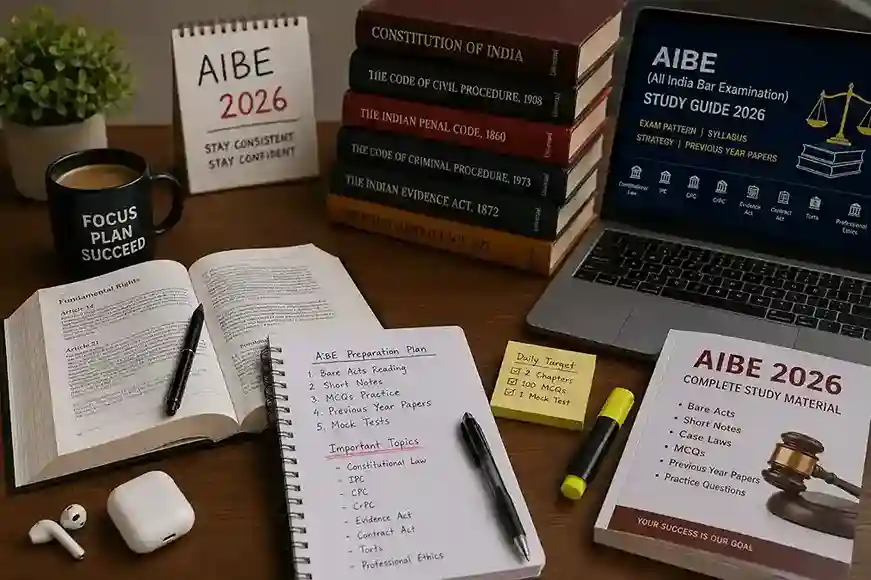
AIBE is not like CLAT or your law school finals. It does not test memory. It tests whether you can find the right law and apply it under time pressure. That single fact should shape how you study.
You are allowed to carry bare acts into the exam hall. So the real skill is not recall. It is speed and recognition. You need to know which act covers which problem, and where in that act the answer sits.
This page builds your study material around that fact. We cover every subject in the AIBE syllabus, tell you what bare acts to carry, and give you a realistic week-by-week plan. We also flag the three new criminal laws that replaced the IPC, CrPC, and Evidence Act, since many candidates still prepare from outdated material.
1. What AIBE Actually Tests
AIBE stands for All India Bar Examination. The Bar Council of India runs it. Every law graduate who wants to practise in an Indian court must clear it.
It is not a competitive exam. There is no rank and no merit list. You either score above the passing mark or you don't. If you don't, you sit again next session. There is no limit on attempts.
The exam has 100 multiple choice questions. Each carries one mark. There is no negative marking, so attempt every question. Even a guess has a chance of being right. A blank answer never does.
You get three hours and thirty minutes. That sounds generous, but with 19 subjects and 100 questions, the real constraint is finding answers fast in your bare acts, not lack of time to think.
In a closed-book exam, you memorise sections. In AIBE, you build a mental map of your bare acts. You should be able to flip to the right chapter within seconds. That skill comes from practice with the actual books you'll carry, not from reading typed notes alone.
2. The 19 Subjects, Ranked by Weight
The Bar Council sets 19 subjects. They don't carry equal weight in the paper. Some subjects send 8 to 10 questions. Others send 2 or 3. Knowing this changes how you split your time.
| Subject | Typical Weight | Why it matters |
|---|---|---|
| Constitutional Law | High | Forms the base for many other questions, including writs and fundamental rights |
| Code of Civil Procedure (CPC) | High | Tests your grip on suits, decrees, and execution, all daily court work |
| Bharatiya Nagarik Suraksha Sanhita (BNSS) | High | Replaced the CrPC; covers arrest, bail, and trial procedure |
| Bharatiya Nyaya Sanhita (BNS) | High | Replaced the IPC; defines crimes and punishments |
| Bharatiya Sakshya Adhiniyam (BSA) | Medium-High | Replaced the Evidence Act; governs what counts as proof in court |
| Law of Contract | Medium-High | Underlies most civil disputes you'll handle as a junior advocate |
| Family Law | Medium | Marriage, divorce, succession, and maintenance questions are common |
| Property Law and Transfer of Property Act | Medium | Tests sale, mortgage, lease, and gift transactions |
| Law of Torts, including consumer and motor accident claims | Medium | Negligence and compensation questions appear most often |
| Company Law | Medium | Basic incorporation, director duties, and winding-up concepts |
| Professional Ethics and Bar Council Rules | Medium | Direct rules from the Advocates Act and BCI Rules; usually scoring |
| Alternative Dispute Resolution (Arbitration, Mediation) | Low-Medium | Short, rule-based questions on the Arbitration and Conciliation Act |
| Labour and Industrial Law | Low-Medium | Covers retrenchment, wages, and industrial disputes basics |
| Law of Limitation | Low | Short and rule-based; easy marks if you know the time limits |
| Law related to Taxation | Low | Broad concepts of income tax and GST, not calculations |
| Environmental Law | Low | Key statutes and the polluter-pays principle |
| Cyber Law | Low | Core sections of the Information Technology Act |
| Intellectual Property Law | Low | Basics of patents, trademarks, and copyrights |
| Public International Law | Low | Sources of international law and India's treaty practice |
Spend most of your hours on the first six subjects. They send the most questions and overlap with each other. Constitutional Law concepts show up again inside BNSS questions on arrest and bail. Learning them together saves time later.
3. BNS, BNSS, and BSA Explained
From July 1, 2024, India replaced three old codes with three new ones. The Indian Penal Code became the Bharatiya Nyaya Sanhita. The Code of Criminal Procedure became the Bharatiya Nagarik Suraksha Sanhita. The Indian Evidence Act became the Bharatiya Sakshya Adhiniyam.
Many older study guides online still teach IPC sections by their old numbers. That creates real confusion. A section that was 302 under IPC may carry a different number under BNS. Always check the new numbering before you memorise anything.
The core ideas behind most offences stayed similar. Murder is still murder. Theft is still theft. What changed are section numbers, some definitions, and a few new offences like organised crime and mob lynching, which did not exist as named offences before.
For AIBE, expect questions to test the new section numbers directly. Carry the new bare acts, not the old ones. If your law school taught you under the old codes, set aside time to relearn the numbering, not the concepts.
Some candidates still bring old IPC or CrPC bare acts to the exam out of habit. Since the official syllabus now refers to BNS, BNSS, and BSA, an old bare act will not match the question numbering. Buy or print the current versions before exam day.
4. Bare Acts You Need to Carry
You cannot carry typed notes or handwritten comments inside bare acts. Markings of any kind can get a bare act rejected at entry. Keep your copies clean.
| Subject Group | Bare Acts to Carry |
|---|---|
| Constitution | The Constitution of India (bare text, no commentary) |
| Criminal Law | Bharatiya Nyaya Sanhita, 2023; Bharatiya Nagarik Suraksha Sanhita, 2023; Bharatiya Sakshya Adhiniyam, 2023 |
| Civil Procedure | Code of Civil Procedure, 1908 |
| Contract and Property | Indian Contract Act, 1872; Transfer of Property Act, 1882; Sale of Goods Act, 1930 |
| Family Law | Hindu Marriage Act; Special Marriage Act; Muslim personal law digest; Hindu Succession Act |
| Company and Tax | Companies Act, 2013 (key sections); Income Tax Act (overview sections); GST Act basics |
| Procedure and Ethics | Limitation Act, 1963; Advocates Act, 1961; BCI Rules |
| Other Laws | Arbitration and Conciliation Act; Information Technology Act; Environment Protection Act; relevant IP statutes |
You don't need every act in full length. Pocket-size or compact editions work fine since the open-book rule allows printed bare acts without notes. Many candidates carry a single compiled volume that groups all 19 subjects together, which saves carrying weight and search time.
5. Open-Book Strategy That Saves Time
An open-book exam can trick you into a false sense of safety. Many candidates fail not because they don't know the law, but because they can't find it fast enough.
Build a simple index before exam day. On the first page of each bare act, write down the chapter numbers and what each one covers in plain words. This turns a three-minute search into a fifteen-second flip.
Practise with the same physical copies you will carry. Tabs, sticky flags, or coloured markers on the edge of pages help you jump straight to a chapter. Use one colour per major topic inside each act.
Time yourself. Pick ten questions from old papers and solve them only by flipping through your bare acts, exactly as you would on exam day. If a question takes more than two minutes, your index needs work.
You have roughly two minutes per question on average. Spend less time on subjects you know well, like Professional Ethics, and bank that time for subjects with longer fact patterns, like CPC or Family Law.
6. Six-Week Study Plan
Most AIBE candidates are working or settling into a new role. This plan assumes one to two hours a day, not full-time study.
In the final week, stop reading new material. Solve full mock papers under exam timing instead. Review every wrong answer and note exactly which chapter you missed it in. That single habit improves scores faster than re-reading notes.
7. Mistakes That Cost Easy Marks
Many candidates know the law but still lose marks. The reasons are almost always avoidable.
- Carrying outdated IPC, CrPC, or Evidence Act books instead of BNS, BNSS, and BSA.
- Spending too long on one tricky question instead of marking it and moving on, since there's no negative marking.
- Leaving questions blank out of fear, even with no penalty for a wrong guess.
- Bringing bare acts with handwritten notes, which can be confiscated at the entry check.
- Not practising with the actual physical books that will be carried into the hall.
- Ignoring short, low-weight subjects entirely, even though five easy marks from Limitation or Ethics can be the difference between passing and failing.
Candidates who pass usually share one habit: they practise with full mock papers under real time pressure at least five times before the exam. Reading notes alone rarely builds the speed AIBE demands.
8. Common Questions
No. Most candidates pass through self-study using bare acts and short notes. Coaching can help with structure if you're short on time, but it is not required to pass.
Six to eight weeks of steady, focused study is enough for most graduates. If you remember your LLB subjects well, four weeks of revision can also work.
No. AIBE is a pen-and-paper exam. You must carry printed bare acts. Digital devices, including phones and tablets, are not allowed inside the hall.
You can reappear in the next session. There is no cap on attempts. You stay provisionally enrolled with your State Bar Council until you clear the exam and receive your Certificate of Practice.