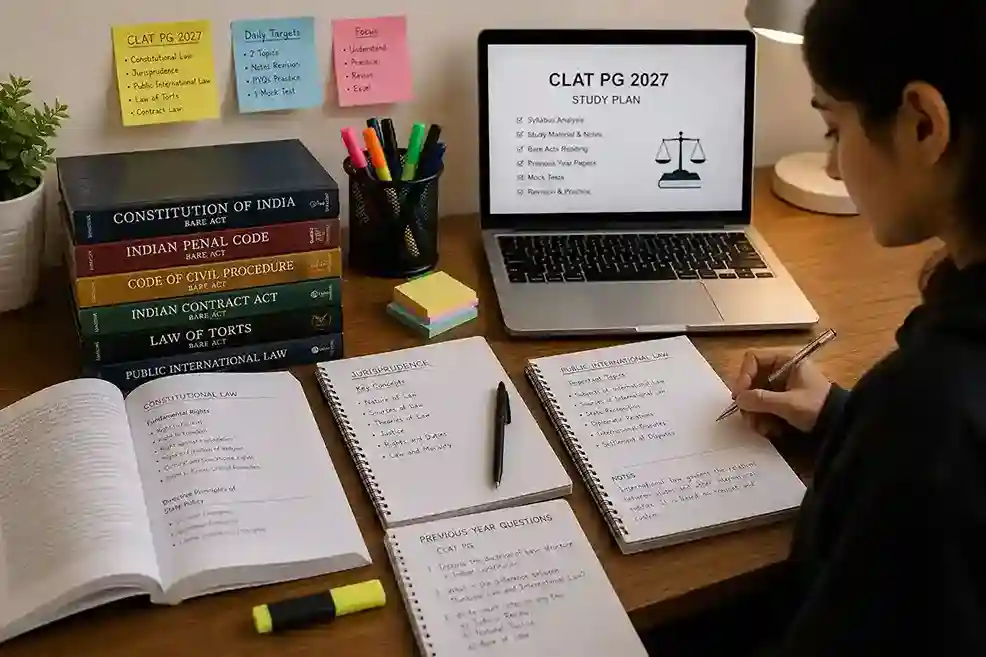
This exam is not a fresh subject to learn. It is your LLB tested under pressure. You already studied Constitutional Law, Jurisprudence, and Contract Law. The paper checks whether you can apply that knowledge fast, inside a passage you have never seen before.
That single fact should shape your entire study plan. Re-reading old notes will not help much. You need material that trains comprehension. It should sharpen recall of doctrines too. And it should build speed on passage-based questions drawn from judgments and bare acts.
This page builds your study material around that need. We rank every major subject by weight. We list the bare acts and case law you actually need. We also lay out a realistic week-by-week plan. Beyond that, we place this entrance test inside the wider map of law courses in India, so you know where an LLM fits if you are still deciding your path.
1. What This Exam Actually Tests
CLAT PG stands for the Common Law Admission Test for postgraduate studies. The Consortium of National Law Universities runs it once a year for LLM admission.
It is a rank-based exam, not a pass-fail one. Your score decides your All India Rank. That rank, along with your category and your NLU preferences, decides which law school offers you a seat.
The paper has 120 multiple choice questions, each worth one mark. A wrong answer costs you 0.25 marks. There is no separate section for general knowledge or maths. Every question comes from core law subjects taught in an LLB programme.
You get two hours. With 120 questions and negative marking, the real constraint is accuracy under time pressure, not raw legal knowledge. Most candidates already know the law. Rank is decided by who reads passages faster and avoids careless wrong answers.
Most questions sit inside a passage drawn from a judgment, a bare act, or a legal commentary. You read the passage, then answer questions on its meaning, application, or implication. Strong subject knowledge helps you read faster, but it does not replace the need to read carefully under a clock.
Who can apply for this LLM entrance exam
You need an LLB degree, either the three-year or the five-year integrated programme, from a recognised university. General and OBC candidates need at least 50% marks in that degree. SC and ST candidates get a relaxation and need 45% marks.
There is no upper age limit. Final-year LLB students can also apply. They just need to complete their degree with the required marks before admissions close. This makes the exam accessible to fresh graduates and working professionals alike.
How your score decides your seat
Your raw score converts into an All India Rank. The Consortium then runs centralised counselling, where you list your preferred NLUs in order. Seats go out round by round, based on rank, category, and your preference list.
Top NLUs like NLSIU Bangalore, NALSAR Hyderabad, and WBNUJS Kolkata usually close within the first few hundred ranks. This applies to the general category. Several other NLUs accept a wider range. That gives mid-rank candidates real options if they apply with a long preference list.
2. Core Subjects, Ranked by Weight
The syllabus draws from the full LLB curriculum, but not every subject gets equal space. A small group of subjects carries most of the marks. Knowing this changes how you split your study hours.
| Subject | Typical Weight | Why it matters |
|---|---|---|
| Constitutional Law | High | Fundamental rights, judicial review, and federal structure form the base of most passages |
| Jurisprudence | High | Legal theory questions test how well you understand the purpose behind laws, not just their text |
| Criminal Law (BNS, BNSS, BSA) | High | Mens rea, stages of crime, and procedure questions appear from the new criminal codes |
| Law of Contract | High | Offer, acceptance, breach, and remedies underlie a large share of civil law passages |
| Law of Torts | Medium-High | Negligence, strict liability, and remedies are common across passage-based questions |
| Family Law | Medium | Marriage, divorce, succession, and maintenance questions test applied personal law |
| Property Law | Medium | Transfer of Property Act concepts like sale, lease, and mortgage appear regularly |
| Company Law | Medium | Incorporation, director duties, and corporate governance basics from the Companies Act |
| Administrative Law | Medium | Delegated legislation, natural justice, and judicial review of executive action |
| International Law | Low-Medium | Sources of international law, treaties, and India's stand on global legal questions |
| Environmental Law | Low | Key statutes and the polluter-pays principle, usually one or two questions |
| Intellectual Property Law | Low | Basics of patents, trademarks, and copyrights, often passage-based |
| Labour and Industrial Law | Low | Industrial disputes, wages, and worker rights, usually a small share |
Spend most of your hours on the first four subjects. They send the most questions and overlap with each other. A strong grip on Constitutional Law also helps with Administrative Law and International Law. The reasoning style across these subjects is similar.
Constitutional Law: the subject that decides your rank
Constitutional Law sends the highest number of questions in most papers. Focus on fundamental rights, directive principles, the basic structure doctrine, and the scope of judicial review. Passages often quote a judgment and ask you to identify the principle it applied.
Pay close attention to amendments and recent constitutional developments. Examiners like to test whether you track how the law has changed, not just its original text from 1950.
Jurisprudence: the subject most candidates underrate
Jurisprudence feels abstract, so many candidates leave it for the last week. That is a mistake. It carries high weight and rewards careful reading more than memorisation. Know the core schools of legal thought. Know the difference between law and morality too. Understand how each school explains the purpose of punishment.
Questions in this subject often present a short scenario and ask which jurisprudential approach explains it best. Practice matching real-world fact patterns to theoretical schools, rather than just listing definitions.
Criminal Law under the new codes
India replaced three old criminal codes from July 2024. The Indian Penal Code became the Bharatiya Nyaya Sanhita. The Code of Criminal Procedure became the Bharatiya Nagarik Suraksha Sanhita. The Evidence Act became the Bharatiya Sakshya Adhiniyam. Questions now draw from these new codes, not the old ones.
The core legal concepts, such as mens rea, stages of crime, and rules of evidence, stayed largely the same. What changed are section numbers and a few new offence categories. If your LLB notes still reference old IPC sections, update them before you revise this subject.
3. Law Courses in India and Where LLM Fits
India offers several paths into a legal career. This entrance test sits at one specific point in that map. Understanding the full picture helps you plan beyond just this one exam.
The five-year integrated LLB, taken after class 12, is the most common starting point. Students enter through CLAT UG, AILET, or state-level law entrance tests. This path combines a bachelor's degree with law training in one programme.
The three-year LLB is for graduates from any stream who decide on law later. Many state universities and private law schools run this course, with entry through university-specific tests or merit lists.
An LLM, or Master of Laws, comes after either LLB path. It is a one or two-year postgraduate degree. You can specialise in areas like Constitutional Law, Criminal Law, Corporate Law, or International Law. This exam is the main entrance route into LLM programmes at NLUs. Some private institutions also run their own postgraduate law tests.
After an LLB, the All India Bar Examination becomes mandatory if you want to practise in court. AIBE is open-book and tests practical readiness. This exam tests comprehension and conceptual depth for academic admission instead.
Both paths work. An LLM straight after LLB suits candidates aiming for academia, research, or a specialised litigation practice. Working for a year or two first has its own benefit. It can sharpen your sense of which specialisation actually fits your interest. Classroom exposure and courtroom reality often differ.
Popular LLM specialisations at NLUs
Most NLUs offer specialisation tracks within their LLM programme. Common choices include Constitutional Law, Criminal Law and Justice, Corporate and Commercial Law, Intellectual Property Law, and International Trade Law. Some universities also run dedicated tracks in Human Rights, Environmental Law, or Technology Law.
Your specialisation choice affects your career path more than the entrance score itself. Corporate and IP tracks often lead toward law firms and in-house roles. Constitutional and Human Rights tracks suit candidates aiming for litigation, academia, or policy work.
This exam versus the undergraduate version: a quick comparison
CLAT UG tests aptitude through English, current affairs, legal reasoning, logical reasoning, and basic quantitative skills. It assumes no prior law knowledge, since most candidates apply right after class 12.
The postgraduate paper drops the aptitude sections entirely. It assumes you already hold a law degree. It tests how well you apply that training. The reading material is denser. The time per question is tighter. There is less room to guess your way through a topic you skipped.
LLM programme structure and duration
Most NLU LLM programmes run for one year. Some universities still offer a two-year format with a research dissertation component. A one-year LLM usually includes core courses, elective specialisations, and a shorter research paper. A two-year programme adds more coursework and a longer thesis.
Fees vary widely across NLUs. Some universities charge a modest amount, while others charge more, depending on infrastructure and scholarship support. Check each NLU's official fee structure during counselling. This affects your final choice more than rank alone.
4. Bare Acts and Case Law You Need
Most passages draw heavily from statutes and landmark judgments. You don't need to memorise full case citations, but you do need to know the principle each major case established.
| Subject Group | Bare Acts and Case Law to Cover |
|---|---|
| Constitution | The Constitution of India, with focus on Articles 12-35, 226, and 32 |
| Criminal Law | Bharatiya Nyaya Sanhita, 2023; Bharatiya Nagarik Suraksha Sanhita, 2023; Bharatiya Sakshya Adhiniyam, 2023 |
| Contract and Torts | Indian Contract Act, 1872; key negligence and strict liability judgments |
| Jurisprudence | Core legal theories from natural law, positivism, and the sociological school |
| Family Law | Hindu Marriage Act; Special Marriage Act; Hindu Succession Act; relevant personal law digests |
| Property Law | Transfer of Property Act, 1882, with focus on sale, lease, mortgage, and gift |
| Company Law | Companies Act, 2013, focused on incorporation and director duties |
| Administrative Law | Principles of natural justice and major judicial review judgments |
You don't need to read every act cover to cover. A compact digest works better than a full statute book. Group core doctrines with two or three landmark judgments per topic. Many candidates build a one-page summary per subject during revision. Each page lists the doctrine, one supporting case, and one common exception.
Building your own subject digest
Start each subject page with the core doctrine in one sentence. Add the leading case that established it, written in your own words, not copied from a textbook. Then note one exception or limit to the doctrine, since examiners often test edge cases.
Keep each digest to one page per subject. A shorter, well-organised page beats a long printout you never revise twice. Update these pages as you solve mock papers, adding any doctrine that tripped you up.
5. Comprehension Strategy That Builds Rank
An open-conceptual exam can trick you into over-preparing theory and under-preparing speed. Many candidates know the law well but still lose rank because they read passages too slowly.
Practise reading legal passages daily, even outside formal study time. Read one short judgment extract or bare act section each day and summarise it in two lines. This builds the same skill the exam tests.
Time yourself on full passages, not single questions. Pick a set of five passages from past papers and solve them under a strict two-minute-per-question limit. If you consistently run over, your reading speed needs work before your subject knowledge does.
Negative marking changes your approach to uncertain questions. Skip a question only when you have no real basis for an answer. A reasoned guess, where you can eliminate two of four options, is usually worth attempting.
You get roughly one minute per question on average. Spend less time confirming answers you're sure of. Bank that time for longer passages in Constitutional Law or Jurisprudence. These often need a second read.
Reading current affairs without losing focus
Some passages draw from recent judgments or legislative changes. You don't need to track every news story. Instead, follow a weekly digest of Supreme Court rulings and major bills passed in Parliament. Stay focused on subjects already in your syllabus.
Avoid the trap of reading broad current affairs meant for CLAT UG or other general exams. This paper stays narrowly legal, so your current affairs reading should stay narrowly legal too.
6. Eight-Week Study Plan
Most candidates preparing for this exam are final-year LLB students or working graduates. This plan assumes one to two hours a day, building toward full mock papers in the final two weeks.
In the final two weeks, stop reading new theory. Solve complete mock papers under exam timing instead. Review every wrong answer and note whether it was a knowledge gap or a reading error. That distinction changes what you fix next.
7. Mistakes That Cost Easy Rank
Many candidates know the law but still lose rank. The reasons are almost always avoidable.
- Treating the exam like a memory test instead of a comprehension and application test.
- Re-reading old LLB notes without practising passage-based questions under time pressure.
- Guessing blindly on questions with no real elimination logic, given the negative marking.
- Ignoring Jurisprudence because it feels abstract, even though it carries high weight.
- Studying the old IPC, CrPC, and Evidence Act instead of the current BNS, BNSS, and BSA.
- Skipping full mock papers until the last week, leaving no time to fix reading speed issues.
Candidates who improve their rank in the final month usually share one habit: they solve at least eight full-length mock papers under real time pressure before the exam. Subject revision alone rarely builds the reading speed this paper demands.
8. Common Questions
No. Most candidates clear CLAT PG through self-study using bare acts, case digests, and mock papers. Coaching can help if your LLB notes are weak in core subjects. It is not required to get a competitive rank.
Eight to ten weeks of steady, focused study works for most graduates. If your LLB foundation in Constitutional Law and Jurisprudence is strong, six weeks of revision can also be enough.
Yes. Candidates in their final year of LLB can apply. They just need to complete their degree with the required marks before admissions close.
You can reappear next year. There is no cap on attempts and no upper age limit. Many candidates also explore non-NLU law schools or university-specific LLM entrance tests as parallel options.
It tests the current legal framework. For criminal law, this means the Bharatiya Nyaya Sanhita, the Bharatiya Nagarik Suraksha Sanhita, and the Bharatiya Sakshya Adhiniyam. It does not test the older IPC, CrPC, or Evidence Act.
It can help, especially if you choose a specialisation that matches your intended practice area. An LLM is not mandatory for litigation, since an LLB plus AIBE is enough to practise. It does build deeper expertise and stronger academic credentials.