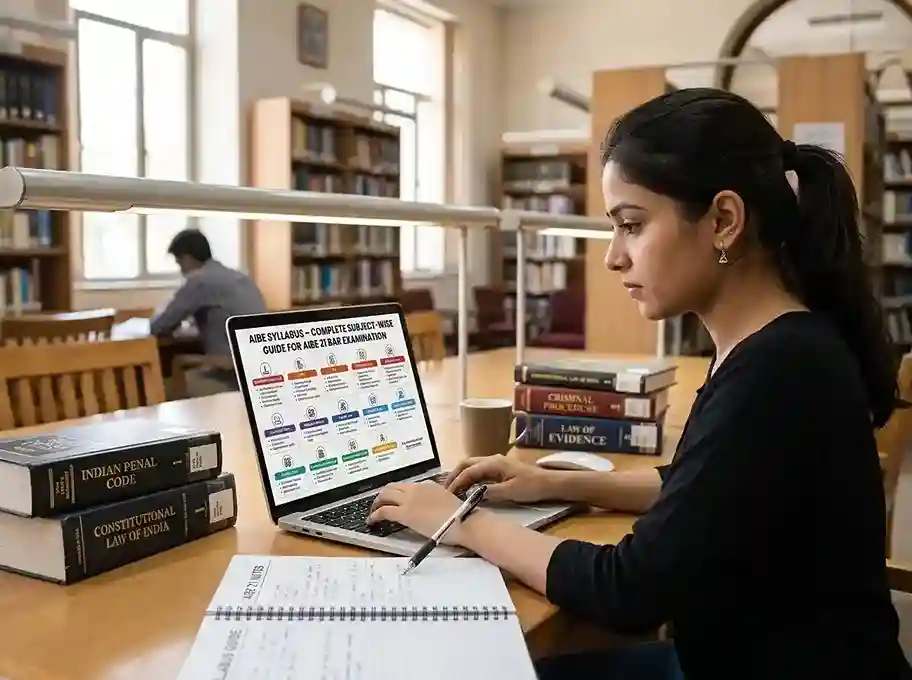
1. What is the AIBE 2026 Syllabus?
The AIBE Syllabus 2026 is the official list of law subjects, topics, and sub-topics prescribed by the Bar Council of India (BCI) for the All India Bar Examination (AIBE 21). It defines exactly what law graduates need to study and understand to pass the AIBE and earn the Certificate of Practice (CoP) — the mandatory licence required to practise law in Indian courts and tribunals.
The AIBE is not a competitive entrance exam — it is a qualifying examination that every law graduate in India must pass after enrolment with a State Bar Council. The syllabus is designed to test practical legal knowledge across the core subjects that an advocate encounters daily, from constitutional matters to criminal trials to civil disputes. The exam is held in offline mode and uniquely allows candidates to bring Bare Acts into the examination hall — a feature that distinguishes AIBE from all other law examinations in India.
For AIBE 21 (2026), the Bar Council of India confirmed on March 2, 2026, that the syllabus remains largely the same as AIBE 20 (2025). The key structural change first introduced in AIBE 19 (2024) — replacing the traditional IPC, CrPC, and Indian Evidence Act with the three new criminal codes — continues to be part of the AIBE 21 syllabus. Candidates must therefore prepare for Bharatiya Nyaya Sanhita (BNS), Bharatiya Nagarik Suraksha Sanhita (BNSS), and Bharatiya Sakshya Adhiniyam (BSA) alongside the traditional subjects.
Starting from 2026, the Bar Council of India conducts AIBE twice a year instead of once. This was done to reduce the waiting period for law graduates who want to begin practising law. AIBE 21 is scheduled for June 7, 2026. The second edition for 2026 will be announced separately. Candidates who fail AIBE 21 will have an earlier opportunity to appear again without waiting a full year.
2. AIBE 2026 Exam Pattern
Understanding the AIBE exam pattern is essential before diving into the syllabus. The exam structure directly informs how you should allocate study time across subjects.
| Parameter | Details |
|---|---|
| Exam Name | All India Bar Examination (AIBE XXI) |
| Conducted by | Bar Council of India (BCI) |
| Exam Date | June 7, 2026 |
| Exam Mode | Offline (OMR-based pen and paper) |
| Duration | 3 Hours 30 Minutes (210 minutes) |
| Total Questions | 100 MCQs |
| Total Marks | 100 (1 mark per question) |
| Negative Marking | None |
| Passing Marks | 45 out of 100 (General/OBC/EWS); 40 out of 100 (SC/ST) |
| Number of Subjects | 19 law subjects |
| Languages | 25 languages (English + regional languages) |
| Bare Acts | Allowed inside examination hall |
| Award | Certificate of Practice (CoP) |
| Official Website | allindiabarexamination.com |
With 100 questions in 210 minutes, you have approximately 2 minutes and 6 seconds per question. Since Bare Acts are allowed, many candidates rely on looking up provisions during the exam. The smart strategy: thoroughly understand the structure of each Bare Act so you can quickly navigate to the right section, rather than reading each Act cover-to-cover during the exam. Prioritise subjects with the highest weightage for self-study.
3. AIBE 2026 Subject-Wise Weightage (All 19 Subjects)
The table below shows all 19 subjects in the AIBE 21 syllabus along with the number of questions from each subject. Constitutional Law, CrPC/BNSS, and CPC carry the highest weightage at 10 questions each.
| # | Subject | Questions | % of Paper | Priority |
|---|---|---|---|---|
| 1 | Constitutional Law | 10 | 10% | HIGH |
| 2 | IPC / Bharatiya Nyaya Sanhita (BNS) NEW | 8 | 8% | HIGH |
| 3 | CrPC / Bharatiya Nagarik Suraksha Sanhita (BNSS) NEW | 10 | 10% | HIGH |
| 4 | Code of Civil Procedure (CPC) | 10 | 10% | HIGH |
| 5 | Evidence Act / Bharatiya Sakshya Adhiniyam (BSA) NEW | 5 | 5% | MEDIUM |
| 6 | Family Law I (Hindu Law) | 4 | 4% | MEDIUM |
| 7 | Family Law II (Muslim/Other Personal Laws) | 4 | 4% | MEDIUM |
| 8 | Law of Contract & Specific Relief | 7 | 7% | HIGH |
| 9 | Torts including Motor Vehicle Accidents & Consumer Protection | 4 | 4% | MEDIUM |
| 10 | Law of Limitation & Intellectual Property Rights | 4 | 4% | MEDIUM |
| 11 | Administrative Law | 4 | 4% | MEDIUM |
| 12 | Public Interest Lawyering, Legal Aid & Para-Legal Services | 4 | 4% | MEDIUM |
| 13 | Professional Ethics & Cases of Professional Misconduct | 8 | 8% | HIGH |
| 14 | Company Law | 4 | 4% | MEDIUM |
| 15 | Labour & Industrial Law | 4 | 4% | MEDIUM |
| 16 | Environmental Law | 3 | 3% | LOW |
| 17 | Cyber Law (IT Act & Amendments) | 3 | 3% | LOW |
| 18 | Alternative Dispute Resolution (ADR) | 3 | 3% | LOW |
| 19 | Right to Information (RTI Act) | 3 | 3% | LOW |
| TOTAL | 100 | 100% | — | |
4. Detailed Subject-Wise AIBE Syllabus 2026
Below is a comprehensive breakdown of the topics covered under each subject in the AIBE 2026 syllabus. Use this as your master checklist while preparing from Bare Acts and reference books.
5. New Criminal Codes in AIBE 2026: BNS, BNSS & BSA
One of the most significant developments in the AIBE syllabus since 2024 is the inclusion of three new criminal codes that replaced India's century-old laws on July 1, 2024. Every AIBE 21 candidate must understand these thoroughly.
| New Code | Replaces | Effective Date | Key Changes |
|---|---|---|---|
| Bharatiya Nyaya Sanhita (BNS), 2023 | Indian Penal Code (IPC), 1860 | July 1, 2024 | Sedition removed; organised crime & terrorism added; punishment for crimes against women enhanced; community service as punishment introduced |
| Bharatiya Nagarik Suraksha Sanhita (BNSS), 2023 | Code of Criminal Procedure (CrPC), 1973 | July 1, 2024 | Zero FIR recognised; trials by video conferencing; attachment of property of absconding persons; timelines for investigation and trial prescribed; forensic evidence mandatory in serious offences |
| Bharatiya Sakshya Adhiniyam (BSA), 2023 | Indian Evidence Act, 1872 | July 1, 2024 | Electronic and digital records expanded; electronic evidence admissibility simplified; definition of "document" updated to include electronic records |
Many candidates attempt to prepare only BNS/BNSS/BSA without the original IPC/CrPC/Evidence Act. This is a mistake. The new codes retain large portions of the old laws with modifications. The smartest approach is to: (1) first study IPC/CrPC/Evidence Act thoroughly as they form the foundation; (2) then study BNS/BNSS/BSA specifically for the changes, new sections, renumbered provisions, and new provisions. Many previous year AIBE questions are still directly applicable under the new codes. Keep both Bare Acts in the exam hall.
6. Bare Acts Allowed in AIBE 2026 — Complete List
The AIBE is unique in Indian legal education for allowing candidates to bring Bare Acts into the examination hall. This is by design — the exam tests whether a practising advocate can locate and apply law efficiently, which is a real-world skill. However, annotated books, commentary texts, or highlighted/marked Bare Acts may not be permitted — always verify the exact rules from the official notification.
| Category | Key Bare Acts to Carry |
|---|---|
| Constitutional | Constitution of India (with all Amendments) |
| Criminal Law (New) | Bharatiya Nyaya Sanhita (BNS) 2023; Bharatiya Nagarik Suraksha Sanhita (BNSS) 2023; Bharatiya Sakshya Adhiniyam (BSA) 2023 |
| Criminal Law (Old Reference) | Indian Penal Code, 1860; Code of Criminal Procedure, 1973; Indian Evidence Act, 1872 |
| Civil Law | Code of Civil Procedure, 1908; Specific Relief Act, 1963; Limitation Act, 1963 |
| Contract & Commerce | Indian Contract Act, 1872; Sale of Goods Act, 1930; Transfer of Property Act, 1882 |
| Family Law | Hindu Marriage Act, 1955; Hindu Succession Act, 1956; Muslim Personal Law (Shariat) Application Act; Special Marriage Act, 1954 |
| Professional | Advocates Act, 1961; BCI Rules |
| Other Important Acts | Consumer Protection Act, 2019; RTI Act, 2005; IT Act, 2000; Arbitration & Conciliation Act, 1996; Companies Act, 2013; Motor Vehicles Act, 1988 |
7. High-Weightage Topics to Prioritise in AIBE 2026
Strategic preparation requires knowing which topics yield the most marks. Based on analysis of previous year AIBE question papers and the official AIBE 21 weightage breakdown, the following topics have consistently appeared and carry significant scoring potential.
| Topic | Subject | Why Important |
|---|---|---|
| Fundamental Rights (Art. 12–35) | Constitutional Law | 2–3 questions in every AIBE; covers Art. 14, 19, 21, 32 extensively |
| Emergency Provisions (Art. 352–360) | Constitutional Law | Frequently tested; well-defined sections in Bare Act |
| Bail Provisions (BNSS) | CrPC / BNSS | Highly practical; every criminal advocate must know; tested every year |
| FIR & Investigation | CrPC / BNSS | Fundamental procedure; easy marks with Bare Act reference |
| Res Judicata (S.11 CPC) | CPC | Classic AIBE topic; concept + application questions |
| Temporary Injunctions (Order 39 CPC) | CPC | Practical relevance + frequently tested procedural law |
| BCI Rules on Professional Conduct | Professional Ethics | All 8 questions likely from Advocates Act + BCI Rules; highly scorable |
| Offer & Acceptance (Contract Act) | Contract Law | Foundational concept; scenario-based MCQs common |
| Divorce under Hindu Marriage Act | Family Law I | Grounds for divorce under S.13 HMA; frequent exam favourite |
| Section 65B BSA (Digital Evidence) | Evidence/BSA | New inclusion; highly testable in the digital age |
| Consumer Disputes Redressal | Torts/Consumer | District/State/National Commission jurisdiction; straightforward marks |
| RTI: Time Limits & Exemptions | RTI Act | Specific provisions tested; 3 questions — score all 3 with Bare Act |
8. AIBE 2026 Preparation Strategy: Step-by-Step
AIBE is fundamentally different from law entrance exams like CLAT or AILET — it is a professional examination that tests applied legal knowledge. Here is a proven step-by-step preparation strategy tailored for AIBE 21 (June 2026).
Download the Official Syllabus & Map It to Weightage
Download the official AIBE 21 syllabus from allindiabarexamination.com. Create a priority map: mark Constitutional Law, CrPC/BNSS, CPC (10Q each), IPC/BNS, Contract, Professional Ethics as Priority 1. Family Laws, Evidence, Torts as Priority 2. Remaining 7 subjects as Priority 3. This focus ensures you target the 55 highest-weightage questions first.
Assemble and Organise Your Bare Acts
AIBE allows Bare Acts in the hall — this is your greatest tool. Get clean (non-annotated) Bare Acts for all 19 subjects. Organise them with small paper bookmarks or tabs for key sections. Practise navigating quickly: can you open to Section 300 BNS in 15 seconds? Speed of Bare Act navigation directly determines your score.
Study New Criminal Codes (BNS/BNSS/BSA) Specifically
Dedicate at least 2 full weeks exclusively to BNS, BNSS, and BSA. Create a comparison chart: old IPC section → corresponding BNS section number. Example: S.302 IPC (murder) = S.101 BNS. This mapping ensures you are not confused during the exam when both old and new codes may be referenced. Pay particular attention to genuinely new provisions: organised crime, community service punishment, forensic evidence mandates, Zero FIR.
Solve Previous Year AIBE Question Papers
Practice AIBE question papers from AIBE 10 (2016) to AIBE 20 (2025). At least 30–40% of questions in any given AIBE are based on perennially tested provisions. Previous papers reveal the examiner's style: they tend to ask procedural "which section applies" type questions that are easily answerable with Bare Acts. Target 90 minutes per paper initially, then reduce to 60 minutes with Bare Act reference.
Focus on Professional Ethics — Score 8/8
Professional Ethics (8 questions) is an underestimated scoring opportunity. The entire subject comes from the Advocates Act, 1961 and BCI Rules. With just 60–70 pages of reading, you can target a perfect 8/8. Study the duties of an advocate — to court, to client, to opponent. Memorise the key disciplinary provisions, enumeration of professional misconduct, and rules on advertising.
Take Full-Length Mock Tests with Bare Acts (Simulate Exam Conditions)
One week before the AIBE 21 exam date (June 7, 2026), take at least 3 full-length mock tests under exam conditions: 100 questions, 210 minutes, Bare Acts physically present. This trains you to balance time between questions you know from memory and questions you need to look up. Aim to attempt all 100 questions — there is no negative marking, so never leave a question blank.
The minimum passing mark for AIBE is just 45/100 for General category (45%). Yet approximately 40–50% of first-time candidates fail. The primary reason: candidates over-rely on Bare Acts during the exam and run out of time. The solution is to know at least 50–55 questions from memory (the highest-weightage topics), and use Bare Acts only for the remaining 45–50 uncertain questions. This balance ensures you score well above 45 marks comfortably.
9. Recommended Books & Resources for AIBE 2026
| Subject | Recommended Book / Resource | Author / Publisher |
|---|---|---|
| Constitutional Law | Introduction to the Constitution of India | D.D. Basu |
| BNS / IPC | Bare Act: Bharatiya Nyaya Sanhita, 2023 + BNS & IPC Comparison Guide | Universal Law Publishing |
| BNSS / CrPC | Bare Act: BNSS 2023 + The Code of Criminal Procedure | R.V. Kelkar; Universal |
| CPC | Civil Procedure Code (with Short Notes) | C.K. Takwani |
| Evidence / BSA | Law of Evidence + BSA Bare Act | Batuk Lal / Vepa P. Sarathi |
| Contract Law | The Indian Contract Act (with Specific Relief Act) | Pollock & Mulla / Avtar Singh |
| Family Law | Family Law (Volumes I & II) | Paras Diwan |
| Professional Ethics | Advocates Act, 1961 Bare Act + BCI Rules | Bar Council of India |
| All Subjects (MCQs) | AIBE Previous Year Question Papers (AIBE 10–20) | Various Publishers |
| All Subjects (Mock Tests) | Online AIBE Mock Tests | LegistaCampus, Legal Edge, Lawctopus |
10. How AIBE Syllabus Differs from Other Law Exams
Understanding how AIBE differs from entrance exams helps law graduates recalibrate their preparation approach.
| Feature | AIBE 2026 | CLAT (UG) | CLAT PG |
|---|---|---|---|
| Purpose | Licence to practise law | LLB admission | LLM admission |
| Who Can Appear | LLB graduates enrolled with State Bar Council | Class 12 students | LLB graduates |
| Syllabus Focus | Applied/procedural law — all 19 core subjects | English, GK, Legal Reasoning, Maths | Constitutional Law, Jurisprudence, Contract, Torts, IPR |
| Question Type | MCQ — fact-application, procedure-based | MCQ — comprehension-based passages | MCQ — analytical law passages |
| Bare Acts | Allowed inside exam hall | Not applicable | Not applicable |
| Negative Marking | None | -0.25 | -0.25 |
| Passing Criterion | 45/100 (qualifying) | Rank-based (competitive) | Rank-based (competitive) |
11. AIBE Syllabus 2026 – Frequently Asked Questions (FAQs)
The AIBE 2026 (AIBE XXI) syllabus covers 19 law subjects with a total of 100 MCQ questions. Major subjects include Constitutional Law (10 questions), Criminal Procedure Code/BNSS (10 questions), Code of Civil Procedure (10 questions), IPC/BNS (8 questions), Professional Ethics (8 questions), Contract Law (7 questions), Evidence Act/BSA (5 questions), and more. The Bar Council of India officially released the AIBE 21 syllabus on March 2, 2026. A key feature of the 2026 syllabus is the inclusion of the three new criminal codes: BNS, BNSS, and BSA, which replaced IPC, CrPC, and Indian Evidence Act from July 1, 2024.
The AIBE 21 syllabus (2026) is the same as AIBE 20 (2025) in terms of subjects and weightage. The major structural change happened in AIBE 19 (2024) when BNS, BNSS, and BSA replaced IPC, CrPC, and Evidence Act respectively. These three new criminal codes remain part of the AIBE 21 syllabus. There have been no additional new subjects or significant weightage changes for 2026. Candidates who prepared for AIBE 20 do not need to start from scratch for AIBE 21.
Yes, Bare Acts (unannotated statutory texts) are allowed inside the AIBE examination hall. This is a unique feature of the AIBE — unlike any other law examination in India. Candidates can bring physical copies of relevant statutes such as the Constitution of India, BNS, BNSS, BSA, CPC, Contract Act, and other relevant laws. However, annotated books, books with commentary, or books with excessive highlighting may not be permitted. Always verify the exact rules from the official AIBE 21 notification at allindiabarexamination.com before the exam date.
For AIBE 2026, General/OBC/EWS candidates need to score a minimum of 45 out of 100 marks to qualify and receive the Certificate of Practice (CoP). SC/ST candidates need a minimum of 40 out of 100. There is no negative marking for wrong answers — every question should be attempted. Unlike competitive law exams like CLAT, AIBE is a qualifying examination and there is no merit-based ranking. Any candidate scoring at or above the cut-off receives the CoP.
The Bar Council of India updated the AIBE schedule in 2026 to conduct the examination twice a year instead of once annually. AIBE 21 is scheduled for June 7, 2026. The date for the second AIBE in 2026 will be announced separately. This change reduces the waiting period for law graduates who want to begin practising law. If a candidate fails AIBE 21, they will have another opportunity within the same calendar year rather than waiting 12 months.
In AIBE 2026, the subjects with the highest weightage (number of questions) are: Constitutional Law (10 questions), Code of Criminal Procedure / BNSS (10 questions), and Code of Civil Procedure (10 questions). These three subjects alone account for 30 out of 100 marks — 30% of the entire paper. IPC/BNS (8 questions) and Professional Ethics (8 questions) are the next highest. Together, the top 5 subjects account for 46 out of 100 questions. Candidates should invest most of their study time in these five subjects.
AIBE 2026 can be taken in 25 languages, making it one of the most linguistically inclusive professional examinations in India. The available languages include English, Hindi, Tamil, Telugu, Kannada, Malayalam, Gujarati, Marathi, Bengali, Odia, Punjabi, Urdu, Assamese, and several other regional languages. Candidates select their preferred language at the time of registration. The question paper is provided in the selected language. Most candidates appear in either English or Hindi, which are the most commonly used languages in legal practice.