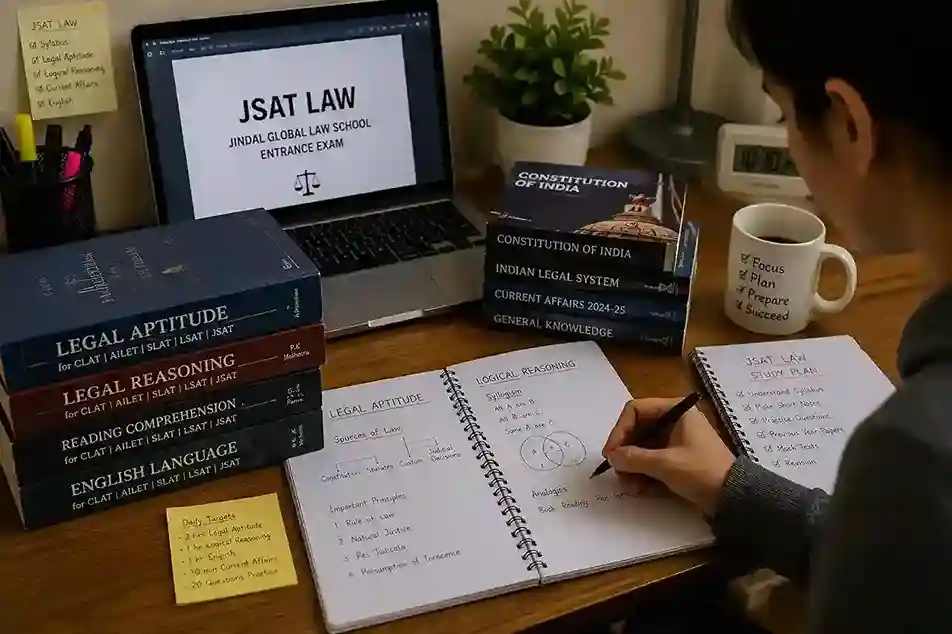
What is JSAT Law?
JSAT Law stands for Jindal Scholastic Aptitude Test | Law. It is the entrance exam for law programmes at Jindal Global Law School (JGLS), Sonipat, Haryana.
JGLS is part of O.P. Jindal Global University (JGU). The university conducts JSAT Law through Pearson VUE | a well-known international exam platform. This makes JSAT Law fully online and AI-proctored. You can take the exam from home using a desktop or laptop.
The test has 60 multiple-choice questions to be answered in 90 minutes. It covers three areas: Analytical Reasoning, Logical Reasoning, and Reading Comprehension. There is no negative marking. Candidates need 50% or above to qualify.
JSAT Law is separate from JSAT General. JSAT General is for non-law programmes at JGU like BBA, BCom, and Liberal Arts. JSAT Law is only for law programmes at JGLS. The question format and syllabus are different for both.
Jindal Global Law School is one of India's top-ranked private law schools. It appears consistently in the NIRF law school rankings. For students who want a globally oriented legal education outside the NLU system, JSAT Law is the primary gateway.
Courses Offered Through JSAT Law
JSAT Law scores are accepted for both undergraduate and postgraduate law programmes at JGLS. However, the 5-year integrated LLB programmes require a different exam | LNAT (Law National Aptitude Test) from the UK.
| Programme | Level | Duration | Entrance Required |
|---|---|---|---|
| 3-year LLB (Hons.) | Undergraduate (Post-Graduation) | 3 Years | JSAT Law |
| LLM (Master of Laws) | Postgraduate | 1 Year | JSAT Law |
| BA (Hons.) in Legal Studies | Undergraduate | 3 Years | JSAT Law |
| BA (Hons.) in Criminology & Criminal Justice | Undergraduate | 3 Years | JSAT Law |
| BA (Hons.) in AI and Law | Undergraduate | 3 Years | JSAT Law |
| BA LLB (Hons.) | 5-year Integrated | 5 Years | LNAT | not JSAT |
| BBA LLB (Hons.) | 5-year Integrated | 5 Years | LNAT | not JSAT |
| BCom LLB (Hons.) | 5-year Integrated | 5 Years | LNAT | not JSAT |
Eligibility for JSAT Law 2026
Eligibility varies by programme. Check the table below carefully before applying.
| Programme | Minimum Qualification | Minimum Marks | Age |
|---|---|---|---|
| 3-year LLB (Hons.) | Graduation in any stream from a recognised university | 45% aggregate | No age bar |
| BA (Hons.) Legal Studies / Criminology / AI & Law | Class 12 (10+2) from a recognised board | 60% aggregate | Minimum 17 years at time of admission |
| LLM (1-year) | LLB or equivalent law degree from a recognised university | 45% | No age bar |
- Candidates who are awaiting Class 12 or graduation results can also apply and appear for JSAT Law.
- Candidates from any stream can apply for 3-year LLB | arts, science, and commerce graduates are all eligible.
- NRI and PIO cardholders are eligible to apply for JSAT Law 2026.
- No backlog in the qualifying exam is allowed at the time of admission.
JSAT Law Exam Pattern 2026
The JSAT Law exam is fully objective. There are no subjective or descriptive questions. Every question is an MCQ with four answer options. Here is the complete pattern:
| Feature | Details |
|---|---|
| Total Questions | 60 MCQs |
| Total Marks | 240 (4 marks per correct answer) |
| Duration | 90 minutes |
| Mode | Online, Remote Proctored (via Pearson VUE) |
| Device | Desktop or Laptop only (no mobile or tablet) |
| Negative Marking | None | attempt all 60 questions |
| Qualifying Score | 50% (120 marks out of 240) |
| Skipped Questions | Cannot go back to skipped questions | answer in order |
| Result | Available within 48 hours on the application portal |
| Sectional Cutoff | None | only overall 50% required |
| Section | Questions | Marks |
|---|---|---|
| Section 1 | Analytical Reasoning | 20 Questions | 80 Marks |
| Section 2 | Logical Reasoning | 20 Questions | 80 Marks |
| Section 3 | Reading Comprehension | 20 Questions | 80 Marks |
| Total | 60 Questions | 240 Marks |
JSAT Law Syllabus 2026 | Section by Section
The JSAT Law syllabus is officially defined by JGLS. It covers three sections. Each section has 20 questions. Together they test how well you can think, reason, and understand complex text. There are no legal knowledge questions in JSAT Law.
Analytical Reasoning
- Seating and circular arrangements
- Blood relations and family trees
- Ranking and ordering
- Direction and distance
- Scheduling and sequencing
- Grid-based puzzles
- Data sufficiency
Logical Reasoning
- Syllogisms and deductive reasoning
- Statement and conclusion
- Statement and assumptions
- Strengthening and weakening arguments
- Cause and effect
- Critical reasoning
- Inference and logical gaps
Reading Comprehension
- Dense analytical passages (400–600 words)
- Main idea and central argument
- Inference and implied meaning
- Author's tone and purpose
- Fact vs. opinion distinction
- Title identification
- Vocabulary in context
The JSAT Law syllabus does not include legal theory, constitutional law, or current affairs. It tests pure reasoning and comprehension. This means you do not need any prior law knowledge to score well.
Section 1 | Analytical Reasoning: Study Guide
Analytical Reasoning is the first section of JSAT Law. It tests your ability to work with structured information. You receive a set of facts or conditions. Then you answer questions based only on those facts.
Think of it like a puzzle. You are given a scenario | say, six people sitting in a row, with conditions about who can sit next to whom. The questions ask you to figure out the arrangement. You do not need any outside knowledge. Everything you need is given in the question.
Key Topic Types in Analytical Reasoning
| Topic | What It Tests | Difficulty | Frequency |
|---|---|---|---|
| Seating Arrangement (Linear) | Who sits where in a row based on given conditions | Moderate | High |
| Circular Arrangement | People arranged around a table with directional conditions | Hard | High |
| Blood Relations | Identify family relationships from coded or described clues | Easy–Moderate | High |
| Scheduling and Order | Who does what activity and in what order | Moderate | Medium |
| Direction and Distance | Track position and distance after a series of movements | Easy | Medium |
| Grid / Matrix Puzzles | Fill a matrix based on multiple conditions | Hard | Low |
How to Prepare for Analytical Reasoning
- Read the entire set of conditions before drawing any diagram or table.
- Always draw a rough diagram | a line for linear arrangements, a circle for circular ones.
- Write conditions in shorthand (e.g., A≠B, C is left of D) to avoid rereading.
- In blood relation questions, draw the family tree step by step.
- Practice 5 arrangement puzzles daily. Speed improves only through repeated practice.
- Start with linear seating, then move to circular, then to scheduling.
Section 2 | Logical Reasoning: Study Guide
Logical Reasoning tests how well you evaluate arguments. Each question gives you a short passage. The passage contains a claim, argument, or statement. You must answer what follows logically from it.
This is not about what you know. It is about how you reason. A student who reads newspapers daily and practises argument analysis does well in this section.
Important Topics in Logical Reasoning
| Topic | Description | JSAT Weight |
|---|---|---|
| Syllogisms | Two premises → one conclusion. Test if conclusion necessarily follows. | High |
| Statement and Conclusion | Given a statement, identify which conclusion definitely follows. | High |
| Statement and Assumptions | Identify hidden assumptions that make the statement valid. | High |
| Strengthening / Weakening Arguments | Choose the option that most strengthens or weakens the given argument. | Medium |
| Cause and Effect | Identify whether two statements are cause and effect or coincidence. | Medium |
| Critical Reasoning (Flaw in Argument) | Identify the logical flaw or gap in an argument. | Medium |
| Inference Questions | What can be inferred from the given statements? Only certain inferences qualify. | Medium |
Tips for Logical Reasoning
- For syllogism questions, use Venn diagrams to check if conclusions are valid.
- Never add your own knowledge. Answer based only on what the passage says.
- Watch for extreme words in conclusions | "always," "never," "all" | these are usually wrong.
- For strengthening/weakening: read the argument's main assumption first. Then see which option attacks or supports that assumption.
- In critical reasoning, look for the gap between the evidence and the conclusion.
- Practise at least 15 logical reasoning questions per day for 4 weeks.
Section 3 | Reading Comprehension: Study Guide
Reading Comprehension (RC) is the third section of JSAT Law. It has 20 questions based on 3–4 dense passages. Each passage is 400–600 words long. The topics are typically analytical | covering social issues, philosophy, law, science, and language.
The JSAT Law sample paper shows that RC passages are literary or analytical in nature. One past passage analysed the writing style of Thomas Hardy. Others have covered political arguments, social justice, and language diversity. The passages are not easy. But the questions are fair if you read actively.
Question Types in RC
- Main idea: What is the central argument of the passage?
- Factual recall: What does the passage say about X?
- Inference: What can be concluded from the passage even if not directly stated?
- Author's purpose: Why did the author write this passage? What is the tone?
- Title identification: Which title best fits this passage?
- Vocabulary in context: What does the word X mean as used in the passage?
- Critical evaluation: Which option strengthens or weakens the author's argument?
Reading Strategy for JSAT Law RC
- Read the first and last paragraph carefully. They usually contain the main argument.
- Read the questions before re-reading the passage. Know what to look for.
- Do not bring in outside knowledge. Answer only from what the passage says.
- Mark the location of each key point as you read | note the paragraph number.
- For inference questions, choose the safest logical step | not a wild leap.
- For tone questions, note the words the author uses. Words like "unfortunately" or "remarkably" signal the author's attitude.
- Practise reading one dense editorial or analytical article every day for at least 3 months before the exam.
Sample Questions | JSAT Law Style
These questions follow the style and difficulty of actual JSAT Law questions. They are based on the official JGLS sample paper and are representative of what you will face in the exam.
Analytical Reasoning | Seating Arrangement
Directions: Six students | A, B, C, D, E, and F | are sitting in a straight line facing north. C sits third from the left end. A is not adjacent to C. B sits at the extreme right end. D is to the immediate left of B. E is not at the extreme ends. F sits to the left of A.
Q1. Who sits second from the right end?
- A A
- B E
- C D
- D C
Logical Reasoning | Critical Reasoning
Passage: All intelligent people are nearsighted. Ram is very nearsighted. So Ram must be a genius.
Which of the following best describes the logical flaw in the argument above?
- A The conclusion is the same as one of the premises stated differently.
- B It concludes that because something is a characteristic of intelligent people, having that characteristic makes someone intelligent.
- C It relies on a definition of intelligence that is not universally accepted.
- D It assumes Ram's nearsightedness is caused by intelligence, not genetics.
Reading Comprehension | Author's Argument
Passage (excerpt): "Hindi ought to be the official language of India. There is no reason for the government to spend money printing documents in different languages just to cater to people who do not know Hindi. The government has better ways to spend taxpayers' money. People across India should learn Hindi at the earliest."
Q. Which of the following, if true, would most weaken the speaker's argument?
- A The government currently translates official documents into more than eighteen languages because doing so significantly reduces social exclusion and is constitutionally mandated.
- B Hindi is the most spoken language in India.
- C Most people who travel across India learn basic Hindi within five years.
- D People who are multilingual usually pay maximum taxes.
Best Books and Study Resources for JSAT Law
JSAT Law does not have an official dedicated textbook. But the three sections map closely to standard aptitude and law entrance exam material. These books and resources are the most effective for JSAT Law preparation:
| Section | Recommended Resource | Why Useful |
|---|---|---|
| Analytical Reasoning | A Modern Approach to Verbal and Non-Verbal Reasoning | R.S. Aggarwal (S. Chand) | Covers all arrangement and puzzle types with explained solutions. Best starting resource. |
| Analytical Reasoning | Analytical Reasoning | M.K. Pandey (BSC Publishing) | Dedicated to analytical puzzles. Better depth than Aggarwal for complex grid and scheduling puzzles. |
| Logical Reasoning | Logical Reasoning for the CLAT | A.P. Bhardwaj | Designed for law entrance exams. Covers syllogisms, critical reasoning, and argument analysis well. |
| Logical Reasoning | How to Prepare for Logical Reasoning for CAT | Arun Sharma (McGraw Hill) | The best single resource for critical reasoning, strenghening/weakening, and assumption questions. |
| Reading Comprehension | Word Power Made Easy | Norman Lewis | Builds vocabulary and word recognition in context | critical for RC passages with dense language. |
| Reading Comprehension | Daily reading of quality editorial pages (one newspaper per day) | RC passages in JSAT Law are analytical and editorial in style. Daily reading builds speed and comprehension naturally. |
| All Sections | Official JSAT Law Sample Paper (from lawadmissions.jgu.edu.in) | The single most important resource. Attempt it first to understand the exact style and difficulty. |
| All Sections | CLAT Previous Year Papers (Legal Reasoning and RC sections) | CLAT RC and logical reasoning overlap strongly with JSAT Law content. |
JSAT Law Preparation Strategy
JSAT Law is not a test you need months of coaching for. The university itself says it is not a test that requires extensive preparation. But you do need focused, structured practice. Here is a clear strategy:
- 1 Attempt the official sample paper first. Do this before reading any book or guide. Give yourself 90 minutes. Attempt all 60 questions. Check your score. This shows your real starting level in each section.
- 2 Identify your weakest section. Most students find Analytical Reasoning (puzzles) hardest. Some struggle with RC. Spend 60% of your study time on your weakest section. Do not ignore the other two.
- 3 Study one section at a time for two weeks. Analytical Reasoning first. Then Logical Reasoning. Then RC. Revisit each section in the final week. Mixing all three daily at the start is less effective than focused single-section study.
- 4 Practise 20 questions per section every day. Use the books recommended above. Time yourself. Do not spend more than 90 seconds per question during practice. Speed is a real constraint on exam day.
- 5 Take full-length mock tests every Sunday. Simulate the exact exam | 60 questions, 90 minutes, no breaks. Analyse every wrong answer. Understand why you got it wrong. Fix the concept before the next mock.
- 6 Read one analytical article or editorial daily for RC. Choose long-form writing with dense argument structures. This builds reading speed and comprehension simultaneously. There is no shortcut for RC | only daily practice works.
- 7 Use your 3 attempts wisely. Many candidates score poorly on the first attempt because they are unfamiliar with the remote proctoring format and question style. Treat the first attempt as a diagnostic. Use insights from it to improve for the second or third attempt.
6-Week Study Schedule for JSAT Law
This schedule works for a student starting from scratch. If you have 6 weeks before your exam, follow this week-by-week plan:
How to Apply for JSAT Law 2026
The application process for JSAT Law is fully online. Here are the steps:
- 1 Visit the official portal | lawadmissions.jgu.edu.in. This is the only official application link for JSAT Law.
- 2 Register with your name, email, and mobile number. Create your login ID and password.
- 3 Fill in the detailed application form | personal details, academic qualifications, programme choice.
- 4 Pay the application fee of Rs 1,000 online. The fee is non-refundable.
- 5 After payment, the "Book JSAT Law Slot" button appears on your dashboard. Book your preferred exam date and time through Pearson VUE.
- 6 Take the exam from home on your chosen date using your desktop or laptop. Ensure good internet, a webcam, and a quiet room.
- 7 Results appear on your application portal within 48 hours of the exam. If you score 50%+, you proceed to the next stage of JGLS admission.
JSAT Law vs LNAT | Which Exam Do You Need?
Many students get confused about JSAT Law and LNAT. JGLS accepts both, but for different programmes. Here is a clear comparison:
| Feature | JSAT Law | LNAT |
|---|---|---|
| Full Name | Jindal Scholastic Aptitude Test | Law | Law National Aptitude Test |
| Conducted By | Pearson VUE for JGU | LNAT Consortium, UK |
| Programmes | 3-year LLB, LLM, BA Legal Studies, BA Criminology, BA AI & Law | 5-year BA LLB, BBA LLB, BCom LLB at JGLS |
| Questions | 60 MCQs | 42 MCQs + 1 Essay |
| Duration | 90 minutes | 2 hours 15 minutes |
| Sections | Analytical Reasoning, Logical Reasoning, RC | Reading Comprehension (MCQ) + Essay Writing |
| Negative Marking | None | None |
| Test Fee | Rs 1,000 (application) + Rs 1,020 per re-attempt | International fee (in GBP/USD) |
If you want to study BA LLB at JGLS, you need LNAT. If you want 3-year LLB or LLM at JGLS, you need JSAT Law. Some candidates apply for both programmes and take both exams. Decide your target programme first, then prepare for the right exam.
Law Courses After Qualifying JSAT Law
Qualifying JSAT Law opens the door to JGLS. But law aspirants in India have many other options too. Here is how JSAT Law fits into the broader picture of law education in India:
| Law Programme | Entrance Exam | Duration |
|---|---|---|
| 3-year LLB at JGLS | JSAT Law | 3 years |
| 5-year BA LLB / BBA LLB at NLUs | CLAT | 5 years |
| 5-year BA LLB at NLU Delhi | AILET | 5 years |
| 5-year BA LLB / BBA LLB at JGLS | LNAT | 5 years |
| 3-year LLB at general universities | DU LLB, MH CET Law, state-level tests | 3 years |
| LLM at NLUs | CLAT PG | 1–2 years |
| LLM at JGLS | JSAT Law | 1 year |
If you are preparing for JSAT Law, the same preparation | Analytical Reasoning, Logical Reasoning, and RC | also builds skills for CLAT, AILET, and LSAT India. These exams share large overlapping skill requirements.