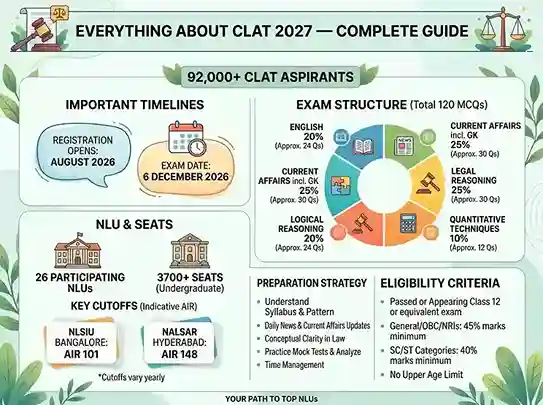
The Common Law Admission Test (CLAT) is India's most competitive law entrance exam | the gateway to 26 National Law Universities and 60+ affiliated colleges. Whether you are a Class 11 student planning two years ahead, a Class 12 student with less than 7 months to go, or a law graduate targeting the CLAT PG for LLM admission | this is the only guide you need. Everything about CLAT, explained clearly and completely.
✍️ By Kavya Sharma, LLB NALSAR Hyderabad (2021) | Senior Law Exams Editor
🔍 Data Sources: Consortium of NLUs (consortiumofnlus.ac.in)
Everything About CLAT 2027 | Exam Date, Syllabus, Pattern, NLU List, Cutoff & Preparation | LawGuru India | Source: Consortium of NLUs
📌 CLAT 2027 | At a Glance
Exam Date (Expected)
6 December 2026 (Sunday)
Registration Opens
1 August 2026
Mode & Duration
Offline | 120 minutes
Questions & Marking
120 MCQs | +1 / −0.25
Conducting Body
Consortium of NLUs
Official Website
consortiumofnlus.ac.in
🏛
CLAT 2027 Reform Committee: The Consortium of NLUs has formed an Expert Committee chaired by Justice Indu Malhotra (Retd.) to review and recommend reforms for CLAT starting from 2027. The panel includes professors from Oxford, LSE, Columbia, Cambridge, and BML Munjal University. Expected changes include enhanced reading comprehension depth, improved legal reasoning question quality, and greater transparency in evaluation. Aspirants should monitor the official website for any syllabus or pattern updates once the committee's recommendations are published.
CLAT | the Common Law Admission Test | is India's centralised national-level law entrance examination. Conducted annually by the Consortium of National Law Universities (NLUs), CLAT provides a single gateway for admission to both undergraduate (BA LLB) and postgraduate (LLM) law programmes across India's premier National Law Universities.
CLAT was first introduced in 2008, replacing the separate entrance exams conducted by individual NLUs. Today, it has grown into one of India's most competitive entrance tests, attracting over 92,000 aspirants in 2026 for approximately 3,700 UG seats across 26 participating NLUs | an acceptance rate of roughly 4%. The exam has evolved from a knowledge-heavy test to a comprehension and reasoning-intensive assessment, making regular reading and analytical thinking the central preparation activities.
1.1 Why CLAT Matters | What a CLAT Score Unlocks
🏛
Top NLU Admission
26 NLUs including NLSIU, NALSAR, NUJS | India's finest law schools
💼
Elite Career Access
Tier-1 law firms, Big 4, MNCs, investment banks, judiciary
📜
60+ Affiliated Colleges
Non-NLU law colleges also accept CLAT scores for admission
⚖️
Judicial Services Path
NLU degree is strong foundation for State PCS (J) & HJS exams
🌍
Global Opportunities
NLU alumni pursue LLMs at Oxford, Harvard, LSE, NYU
🎓
LLM Admissions (PG)
CLAT PG for LLM at all 26 NLUs | separate paper, same exam cycle
2. CLAT 2027 Key Dates & Complete Schedule
The CLAT 2027 exam cycle follows a predictable annual pattern established by the Consortium of NLUs. The official notification for CLAT 2027 is expected in July 2026, with registration opening on 1 August 2026. The exam itself is expected on 6 December 2026 (Sunday), consistent with the CLAT 2026 date of 7 December 2025.
Event
Expected Date / Timeline
Notes
Official Notification Release
July 2026
Published at consortiumofnlus.ac.in
Registration Opens
1 August 2026
Online only; apply at consortiumofnlus.ac.in
Last Date to Apply
Last week of October 2026
Late fee may apply beyond regular deadline
Application Correction Window
To be announced (typically 3–5 days after deadline)
One-time correction of specified fields
Admit Card Download
November 2026 (15 days before exam)
Download from CLAT portal; mandatory at exam hall
🗓 CLAT 2027 Exam Date
6 December 2026 (Sunday)
Offline mode | 2:00 PM – 4:00 PM (expected)
Answer Key Release
Within 48–72 hours of exam
Provisional key; objection window follows
CLAT 2027 Result Declaration
3rd week of December 2026
Score + All India Rank released together
Counselling & Seat Allotment
December 2026 – March 2027
3–5 rounds; via CLAT portal
Classes Begin at NLUs
July–August 2027
Varies by NLU; confirmed post-document verification
⏰
Don't miss the registration window: CLAT registration is typically open for approximately 90 days. Missing the deadline means waiting an entire year for the next cycle. Set calendar reminders for 1 August 2026 (registration opens) and 15 October 2026 (target date to apply, well before the last date). The correction window after the deadline allows you to fix only specific fields | not your entire application | so submit carefully the first time.
3. CLAT Eligibility Criteria 2027 | UG & PG
CLAT has separate eligibility criteria for the UG (undergraduate BA LLB) and PG (postgraduate LLM) programmes. There is no upper age limit for CLAT | a frequently misunderstood point. Below is the complete eligibility framework:
3.1 CLAT UG 2027 Eligibility
Eligibility Factor
General / OBC / PWD / NRI / PIO / OCI
SC / ST
Qualifying Exam
10+2 (Class 12) or equivalent from a recognised board
Minimum Marks
45% aggregate
40% aggregate
Appearing Candidates
Students appearing in Class 12 boards in 2027 are eligible to apply
Upper Age Limit
No upper age limit | any age can appear
Stream Restriction
Any stream (Science, Commerce, Arts) | no restriction
Nationality
Indian nationals + NRI/PIO/OCI (separate fees); foreign nationals permitted
3.2 CLAT PG 2027 Eligibility (LLM)
Eligibility Factor
General / OBC / NRI
SC / ST
Qualifying Degree
LLB degree (3-year or 5-year integrated) from a BCI-recognised university
Minimum Marks in LLB
50% aggregate
45% aggregate
Final-Year LLB Students
Eligible to apply | admission conditional on final results meeting the minimum %
Age Limit
No upper age limit
ℹ️
Key eligibility facts often misunderstood: (1) A student from a Science or Commerce background in Class 12 is fully eligible | CLAT has no stream restriction. (2) There is truly no upper age limit | even a 30-year-old professional can sit the CLAT UG exam. (3) A student who has appeared in Class 12 boards but not yet received results can apply using anticipated marks. (4) Candidates with PWD (Persons with Disability) certificates qualify at 45% (General) and 40% (SC/ST).
The CLAT 2027 UG exam is conducted in offline (pen-and-paper) mode with a single question booklet of 120 MCQs to be attempted in 120 minutes. This means exactly one minute per question | making time management a critical skill. Every question carries +1 mark for a correct answer and −0.25 marks (negative marking) for a wrong answer. Unattempted questions carry zero marks.
Parameter
CLAT UG 2027
CLAT PG 2027
Mode
Offline (pen-and-paper)
Offline (pen-and-paper)
Duration
120 minutes (2 hours)
120 minutes (2 hours)
Total Questions
120 MCQs
120 MCQs
Total Marks
120 marks
120 marks
Marking Scheme
+1 correct | −0.25 wrong | 0 unattempted
+1 correct | −0.25 wrong | 0 unattempted
No. of Sections
5 sections
Not divided into fixed sections
Question Type
Passage-based MCQs (all sections)
Passage-based MCQs (law-focused)
Language
English only
English only
Frequency
Once a year (December)
Once a year (same day as UG)
4.1 Section-Wise Breakdown | Questions, Weightage & Time Allocation
SectionWeightageQsMarksSuggested Time
English Language
20%22–26 Qs
Reading comprehension, grammar, vocabulary | all through passages of 400–450 words | Suggested: 22–24 min
Current Affairs + GK
25%28–32 Qs
National/international events, static GK, environment, government schemes | via news-article passages | Suggested: 28–30 min
Legal Reasoning
25%28–32 Qs
Legal principles given in passages → apply to factual scenarios. No prior law knowledge needed | only interpretation | Suggested: 30–32 min
Logical Reasoning
20%22–26 Qs
Analogies, argument structures, logical inferences | via prose passages. Tests ability to spot patterns and contradictions | Suggested: 22–24 min
Quantitative Techniques
10%10–14 Qs
Class 10-level arithmetic | percentages, ratios, profit & loss, averages, data interpretation through tables/graphs | Suggested: 12–14 min
🎯
Exam strategy from the weightage data: Current Affairs + Legal Reasoning together account for 50% of the paper. Any aspirant who masters these two sections and performs decently in the remaining three has a very strong shot at a top-100 rank. Conversely, ignoring Quantitative Techniques (10%) is a common mistake | these 10–14 questions are among the easiest to score in the paper if you have solid Class 10 maths basics. Never skip any section during preparation.
The CLAT 2027 syllabus is comprehension-first and passage-based across all five sections. Unlike most competitive exams, CLAT does not test rote memory in isolation | every question is anchored to a passage of 400–450 words. Your reading speed, comprehension depth, and ability to extract inferences are what determine your score. Here is the detailed section-wise syllabus:
Section 1: English Language20% | 22–26 Questions
Tests English comprehension skills through passages from literature, journalism, and analytical writing. Grammar and vocabulary are not tested in isolation | they appear only within the context of passages.
Reading ComprehensionVocabulary in ContextGrammar Through PassagesMain Idea IdentificationInference & ImplicationAuthor's Tone & Purpose
Section 2: Current Affairs including General Knowledge25% | 28–32 Questions
Passages drawn from news articles and current events reporting. Tests awareness of recent national and international events, as well as historically significant static GK. A student who reads quality newspapers daily will process these passages significantly faster.
Current Affairs Topics:
National & International Events
Indian & World Politics
Government Schemes & Policies
Awards, Appointments, Summits
Environment & Climate
Science & Technology
Economy & Finance
Static GK Topics:
Indian History & Culture
Geography | India & World
Indian Polity & Constitution
Sports | India & International
Books, Authors, Organisations
Art, Heritage, & Monuments
Science | Inventions & Discoveries
Section 3: Legal Reasoning25% | 28–32 Questions ★ Most Critical
Crucial: No prior knowledge of law is required for this section. All legal principles are stated within the passage itself. Your task is to read the passage, understand the principle, and correctly apply it to the factual scenario in the question. This tests legal aptitude | the most important skill for a law career.
Apply Legal Principles to FactsContract Law ScenariosTort Law PrinciplesConstitutional Law ScenariosCriminal Law ReasoningLegal Maxims & DoctrinesLegal Analysis of Events
Section 4: Logical Reasoning20% | 22–26 Questions
Passage-based logical reasoning. Questions test whether you can correctly identify arguments, spot logical fallacies, draw valid inferences, and recognise patterns and analogies | all from within the given passage text.
Class 10-level mathematics presented through data tables, graphs, or short text passages. Many aspirants over-prepare this section (it's only 10%) or under-prepare it (easy marks). Target 8–10/12 here with solid fundamentals | don't spend more than 15% of your preparation time on it.
CLAT 2027 registration is conducted entirely online at consortiumofnlus.ac.in. There is no offline registration mode. Candidates should keep their documents, payment method, and passport-size photograph ready before beginning the application. Here is the complete step-by-step registration process:
1Start
Visit consortiumofnlus.ac.in & Click Registration
Navigate to the official CLAT 2027 portal. Click "New Registration" or "Apply Now". Available from 1 August 2026.
2ID
Create Login Credentials
Enter your full name, email ID, and mobile number. An OTP is sent to your mobile for verification. Store your login credentials securely.
3Details
Fill Personal & Category Information
Enter date of birth, gender, nationality, category (General/SC/ST/OBC/EWS/PWD), state of domicile, and contact details including address with PIN code.
4Academic
Enter Qualifying Examination Details
Enter board name (CBSE, State Board, ICSE etc.), passing year, Class 12 marks (or expected marks if appearing). Select UG, PG, or both.
5Centres
Select 3 Exam Centre Preferences
Choose three cities as exam centre preferences in order of priority. CLAT has exam centres in 50+ cities across India. Allocation is based on availability.
6Docs
Upload Documents
Upload: (a) Passport-size photograph (JPEG, max 80 KB), (b) Signature (JPEG, max 30 KB), (c) Category certificate (SC/ST/OBC/EWS/PWD) in PDF | upload even if provisional at this stage.
7Pay
Pay Application Fee
General / OBC / EWS: ₹4,000. SC / ST / PWD: ₹3,500. Foreign nationals/NRI/PIO/OCI: ₹4,000. Payment via Debit/Credit card, UPI, Net Banking. Save payment receipt.
8Done
Submit & Download Confirmation
Review all details before final submission. Download and save the Application Confirmation PDF. This is your reference for all future correspondence.
💳
Application fee (estimated for CLAT 2027): Based on CLAT 2026 fees | General/OBC/PWD: ₹4,000; SC/ST: ₹3,500. These figures are subject to revision for 2027; check the official notification. The application fee is non-refundable. Once you receive your confirmation number, your registration is complete | keep it safe for admit card download and counselling registration.
7. 26 NLUs in CLAT 2027 | Tier-Wise List & Seats
As of 2026, 26 National Law Universities participate in CLAT counselling through the Consortium. Note that NLU Delhi does NOT accept CLAT | it conducts its own exam, AILET (All India Law Entrance Test). Here is the NLU list organised by tier, based on academic reputation, placement outcomes, and CLAT cutoff competitiveness:
🏆 Tier 1 | Elite NLUs (AIR 1–500)
NLSIU Bangalore | #1 | Est. 1987 | 310 seats NALSAR Hyderabad | #2 | Est. 1998 | 160 seats NUJS Kolkata | #3 | Est. 1999 | 120 seats NLU Jodhpur | #4 | Est. 1999 | 120 seats GNLU Gandhinagar | #5 | Est. 2003 | 180 seats
CLAT 2026 Gen. Cutoff: AIR 101–500
⭐ Tier 2 | Strong NLUs (AIR 500–2,000)
RMLNLU Lucknow | Est. 2006 | 120 seats HNLU Raipur | Est. 2003 | 120 seats NLIU Bhopal | Est. 1997 | 120 seats RGNUL Punjab | Est. 2006 | 120 seats CNLU Patna | Est. 2006 | 120 seats NLUO Cuttack | Est. 2008 | 120 seats
Newer NLUs established after 2013, many still developing placement infrastructure. Still offer quality legal education under BCI and UGC framework.
NLCBF Bhopal | MNLU Nagpur Plus other recently added participating institutions Total: 26 NLUs participate in CLAT counselling (2026)
CLAT 2026 Gen. Cutoff: AIR 5,000+
⚠️
NLU Delhi NOT in CLAT: NLU Delhi (National Law University Delhi, also called GNLU-D or NLU-D) is one of India's top law schools but does not participate in CLAT. It conducts AILET (All India Law Entrance Test) independently. If NLU Delhi is your target, prepare for both CLAT and AILET | they test similar skills with some differences in pattern. AILET has 150 questions in 90 minutes and does not have negative marking.
CLAT cutoff refers to the closing All India Rank (AIR) at which a candidate gets admitted to a particular NLU in a given category, after all rounds of counselling. Understanding cutoff trends is essential for setting realistic targets and planning your preparation intensity.
8.1 Top NLU CLAT 2026 Actual Cutoff (General Category)
NLU
CLAT 2026 Closing Rank (Gen.)
CLAT 2025 Closing
2027 Safe Target
NLSIU Bangalore (#1)
AIR 101 (R1) → ~115 (Final)
AIR 112 (Final)
AIR ≤ 80
NALSAR Hyderabad (#2)
AIR 148 (R1) → ~180
AIR ~200
AIR ≤ 130
NUJS Kolkata (#3)
AIR ~280–350
AIR ~320
AIR ≤ 250
NLU Jodhpur (#4)
AIR ~350–450
AIR ~380
AIR ≤ 350
GNLU Gandhinagar (#5)
AIR ~450–600
AIR ~500
AIR ≤ 450
RMLNLU Lucknow
AIR ~600–900
AIR ~700
AIR ≤ 700
HNLU Raipur / NLIU Bhopal
AIR ~800–1,400
AIR ~900–1,200
AIR ≤ 1,200
Tier 3 NLUs (NUSRL, CNLU, etc.)
AIR ~2,000–5,000
AIR ~2,500–5,500
AIR ≤ 4,000
8.2 Target Scores by Category | CLAT 2027
Score needed for any seat in top-5 NLUs (CLAT 2027 estimate)
CLAT PG (Postgraduate) is conducted on the same day as CLAT UG | 6 December 2026 (expected) | but at a different time. It is the gateway to LLM programmes at all 26 participating NLUs. CLAT PG is a separate paper and requires a separate registration fee payment. Here are the key differences from CLAT UG:
English, Current Affairs, Legal Reasoning, Logical Reasoning, Quant
Section Divisions
Not divided into fixed sections
5 distinct sections
2026 Cutoff (Gen., NLSIU)
AIR 87 (Round 1)
AIR 101 (Round 1)
Safe 2027 Target (NLSIU)
AIR ≤ 100 (PG)
AIR ≤ 80 (UG)
🎓
CLAT PG syllabus strategy: Constitutional Law is the most heavily tested subject in CLAT PG. Focus on landmark Supreme Court judgements, fundamental rights jurisprudence, federalism, and constitutional amendments. Contract Law and IPC together typically form the next largest block. Jurisprudence (natural law, analytical positivism, Dworkin, Hart, Fuller) is tested in longer passages requiring interpretive analysis. Unlike UG CLAT, prior law knowledge is essential for PG | the principles are not always explained in the passage.
10. How to Prepare for CLAT 2027 | Month-by-Month Strategy
The ideal CLAT preparation window is 12–18 months | enough to cover all sections systematically, build reading speed, and take sufficient mock tests. Even with 6 months, structured preparation can yield excellent results. Here is the month-by-month approach for students beginning in June 2026 (6 months to CLAT 2027):
JunMonth 1
Foundation | Understand the Exam & Build Reading Habits
Read the official CLAT syllabus and previous years' papers (2022–2026). Start reading a quality national newspaper (The Hindu, Indian Express) daily | 45 mins minimum. Begin Class 10 maths revision for Quantitative Techniques. Understand passage-based question format. Take one diagnostic mock test to identify weaknesses.
JulMonth 2
Section Focus 1 | Legal Reasoning & Current Affairs Deep Dive
Practice Legal Reasoning passages daily (50% of combined CLAT weight). Build a current affairs notebook | record 5 key events per day with context. Focus on understanding legal reasoning approach: extract principle → map to facts → apply correctly. Take 1 sectional mock per week for Legal Reasoning.
AugMonth 3
Register + Section Focus 2 | English & Logical Reasoning
Registration opens 1 August 2026 | apply immediately. Begin systematic English comprehension practice (5 passages/day). Logical Reasoning | focus on argument analysis and inference questions. Continue daily newspaper reading. Attempt 2 full-length mock tests this month. Analyse mistakes in detail | map to specific question types.
SepMonth 4
Integration | Full Mock Tests & Weak Section Revision
Take 1 full-length mock test every 4 days (7–8 mocks this month). Analyse every mock in detail | section-wise accuracy, time per question, pattern of errors. Revise current affairs for the past 6 months using a compiled list. Quantitative Techniques | complete all topics with focus on DI (data interpretation).
Target: 1 full mock every 3 days. Build speed to attempt all 120 questions in 110 minutes (leave 10 min buffer for review). Focus on accuracy | no random guessing (−0.25 penalty). Revise static GK, landmark judgements for Legal Reasoning, and key current events of 2025–2026. Apply for admit card when released.
NovMonth 6
Final Revision | Consolidation & Exam Readiness
Download admit card. Revise weak areas only | do not start new topics. Take 2 full mocks per week under strict exam conditions. Revise current affairs for Aug–Nov 2026 intensively. One week before exam: only light revision, newspaper reading, mock test analysis. Night before exam: no new revision. Rest well.
11. Best Books & Study Material for CLAT 2027
CLAT preparation does not require an enormous library. The most successful CLAT toppers consistently point to three habits over dozens of books: daily newspaper reading, consistent mock test practice, and targeted revision of weak areas. That said, structured books help in the early months:
📰
English & Current Affairs
The Hindu / Indian Express | read daily (non-negotiable for Current Affairs and English). For vocabulary and grammar, Word Power Made Easy by Norman Lewis. For comprehension practice: previous CLAT papers 2016–2026.
⚖️
Legal Reasoning
Legal Awareness and Legal Reasoning by AP Bhardwaj (Pearson). Legal Aptitude and Legal Reasoning for CLAT by Bharat Lal. Practice using actual CLAT legal reasoning passage sets | no textbook substitutes passage practice. Focus on constitutional law basics for context.
🧠
Logical Reasoning
Logical Reasoning for the LSAT (useful for passage-based reasoning). A Modern Approach to Logical Reasoning by RS Aggarwal (for non-passage basics). Primarily practice through CLAT Previous Year Questions (PYQs) | the CLAT Consortium's own papers remain the best preparation tool.
📊
Quantitative Techniques
Class 10 NCERT Mathematics textbooks | mandatory revision. Quantitative Aptitude by RS Aggarwal (focus on first 15 chapters only). Data Interpretation from any QA book. This section is Class 10 level | don't over-invest time here.
📚
CLAT GK / Current Affairs
Lucent's General Knowledge for static GK foundation. Manorama Yearbook 2026 for comprehensive current affairs. Monthly current affairs compilations from LegalEdge. The best GK preparation is simply reading national news for 12+ months.
🎯
Mock Tests & Full-Length Practice
Target 25–35 full-length mocks before the exam. Sources: LegalEdge Test Series, ClatGyan Mock Series, LawPrep Tutorial Mocks, Career Launcher CLAT Series. Previous year official CLAT papers (2008–2026) from the Consortium website | free and the most accurate simulation.
📖
The single most important CLAT preparation activity: Reading. Every CLAT topper says it. Not textbook reading | reading quality journalism, long-form essays, and legal commentary. This builds reading speed, comprehension accuracy, and Current Affairs knowledge simultaneously. A student who has read The Hindu daily for 12 months approaches CLAT passage questions with a meaningful contextual advantage. Start today | even if your exam is still 18 months away.
12. After CLAT | Counselling, Seat Allotment & NLU Admission
Once results are declared in the third week of December 2026, the CLAT counselling process begins. This is the multi-round seat allocation process through which candidates are assigned NLU seats based on their AIR and NLU preferences. Understanding the post-result process prevents costly mistakes.
Post-Result Stage
Timeline
What to Do
Score & Rank Card
3rd week Dec 2026
Download score card from CLAT portal; note your AIR, category rank, and marks
Counselling Registration
Dec 2026 (after result)
Register for CLAT counselling separately (additional fee); fill NLU preferences in preferred order
Preference Locking
Dec 2026
List all 26 NLUs in preference order | list even NLUs you may not prefer (can always reject later)
Round 1 Allotment
Jan 2027
Check allotment; pay seat confirmation fee within 48–72 hrs if allotted. DO NOT miss deadline.
Rounds 2–3+ Allotment
Jan–Feb 2027
If higher preference NLU is available, you may receive upgraded allotment. Continue until final round.
Document Verification
Feb–Mar 2027
Visit allotted NLU with original documents: Class 12 marks, category certificate, transfer certificate, photos
Admission & Fee Payment
Mar 2027
Pay university admission fee to NLU directly. Hostel registration (if applicable) done separately
Classes Begin
Jul–Aug 2027
NLUs typically begin the academic year in July–August; orientation week precedes regular classes
🚨
Most common post-CLAT mistakes to avoid: (1) Missing the seat confirmation fee deadline | results in permanent forfeiture of the allotted seat. (2) Listing only top 3 NLUs as preferences | always list all NLUs you would consider; you can reject an allotment but can't go back to a skipped round. (3) Submitting invalid or expired category certificates | verify all certificates are current and from competent authority before counselling opens. (4) Withdrawing prematurely from a borderline rank | at NLSIU, the cutoff moved from AIR 101 (Round 1) to AIR 112 (Final) in 2025. Candidates ranked 102–112 who stayed got a seat.
13. Frequently Asked Questions | Everything About CLAT
Q What is the CLAT 2027 exam date?
The CLAT 2027 exam is expected on 6 December 2026 (Sunday), consistent with the annual December exam cycle. The official notification will be released by the Consortium of NLUs in July 2026, and registration opens on 1 August 2026 at consortiumofnlus.ac.in. The admit card will be available approximately 15 days before the exam in November 2026.
Q Is there negative marking in CLAT?
Yes. CLAT has negative marking: +1 mark for correct answer and −0.25 marks for wrong answer. Unattempted questions carry zero marks. This means attempting 4 wrong questions cancels the gain from 1 correct answer. Never guess randomly | only attempt a question if you can eliminate at least 2 options with confidence.
Q What is the minimum age for CLAT 2027?
There is no minimum or maximum age limit for CLAT. Any student who has passed (or is appearing in) Class 12 with the required percentage is eligible for CLAT UG. This means a 16-year-old and a 30-year-old with the same Class 12 qualifications are equally eligible. For CLAT PG (LLM), the only age-related factor is having completed an LLB degree.
Q How many times can I appear for CLAT?
There is no limit on attempts for CLAT. You can appear in CLAT as many times as you want, as long as you meet the eligibility criteria. Many candidates appear 2–3 times to improve their rank. Each year's CLAT is a fresh attempt | your previous score does not carry forward or average with the current year's score.
Q Does CLAT require prior knowledge of law?
For CLAT UG | No. The Legal Reasoning section includes all legal principles within the passage. You only need to read, understand, and apply | no prior law knowledge needed. However, background knowledge of basic constitutional concepts, fundamental rights, and landmark judgements can help you process passages faster. For CLAT PG | Yes, substantive law knowledge (Constitutional Law, Contract, IPC, Tort etc.) is required, as PG questions assume LLB-level legal knowledge.
Q Which is the best NLU for law in India?
NLSIU Bangalore (National Law School of India University) is consistently ranked #1 in India by NIRF, India Today, and Outlook for 7 consecutive years. NALSAR Hyderabad and NUJS Kolkata are ranked 2nd and 3rd respectively. All three are tier-1 NLUs with placements at top law firms (CAM, AZB, SAM, Trilegal, Cyril Amarchand), Big 4 advisory firms, investment banks, and international organisations. The CLAT cutoff reflects this hierarchy: NLSIU General closes at AIR ~101–115, while NALSAR closes at AIR ~148–200.
Q Can I crack CLAT through self-study?
Yes | many CLAT toppers have cracked the exam through self-study. The essential elements are: (1) Daily newspaper reading for 12+ months, (2) Systematic mock test practice with honest analysis of mistakes, (3) Coverage of the CLAT syllabus using standard books, and (4) Discipline to maintain consistent study over 12–18 months. Coaching institutes can provide structure and shortcuts, but they are not mandatory. CLAT is a reading and reasoning exam | both skills develop through practice, not classroom hours.
Ready to Start Your CLAT 2027 Journey?
Exam date: 6 December 2026. Registration opens 1 August 2026. You have the time | but the window is finite. Every week of consistent reading, reasoning practice, and mock tests compounds into the score that separates an NLSIU seat from a missed opportunity. Start structured. Start now.