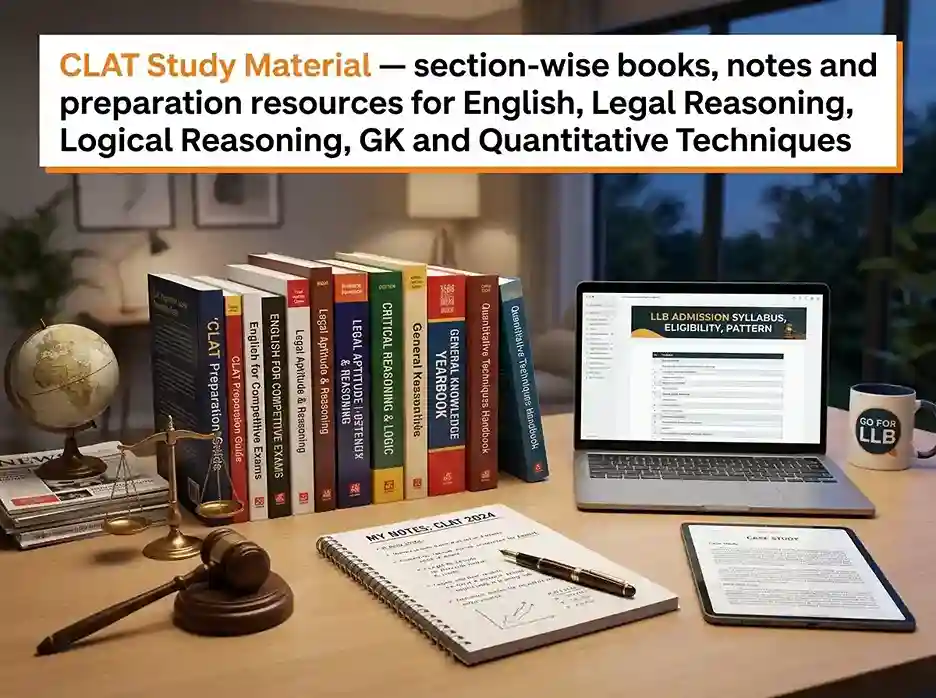
1. CLAT 2027 Exam Pattern & Section-Wise Weightage
Before selecting study material, every CLAT aspirant must deeply understand the exam pattern. CLAT 2027 is a reading-comprehension and reasoning-driven exam — every single question is based on a passage. There are no standalone general knowledge questions, no direct grammar questions, and no bare-formula maths. This fundamentally shapes which study material is useful and which is a waste of time.
| Section | No. of Questions | Marks | Weightage | Passage Length |
|---|---|---|---|---|
| English Language | 22–26 | 22–26 | ~20% | 450 words |
| General Knowledge & Current Affairs | 28–32 | 28–32 | ~25% | 450 words |
| Legal Reasoning | 28–32 | 28–32 | ~25% | 450 words |
| Logical Reasoning | 22–26 | 22–26 | ~20% | 300 words |
| Quantitative Techniques | 10–14 | 10–14 | ~10% | 300 words |
| Total | 120 | 120 | 100% | ~20,000 words total |
Every CLAT question is embedded in a 300–500 word passage. For GK, you are given a news article and tested on reasoning about the event — not recall. For Legal Reasoning, a legal principle is stated in the passage and you apply it to a hypothetical fact. For Maths, data is presented in a table or graph within a passage. This means your study material must develop reading speed, comprehension depth, and inference ability — not just factual knowledge.
2. Free CLAT Study Material | What LawGuru Provides
LawGuru India provides comprehensive free CLAT study material across all 5 sections. Everything is updated for the CLAT 2027 exam pattern and is available without registration. Here is what you can access:
3. Section-Wise Notes & Key Concepts
Here is a structured breakdown of what to study in each CLAT section, what the passage types look like, and how to approach them effectively.
CLAT English tests reading comprehension exclusively — you will not see standalone grammar or vocabulary questions. Passages are typically 400–500 words from newspaper editorials, literary essays, or social commentary. Questions test:
Read 2–3 editorials from The Hindu or Indian Express daily. After reading, summarise the main argument in 2 sentences, identify the author's tone, note any unfamiliar words and look them up in context. This daily habit, maintained for 6 months, is more effective than any English workbook for CLAT.
The GK section is passage-based — you receive a news article or event description and answer questions about it. You need both static GK (background knowledge to understand the context) and dynamic current affairs (to follow the events discussed). Key topic areas:
| Topic Area | Static GK Focus | Dynamic CA Focus |
|---|---|---|
| Indian Polity | Constitution, Fundamental Rights, Directive Principles, Parliament structure | Supreme Court verdicts, new legislation, constitutional amendments |
| Economy | RBI functions, budget terms, GDP, inflation concepts | Union Budget highlights, RBI policy decisions, economic reports |
| International Affairs | UN bodies, major treaties, India's foreign policy basics | G20, SCO, BRICS outcomes; bilateral summits; global conflicts |
| Science & Tech | Space agencies, basic scientific terms | ISRO launches, AI regulations, recent discoveries |
| Environment | Climate agreements, biodiversity conventions | COP outcomes, NGT orders, wildlife news |
| Sports & Awards | Major sporting bodies, Bharat Ratna, Nobel history | Recent Olympics/CWG results, latest Nobel, Padma awardees |
Combine Lucent's General Knowledge (for static base) with a monthly CLAT-specific current affairs digest and daily newspaper reading. Do NOT memorise lists — understand the context behind events. In CLAT, the passage gives you the event; your background knowledge helps you answer contextual questions faster and more accurately.
No prior legal knowledge is required for CLAT Legal Reasoning. Each question set is preceded by a passage that contains a legal principle, rule, or situation. You must apply the stated principle to a given factual scenario. The following legal subject areas appear most frequently:
Fundamental Rights (Art. 14–32), Directive Principles, President/Parliament powers, emergency provisions. Highest weightage topic.
Offer & acceptance, consideration, void/voidable contracts, breach of contract, damages. Based on Indian Contract Act principles.
Negligence, defamation, trespass, strict liability (Rylands v Fletcher), nuisance. Common scenario-based questions.
IPC concepts — mens rea, actus reus, self-defence, abetment. CLAT tests principles, not section numbers.
Hindu Marriage Act basics, succession, adoption. Appears occasionally with social justice passages.
Landmark SC judgments, new laws enacted, recent PIL outcomes. Often featured in CA passages with legal context.
Practice principle-application using A.P. Bhardwaj's book and CLAT previous year papers (2017–2026). Focus on understanding the logical structure of "If Principle P, and Facts F, then Conclusion C" — not on memorising legal code sections. Read legal news from Bar & Bench, LiveLaw, and The Hindu's legal column to build contextual awareness.
CLAT Logical Reasoning is argument-analysis based, not the old-style coding-decoding or blood relations format. Passages contain arguments, assumptions, and conclusions. You are tested on:
Old logical reasoning books (like RS Aggarwal's full book) contain many question types — coding-decoding, blood relations, seating arrangements — that no longer appear in CLAT. Selectively use only the sections on critical reasoning, argument analysis, and syllogisms. Prioritise CLAT-specific practice over generic aptitude books.
With the lowest weightage (10%), Quant tests Class 8–10 level mathematics presented in data interpretation format — graphs, tables, pie charts, or data sets within a passage. Key topics:
Quant is only 10% of the paper but requires speed in calculation. Target 8–10 correct out of 10–14 questions. Spend 15–20 minutes daily on basic arithmetic and DI practice for 3 months. Don't invest 4-hour study blocks here — that time is better spent on Legal Reasoning or GK, which together form 50% of the paper.
4. Best Books for CLAT 2027 | Section-Wise Recommended List
The golden rule: master 6–8 books thoroughly rather than collecting 20 and reading none deeply. Here is the expert-curated, section-wise booklist for CLAT 2027 — updated for the current exam pattern.
📖 English Language — Recommended Books
⚖️ Legal Reasoning — Recommended Books
🌐 GK & Current Affairs — Recommended Books
🧩 Logical Reasoning — Recommended Books
🔢 Quantitative Techniques — Recommended Books
5. Newspaper Reading Strategy for CLAT
Daily newspaper reading is the single most impactful preparation habit for CLAT — it simultaneously improves all five sections. Here is exactly how to read a newspaper for CLAT, not just for general awareness:
| Newspaper Section | CLAT Section Benefited | What to Focus On | Time per Day |
|---|---|---|---|
| Editorial Page | English + Logical Reasoning | Read 2 editorials. Identify main argument, supporting points, author's tone. Note vocabulary in context. | 30–40 min |
| Front Page / National News | GK + Legal Reasoning | Track government policies, Supreme Court orders, constitutional developments, economic data. | 15–20 min |
| International Section | GK | Major geopolitical events, India-world relations, UN/multilateral developments. | 10 min |
| Business/Economy | GK + Quant | Budget news, RBI decisions, major economic data (GDP, inflation). Understand, don't memorise numbers. | 10 min |
| Legal/Court Reporting | Legal Reasoning + GK | Supreme Court and High Court verdicts. Understand the principle decided, not case law citation. | 10 min |
Primary: The Hindu (best for editorial quality, legal reporting, and language complexity matching CLAT passages). Alternate: The Indian Express (strong on political analysis and constitional affairs). Supplement: Livemint for economic news. You do not need to read all three daily — one primary newspaper read thoroughly is far better than three read superficially.
6. Mock Test Strategy | How to Use Mocks Effectively
Most CLAT aspirants take mock tests — but very few use them correctly. A mock test is not just a measurement tool; it is a preparation tool. Here is how to extract maximum value from every mock:
| Preparation Phase | Mock Frequency | Focus |
|---|---|---|
| 6–12 months before exam (Foundation) | 1 mock per fortnight | Identify baseline, understand question types |
| 3–6 months before exam (Building) | 1 mock per week | Track section-wise improvement, fix identified weaknesses |
| 1–3 months before exam (Peak Prep) | 2–3 mocks per week | Speed improvement, attempt rate optimisation, pattern mastery |
| Final 2 weeks before exam | Daily mocks (1 per day) | Confidence building, consistency, revision — not new learning |
7. 12-Month CLAT Preparation Plan (Jan–Dec 2026 for CLAT 2027)
If you are starting your CLAT 2027 preparation in early 2026, here is a structured 12-month roadmap:
Foundation
Concept Building
Practice Phase 1
Practice Phase 2
Intensification
Peak Preparation
Final Lap
8. Topper Tips & Common Mistakes to Avoid
CLAT is fundamentally a reading speed and comprehension exam. The paper contains approximately 20,000 words across all passages. A student who reads faster and understands deeper has a structural advantage over a student who has memorised more facts. This means daily reading — not just studying — is the most important habit you can build. Start today, not next month.
9. Self-Study vs Coaching | Which Is Right for You?
One of the most common questions from CLAT aspirants: "Do I need coaching?" The honest answer depends on your circumstances, not a one-size-fits-all recommendation.
| Factor | Self-Study | Coaching (Online/Offline) |
|---|---|---|
| Cost | ₹5,000–15,000 (books + mocks) | ₹20,000–2,00,000+ (offline) / ₹5,000–30,000 (online) |
| Flexibility | Full flexibility — study at your pace | Fixed schedule (offline) / moderate (online) |
| Structure | You build your own schedule — requires self-discipline | Structured syllabus and deadlines provided |
| Peer Competition | Limited — need to seek mock test groups | High — regular comparison with peers motivates |
| Mock Tests | Available separately (free/paid) | Usually included in package |
| Doubt Solving | Forums, communities, YouTube | Direct access to faculty |
| Track Record | Many toppers have cleared with self-study | Top coaching institutes produce many toppers too |
| Best For | High self-discipline, above-average reading ability, 12+ months to prepare | Needs structure, peer accountability, or shorter preparation window |
Coaching is not a requirement for CLAT success — it is a support system. If you are self-disciplined, have access to good books and mocks, and can maintain a daily reading habit, self-study is entirely viable. If you lack structure or need peer accountability, online coaching (more affordable than classroom) is a worthwhile investment. The decisive factor is not where you study — it is how consistently and analytically you practice.
10. Frequently Asked Questions | CLAT Study Material
The best CLAT 2027 study material combines 5–6 targeted books with daily newspaper reading and regular mock tests. English: Word Power Made Easy (Norman Lewis) + The Hindu editorials. Legal Reasoning: A.P. Bhardwaj's Legal Aptitude + previous year papers. GK: Lucent's GK + Manorama Yearbook + monthly current affairs. Logical Reasoning: M.K. Pandey's Analytical Reasoning. Quant: NCERT Class 8–10 + RS Aggarwal basics. Supplement everything with 30–40 full-length mock tests with post-mock analysis.
NCERTs are helpful for Quantitative Techniques (Class 8–10 Maths) and provide a basic foundation for GK. However, NCERTs alone are NOT sufficient for CLAT 2027. The exam is comprehension and reasoning-driven — English passage analysis, legal principle application, and logical argument analysis require exam-specific practice and daily reading habits. NCERTs are the base for GK and Maths, not the full preparation.
For CLAT 2027, 5–8 hours of focused daily study is ideal for students starting 6+ months before the exam. Breakdown: 1–1.5 hours of newspaper reading, 2–3 hours of section-wise study and practice, 30–45 minutes of vocabulary and legal reasoning drills, and 1 hour of revision. In the final 2 months, add 1–2 full-length mock tests per week with detailed analysis. Consistency trumps volume — 5 focused hours daily beats 10 distracted hours every time.
The Hindu is the most recommended newspaper for CLAT preparation. Its editorials closely match CLAT English passage tone and complexity. The Hindu also has excellent coverage of Supreme Court and constitutional affairs (Legal Reasoning), current events (GK), and analytical writing (Logical Reasoning). The Indian Express is a strong alternative or supplement. Read 2–3 editorials daily, note vocabulary, summarise the argument, and identify the author's stance.
Yes. Many CLAT toppers have cracked the exam through self-study. The key requirements are the right books (5–6, not 20), daily newspaper reading (non-negotiable), consistent mock tests with deep analysis (30–40 mocks), and a structured preparation timeline. Coaching provides structure and peer accountability but is not a prerequisite. If self-discipline is a challenge, affordable online coaching can provide structure without the high cost of classroom coaching.
Absolutely — previous year CLAT papers (especially 2020–2026, when the comprehension-based pattern was fully established) are among the most important preparation resources. They reveal actual question types, passage complexity, answer option patterns, and time management benchmarks. Solve all 7+ years of papers under timed conditions. Focus on 2020–2026 papers as they reflect the current format; earlier papers (pre-2020) used a different direct-knowledge format that is now largely obsolete.