Study Material Guide · Updated June 2026

LSAT India Study Material

Everything you need to know about LSAT India | the four sections, the best preparation approach, score validity, and the most important update: what replaced it for law admissions in 2025.

Overview

What Was LSAT India?

LSAT India (Law School Admission Test | India) was a standardised entrance exam for admission to LLB and LLM programmes at private law schools in India. It tested critical thinking, logical reasoning, and reading comprehension | not General Knowledge or Mathematics. LSAC officially discontinued it in late 2024. No sessions have been conducted from 2025 onwards.

The exam was designed and owned by the Law School Admission Council (LSAC), a global non-profit body based in the United States. Pearson VUE administered it in India. The last session was conducted in May 2024.

Over 50 private law schools in India accepted LSAT India scores. These included well-known institutions offering five-year integrated BA LLB, BBA LLB, three-year LLB, and LLM programmes. The exam was popular because it had no subject knowledge requirement. Anyone who could think logically could perform well | regardless of their Class 12 stream.

Understanding the LSAT India format still matters in 2026. First, scores earned before the discontinuation remain valid for up to five years. Second, the skills tested | analytical reasoning, logical reasoning, and reading comprehension | are equally valuable for CLAT, AILET, and other current law entrance exams. The preparation approach transfers directly.

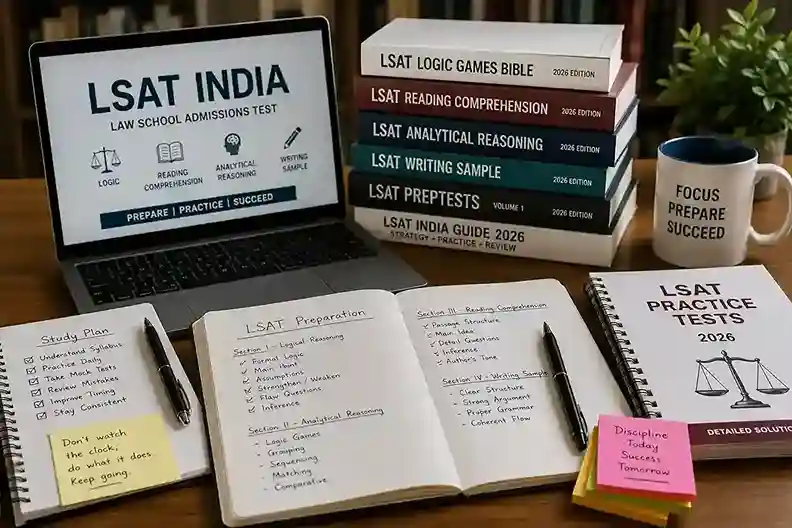
LSAT India study material books and preparation resources for law course admissions in India
Exam Pattern

LSAT India Exam Pattern | Structure and Scoring

The exam had four sections. Total time was 140 minutes. All questions were multiple choice. There was no negative marking. Scores were reported on a percentile scale, not a raw score scale.

SectionQuestionsTimeWhat It Tests
Analytical Reasoning (AR)22–24~35 minLogic puzzles, ordering, grouping, relationships
Logical Reasoning 1 (LR1)22–24~35 minArgument analysis, inference, strengthening/weakening
Logical Reasoning 2 (LR2)22–24~35 minStatement-assumption, cause-effect, analogy
Reading Comprehension (RC)24~35 minFour passages | humanities, science, law, social science
Total92140 minCritical thinking and reasoning

Key Features of the Exam Pattern

What the exam did NOT include

General Knowledge Mathematics Current Affairs Legal Knowledge Negative Marking Essay/Writing Section

What the exam DID include

Analytical Reasoning Logical Reasoning (2 sections) Reading Comprehension All MCQ format Online remote-proctored

Scoring System

LSAT India did not use a 120–180 scale like the US version of the exam. Scores were reported purely as percentile ranks. A score of 460 on the internal scale was considered excellent. A score above 380 was generally considered competitive for most participating colleges.

Each correct answer earned one mark. Wrong answers carried no penalty. This meant attempting every question was always the right strategy | even educated guessing improved expected score.

For students with valid past scores: LSAT India scores remained valid for five years from the test date. If you appeared in 2021, 2022, 2023, or the January/May 2024 sessions, your score may still be valid. Check directly with individual colleges whether they accept older LSAT India scores.

Section-by-Section Breakdown

LSAT India | All Four Sections Explained in Detail

Each section tests a different thinking skill. Understanding what each section demands is the first step to preparing for it effectively.

1

Analytical Reasoning (AR)

22–24 questions · ~35 minutes

This section presents a scenario | a set of rules or conditions | and asks you to apply logic to determine what must, can, or cannot be true. Common formats include ordering (who sits where), grouping (who is in which team), and matching (which item goes with which category).

The questions are not about legal knowledge. They test pure logical deduction. Each question set shares one scenario with multiple questions. Once you understand the rules of the scenario, multiple questions become faster to solve.

Ordering Grouping Sequencing Conditional Logic
2

Logical Reasoning 1 (LR1)

22–24 questions · ~35 minutes

Each question in this section has a short argument or passage followed by one question about it. You might be asked to identify the main conclusion, find an assumption the argument relies on, or pick a fact that would strengthen or weaken the argument.

This section tests argument analysis. You need to read quickly and identify the structure of an argument | its premises, conclusion, and any gaps in logic. One question per passage means you cannot share reasoning across questions.

Assumption Strengthen / Weaken Inference Main Conclusion
3

Logical Reasoning 2 (LR2)

22–24 questions · ~35 minutes

Structurally identical to LR1. The same question types appear, but this section is independently timed. The topics of the argument passages differ. Having two LR sections means logical reasoning carries the highest overall weight in the exam | roughly half the total score.

Common question types include statement-assumption, cause-effect relationships, resolving paradoxes, and identifying the flaw in an argument. Each question is self-contained.

Flaw in Argument Parallel Reasoning Resolve Paradox Statement-Assumption
4

Reading Comprehension (RC)

24 questions · ~35 minutes

This section has four passages. Three are long standalone passages. The fourth is a comparative passage | two shorter texts on a related topic. Passages cover humanities, social sciences, natural sciences, and law. Questions ask about the main idea, specific details, the author's tone, and inferences.

You do not need prior knowledge of the passage's subject. Everything you need to answer is in the text. The challenge is reading quickly and understanding dense academic writing under time pressure.

Main Idea Author's Viewpoint Specific Details Comparative Reading
Study Material & Books

Best LSAT India Study Material and Preparation Books

The most effective LSAT India study resources focus on skill-building, not memorisation. No amount of factual reading replaces timed practice under actual conditions.

Official Study Material

The most important starting point is official material from LSAC. LSAC published a set of official LSAT India preparation books. These contain real past questions. No third-party resource replicates the exact question style better than official material.

LSAC also provided free sample questions and a system readiness test on its official platform before the exam. Practising on the same interface used for the actual exam reduced technical anxiety on test day.

Note: Since LSAT India has been discontinued, some official LSAC India resources may no longer be accessible online. Focus on official LSAC PrepTest books (available through booksellers) and the general LSAT preparation ecosystem, which maps directly to the skills tested.

Recommended Books for LSAT India Preparation

LSAC Official LSAT PrepTests

Best for: Practice with real questions

These compilations contain actual past LSAT exams. Each test mirrors the real exam structure. Working through timed full tests is the single most effective preparation activity. The analytical and logical reasoning question types in these books are identical to what LSAT India tested.

The PowerScore LSAT Logical Reasoning Bible

Author: David M. Killoran · Best for: LR mastery

Widely considered the most thorough guide for the Logical Reasoning section. It classifies every LR question type, explains the underlying structure of arguments, and provides a systematic approach for each question category. Essential for students who find LR inconsistent.

The PowerScore LSAT Analytical Reasoning Bible

Author: David M. Killoran · Best for: Logic games / AR

Dedicated entirely to Analytical Reasoning. The book teaches diagramming techniques that translate complex game conditions into workable visual formats. Students who practise the templates in this book can significantly improve their AR speed and accuracy.

Manhattan Prep LSAT Strategy Guide Set

Best for: Structured strategy across all sections

The Manhattan Prep set covers all sections with a structured approach. It is particularly effective for students who want a coached, step-by-step methodology rather than learning by trial and error. Good for students new to standardised test preparation.

Legal Awareness & Legal Reasoning by A.P. Bhardwaj

Best for: Indian law entrance context

Written specifically for Indian law entrance exams including CLAT and LLB admissions. It bridges legal reasoning with the logical reasoning approach tested in LSAT India. Particularly useful for students preparing across multiple law entrance exams simultaneously.

Thinking Like a Lawyer by Frederick Schauer

Best for: Legal reasoning foundations

A strong conceptual foundation for legal reasoning. While not a test-prep book in the traditional sense, it builds the analytical thinking patterns that LSAT India's Logical Reasoning section rewards. Recommended as supplementary reading once core question types are understood.

Preparation Strategy

How to Prepare for LSAT India | Section-wise Strategy

Most students who underperform on LSAT India make one of two mistakes. They either skip timed practice and only read theory, or they practise without understanding why they got questions wrong. Neither approach builds actual skill.

The best approach combines conceptual understanding, deliberate practice, and error analysis in equal measure.

Analytical Reasoning | How to Prepare

AR is the most learnable section. With the right technique, most students see improvement within weeks.

1

Learn to Diagram Every Game

Never try to solve AR puzzles in your head. Draw a clear diagram for the scenario. List all conditions clearly. Students who skip diagramming lose time and make errors on easy questions.

2

Identify the Game Type First

Before answering any question, identify whether the game is an ordering game, grouping game, or hybrid. Each type has a standard diagramming approach. Recognising the type fast saves minutes per game set.

3

Work Out the Inferences First

Before reading the questions, work out what the conditions imply. Many AR questions can be answered immediately if you already know the valid arrangements from your initial analysis.

4

Practise 3–4 Full Game Sets Per Day

AR fluency comes from volume. Solve at least three to four complete game sets daily during the two months before your exam. Time yourself strictly | 35 minutes per section.

Logical Reasoning | How to Prepare

LR covers half the total score across two sections. It rewards students who understand argument structure.

1

Learn to Identify Argument Structure

Every LR stimulus has premises and a conclusion. Before looking at the question stem, identify what the conclusion is. Wrong answer choices often distort the premise-conclusion relationship.

2

Memorise the Question Type Categories

LSAT LR uses a fixed set of question types: assumption, strengthen, weaken, flaw, inference, main conclusion, parallel reasoning, and resolve paradox. Each type requires a different approach. Know all of them.

3

Analyse Every Wrong Answer

Understanding why a wrong answer is wrong teaches more than understanding why a right answer is right. After every practice set, review all five choices for every question you got wrong or guessed on.

Reading Comprehension | How to Prepare

RC is the hardest section to improve quickly. It rewards consistent readers. Daily reading practice matters more than any single technique.

1

Read Dense Academic Content Daily

Read long-form articles from fields like philosophy, science, law, and economics every day. The goal is reading speed and active comprehension | not just moving your eyes across the page.

2

Map the Structure of Each Passage

As you read each RC passage, mentally note: what is the author's main point? What is the structure | does it present a debate, a theory, or a historical account? This mapping makes answering questions faster.

3

Spend More Time on the Passage, Less on the Questions

Students who rush through the passage and spend more time re-reading during questions are less efficient. Read the passage carefully once. The questions will be answerable faster with a solid initial reading.

Sample 8-Week Study Plan

Weeks 1–2: Foundations

  • Learn all AR game types
  • Learn all LR question categories
  • Read the PowerScore Bibles for AR and LR
  • No timed practice yet | pure skill building

Weeks 3–4: Untimed Practice

  • Solve 2–3 AR game sets daily
  • Solve 10 LR questions daily
  • Read 2 RC passages daily
  • Full review of every answer after each session

Weeks 5–6: Timed Section Practice

  • Begin timing each section | 35 minutes per section
  • One full timed section per day
  • Review errors same day
  • Track improvement by section

Weeks 7–8: Full Timed Mock Tests

  • Two full timed mock tests per week
  • Review all four sections after each test
  • Work on your weakest section daily
  • Focus on system readiness and test comfort
Eligibility Criteria

LSAT India Eligibility | Who Could Apply

One of LSAT India's unique features was its open eligibility. LSAC itself set no minimum marks or age limit. Each participating college set its own conditions in line with Bar Council of India rules.

ProgrammeMinimum QualificationMinimum MarksAge Limit
5-Year BA LLB / BBA LLBClass 12 (any stream)45% (40% for SC/ST as per BCI)Under 20 yrs for most colleges
3-Year LLBBachelor's degree (any discipline)45% (40% for SC/ST)No upper age limit typically
LLM (1 or 2 years)3-year LLB or 5-year integrated LLB55% in LLBNo standard age limit

The Bar Council of India regulates legal education standards. All law colleges | including private colleges that accepted LSAT India scores | must comply with BCI guidelines on minimum qualifications, pass marks, and age limits for their programmes.

LSAT India vs CLAT eligibility: CLAT sets a strict upper age limit of 20 years (45 for reserved categories) for its five-year programme. LSAT India had no LSAC-mandated age limit, making it more flexible for mature students. This was one reason LSAT India was attractive to older candidates returning to education.

Score Validity

Is Your Old LSAT India Score Still Valid?

LSAT India scores were valid for five years from the test date. Students who appeared in 2021, 2022, 2023, or the 2024 January and May sessions may still hold valid scores.

However, with the exam discontinued, the question is whether individual colleges still accept these scores. Here is what we know:

Test YearScore Validity WindowAction Required
Jan / May 2024Valid until 2029Confirm with each target college individually
Jan / May 2023Valid until 2028Confirm with each target college individually
2022 sessionsValid until 2027Confirm with each target college individually
2021 sessionsValid until 2026Confirm urgently | near expiry
2020 and earlierExpired or expiringLikely not accepted | check CLAT or university exams

Do not assume your score is still accepted. Colleges that previously relied on LSAT India have updated their admission requirements since the discontinuation. Some now use CLAT. Some run their own exams. Contact the admissions office of each college you are applying to | do not rely on outdated portal information.

LSAT India vs CLAT

LSAT India vs CLAT | Key Differences

For students who prepared for LSAT India and now need to pivot to CLAT, understanding the differences is essential. The two exams test overlapping skills in very different formats.

FeatureLSAT IndiaCLAT
Conducted byPearson VUE / LSACConsortium of NLUs
Current statusDiscontinued (2025)Active
Colleges acceptingPrivate law schools only21 NLUs + 50+ private colleges
Total questions92120
Total time140 minutes120 minutes
Negative markingNoYes (0.25 per wrong answer)
General KnowledgeNot testedTested (significant section)
Legal ReasoningNot directly testedYes | passage-based legal reasoning
Mathematics / QuantitativeNot testedBasic numeracy tested
DifficultyModerateHigh
Attempts per yearUp to 2 (Jan + May)1 per year

Skills developed for LSAT India | especially Logical Reasoning and Reading Comprehension | transfer directly to CLAT's Legal Reasoning and English sections. If you prepared seriously for LSAT India, you are not starting from zero for CLAT. Add General Knowledge, current affairs, and basic numeracy to your CLAT preparation.

Post-Discontinuation Alternatives

What to Do Now | Alternatives to LSAT India in 2026

Students who planned to use LSAT India scores for 2026 or 2027 law admissions must switch to alternative exams. Here are the main options, organised by type.

National-Level Exams

National

CLAT | Common Law Admission Test

The primary national entrance exam for 21 NLUs and many private colleges. Conducted once per year in December. Tests English, GK, Legal Reasoning, Logical Reasoning, and Quantitative Techniques. More competitive than LSAT India but opens far more doors | including all NLUs.

National

AILET | All India Law Entrance Test

Conducted by NLU Delhi for admission to its own programmes only. One of the most competitive law entrance exams in India. Tests similar domains to CLAT. If NLU Delhi is your goal, AILET is non-negotiable.

Postgraduate

CLAT-PG

For LLM admissions at NLUs. Conducted alongside CLAT UG. If you are seeking a postgraduate law programme, CLAT-PG is the main national gateway. Tests core law subjects including constitutional law, criminal law, and jurisprudence.

University-Specific Exams

University Exam

LNAT UK

Jindal Global Law School (JGLS) now accepts LNAT UK scores for admission to its five-year integrated LLB programme. LNAT UK is the UK National Admissions Test for Law. It tests reading and analytical reasoning | skills very similar to LSAT India's RC and LR sections.

University Exam

JSAT Law (Jindal)

JGLS uses its own JSAT Law exam for admission to three-year LLB, LLM, and BA in Law programmes. Students targeting Jindal Global Law School should register for JSAT Law and confirm directly with JGLS admissions for current dates and eligibility.

University Exam

UPES ULSAT

UPES School of Law in Dehradun conducts its own ULSAT entrance exam. UPES previously accepted LSAT India scores. Check the UPES admissions website for their 2026–27 admission process and entrance exam requirements.

State-Level Exams

State-Level

GUJCET Law / Gujarat State Exam

Gujarat state law colleges have their own admission processes. Students in Gujarat applying to state colleges should check the Gujarat state government's Higher Education Department for the current admission exam and process.

State-Level

MH CET Law

Maharashtra CET Cell conducts MH CET Law for admission to law colleges in Maharashtra. Covers sections similar to CLAT including logical reasoning and legal aptitude. Strong choice for students targeting Maharashtra law colleges.

State-Level

TS PGLCET

Telangana State PG Law Common Entrance Test for LLM admissions in Telangana. Other states run similar PG law entrance tests. Check your state's Higher Education Department or Bar Council for applicable exams.

Recommendation: If you are a serious law aspirant in India in 2026-27, prioritise CLAT preparation. It opens the most doors | all 21 NLUs plus most major private colleges. The reading comprehension and logical reasoning skills you build for CLAT are identical to what LSAT India tested, plus you add General Knowledge and Legal Reasoning.

Start Preparing

Find the Right Law Entrance Exam for You

Browse full guides for CLAT, AILET, and other current law entrance exams on the Digital Gujarat Law Portal.

All Entrance Exam Guides
Law Courses in India

Law Courses in India | What LSAT India Led To

Understanding where LSAT India scores were used helps clarify which law programmes you are targeting and which alternative exams apply.

ProgrammeDurationEntry PointLSAT India Covered?
BA LLB / BBA LLB (Integrated) 5 years After Class 12 Yes (private colleges)
3-Year LLB 3 years After graduation Yes (private colleges)
LLM (Master of Laws) 1–2 years After LLB Yes (some colleges)
BA LLB at NLUs 5 years After Class 12 via CLAT Not applicable | NLUs use CLAT
LLM at NLUs 1–2 years After LLB via CLAT-PG Not applicable | NLUs use CLAT-PG

LSAT India served the private law school ecosystem in India. NLUs | the National Law Universities | never accepted LSAT India scores. They use CLAT exclusively. If your target is an NLU, CLAT has always been the right exam and remains so.

Frequently Asked Questions

LSAT India | Common Questions Answered

Is LSAT India still conducted in 2026-27?
No. LSAC (Law School Admission Council) officially discontinued the LSAT India exam in late 2024. No LSAT India session has been held from 2025 onwards. LSAC cited a broader business decision for the discontinuation. No new replacement exam from LSAC is planned for India. Students should explore CLAT, AILET, or university-specific exams for their 2026–27 law admissions.
What was LSAT India testing?
LSAT India tested analytical reasoning, logical reasoning, and reading comprehension. It did not test General Knowledge, Mathematics, Current Affairs, or any subject-specific legal knowledge. The exam assessed your ability to think critically and reason under time pressure | skills directly relevant to law school success.
What are the four sections of LSAT India?
LSAT India had four sections: Analytical Reasoning (logic puzzles and game-based questions), Logical Reasoning 1 (argument analysis), Logical Reasoning 2 (a second argument analysis section), and Reading Comprehension (four passage-based sets). Total questions: 92. Total time: 140 minutes.
My LSAT India score is from 2022. Is it still valid?
LSAT India scores were valid for five years from the test date. A 2022 score is technically valid until 2027. However, whether individual colleges accept older LSAT India scores after the exam's discontinuation varies by institution. You must confirm directly with each college you are applying to. Do not rely on outdated information on third-party portals.
Which colleges accepted LSAT India scores?
Over 50 private law schools in India accepted LSAT India scores. Key institutions included O.P. Jindal Global University's Jindal Global Law School, UPES School of Law, BML Munjal University, Alliance University, VIT School of Law, and Azim Premji University among others. National Law Universities never accepted LSAT India | they use CLAT exclusively. All admission processes for formerly LSAT India-accepting colleges have been updated since the discontinuation.
Is LSAT India easier than CLAT?
Yes, LSAT India was generally considered easier than CLAT. LSAT India had no General Knowledge section, no negative marking, and two attempts per year. CLAT has negative marking, requires General Knowledge preparation, and is conducted only once per year. That said, CLAT opens more doors | including all NLUs | making it a worthwhile investment despite the higher difficulty.
What is the best LSAT India study material?
The most effective study material includes official LSAC PrepTest books (real past LSAT exams), the PowerScore LSAT Logical Reasoning Bible, the PowerScore LSAT Analytical Reasoning Bible, and the Manhattan Prep LSAT Strategy Guides. For the Indian law school context, A.P. Bhardwaj's Legal Awareness and Legal Reasoning is also useful. Timed full mock tests under actual conditions produce the most reliable improvement.
How does LSAT India preparation help for CLAT?
LSAT India preparation builds strong foundations in logical reasoning and reading comprehension | two major sections of CLAT. Students who prepared seriously for LSAT India have a significant head start for CLAT. The key additions for CLAT are General Knowledge and current affairs (which LSAT India did not test), a basic numeracy section, and the specific legal reasoning passage format used in CLAT.
Summary

LSAT India Study Material | Quick Reference Summary

Full NameLaw School Admission Test | India
Conducted byPearson VUE on behalf of LSAC (Law School Admission Council)
Current StatusDiscontinued | no sessions from 2025 onwards
SectionsAnalytical Reasoning, Logical Reasoning 1, Logical Reasoning 2, Reading Comprehension
Total Questions92 multiple-choice questions
Duration140 minutes (2 hours 20 minutes)
Negative MarkingNone
Score Validity5 years from test date
Was NOT testedGeneral Knowledge, Mathematics, Current Affairs, Legal Knowledge
Best Study MaterialLSAC Official PrepTests, PowerScore Bibles, Manhattan Prep Guides
Primary AlternativeCLAT (for most colleges including NLUs)
For Jindal GlobalLNAT UK (5-yr integrated) and JSAT Law (3-yr LLB and LLM)
Last updated: June 2026 · LSAT India discontinued by LSAC in late 2024. Content reflects the most current publicly available information on LSAT India history, score validity, and 2026 alternatives · law.digitalgujaratscholarships.com/study-material/lsat-india/