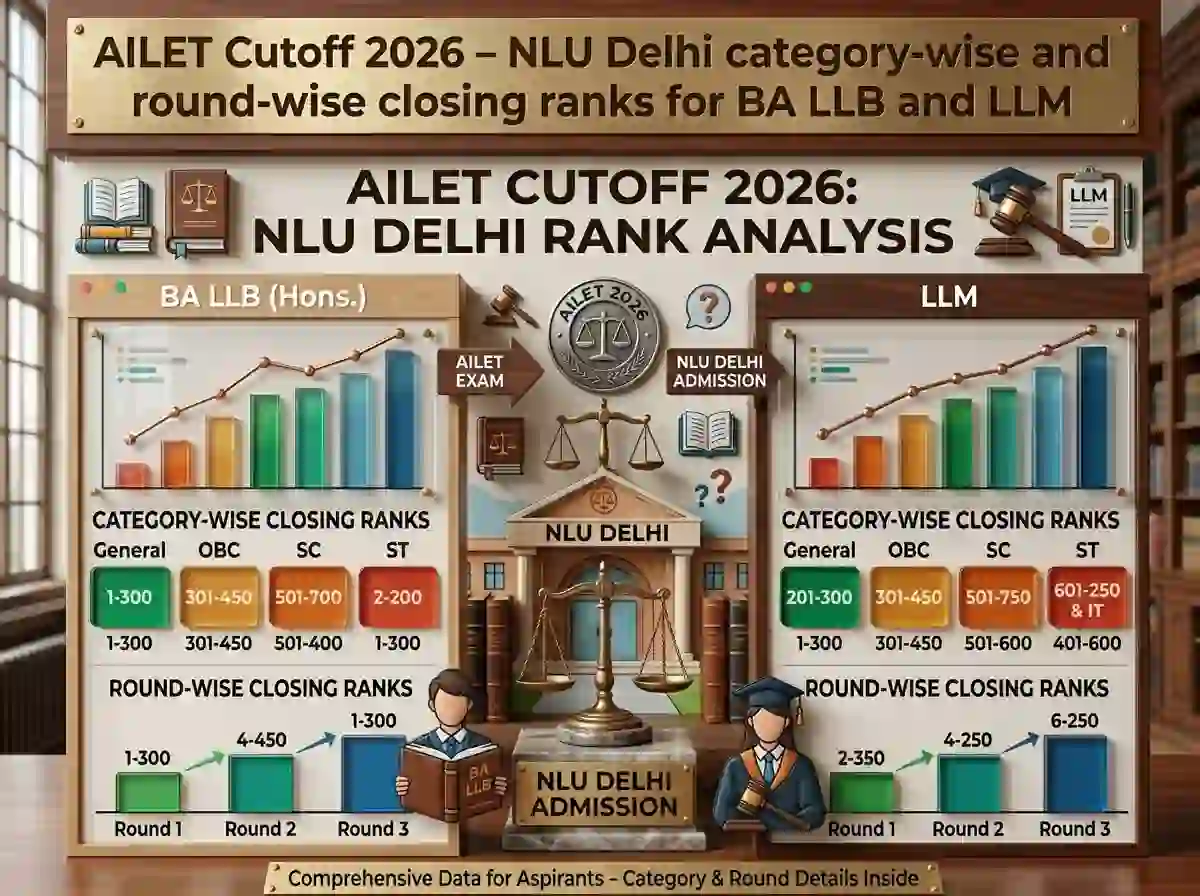
- 01 What is the AILET Cutoff? Key Facts
- 02 AILET 2026 Round-Wise Cutoff (BA LLB)
- 03 AILET 2026 LLM Cutoff (Round-Wise)
- 04 AILET 2026 Marks vs Rank Analysis
- 05 NLU Delhi Seat Matrix 2026
- 06 AILET Cutoff 2024 & 2025 (Previous Years)
- 07 3-Year Trend Analysis 2024–2026
- 08 What Score Gets You Into NLU Delhi?
- 09 Factors Affecting AILET Cutoff
- 10 AILET 2027 Expected Cutoff
- 11 Counselling Process & Seat Movement
- 12 FAQs on AILET Cutoff
What is the AILET Cutoff? Key Facts for 2026
The AILET cutoff is the minimum All India Rank (AIR) a candidate must achieve to secure admission to the National Law University, Delhi (NLU Delhi) through the All India Law Entrance Test (AILET). Unlike CLAT, which serves 25+ NLUs, AILET is conducted exclusively for NLU Delhi | making it the most concentrated, high-stakes law entrance in India.
NLU Delhi offers just 110 seats for BA LLB (Hons) and 81 seats for LLM through AILET 2026. With 25,319 candidates appearing for the December 14, 2025 exam, the seat-to-applicant ratio for BA LLB is approximately 1 seat for every 230 candidates | among the most competitive ratios of any law entrance in India.
The AILET cutoff is released by NLU Delhi in the form of merit lists before each counselling round. The last rank in the merit list for a given category in a given round becomes the closing rank for that round. NLU Delhi typically conducts 3–4 rounds of counselling. The cutoff for Round 3 (final round in 2026) is considered the definitive cutoff for the academic year.
Candidates Appeared (BA LLB): 22,532 | Candidates Appeared (LLM): 2,787
Topper (AIR 1): Aryan | Topper Score: 142.5 / 150
Total Marks: 150 | Exam Centres: 47 across 36 cities
Counselling Rounds: 3 completed (Round 3 final merit list: February 4, 2026)
AILET 2026 Round-Wise Cutoff | BA LLB (Hons)
NLU Delhi released three rounds of AILET 2026 merit lists. The table below shows the opening and closing All India Ranks for each category in all three rounds. The closing rank is the cutoff | the AIR of the last candidate admitted in that category during that round.
Round 1 | BA LLB Cutoff (January 2026)
| Category | Opening Rank (AIR) | Closing Rank (AIR) | Seats (Approx.) |
|---|---|---|---|
| General (AI) | AIR 1 | AIR 60 | 47 |
| OBC (Non-Creamy Layer) | AIR 92 | AIR 330 | 23 |
| EWS (Economically Weaker Section) | AIR 172 | AIR 298 | 10 |
| SC (Scheduled Caste) | AIR 507 | AIR 1,480 | 16 |
| ST (Scheduled Tribe) | AIR 381 | AIR 1,372 | 8 |
| PwD (Horizontal Reservation) | Across all categories | AIR varies | 6 | |
Round 2 | BA LLB Cutoff
| Category | Opening Rank (AIR) | Closing Rank (AIR) | Change from Round 1 |
|---|---|---|---|
| General (AI) | AIR 62 | AIR 70 | ↑ Tighter by 10 |
| OBC (Non-Creamy Layer) | AIR 364 | AIR 369 | ↑ Tighter by 39 |
| EWS (Economically Weaker Section) | Not released / No new allotments | | | |
| SC (Scheduled Caste) | AIR 1,602 | AIR 1,602 | ↑ Tighter by 122 |
| ST (Scheduled Tribe) | AIR 2,888 | AIR 2,888 | ↑ Opened further |
Round 3 | BA LLB Cutoff (Final | February 4, 2026)
| Category | Closing Rank (AIR) | Change from Round 2 | Year-on-Year (vs 2025) |
|---|---|---|---|
| General (AI) | AIR 71 | ↑ Tighter by 1 | ↑ vs AIR 61 in 2025 |
| OBC (Non-Creamy Layer) | AIR 373 | ↑ Tighter by 4 | ↑ vs AIR 358 in 2025 |
| EWS (Economically Weaker Section) | AIR 298 | | | Data awaited |
| SC (Scheduled Caste) | AIR 1,731 | ↑ Tighter by 129 | ↓ Eased vs AIR 1,288 in 2025 |
| ST (Scheduled Tribe) | AIR 2,888 | Stable | ↑ vs AIR 2,018 in 2025 |
AILET 2026 LLM Cutoff | Round-Wise
NLU Delhi's LLM programme through AILET 2026 has a separate cutoff from BA LLB. The LLM exam is conducted on the same day as the BA LLB exam but with a separate question paper. The LLM programme has 81 seats total (General: 32, OBC: 15, SC: 10, ST: 5, EWS: 11, PwD: 4).
| Category | Round 1 Closing (AIR) | Round 2 Closing (AIR) | Round 3 Closing (AIR) | 2025 Round 1 (AIR) |
|---|---|---|---|---|
| General (AI) | AIR 41 | AIR 41 | AIR 45 | AIR 41 |
| OBC (Non-Creamy Layer) | AIR 161 | AIR 161 | AIR 176 | Data N/A |
| EWS | Data N/A | Data N/A | AIR 167 | Data N/A |
| SC (Scheduled Caste) | Data N/A | Data N/A | AIR 167 | Data N/A |
| ST (Scheduled Tribe) | Data N/A | Data N/A | Data N/A | Data N/A |
The LLM General closing rank of AIR 45 (Round 3, 2026) is nearly identical to the 2025 figure of AIR 42, suggesting the LLM cutoff has remained very stable at NLU Delhi over the past three years (AIR 36–58 range for General). LLM aspirants should target a rank within AIR 35 in General category to have a comfortable buffer.
AILET 2026 Marks vs Rank | Score Conversion Table
AILET is conducted for 150 marks. The official cutoff is expressed in AIR, not marks. However, candidates preparing for AILET 2027 need to know what score corresponds to what rank. The table below is derived from the official AILET 2026 rank distribution.
| Marks Range (out of 150) | Expected AIR Range | Admission Prospect (General) |
|---|---|---|
| 127+ marks | AIR 1 | Topper Zone |
| 125 – 127 marks | AIR 2 – 5 | Certain Admission |
| 123 – 125 marks | AIR 6 – 15 | Certain Admission |
| 121 – 123 marks | AIR 16 – 40 | Safe General Admission |
| 119 – 121 marks | AIR 41 – 80 | Safe General Admission |
| 117 – 119 marks | AIR 81 – 150 | EWS / OBC Safe Zone |
| 110 – 117 marks | AIR 150 – 350 | OBC / EWS Likely |
| 100 – 110 marks | AIR 350 – 700 | OBC / SC Possible |
| 90 – 100 marks | AIR 700 – 1,500 | SC / ST Range |
| 75 – 90 marks | AIR 1,500 – 2,500 | SC / ST / PwD Only |
| Below 75 marks | AIR 2,500+ | Admission Very Unlikely |
Score Band Visualisation
NLU Delhi Seat Matrix 2026 | BA LLB & LLM
Understanding the seat matrix is critical for cutoff analysis. With only 110 BA LLB seats (104 effective after PwD horizontal reservation), a single rank difference can determine admission or rejection in competitive categories. The seat matrix below reflects the official NLU Delhi 2026–27 admissions data.
BA LLB (Hons) Seat Matrix
| Category | Total Seats | PwD (Horizontal) | Effective Seats | % of Total |
|---|---|---|---|---|
| General (AI) | 50 | 3 | 47 | 42.7% |
| OBC Non-Creamy Layer (22%) | 24 | 1 | 23 | 20.9% |
| SC (15%) | 17 | 1 | 16 | 14.5% |
| ST (7.5%) | 8 | 0 | 8 | 7.3% |
| EWS (10%) | 11 | 1 | 10 | 9.1% |
| Sub Total (Domestic) | 110 | 6 | 104 | | |
| Foreign Nationals + OCI/PIO | 10 | | | 10 | | |
| Grand Total | 120 | | | | | | |
LLM Seat Matrix
| Category | Total Seats | PwD (Horizontal) | Effective Seats |
|---|---|---|---|
| General (AI) | 32 | 2 | 30 |
| OBC Non-Creamy Layer (22%) | 15 | 1 | 14 |
| SC (15%) | 10 | 1 | 9 |
| ST (7.5%) | 5 | 0 | 5 |
| EWS (10%) | 11 | 1 | 10 |
| PwD Horizontal | 8 | | | | |
| Total | 81 | | | | |
AILET Cutoff 2024 & 2025 | Previous Year Round 1 Data
Comparing AILET cutoffs across years is essential for trend analysis. The following table presents the official Round 1 closing ranks for the BA LLB programme from 2024 and 2025, alongside the corresponding AILET marks that approximate those ranks.
| Category | 2026 Round 1 AIR | 2025 Round 1 AIR | 2024 Round 1 AIR | 2024 Marks (approx.) |
|---|---|---|---|---|
| General | AIR 60 | AIR 53 | AIR 62 | ~72.75 marks* |
| EWS | AIR 298 | AIR 200 | AIR 290 | ~57.25 marks* |
| OBC (NCL) | AIR 330 | AIR 358 | AIR 457 | ~57.5 marks* |
| SC | AIR 1,480 | AIR 1,288 | AIR 1,559 | ~49.75 marks* |
| ST | AIR 1,372 | AIR 2,018 | AIR 2,646 | Data N/A |
AILET Cutoff Trend Analysis 2024–2026
Analysing three years of AILET data reveals important patterns that candidates preparing for AILET 2027 must understand:
General Category Trend (BA LLB Round 1 Closing Rank)
| Year | Round 1 Closing AIR | Round 3 Closing AIR | Total Candidates | Trend |
|---|---|---|---|---|
| AILET 2024 | AIR 62 | AIR ~65 | ~22,000 (BA LLB) | Stable |
| AILET 2025 | AIR 53 | AIR 60 | ~20,500 (BA LLB) | Tighter (fewer candidates) |
| AILET 2026 | AIR 60 | AIR 71 | 22,532 (BA LLB) | Slightly Easier |
The 2026 General closing rank of AIR 71 (Round 3) is looser than 2025's AIR 60 (Round 3). The Careers360 data confirms the Round 2 cutoff jumped 15 ranks compared to last year, signalling a less intense competition in 2026 relative to 2025. This is attributed to increased candidate count (22,532 in 2026 vs approximately 20,500 in 2025), meaning score compression at the top | more candidates bunched at high scores | which paradoxically allows a slightly higher AIR to make the cut.
OBC trend: The OBC closing rank tightened slightly from AIR 358 (2025 Round 1) to AIR 330 (2026 Round 1), suggesting OBC competition for the 24 seats grew marginally. However, the Round 3 OBC closing rank (AIR 373) remains within the historical range of AIR 330–500 seen over 2021–2026.
SC/ST trend: The SC closing rank showed significant movement | AIR 1,480 in Round 1 (2026) vs AIR 1,288 (2025). For ST, the Round 1 cutoff was AIR 1,372 in 2026 vs AIR 2,018 in 2025, showing considerable fluctuation that is typical for small-cohort categories (only 8 ST seats).
Key insight for AILET 2027: The General category cutoff has fluctuated between AIR 53 and AIR 71 over 2024–2026. A safe preparation target should aim for an AIR within 50 | which requires approximately 122+ marks out of 150.
What Score Gets You Into NLU Delhi? Category-Wise Guide
NLU Delhi (AILET) is India's most competitive law school for a pure rank-to-seat ratio. Here is the complete category-wise guide for what score you need to secure admission:
For BA LLB (Hons) | Based on AILET 2026 Actuals
| Category | Safe Score (AILET 2026 Pattern) | Target AIR | Available Seats |
|---|---|---|---|
| General (AI) | 120+ marks (out of 150) | AIR within 65 | 47 |
| EWS | 112+ marks | AIR within 290 | 10 |
| OBC (NCL) | 110+ marks | AIR within 340 | 23 |
| SC | 92+ marks | AIR within 1,550 | 16 |
| ST | 80+ marks | AIR within 2,000 | 8 |
| PwD (Horizontal) | Category-dependent | Across all categories | 6 |
It is important to note that NLU Delhi admits candidates strictly based on AILET rank | there is no consideration of Class XII marks or other factors (except for tie-breaking). A single mark's difference in the AILET exam can shift a candidate by 5–30 ranks in the General zone (AIR 50–80), which can be the difference between admission and waitlist.
AILET uses Logical Reasoning marks as the first tiebreaker. If two candidates score identically, the one with higher LR marks gets the better AIR. This makes Logical Reasoning the most high-stakes section in the AILET exam | a fact that top rankers consistently emphasise in interviews.
Factors Affecting AILET 2026 Cutoff
Multiple factors determine the AILET cutoff each year. Understanding them helps you predict the likely range for AILET 2027:
- Total number of candidates: In 2026, 22,532 candidates appeared for BA LLB | a rise from 2025. More candidates at the top end of scores creates score compression, making the rank distribution tighter at high scores. With more candidates scoring 120+, the AIR for a given score becomes higher (worse) than in a year with fewer test-takers.
- Exam difficulty: A harder AILET paper lowers scores across the board, causing the General closing score (in marks) to drop, but the AIR range stays similar. A very easy paper (like 2026, where the topper scored 142.5/150) bunches candidates in a narrow score range, making small score differences matter enormously for rank.
- Seat intake: NLU Delhi has kept the BA LLB intake at 110 seats for the past several years. Any increase or decrease directly affects cutoffs. Even 5 additional seats would ease the General closing rank by approximately 5–8 AIR positions.
- Category-wise competition: OBC and EWS categories have grown more competitive over 2022–2026 as awareness increases. SC/ST cutoffs fluctuate more because the absolute seat count is smaller (8–17 seats), so individual candidates' choices create larger swings.
- Tiebreaking cascades: AILET uses a multi-step tiebreaker (LR marks → overall marks → Class XII aggregate). In highly competitive years, tiebreaking can push candidates one rank lower even without affecting their score.
AILET 2027 Expected Cutoff | Preparation Targets
Based on three-year trend data (2024–2026), the following expected cutoffs are projected for AILET 2027 (likely conducted in December 2026):
| Category | Expected Closing AIR (Round 1) | Expected Safe Score | Confidence Level |
|---|---|---|---|
| General (AI) | AIR 55 – 70 | 120 – 125 marks | High Confidence |
| EWS | AIR 250 – 320 | 112 – 116 marks | Medium Confidence |
| OBC (NCL) | AIR 320 – 400 | 110 – 114 marks | Medium Confidence |
| SC | AIR 1,300 – 1,700 | 92 – 98 marks | Medium Confidence |
| ST | AIR 1,500 – 2,500 | 80 – 90 marks | Low Confidence (volatile) |
AILET 2026 Counselling Process | How Cutoffs Work Round-by-Round
Unlike CLAT counselling (which covers 25 NLUs), AILET counselling is exclusive to NLU Delhi. This single-institution counselling model has a distinct impact on how cutoffs behave across rounds:
- No upgrade mechanism: Candidates allotted in Round 1 can only confirm or reject their seat | they cannot upgrade to a different college (since there is only one). This means almost all Round 1 allottees accept their seats.
- Minimal round-to-round movement: Unlike CLAT where cutoffs for lower-tier NLUs drop significantly in later rounds as top-rank candidates vacate seats, AILET sees very minimal movement. In 2026, the General closing rank moved only from AIR 60 (Round 1) to AIR 71 (Round 3) | a change of just 11 positions over three rounds.
- Waitlist dynamics: Candidates ranked AIR 61–110 in General category were essentially on a waitlist. The waitlist movement in 2026 released only about 11 additional General seats by Round 3 | meaning being at AIR 62 did not automatically guarantee admission.
- AILET 2026 Merit List Timeline: Round 1 merit list → January 2026; Round 2 merit list → late January 2026; Round 3 (Third Merit List) → February 4, 2026. Fourth merit list was expected May 5, 2026 for any remaining vacancies.
Counselling process steps for AILET: After results are declared, NLU Delhi releases an Invite List (3× the number of seats). Invited candidates register for counselling online, upload documents, and pay a counselling fee. Seat allotment is released round-wise. Allotted candidates must pay the first-year fee to confirm the seat. NLU Delhi does not offer a "float" or "freeze" mechanism like CLAT | once you accept and pay, the seat is locked.
FAQs | AILET Cutoff 2026
The AILET 2026 cutoff for the General (AI) category in the BA LLB (Hons) programme closed at AIR 60 in Round 1, AIR 70 in Round 2, and AIR 71 in Round 3 (Final Merit List, February 4, 2026). A safe score for General category admission is 120+ marks out of 150. The AIR 1 topper scored 142.5/150 in AILET 2026, and the exam was held on December 14, 2025.
The AILET 2026 OBC (Non-Creamy Layer) category cutoff for BA LLB closed at AIR 330 in Round 1, AIR 369 in Round 2, and AIR 373 in Round 3. For LLM, the OBC Round 1 closing rank was AIR 161 and Round 3 was AIR 176. NLU Delhi has 24 OBC seats for BA LLB. A score of 110+ marks is considered safe for OBC candidates targeting NLU Delhi through AILET.
AILET 2026 had a slightly easier cutoff (higher AIR = more candidates admitted) than 2025 for the General category. The 2026 General Round 3 closing rank was AIR 71, compared to AIR 60 in 2025. This is because: (1) 22,532 candidates appeared in 2026 vs approximately 20,500 in 2025, creating more bunching at top scores; (2) The topper scored 142.5/150 in 2026, suggesting an accessible paper. For SC category, 2026 was tighter (AIR 1,480 in Round 1 vs AIR 1,288 in 2025). For ST, 2026 was significantly easier (AIR 1,372 in Round 1 vs AIR 2,018 in 2025).
100 marks out of 150 in AILET 2026 corresponds approximately to AIR 700–1,000, which is well outside the General category cutoff (AIR 71) and EWS/OBC cutoff (AIR 298–373). However, 100 marks may be sufficient for SC category (cutoff AIR 1,480–1,731) and is on the borderline for SC in later rounds. For ST category, 100 marks is a strong score that would likely be within the AIR 1,372–2,888 range. In summary: 100 marks is insufficient for General/EWS/OBC admission but can work for SC/ST candidates depending on the category.
Yes. While AILET is primarily conducted for NLU Delhi, several other law colleges across India accept AILET scores for admission. These include select state law universities and private law schools. However, NLU Delhi is the only NLU that accepts AILET; all other NLUs use CLAT for admission. If you have a strong AILET score but did not make NLU Delhi's cutoff, check individual college admission notifications | some private law schools with NIRF rankings accept AILET as an alternative to CLAT. Candidates who appear in both AILET and CLAT maximise their options across all law institutions.
Based on 2024–2026 trend data, the AILET 2027 expected cutoff for General category (BA LLB Round 1) is projected at AIR 55–70. The safe preparation score is 120–125 marks out of 150. For EWS, expect AIR 250–320 (score: 112–116 marks). For OBC, expect AIR 320–400 (score: 110–114 marks). For SC, expect AIR 1,300–1,700 (score: 92–98 marks). The AILET 2027 exam is expected to be conducted in December 2026. Registration typically opens in August–September. Candidates should target 125+ marks for a comfortable General category buffer.