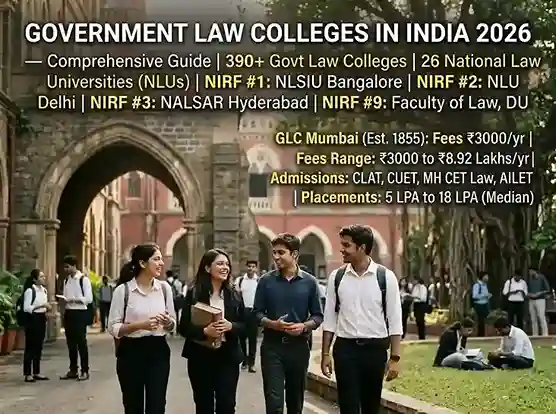
1. Overview | Government Law Colleges in India
Government law colleges in India encompass a broad spectrum of institutions | from elite National Law Universities consistently ranked among Asia's top law schools, to historic central university law faculties, and thousands of state-funded law colleges across every state. What unites them is government funding (directly or through state legislature acts), BCI (Bar Council of India) recognition, and significantly lower fees compared to private institutions.
The government law college landscape is best understood through four distinct categories:
26 NLUs established by state legislature acts; most autonomous; funded by state government. Admissions through CLAT (25 NLUs) or AILET (NLU Delhi). Premium legal education; highest placement outcomes.
Faculty of Law, DU; Faculty of Law, BHU; AMU; JMI; Panjab University; Hyderabad University etc. Admissions through CUET or institutional tests. Highly affordable; strong academic tradition.
GLC Mumbai, GLC Trivandrum, Government Law College Ernakulam, etc. Under state bar councils/governments. Admissions through state CETs. Very low fees (₹3,000–₹30,000/year). Strong local bar practice culture.
ILS Pune, Army Institute of Law Mohali, and others that receive partial government grants. Lower fees than private; admission through state CETs or CLAT. Good academic quality; often affiliated to state universities.
2. NIRF 2025 Rankings | Top Government Law Colleges
The National Institutional Ranking Framework (NIRF), published annually by the Ministry of Education, Government of India, is the most authoritative ranking system for Indian law colleges. NIRF evaluates institutions on five parameters: Teaching, Learning & Resources (TLR); Research and Professional Practice (RP); Graduation Outcomes (GO); Outreach and Inclusivity (OI); and Peer Perception (PR). All top government law colleges dominate the NIRF 2025 Law rankings.
| NIRF 2025 Rank | Institution | Type | Location | NIRF Score | NAAC |
|---|---|---|---|---|---|
| #1 | NLSIU Bangalore | NLU (State) | Bangalore, Karnataka | 80.52 | A++ |
| #2 | NLU Delhi | NLU (Central) | New Delhi | 73.8 | | |
| #3 | NALSAR Hyderabad | NLU (State) | Hyderabad, Telangana | 68.04 | A |
| #4 | NUJS Kolkata | NLU (State) | Kolkata, West Bengal | 65.6 | A |
| #5 | GNLU Gandhinagar | NLU (State) | Gandhinagar, Gujarat | 63.4 | A |
| #6 | NLU Jodhpur | NLU (State) | Jodhpur, Rajasthan | 62.0 | A |
| #7 | NLIU Bhopal | NLU (State) | Bhopal, M.P. | 58.5 | A |
| #8 | Jamia Millia Islamia (JMI) | Central University | New Delhi | 57.2 | A+ |
| #9 | Faculty of Law, Delhi University | Central University | New Delhi | 56.8 | | |
| #10 | Aligarh Muslim University (AMU) | Central University | Aligarh, U.P. | 55.4 | A+ |
| #11–15 | RMLNLU Lucknow, HNLU Raipur, RGNUL Punjab, CNLU Patna, BBAU Lucknow | NLU / Central Univ. | Various | 52–56 | A/A+ |
| #16–25 | Remaining NLUs + BHU, Panjab University, ILS Pune | NLU / Govt. Aided | Various | 45–52 | A/B++ |
Source: NIRF 2025 official rankings (nirfindia.org). Rankings and scores subject to annual revision. All government institutions are evaluated on equal parameters regardless of funding model.
3. National Law Universities (NLUs) | All 26 with Data
The 26 National Law Universities (NLUs) are the crown of India's government law education system. Established between 1987 (NLSIU) and 2020 (newest NLUs), they offer 5-year integrated BA LLB and BBA LLB programmes through the CLAT system. Together they provide approximately 3,700 UG seats and nearly 1,200 LLM seats annually. Here are the Tier-1 and Tier-2 NLUs in detail:
3.1 Tier-1 NLUs | Detailed Profiles
3.2 Tier-2 NLUs | Summary Table
| NLU | Location | Est. | Annual Fee (approx.) | UG Seats | CLAT 2026 Cutoff (Gen. AI) | Median Placement |
|---|---|---|---|---|---|---|
| RMLNLU Lucknow | Lucknow, UP | 2006 | ~₹2.5L/yr | 120 | AIR ~600–800 | ₹7 LPA |
| HNLU Raipur | Raipur, CG | 2003 | ~₹2.3L/yr | 120 | AIR ~700–900 | ₹6–8 LPA |
| NLIU Bhopal | Bhopal, MP | 1997 | ~₹1.5–2L/yr | 120 | AIR ~432–600 | ₹16 LPA |
| RGNUL Punjab | Patiala, Punjab | 2006 | ~₹2.5L/yr | 120 | AIR ~800–1000 | ₹6–8 LPA |
| CNLU Patna | Patna, Bihar | 2006 | ~₹2L/yr | 120 | AIR ~1000–1400 | ₹5–7 LPA |
| NLUO Cuttack | Cuttack, Odisha | 2008 | ~₹2L/yr | 120 | AIR ~1200–1600 | ₹5–7 LPA |
| NUSRL Ranchi | Ranchi, Jharkhand | 2010 | ~₹2L/yr | 120 | AIR ~2000–3000 | ₹8–10 LPA |
| NLUJAA Guwahati | Guwahati, Assam | 2009 | ~₹1.8L/yr | 120 | AIR ~3000–5000 | ₹4–6 LPA |
| DSNLU Visakhapatnam | Vizag, AP | 2008 | ~₹1.8L/yr | 120 | AIR ~2500–4000 | ₹5–7 LPA |
| TNNLS Tiruchirappalli | Trichy, Tamil Nadu | 2012 | ~₹1.5L/yr | 120 | AIR ~3000–5000 | ₹4–6 LPA |
| MNLU Mumbai | Mumbai, Maharashtra | 2014 | ~₹2L/yr | 120 | AIR ~2000–3500 | ₹6–9 LPA |
| MNLU Nagpur | Nagpur, Maharashtra | 2017 | ~₹2L/yr | 120 | AIR ~3000–5000 | ₹5–7 LPA |
| HPNLU Shimla | Shimla, H.P. | 2009 | ~₹1.5L/yr | 120 | AIR ~4000–7000 | ₹4–6 LPA |
| DBRANLU Sonepat | Sonepat, Haryana | 2012 | ~₹1.5L/yr | 120 | AIR ~4000–7000 | ₹4–5 LPA |
Note: All NLUs provide fully residential campus with on-campus hostels. Fees are indicative 2026–27 first-year amounts and subject to annual increments. All NLUs are BCI-approved and UGC-recognised. For the complete list of all 26 NLUs, visit our All NLUs guide.
4. Top Non-NLU Government Law Colleges | Detailed Profiles
Outside the NLU system, India has several historic and highly reputed government law institutions that have been producing eminent legal professionals for over a century. These offer exceptional quality at dramatically lower fees, and are increasingly competitive in admissions due to their brand value and location advantages.
5. State Government Law Colleges | Region-Wise Guide
Beyond the nationally recognised institutions, every state in India has its own network of government law colleges | typically offering 3-year LLB programmes at dramatically affordable fees for local students. These colleges are ideal for aspirants who want to enter the legal profession cost-effectively and build a career in state-level courts, government service, or local law firms.
| State / Region | Top Government Law College | Admission Exam | Annual Fee (approx.) | Strengths |
|---|---|---|---|---|
| Maharashtra | Govt. Law College, Mumbai (est. 1855); ILS Pune (aided) | MH CET Law | Score 95+ | ₹3,000 – ₹61,190 | Bombay HC proximity; strongest litigation bar |
| Delhi / NCR | Faculty of Law, DU; USLLS (GGSIPU); JMI | CLAT / CUET / DU entrance | ₹18,030 – ₹72,000 | Delhi HC access; NIRF #9; 100-year legacy |
| Uttar Pradesh | Faculty of Law, BHU; Faculty of Law, Allahabad University; AMU | CUET / AMU entrance | ₹8,000 – ₹1.9L total | Allahabad HC (one of largest); strong litigation bar |
| Punjab / Haryana | UILS, Panjab University, Chandigarh; P.U. Regional Centres | PU LLB CET / CLAT | ₹20,000 – ₹60,000/yr | Punjab & Haryana HC proximity; strong alumni network |
| Rajasthan | Faculty of Law, University of Rajasthan, Jaipur | LSAT / University CET | ₹15,000 – ₹40,000/yr | Rajasthan HC proximity; historic institution |
| Kerala | Govt. Law College, Thiruvananthapuram; GLC Ernakulam | Kerala Law Entrance (KLEE) | ₹10,000 – ₹30,000/yr | Kerala HC proximity; strong litigation tradition |
| Karnataka | Govt. Law College, Bangalore; Karnataka Law Society | Karnataka PGCET / LSAT | ₹20,000 – ₹50,000/yr | High Court proximity; IT sector law boom in Bangalore |
| Tamil Nadu | Government Law College, Chennai; Government Law College, Coimbatore | TANCA / TNLET | ₹15,000 – ₹40,000/yr | Madras HC proximity; strong IPR culture |
| West Bengal | Hazra Law College; Calcutta University Law Department | WB law entrance / CUET | ₹10,000 – ₹35,000/yr | Calcutta HC; strong litigation tradition |
| Gujarat | HK Arts College (Law), Gujarat University; SLS Nagpur (Gov.-aided) | GUJCET Law / LSAT | ₹20,000 – ₹60,000/yr | Gujarat HC; growing commercial law hub |
6. Fee Structure Comparison | Government Law Colleges 2026
One of the most compelling advantages of government law colleges is affordability. The fee spectrum across government institutions is extraordinarily wide | from ₹3,000 per year to ₹8.92 lakhs per year | offering genuine options for every economic background. Here is a comprehensive fee comparison:
7. Admission Process | Entrance Exams, Cutoff & Eligibility
Government law college admissions in India use different entrance exam pathways depending on the type of institution. Understanding which exam each college uses | and what score/rank is required | is the foundation of any law college application strategy.
| Entrance Exam | Conducted By | Colleges Accepting | Pattern | 2026 Cutoff (General) |
|---|---|---|---|---|
| CLAT | Consortium of NLUs | 25 NLUs (all except NLU Delhi) | 120 MCQs | 120 min | Offline | AIR 101 (NLSIU) | AIR 8000+ (newer NLUs) |
| AILET | NLU Delhi | NLU Delhi only | 150 MCQs | 90 min | No –ve marking | Top ~80 ranks for General (UG) |
| CUET (Law) | NTA (Govt. of India) | BHU, AMU, JMI, Panjab University, BBAU, others | MCQ | Computer-based | Domain + Language sections | 95–99 percentile for top central university law seats |
| MH CET Law | CET Cell, Maharashtra | GLC Mumbai, ILS Pune, MNLU Mumbai, all Maharashtra law colleges | MCQ | Legal aptitude + GK | 2 hrs | Score 95%+ for GLC Mumbai / ILS Pune |
| KLEE (Kerala Law Entrance) | LBS Kerala | All Kerala government law colleges | MCQ | Legal aptitude | 2.5 hrs | Top 10% of state applicants for GLC Trivandrum |
| LSAT India | LSAC (via Pearson) | Select state university law departments; private colleges | Logical reasoning focused | 3.5 hrs | 75+ percentile for most government colleges accepting it |
| Institutional Entrance Tests | Individual universities | JMI (own entrance), AMU, some state universities | Varies by institution | Check official website of target institution |
7.1 Eligibility Criteria | Government Law Colleges 2026
| Programme | General / OBC | SC / ST | Other Conditions |
|---|---|---|---|
| 5-Year Integrated LLB (BA/BBA/BCom LLB) | Class 12 (any stream) | minimum 45% | Class 12 | minimum 40% | No upper age limit for CLAT (NLUs) |
| 3-Year LLB | Any bachelor's degree | minimum 45% aggregate | Graduation | minimum 40% | Final-year graduation students may apply provisionally |
| LLM (1-Year) | LLB (3-yr or 5-yr) | minimum 50% | LLB | minimum 45% | CLAT PG / CUET PG / institutional entrance |
| PhD (Law) | LLM | minimum 55% | LLM | minimum 50% | UGC NET/JRF often required; institutional interview |
8. Placements | Government Law College Career Outcomes
Placement outcomes at government law colleges in India span a wide range | from ₹3–4 LPA starting salaries at state government colleges to ₹18–20 LPA median packages at top NLUs. The quality of placement is strongly correlated with college tier, but even lower-ranked government colleges offer pathways to respectful legal careers in litigation, government service, and judicial services.
| College Category | Median Package | Highest Package (reported) | Top Career Pathways | Key Recruiters |
|---|---|---|---|---|
| Tier-1 NLUs (NLSIU, NLU Delhi, NALSAR, NUJS) | ₹18–20 LPA | ₹35+ LPA (international offers) | Tier-1 law firms, Big 4, investment banks, SEBI/RBI | CAM, AZB, SAM, Khaitan, Trilegal, Clifford Chance |
| Tier-2 NLUs (GNLU, NLU Jodhpur, NLIU) | ₹16–18 LPA | ₹25–30 LPA | Tier-1/2 law firms, corporate legal, Big 4 advisory | CAM, Khaitan, Trilegal, JSA, EY, Deloitte |
| Mid-tier NLUs (RMLNLU, HNLU, NUSRL) | ₹6–10 LPA | ₹15–18 LPA | Regional law firms, Tier-2 corporate law, State PSC | Regional firms, government legal offices, PSUs |
| Central University Colleges (DU, JMI, AMU, BHU) | ₹5–12.5 LPA | ₹15–20 LPA (top performers) | Litigation, HC practice, government service, CLAT coaching | Law firms, government bodies, MNC legal teams |
| GLC Mumbai / ILS Pune | ₹5–8 LPA | ₹15–18 LPA (top 10%) | Mumbai bar, corporate law, litigation, government service | Mumbai law firms, Bombay HC chambers |
| State Government Law Colleges | ₹3–5 LPA | ₹10+ LPA (exceptional) | State bar practice, government pleader, judicial services, UPSC | District courts, state government depts., Govt Advocate |
9. Hostel & Campus Facilities
Hostel availability varies considerably across the government law college spectrum. Here is a clear overview:
| College Type | Hostel Status | Details | Annual Hostel Cost (approx.) |
|---|---|---|---|
| All 26 NLUs | ✅ Fully Residential | On-campus hostels for all students | mandatory or strongly advised | ₹80,000–₹2L/year (varies by NLU) |
| BHU, AMU, JMI, Panjab University | ✅ Campus Hostel System | Large university hostel systems; allocated by merit/quota | ₹30,000–₹80,000/year |
| Faculty of Law, Delhi University | ⚠️ Limited | DU hostel system (campus-wide); law faculty gets limited seats | ₹30,000–₹60,000/year (if allotted) |
| GLC Mumbai | ⚠️ Reserved Hostel Seats | No own campus; reserved seats in Govt. hostels at Marine Drive & Telang Memorial | ₹20,000–₹50,000/year |
| ILS Pune | ⚠️ Limited On-Campus | Small hostel capacity; often overcrowded; most students use private PGs | ₹40,000–₹80,000/year (PG) |
| State Govt. Law Colleges (standalone) | ❌ Usually No Hostel | Standalone day colleges; students arrange private accommodation | ₹50,000–₹1.5L/year (private PG) |
9.1 Library Infrastructure | Key Highlights
Government law college libraries are among the finest in India, with historic collections built over decades. Key library facilities at major institutions:
Harilal J. Kania Memorial Library. Houses original 1860 IPC draft, rare colonial-era legal texts. Digital access: LexisNexis, Westlaw. Library founded 1952.
One of the largest law libraries in India: 1.5 lakh books. Extensive law reports and journals. Electronic Research Room (ERR) with LexisNexis and Westlaw access.
All 26 NLUs have fully digital libraries with SCC Online, Manupatra, JSTOR, HeinOnline. NLSIU library is among India's best digitised law libraries with 24×7 student access.
10. How to Choose the Right Government Law College
With 390+ government law colleges to choose from, the selection decision depends on a combination of factors unique to each student. Here is a structured decision framework to find the best-fit government law college for you:
Target CLAT and aim for AIR 1–115 (NLSIU), AIR 116–200 (NLU Delhi/NALSAR), AIR 200–350 (NUJS/GNLU/NLU Jodhpur). The top-5 NLUs deliver ₹16–20 LPA medians. No other government college matches this. If your CLAT score falls short, the gap in placement outcomes is real and significant.
GLC Mumbai (₹3,000/year), BHU LLM (₹8,000/year), Faculty of Law DU (₹18,030/year), AMU (₹1.9L total), or ILS Pune (₹1.89L total) offer world-class legal education at a fraction of NLU costs. All are NIRF-ranked and BCI-approved.
GLC Mumbai (Bombay HC 1 km away), Faculty of Law DU (Delhi HC), BHU/Allahabad University (Allahabad HC | one of India's largest), UILS Panjab University (Punjab & Haryana HC) | all offer unmatched access to top High Courts for internships and early career practice.
Any BCI-recognised government law degree qualifies you for judicial services. State government law colleges often produce more judicial services candidates than NLUs | given their focus on substantive law, local court exposure, and examoriented culture. AMU, BHU, Allahabad University, and Panjab University have outstanding judiciary track records.
GNLU (30+ university exchange tie-ups), NLSIU (strong international research), NLU Delhi (proximity to international law organisations in Delhi), and NALSAR all have international programmes, exchange partnerships, and moot competitions that prepare students for global legal careers.
25 of 26 NLUs reserve 25% seats for home state students, making admission considerably more accessible at much higher rank cutoffs. Karnataka students can target NLSIU at AIR 460+; Gujarat students can target GNLU at AIR 1500+; Rajasthan students can target NLU Jodhpur at AIR 1000+. This is a major strategic advantage.