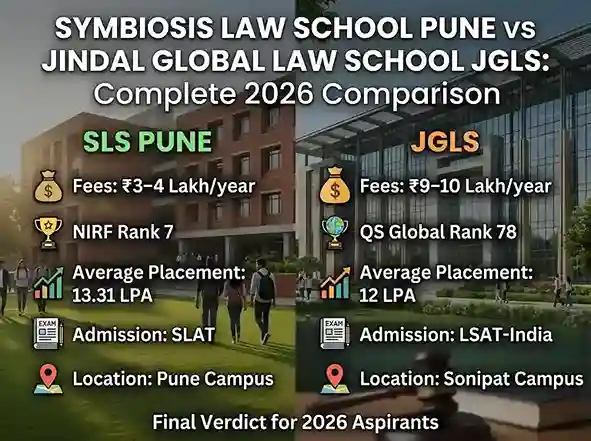
Symbiosis Law School (SLS) Pune wins on: NIRF #7 in Law (2025), lower fees (~₹3–4 lakh/year vs JGLS's ~₹9–10 lakh/year all-in), slightly higher average placement (₹13.31 LPA), legacy (Est. 1977), Pune's mature legal market, and a more accessible admission process (SLAT + GD/PI). JGLS wins on: global reputation (QS #78 in Law globally), international academic collaborations (Yale, Harvard, NYU, Oxford), research depth, modern residential NCR campus, better international placement access, and the most extensive global law network of any Indian law school. The fundamental choice: if you want India's best-value top-ranked private law school, choose SLS Pune. If you want international exposure and can invest 2.5× more, choose JGLS.
1. SLS Pune vs JGLS | At-a-Glance Summary Table
The fee difference between SLS Pune and JGLS is the single most consequential factor in this comparison. This is not a marginal difference | JGLS costs approximately 2.5 to 3 times more than SLS Pune when all charges are included. Understanding the true total cost | not just headline tuition | is essential before making a decision.
JGLS's stated policy of a 10% annual increase on tuition fees means a student who pays ₹6.25 lakh in Year 1 may pay approximately ₹9.14 lakh by Year 5 (before hostel). Over 5 years, the cumulative tuition escalation adds approximately ₹10–15 lakh more than a flat fee would suggest. When budgeting for JGLS, always calculate the full 5-year cost with 10% annual compounding applied | not just the first-year tuition figure. The official JGLS fee structure documentation explicitly states this escalation clause.
SLS Pune offers the best fee-to-ranking ratio of any private law school in the NIRF Top 10. Hostel is optional | day scholars who live locally save significantly. Fee increases are more modest and predictable.
JGLS is one of India's most expensive law programmes | comparable to premium NLUs but significantly more than any other private law school. The mandatory residential fee adds ₹3.1 lakh annually with no opt-out option. Factor the 10% annual increase carefully when planning finances over 5 years.
The ranking picture for these two schools is genuinely complex | each leads by a different metric, and neither metric is universally superior. Understanding what each ranking measures is as important as knowing the numbers.
| Ranking Body | SLS Pune | JGLS Sonipat | What It Measures |
|---|---|---|---|
| NIRF | Law 2025 | #7 (Law Category) | Not prominently ranked | Teaching, research, graduation outcomes, outreach | India-specific metrics |
| QS World | Law & Legal Studies 2025 | Not globally ranked separately | #78 (Globally) | Academic reputation (global peer survey), employer reputation, research citation impact, h-index |
| NIRF | Overall 2025 | Symbiosis International University: ~Top 15 (University category) | OP Jindal Global University: ~#21 (University category) | Overall university performance across all departments |
| NAAC Accreditation | A+ (Symbiosis International University) | A (OP Jindal Global University, 2024) | Quality assessment of teaching, research, infrastructure, governance |
| Times Higher Education | Not prominently ranked | OP Jindal Global University: ~#21 in India | Global research and academic output assessment |
| India Today | Law | Consistently top private school | Consistently top private school | Perception-based survey with outcome metrics |
The admission processes are meaningfully different | and understanding this helps determine which school is more accessible for your academic profile.
Choose SLS Pune admission if: you are a strong communicator, perform well in group settings, have good current affairs awareness, and want your personality and reasoning ability to be assessed holistically. The GD/PI process rewards well-rounded, articulate candidates with genuine motivation for law. Choose JGLS admission if: you are a strong analytical test-taker, may be introverted or less comfortable in GDs, want flexibility in exam choice (LSAT/CLAT/SAT/ACT), or want to apply before having your LSAT score. JGLS's process is more standardised and less subjective | which suits certain candidate profiles very well.
Both schools produce strong placement outcomes | but with different character. SLS Pune's placements are stronger domestically in the India law firm market; JGLS's placements are stronger internationally and in global corporate law.
Top recruiters: AZB & Partners, Khaitan & Co., Cyril Amarchand Mangaldas, Trilegal, Shardul Amarchand Mangaldas, EY, KPMG, Deloitte, SEBI, RBI, corporate legal departments. SLS Pune's 49-year alumni network spans every tier of the Indian legal profession | judges, senior advocates, law firm partners, and in-house legal heads. The ₹52 LPA international package reflects Pune's active international law firm recruitment pipeline.
Top recruiters: AZB & Partners, Khaitan & Co., Cyril Amarchand Mangaldas, Veritas Legal, Trilegal, ICICI Bank, EY, JSA, S&R Associates, Indus Law, Godrej, Cipla. JGLS conducts Day Zero campus recruitments where top firms make offers to graduating students. 26 PPOs (Pre-Placement Offers) were received in 2023, indicating strong internship-to-placement conversion. JGLS's international alumni connections (global law firms, UN, World Bank) create international placement channels not available at most Indian law schools.
Top Recruiters | Combined List (Both Schools)
| Programme | SLS Pune | JGLS Sonipat |
|---|---|---|
| BA LLB (Hons.) | 5 Year | ✅ Yes | SLAT + GD/PI | ✅ Yes | LSAT-India/JSAT/CLAT |
| BBA LLB (Hons.) | 5 Year | ✅ Yes | SLAT + GD/PI | ✅ Yes | LSAT-India/JSAT/CLAT |
| BCom LLB (Hons.) | 5 Year | ✅ Yes (SLS Pune only) | ❌ Not Offered |
| 3-Year LLB | Not prominently offered at Pune | ✅ Yes (for graduates) |
| LLM | ✅ Yes (1-year & 2-year options) | ✅ Yes (1-year residential) |
| JD (Juris Doctor) | ❌ Not Offered | ✅ Yes | First JD in India |
| MPhil / PhD | ✅ Yes | ✅ Yes (Law + Social Sciences) |
| LLM Specialisations | Corporate Law, IPR, International Law, Criminal Justice, etc. | Environmental Law, International Law, Business Law, Human Rights, etc. (incl. WWF partnership LLM) |
| Exchange Programmes | Available with international law schools | Extensive (Yale, Harvard, NYU, Oxford, Cambridge, NUS) |
Jindal Global Law School is the only institution in India to offer a JD (Juris Doctor) programme | the standard law degree in the United States and Canada. The JD at JGLS is a 3-year postgraduate programme for graduates, structured similarly to American law school | emphasising case method teaching, legal clinics, seminars, and research. For students specifically planning international legal careers (US/Canadian law practice or international organisations), the JGLS JD provides a globally recognised credential that no other Indian institution can match. This is one of JGLS's strongest unique differentiators.
Located in Viman Nagar, Pune | one of India's most liveable cities | SLS Pune is situated near Pune Airport in a well-connected area. The campus has a gymkhana (gym, health centres), a well-maintained canteen, stationery and grocery stores, libraries, and a computer lab. Outdoor sports facilities include a basketball court, futsal ground, badminton court, and volleyball court. Separate hostel blocks for boys and girls are available. Pune's city location means students have access to the Pune High Court, the city's growing corporate legal market (many multinationals have India HQs in Pune), and a vibrant student social scene across other Symbiosis institutions. Day scholars commuting from Pune city save significantly on accommodation costs.
JGLS is part of OP Jindal Global University (JGU) in Sonipat, Haryana | approximately 50 km from central Delhi and 30 km from Connaught Place via the Delhi-Sonipat expressway. The campus is fully residential | every student lives on campus, hostel fees are mandatory and non-negotiable. The campus is modern, sprawling, and aesthetically impressive with state-of-the-art classrooms, a well-stocked global law library (including international journals and database access), moot court facilities, a medical centre, and sports infrastructure. Proximity to Delhi gives JGLS students access to the Supreme Court, Delhi High Court, and the country's largest concentration of Tier-1 law firms | all within 60–90 minutes during internship periods.
| Campus Factor | SLS Pune | JGLS Sonipat |
|---|---|---|
| Campus Type | Urban-city (semi-residential) | Suburban (fully residential | mandatory) |
| Location City | Pune, Maharashtra (metropolitan city) | Sonipat, Haryana (NCR | near Delhi) |
| High Court Access (internship) | Bombay High Court (Nagpur/Mumbai) | Pune District Court | Delhi High Court | Supreme Court of India (60–90 min) |
| City Legal Market | Pune | growing corporate legal hub, MNC offices | NCR | India's largest concentration of law firms |
| Library | Well-stocked physical + digital law library | International law library with global journals and databases |
| Hostel | Optional | separate boys/girls blocks | Mandatory | included in fees (no opt-out) |
| Day Scholar Option | Yes | significant cost saving for Pune residents | No | all students must live on campus |
On the dimension of global reputation and international exposure, JGLS is unambiguously superior | this is not a close comparison. The scale and depth of JGLS's international academic and professional network has no peer among Indian private law schools.
Symbiosis Law School Pune offers merit-based scholarships to students who perform exceptionally in SLAT and the GD/PI rounds. Additional scholarships are available for socioeconomically weaker students. As a constituent of Symbiosis International University, students may also be eligible for university-level scholarships and fee concessions under national government scholarship schemes (NSP, state government schemes for SC/ST/OBC/EWS students). Verify current scholarship slabs and eligibility on the official Symbiosis SET portal before applying.
JGLS offers tiered merit scholarships based on LSAT-India percentile scores. Students with higher LSAT percentiles receive higher scholarship percentages | starting from 10% (at around the 80th percentile) up to 75% at the 99.99th percentile. For LLM students, specific named scholarships are available: the Naveen Jindal Young Global Scholarship (50% tuition fee) and the Shallu Jindal Outstanding Women Scholarship (50% tuition fee to 2 outstanding women). Additionally, an in-semester scholarship based on academic performance is available for students whose family income is below ₹50 LPA. Even with scholarship, JGLS's total cost typically exceeds SLS Pune's full fee.
For SLS Pune: Score in the top 5–10% of SLAT and perform strongly in the GD/PI rounds. Apply early in the admission cycle | scholarship availability may be front-loaded. Check the official Symbiosis SET portal for current year scholarship slabs. For JGLS: Maximise your LSAT-India score | the scholarship scale is directly tied to LSAT percentile, and the difference between 85th and 99th percentile is potentially a 50–60% scholarship. Even with JGLS's maximum scholarship, the total 5-year cost often exceeds SLS Pune's unscholarshiped total. Calculate the net cost (fee minus scholarship) carefully for each school before making a final decision.
Return on investment analysis is critical when the fee difference is ₹30+ lakh. Let us examine the numbers:
| ROI Metric | SLS Pune | JGLS Sonipat | Verdict |
|---|---|---|---|
| Total Investment (5-yr est.) | ~₹18 lakh | ~₹48 lakh | SLS ₹30 lakh cheaper |
| Average Starting Salary | ~₹13.31 LPA | ~₹12 LPA | SLS slightly higher average |
| Years to Recover Investment (basic est.) | ~1.4 years (at ₹13.31L salary) | ~4 years (at ₹12L salary) | SLS: significantly faster ROI |
| International Career Potential | Good | but limited structural pathways | Excellent | structural international network | JGLS wins for international ROI |
| Domestic India Career ROI | Excellent | NIRF #7 brand with lower investment | Good | but over-investment for domestic-only career | SLS wins for domestic ROI |
11. Who Should Choose Which | Decision Framework
- Your primary career goal is a domestic Indian law practice | law firms, in-house counsel, litigation, judiciary
- You want the best fee-to-ranking value | NIRF #7 at ~₹18 lakh total is unmatched in private law schools
- You perform well in GD/PI rounds and want your communication skills and personality to be part of the assessment
- You are a Pune resident or plan to be a day scholar | saving on hostel significantly reduces total cost
- You want a BCom LLB | only SLS Pune offers this among the two schools
- You value a 49-year alumni network deeply embedded in Indian legal practice
- Your family has budget constraints and paying ₹48 lakh for JGLS is not realistic without significant scholarship
- You want Pune's city access | legal market, High Court, corporate sector, lifestyle quality
- Your career goal includes international law practice | global law firms, international arbitration, UN/World Bank, international organisations
- You want to pursue an LLM abroad at a top-50 global law school | JGLS's QS rank and faculty letters open doors that SLS Pune's cannot
- You are specifically interested in the JD programme | the only JD offered in India
- You are a strong LSAT-India/standardised test performer who can access substantial merit scholarship (75% on exceptional scores)
- You want Delhi NCR access | Supreme Court, Delhi High Court, and the highest concentration of top-tier law firm offices in India, all within 60–90 minutes
- You want a fully residential campus experience | the JGU campus in Sonipat is widely praised for its quality of student life
- Your family has the financial capacity (₹45–50 lakh) or you can access significant scholarship
- Research and academic output are career goals | JGLS's international faculty and research infrastructure are superior for those planning academia
12. Final Verdict | LawGuru India's Honest Assessment
After comparing 12 parameters with real data, here is the bottom line: Symbiosis Law School Pune is India's best-value top-ranked private law school for students pursuing domestic legal careers. No other private law institution offers NIRF #7 in Law at approximately ₹3–4 lakh per year. The combination of academic pedigree, placement outcomes (₹13.31 LPA average), Pune's legal ecosystem, and 49 years of alumni network makes SLS Pune the rational choice for the majority of Indian law students. Jindal Global Law School is the right choice for students with specific international career ambitions | if you want to work at White & Case, Clifford Chance, or the World Bank; if you want an LLM at Yale or NYU; if you want to practise international arbitration | and you have the financial capacity or scholarship access to manage the ₹45–50 lakh investment. Do not choose JGLS over SLS Pune simply because it "sounds more global" | choose it only if you have a concrete international career plan that JGLS's network specifically enables.
- NIRF #7 | India's highest-ranked private law school by NIRF
- Average placement ₹13.31 LPA | higher than JGLS's ₹12 LPA
- Fee: ~2.5× cheaper all-in (₹18L vs ₹48L total)
- 49-year alumni network embedded in Indian legal practice
- BCom LLB | unique course not available at JGLS
- NAAC A+ (vs JGLS's NAAC A)
- Pune city advantages: High Court access, corporate market
- QS #78 globally in Law | highest global rank of any Indian law school
- International collaborations: Yale, Harvard, NYU, Oxford, Cambridge
- JD programme | India's only Juris Doctor
- International placement access (White & Case, international orgs)
- Research depth and faculty diversity (international law professors)
- Modern residential campus with NCR/Delhi access
- Day Zero/PPO placement drives with top-tier corporate firms
13. Frequently Asked Questions | Symbiosis vs Jindal 2026
For domestic Indian law careers and overall value, Symbiosis Law School Pune is the better choice | NIRF #7, ₹13.31 LPA average placement, and total cost of ~₹18 lakh make it India's best-value top-ranked private law school. For international careers, research ambitions, and global law school networking, JGLS is the better choice | its QS #78 global ranking, Yale/Harvard/NYU/Oxford collaborations, and structured international placement pipelines are unmatched among Indian law schools. Neither is universally better | the right answer depends entirely on your career goals and financial capacity.
JGLS's total 5-year cost requires careful calculation because: (a) tuition fees escalate by 10% annually as per the official policy; (b) hostel fees of ₹3.1 lakh per year (also escalating) are mandatory with no day-scholar option. Starting from approximately ₹6.25–7 lakh tuition in Year 1 and ₹3.1 lakh hostel, the first-year total is approximately ₹9.35–10.1 lakh. With 10% annual increases applied over 5 years, the cumulative 5-year total is approximately ₹45–52 lakh depending on starting fee and escalation rate. Always verify the current fee structure on the official JGLS/OP Jindal Global University website before applying, as fees are revised annually.
Yes | JGLS offers tiered LSAT-India-based scholarships. Reported scholarship ranges: approximately 10% scholarship at the 80th LSAT percentile, scaling up to 75% scholarship at the 99.99th percentile. Named scholarships also exist: the Naveen Jindal Young Global Scholarship (50% tuition for 1-year LLM), Shallu Jindal Outstanding Women Scholarship (50% tuition for 2 outstanding women per year), and the OP Jindal Merit Scholarship (₹1 lakh for top 5 LSAT scorers joining the LLM). In-semester performance-based scholarships are also available for students whose family income is below ₹50 LPA. Even with a 50% scholarship on tuition (say, ₹3.12 lakh off each year), the hostel of ₹3.1 lakh remains mandatory | meaning the total annual cost remains around ₹6 lakh with a 50% scholarship. Verify current scholarship amounts and eligibility criteria on the official JGLS portal.
Based on historical SLAT cutoff patterns, approximately 85–90 percentile in SLAT is needed for a strong chance at SLS Pune (the flagship Symbiosis Law School campus). However, the SLAT score is not the only criterion | the Group Discussion (GD) and Personal Interview (PI) are equally weighted in the final merit calculation. A student with a slightly lower SLAT score but an exceptional GD/PI performance may secure a seat over a higher SLAT scorer with a poor interview. Other SLS campuses (Noida, Hyderabad, Nagpur) have lower cutoffs, approximately 75–80 percentile. Verify expected cutoffs each year on the official Symbiosis SET portal after SLAT results are announced.
Both are strong for corporate law | the answer depends on what type of corporate law you envision. SLS Pune is excellent for domestic corporate law practice | M&A, private equity, securities law, and commercial litigation in India. The alumni network at India's top law firms (AZB, Khaitan, CAM, Trilegal) is deep and active. JGLS is stronger for international corporate law | cross-border M&A, international arbitration, international trade, foreign investment law, and commercial work at global firms like White & Case, Linklaters, or Clifford Chance. JGLS's Yale/Harvard/NYU collaborations are particularly relevant for students targeting LLM programmes in corporate or international business law abroad. If "corporate law" in your mind means India's Tier-1 law firms, both schools work | SLS is cheaper and slightly better by average outcome. If it means international firms, JGLS has a structural advantage.
For domestic career mentorship and opportunities, SLS Pune's alumni network is significantly more powerful | 49 years of graduates are embedded throughout the Indian legal profession, from the Supreme Court bench and senior Bar to law firm partnerships and in-house legal heads at major corporations. This depth of alumni presence, particularly in cities like Pune, Mumbai, Delhi, and Bengaluru, creates mentorship, referral, and networking opportunities that newer institutions cannot replicate. JGLS's alumni network, being only 17 years old, is more limited domestically | but is already strong in international circles and is growing rapidly given JGLS's alumni in global law firms and international organisations. For domestic networking: SLS Pune wins clearly. For international networking: JGLS is the clear leader among Indian law schools.
Symbiosis Law School's primary admission route is SLAT (Symbiosis Law Admission Test) + GD + PI | this is the main path for the vast majority of students. SLAT is a separate test from CLAT and is conducted by Symbiosis International University. SLS also accepts AIAT (All India Admission Test) scores as an alternative to SLAT. SLS does not participate in CLAT Consortium counselling | a CLAT score alone will not secure admission to any SLS campus. JGLS, on the other hand, accepts CLAT-UG scores (along with LSAT-India, JSAT, CUET, SAT, and ACT) | CLAT scores can be used to apply to JGLS. Students who have appeared for CLAT and want to apply to both NLUs and JGLS can do so using their CLAT scorecard for JGLS simultaneously.