1. What is CLAT?
The Common Law Admission Test (CLAT) is the centralised national-level law entrance exam conducted annually by the Consortium of National Law Universities. CLAT 2026 provides admission to 24 NLUs across India offering more than 4,500 BA LLB seats and approximately 1,590 LLM seats.
Since its inception in 2008, CLAT has become the primary gateway to India's most prestigious law schools. The exam was significantly reformed in 2020, shifting to a fully passage-based format across all five sections | eliminating direct knowledge-based questions in favour of testing reading comprehension, analytical reasoning, and application of given rules. CLAT 2026 had 75,009 candidates appear for the exam held in December 2025, with the topper scoring 112.75 out of 120.
2. What is AILET?
The All India Law Entrance Test (AILET) is an independent national-level law entrance exam conducted exclusively by National Law University (NLU), Delhi. AILET is the ONLY route to BA LLB and LLM admission at NLU Delhi | which does not participate in the CLAT Consortium.
NLU Delhi (NIRF Law Rank #3) is one of India's most prestigious law schools, but it has only approximately 110 BA LLB seats for Indian students. This combination of very few seats and a large applicant pool (approximately 30,000–40,000 candidates appear annually) makes AILET extremely competitive. AILET is expected to be held in May 2026, giving it a different calendar slot from CLAT (December 2026).
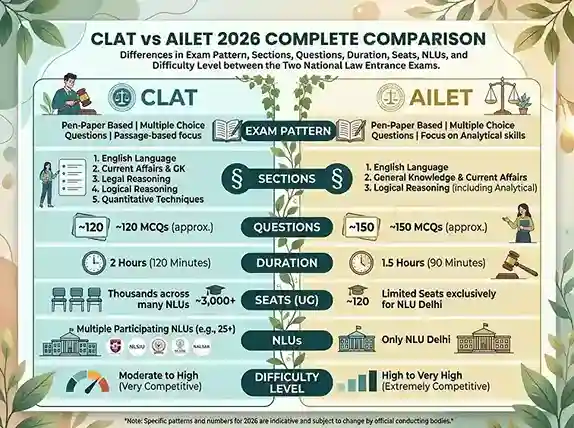
Importantly, AILET has a distinct exam format from CLAT | 3 sections instead of 5, 150 questions instead of 120, and a 90-minute duration instead of 120 minutes. AILET does not include Legal Reasoning or Quantitative Techniques | two sections that CLAT has. AILET's Logical Reasoning section is disproportionately large at 70 out of 150 questions.
3. CLAT vs AILET | 10 Key Differences
CLAT 2026
AILET 2026
4. Exam Pattern Comparison | CLAT 2026 vs AILET 2026
| Feature | CLAT 2026 | AILET 2026 |
|---|---|---|
| Total Questions | 120 | 150 |
| Total Marks | 120 | 150 |
| Duration | 120 minutes (2 hours) | 90 minutes (1.5 hours) |
| Time per Question | 60 seconds | 36 seconds |
| Negative Marking | −0.25 per wrong | −0.25 per wrong |
| Question Format | All passage-based MCQs | MCQs (mix | passage + direct) |
| Number of Sections | 5 | 3 |
| Exam Mode | Offline (OMR sheet) | Offline (OMR sheet) |
| Language | English only | English only |
| Conducting Body | Consortium of NLUs | NLU Delhi independently |
| Official Website | consortiumofnlus.ac.in | nludelhi.ac.in |
AILET's time pressure is significantly higher than CLAT. While CLAT gives you 60 seconds per question (120 minutes ÷ 120 questions), AILET gives only 36 seconds per question (90 minutes ÷ 150 questions). This speed requirement is one of AILET's most challenging aspects | you must read, process, and answer 150 questions in 90 minutes. This demands faster reading and decision-making than CLAT.
5. Syllabus Comparison | Section by Section
CLAT 2026 | Section-Wise Distribution
AILET 2026 | Section-Wise Distribution
Critical Syllabus Differences Between CLAT and AILET
| Syllabus Element | CLAT 2026 | AILET 2026 |
|---|---|---|
| English Language | 28–32 Qs (20%) | Passage-based only. Inference, vocabulary in context, author's tone, summary | 50 Qs (33%) | Passages + some direct questions. Larger section than CLAT's English |
| Current Affairs & GK | 35–39 Qs (25%) | Entirely passage-based; national, international, legal GK events | 30 Qs (20%) | Broad statements or one-liners; includes some factual/static GK. Less passage-based than CLAT |
| Legal Reasoning | 35–39 Qs (25%) | Passage provides legal rule; apply to facts. No prior law knowledge needed | NOT PRESENT IN AILET |
| Logical Reasoning | 28–32 Qs (20%) | Critical reasoning: strengthen/weaken arguments, assumptions, inferences | 70 Qs (47%) | DOMINANT section. Traditional + critical LR: series, coding, blood relations, syllogisms, analogies, critical reasoning |
| Quantitative Techniques / Maths | 13–17 Qs (10%) | Data interpretation, Class 10 arithmetic, graphs, tables | NOT PRESENT IN AILET |
The single biggest structural difference between CLAT and AILET is AILET's massive Logical Reasoning section | 70 out of 150 questions (47%). This is nearly half the entire paper. Students who are naturally strong at reasoning have a significant advantage in AILET. Conversely, CLAT's Legal Reasoning section (25%) | which tests application of legal rules given in a passage | has NO equivalent in AILET. CLAT also includes Maths (Quantitative Techniques, 10%), which AILET entirely omits. This means a student who is weak at Maths actually has one fewer hurdle in AILET.
6. Difficulty Level | Which is Harder, CLAT or AILET?
This is the most frequently debated question. The answer is nuanced | it depends on what kind of difficulty you are measuring and what kind of student you are.
| Dimension of Difficulty | CLAT 2026 | AILET 2026 | Winner (Harder) |
|---|---|---|---|
| Reading Volume | 8,000–12,000 words in 120 min | More targeted, fewer reading passages | CLAT |
| Time Pressure | 60 sec/question | 36 sec/question | AILET |
| Reasoning Demand | 20% of paper (28–32 Qs) | 47% of paper (70 Qs) | AILET |
| Section Breadth | 5 subjects | more ground to cover | 3 subjects | more focused | CLAT |
| GK Format | Passage-based | context provided | One-liner/direct | need factual knowledge | AILET |
| Legal Knowledge Required? | No (passage provides rules) | No legal section at all | Tie |
| Seats Available | 4,500+ (24 NLUs) | ~110 (NLU Delhi only) | AILET (40x fewer seats) |
| Competition Intensity | ~75,000 for 4,500 seats (1:16 ratio) | ~35,000 for 110 seats (1:318 ratio) | AILET is 20x more competitive |
| Content Difficulty | Moderate | reading comprehension focus | Moderate to High | LR heavy | Slight AILET edge |
AILET is functionally harder | primarily because of its extreme seat-to-candidate ratio (1:318 vs CLAT's 1:16). In terms of pure content, AILET's 70-question Logical Reasoning section makes it harder for non-reasoning students, while CLAT's 8,000–12,000 word reading requirement makes it harder for slow readers. For a top scorer (95+ marks in CLAT equivalent), AILET presents genuine additional challenges: faster pace, heavier LR, and more direct GK. The bottom line: both are genuinely difficult exams and must be taken seriously.
7. Seats & Competition Ratio | The Numbers That Matter Most
| Metric | CLAT 2026 | AILET 2026 (estimated) |
|---|---|---|
| Total Candidates Appearing | 75,009 (CLAT 2026 actual) | ~30,000–40,000 (estimated) |
| Total BA LLB Seats | 4,500+ (all 24 NLUs combined) | ~110 (NLU Delhi only) |
| Seat-to-Candidate Ratio (BA LLB) | ~1:16 (1 seat per 16 candidates) | ~1:300–1:360 (far more competitive) |
| Seats at India's #1 NLU (NLSIU, CLAT) | ~100 General seats (AIR 1–102 cutoff) | | |
| Seats at NLU Delhi (AILET) | | | ~110 Indian students (General + Reserved) |
| NLU Delhi International Seats | | | ~5 (separate quota) |
| Top Score (2025–26 exam cycle) | 112.75 / 120 (Geetali Gupta, AIR 1) | Announced separately by NLU Delhi |
The competition ratio data tells you why AILET feels more competitive: 30,000–40,000 students compete for just ~110 seats | roughly 1 seat per 300 applicants. Compare this to CLAT, where 75,009 students competed for 4,500+ seats | about 1 seat per 16 applicants. However, this comparison is slightly misleading because CLAT's top NLU seats (NLSIU, NALSAR) are just as difficult to get as NLU Delhi via AILET.
8. Cutoff Comparison | CLAT vs AILET
CLAT 2026 Cutoff (December 2025 Exam)
| NLU | General Closing Rank (R1) | Approx. Score Required |
|---|---|---|
| NLSIU Bangalore (#1) | AIR 102 | 105–113 marks |
| NALSAR Hyderabad (#2) | AIR 167 | 100–108 marks |
| WBNUJS Kolkata (#4) | AIR 277 | 97–104 marks |
| NLU Jodhpur (#6) | AIR 430 | 93–100 marks |
| GNLU Gandhinagar (#5) | AIR 500 | 92–99 marks |
AILET 2026 Cutoff (Estimated)
| Category | AILET Score (out of 150) | Approximate Rank |
|---|---|---|
| General (UR) | 115–130 | Top 50 |
| OBC (NCL) | 105–118 | 50–120 |
| SC | 88–102 | 100–300 |
| ST | 78–92 | 250–500 |
| EWS | 108–122 | Top 100 |
Official AILET cutoffs are published by NLU Delhi after each exam cycle at nludelhi.ac.in. Figures above are indicative based on available historical data.
9. Application Fees & Registration | CLAT vs AILET
| Feature | CLAT 2026 | AILET 2026 |
|---|---|---|
| Application Fee (General/OBC/EWS) | ₹4,000 | ~₹3,500 |
| Application Fee (SC/ST/PWD) | ₹3,500 | ~₹1,500 |
| Payment Mode | Online | Debit/Credit/UPI/Net Banking | Online | Debit/Credit/UPI/Net Banking |
| Application Portal | consortiumofnlus.ac.in | nludelhi.ac.in |
| Expected Registration Opens | July 2026 | January–February 2026 |
| Expected Last Date | October 2026 | April 2026 |
| Admit Card | November 2026 | April–May 2026 |
| Exam Date | December 2026 | May 2026 (expected) |
| Result | January 2027 | May–June 2026 |
| Counselling | Centralised (Consortium) | NLU Delhi direct counselling |
Total application cost for appearing in both CLAT and AILET (General category) is approximately ₹4,000 + ₹3,500 = ₹7,500. Given that NLU Delhi (AILET) and 24 NLUs (CLAT) together represent the top law education in India, spending ₹7,500 to keep all options open is one of the best investments a law aspirant can make. Always apply for both if you are serious about NLU admission.
10. Preparation Strategy | Preparing for Both CLAT and AILET Together
The good news: CLAT and AILET share three common areas | English Language, Current Affairs & GK, and Logical Reasoning. Preparing well for these three sections serves both exams. The differences are primarily in CLAT's Legal Reasoning and Quantitative Techniques sections (absent in AILET) and AILET's much heavier Logical Reasoning emphasis.
| Section | CLAT Strategy | AILET Strategy | Combined Approach |
|---|---|---|---|
| English Language | Daily editorial reading; inference and tone analysis; 4–5 passage types | Faster reading speed needed; vocabulary more directly tested; 50 questions so volume matters | Daily newspaper + 3 RC passages daily. Focus on speed AND accuracy. Start with The Hindu editorial. |
| Current Affairs & GK | Passage-based | context given; last 12–18 months events; legal GK important | More direct one-liner GK; both current and static GK tested; 30 questions only | Monthly CA notes + Manorama Yearbook + The Hindu. AILET needs static GK too | add NCERT polity/history basics. |
| Logical Reasoning | Critical reasoning focus: strengthen, weaken, assumptions, inferences (28–32 Qs) | Both critical AND traditional LR: series, coding, blood relations, syllogisms, analogies (70 Qs | half the paper!) | Practice R.S. Aggarwal for traditional LR (AILET) + GMAT Critical Reasoning for critical LR (both exams). Solve AILET previous years for LR pattern. |
| Legal Reasoning | 25% of paper. Passage provides rule | apply to facts. No prior law knowledge needed. Essential for CLAT. | NOT in AILET | skip for AILET-only prep | Practise Legal Reasoning from CLAT previous year papers (2020–2025). Build a "rules notebook" as you encounter new principles in passages. |
| Quantitative Techniques | 10% of paper. Data interpretation + Class 10 arithmetic. 13–17 questions. | NOT in AILET | skip for AILET-only prep | 30 minutes weekly on DI practice | NCERT Class 10 Maths + newspaper charts. Don't over-invest; target 12/15 correct. |
Time Allocation Recommendation (12-Month Combined Prep)
| Area | Weekly Hours | Why This Split |
|---|---|---|
| Reading / English (incl. newspaper) | 8–10 hours/week | Serves both exams; builds GK passively |
| Current Affairs Notes | 4–5 hours/week | Monthly CA compilation + AILET static GK |
| Logical Reasoning (Traditional + Critical) | 6–8 hours/week | AILET's 70 Qs demand heavy LR investment |
| Legal Reasoning (CLAT-specific) | 4–5 hours/week | 25% of CLAT; not needed for AILET |
| Quantitative Techniques (CLAT-specific) | 1–2 hours/week | Only 10% of CLAT; skip for AILET |
| Mock Tests (CLAT + AILET previous papers) | Full mock every weekend | Alternating CLAT and AILET mocks from Month 4 |
11. Who Should Choose What | 5 Student Profiles
If NLU Delhi is your primary dream college, AILET is non-negotiable | it is the ONLY route to NLU Delhi. Also appear for CLAT as a backup (for NLSIU, NALSAR, etc.). The exams are in different months so both are possible.
If NLSIU Bangalore or NALSAR Hyderabad is your primary target, CLAT is your main exam. Appear for AILET too for the NLU Delhi option, but your core preparation should optimise for CLAT's passage-based format and Legal Reasoning section.
Appear for both AILET (May) and CLAT (December). This covers all 25 top NLUs in India. The syllabi overlap significantly; additional preparation needed only for AILET's traditional LR, CLAT's Legal Reasoning, and CLAT's Maths. The ₹7,500 combined application cost is entirely justified.
AILET has no Quantitative Techniques section and rewards strong reasoning skills heavily (70/150 questions in LR). If you are naturally strong at logical reasoning and find maths challenging, AILET's format may actually suit you better than CLAT. Still appear for both, but invest more prep time in AILET-style LR.
CLAT's passage-based format rewards strong readers and analytical thinkers. If you can read 400+ words per minute with high comprehension, CLAT's format plays to your strength. AILET's 70 traditional LR questions can be challenging for non-puzzle-inclined students. Still, practise both formats.
12. Should You Appear for Both CLAT and AILET? | The Definitive Answer
Here is the simple logic: CLAT (December) and AILET (May) are in different months. Appearing in both costs only ₹7,500 total. Together they give you access to all 25 of India's top NLUs. Not appearing in one of them is simply leaving admission opportunities on the table for no good reason.
- ✓Different exam months | no conflict
- ✓Covers all 25 top NLUs together
- ✓Syllabi have ~60% overlap
- ✓Combined fee only ₹7,500
- →Core prep (English + GK + critical LR) serves both
- →Add Legal Reasoning + Maths for CLAT
- →Add traditional LR + static GK for AILET
- →Mock AILET papers (May); mock CLAT papers (Oct–Dec)
13. CLAT vs AILET | Frequently Asked Questions
The main differences between CLAT and AILET are: Scope | CLAT admits to 24 NLUs (4,500+ seats); AILET admits to NLU Delhi only (~110 seats). Pattern | CLAT has 120 questions in 5 sections (120 minutes); AILET has 150 questions in 3 sections (90 minutes). Sections | CLAT includes Legal Reasoning and Quantitative Techniques; AILET does NOT have these | instead it has a much heavier Logical Reasoning section (70/150 questions). Dates | CLAT is in December; AILET is in May. Conducting Body | CLAT by Consortium of NLUs; AILET by NLU Delhi independently.
AILET is generally considered harder than CLAT primarily because of its extreme competition ratio (~1:300–1:360 for ~110 NLU Delhi seats vs CLAT's ~1:16 for 4,500+ seats). In terms of content: AILET's Logical Reasoning section (70 out of 150 questions | nearly half the paper) is very demanding for students not strong in reasoning. AILET's time pressure (36 seconds per question) is also higher than CLAT's 60 seconds per question. However, CLAT requires reading 8,000–12,000 words in 120 minutes and tests 5 subjects including Legal Reasoning and Maths, which many students find equally challenging.
No. CLAT 2026 does NOT give admission to NLU Delhi (National Law University, Delhi). NLU Delhi is the only one of India's 25 NLUs that does NOT participate in the CLAT Consortium. Admission to NLU Delhi's BA LLB and LLM programmes is exclusively through AILET (All India Law Entrance Test), conducted independently by NLU Delhi. CLAT 2026 admits to the other 24 NLUs. This is a very common misconception | students often assume CLAT covers all 25 NLUs. Always verify before applying.
AILET 2026 has three sections: Section A | English Language (50 questions, 50 marks); Section B | Current Affairs and General Knowledge (30 questions, 30 marks); Section C | Logical Reasoning (70 questions, 70 marks). Total: 150 questions, 150 marks, 90 minutes, −0.25 negative marking. AILET does NOT have Legal Reasoning or Quantitative Techniques sections (which CLAT has). AILET's Logical Reasoning section at 70 questions is nearly half the entire paper, making strong reasoning skills critical for AILET success.
CLAT 2026 is expected in December 2026 (typically the first or second Sunday of December). Registration opens in July 2026 at consortiumofnlus.ac.in. AILET 2026 is expected in May 2026 (exact date announced by NLU Delhi). AILET registration is expected to open in January–February 2026 at nludelhi.ac.in. Since both exams are in completely different months, students can and should appear for both.
CLAT 2026 has 120 questions for 120 marks in 120 minutes (one question per mark, one minute per question). AILET 2026 has 150 questions for 150 marks in 90 minutes (one question per mark, 36 seconds per question). Both exams use negative marking of −0.25 for each incorrect answer. Both are offline (pen and paper) MCQ-based exams. AILET has more questions but in less time, making it faster-paced than CLAT.