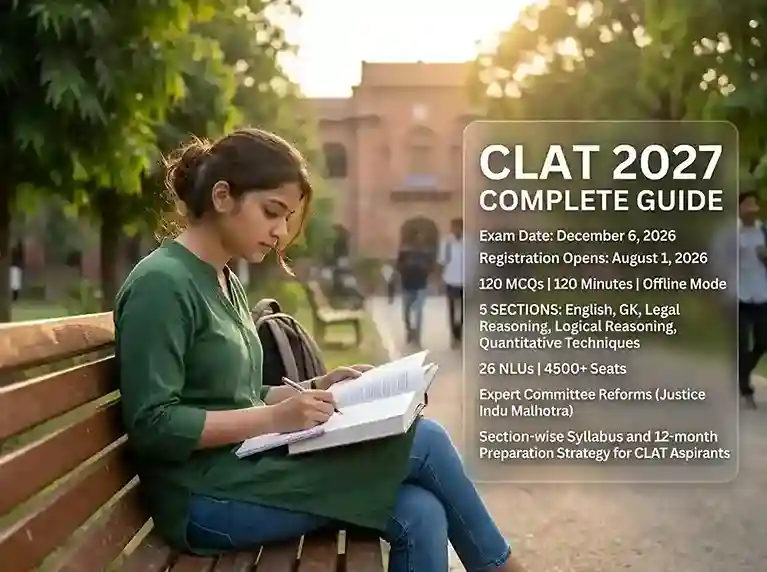
1. What is CLAT? | Purpose, History & Significance
The Common Law Admission Test (CLAT) is India's national-level law entrance examination, conducted annually by the Consortium of National Law Universities. It is the gateway to 26 National Law Universities (NLUs) across India | public universities that collectively represent the pinnacle of legal education in the country.
CLAT was first introduced in 2008 to create a single, centralised entrance examination for NLUs | replacing the fragmented, institution-specific tests that existed before. Since then, it has grown into one of India's most competitive entrance exams, with approximately 75,000–80,000 candidates appearing annually for roughly 4,500 UG seats | a competition ratio of approximately 17:1 for the general category at top NLUs.
| Full Form | Common Law Admission Test |
| Conducting Body | Consortium of National Law Universities |
| Exam Level | National Level |
| Frequency | Once per year |
| Programmes | UG (BA LLB) + PG (LLM) |
| Participating NLUs | 26 NLUs |
| Official Website | consortiumofnlus.ac.in |
- Only route to 26 National Law Universities
- 4,500+ seats across top government law schools
- NLU fees: ₹1.5–2.5L/year (exceptional value)
- NLU placements: ₹17.5–22 LPA at top NLUs
- Score also accepted by 60+ private colleges
- Qualification for prestigious Tier 1 law firms
- NLSIU, NALSAR, NUJS | world-class legal education
- Gateway to judiciary, civil services, global LLMs
2. CLAT 2027 Important Dates | Complete Timeline
The following is the expected CLAT 2027 schedule based on the official CLAT 2026 timeline and the Consortium's established patterns. Official confirmed dates will be published in the CLAT 2027 Information Brochure in July 2026 at consortiumofnlus.ac.in.
| Event | CLAT 2026 (Actual) | CLAT 2027 (Expected) | Status |
|---|---|---|---|
| Official Notification / Brochure | ~July 2025 | ~July 2026 | Expected |
| Registration Opens | July 2025 | August 1, 2026 | Expected |
| Application Fee Payment Closes | November 7, 2025 | ~November 2026 | Upcoming |
| Admit Card Release | ~November 25, 2025 | ~November 25, 2026 | Upcoming |
| CLAT 2027 Exam Date | December 7, 2025 (Sunday) | December 6, 2026 (Sunday) | Tentative |
| Answer Key Release | ~December 10, 2025 | ~December 10, 2026 | Upcoming |
| Result Declaration | December 16, 2025 | ~December 15–16, 2026 | Upcoming |
| Counselling Registration Opens | December 17, 2025 | ~December 16, 2026 | Upcoming |
| Counselling Registration Closes | December 27, 2025 | ~December 27, 2026 | Upcoming |
| Round 1 Seat Allotment | January 7, 2026 | ~January 7, 2027 | Upcoming |
| Final Round (Round 5) | May 15, 2026 | ~May 2027 | Upcoming |
3. CLAT 2027 Eligibility Criteria
The CLAT 2027 eligibility criteria are set by the Consortium of NLUs and apply uniformly to all participating NLUs. Here is the complete eligibility framework for both UG and PG programmes:
| Criterion | CLAT UG 2027 (BA LLB) | CLAT PG 2027 (LLM) |
|---|---|---|
| Qualifying Exam | Class 12 (10+2) from any recognised board | CBSE, ISC, State, IB, Cambridge | LLB / BA LLB or equivalent 3-yr or 5-yr law degree from recognised university |
| Minimum Marks (General) | 45% aggregate | 50% aggregate |
| Minimum Marks (SC / ST) | 40% aggregate | 45% aggregate |
| Stream Requirement | Any stream | Science, Commerce, Arts | Law degree mandatory |
| Age Limit | No upper age limit (Bar Council of India norms) | No upper age limit |
| Appearing Students | Class 12 students appearing in 2027 boards can apply provisionally | Final-year LLB students can apply provisionally |
| Nationality | Indian nationals + NRIs (with OCI/PIO) may apply | Indian nationals + NRIs (with OCI/PIO) may apply |
4. CLAT 2027 Registration Process | Step by Step
CLAT 2027 registration will be available online only at consortiumofnlus.ac.in from August 1, 2026. Here is the complete step-by-step registration process:
5. CLAT 2027 Exam Pattern | Structure & Marking
Understanding the CLAT 2027 exam pattern is the single most important step before starting preparation. The critical insight: CLAT is not a knowledge test | it is a comprehension and reasoning test. Every single question is embedded in a 300–500 word passage. You must read, understand, and answer | not recall facts.
| Total Questions | 120 MCQs |
| Total Marks | 120 Marks |
| Duration | 120 Minutes |
| Mode | Offline (Pen & Paper) |
| Timing | 2:00 PM – 4:00 PM |
| Correct Answer | +1 mark |
| Wrong Answer | −0.25 marks |
| Unattempted | 0 marks |
- Every question comes after a 300–500 word passage
- GK: passage about a news event, test reasoning about it
- Legal: principle stated in passage, apply to hypothetical
- Maths: data in a table/graph, calculate from it
- No standalone vocab, grammar, or bare knowledge Qs
- Reading speed of 3,000 words/20 min is essential
- Total paper = ~20,000 words to read and process
- Comprehension depth > factual knowledge every time
Section-Wise Weightage in CLAT 2027
6. CLAT 2027 Syllabus | Section-Wise Breakdown
The CLAT 2027 syllabus is expected to remain consistent with CLAT 2026 unless the Expert Committee recommends changes. The key principle: CLAT tests reasoning ability, not rote knowledge. Here is the complete, section-wise syllabus:
7. CLAT 2027 Expert Committee Reforms | What's Changing
One of the most significant developments for CLAT 2027 is the formation of an Expert Committee by the Consortium of NLUs to review and recommend reforms to the examination. This is a landmark move | the first structured external review of CLAT in its 16-year history.
Based on the committee's mandate and the criticisms historically levelled at CLAT (ambiguous questions, inconsistent difficulty, outdated GK topics), the reforms expected for CLAT 2027 include:
Higher quality legal passages from contemporary legal sources; reduced ambiguity in answer options; more analytically challenging argument analysis; better alignment with legal current affairs and real-world law practice.
Possible minor rebalancing of section weightages; improved GK passage quality with clearer event descriptions; refined mathematical passage design with unambiguous data sets; stronger research-based question design process.
8. CLAT 2027 Preparation Strategy | 12-Month Plan
If you are starting your CLAT 2027 preparation in mid-2026, you have approximately 6–7 months until the exam. Here is a structured preparation roadmap by phase:
Phase 1: Foundation (June–July 2026) | Know the Exam
Read the official CLAT information brochure thoroughly. Understand the exam pattern at a structural level | go through 2–3 previous year papers without timing to understand what questions actually look like. Start Word Power Made Easy (English). Begin daily newspaper reading | 45 mins of The Hindu. Take one baseline mock test to identify your starting score and weakest sections.
Phase 2: Concept Building (August–September 2026) | Section Mastery
Begin A.P. Bhardwaj (Legal Reasoning) | 2 chapters per week. Study Lucent's GK (polity, history). Complete CLAT previous year papers 2020–2022 under timed conditions. Analyse each paper in detail. Start LR critical reasoning practice. Build a monthly GK diary from newspaper reading. One mock per fortnight with detailed post-mock analysis.
Phase 3: Practice Phase (October 2026) | Speed and Accuracy
Solve CLAT 2023–2026 papers (the most relevant | current pattern). Increase mocks to 1 per week. Track section-wise accuracy across mocks. Focus extra time on your two weakest sections. Build current affairs file covering Jan–Sep 2026. Speed-reading drills: target 3,000 words in 20 minutes.
Phase 4: Intensification (November 2026) | Peak Preparation
2–3 mocks per week. Deep error analysis | categorise every wrong answer by type (knowledge gap / reasoning error / reading mistake / time pressure). Revise all Legal Reasoning principles from notes. Cover October 2026 current affairs. No new topics after November 15 | only revision and consolidation.
Phase 5: Final Lap (December 1–6, 2026) | Exam Ready
Daily mocks in exam-time slot (2 PM–4 PM). Light revision of vocabulary list and legal terms. November 2026 GK capsule revision. Maintain consistent sleep schedule | 10 PM sleep, wake early. Exam day: carry admit card + photo ID, arrive 30 minutes early, stay calm and trust your preparation.
9. Best Books for CLAT 2027 | Section-Wise
| Section | Best Book | Author / Publisher | Why It's Essential |
|---|---|---|---|
| English | Word Power Made Easy | Norman Lewis | Pocket Books | Gold standard for vocabulary-in-context. Learn words through roots and prefixes. |
| English | The Hindu Editorials (Daily) | The Hindu Newspaper | Non-negotiable. CLAT English passages mirror Hindu editorial tone exactly. |
| Legal Reasoning | Legal Aptitude for CLAT | A.P. Bhardwaj | Universal Law Publishing | #1 recommended book. Extensive principle-application practice. Current pattern aligned. |
| Legal Reasoning | CLAT Previous Year Papers (2020–2026) | Consortium Official Papers | Solving actual papers is the most effective legal reasoning preparation. |
| GK / Current Affairs | Lucent's General Knowledge | Lucent Publications | Static GK base | Indian Constitution, polity, history, geography. Selective use. |
| GK / Current Affairs | Manorama Yearbook 2026 | Manorama Publications | Annual events, national and international developments. Read Jan–Mar. |
| Logical Reasoning | Analytical Reasoning | M.K. Pandey | BSC Publication | Argument analysis, assumptions, strengthening/weakening | CLAT-relevant chapters. |
| Quantitative | NCERT Maths Class 8, 9, 10 | NCERT | Free PDF at ncert.nic.in | Entire CLAT Quant syllabus is Class 8–10 level. Free and foundational. |
10. Mock Test Strategy for CLAT 2027
CLAT toppers universally credit mock tests as the single most impactful preparation tool | but only when used analytically. Here is how to extract maximum value from every mock:
- Take mocks in exam slot: 2:00 PM–4:00 PM
- Full 120-minute, no breaks, no phone
- Spend equal time analysing as taking the mock
- Categorise every wrong answer by error type
- Track section-wise accuracy across all mocks
- Target: attempt 110–115 of 120 questions
- Start mocks 6 months before exam (July 2026)
- Complete 30–40 mocks before December 6
- Taking mocks without detailed post-mock analysis
- Waiting until "feeling ready" to start mocks
- Repeating same mocks | use fresh papers each time
- Skipping mocks after bad scores | they give data
- Not tracking section-wise trends across mocks
- Taking mocks at odd hours | always simulate 2 PM slot
- Focusing only on score | accuracy + attempt rate matter more
| Preparation Phase | Mock Frequency | Focus Area |
|---|---|---|
| Foundation (Jun–Jul 2026) | 1 per fortnight | Baseline assessment, pattern familiarisation |
| Building (Aug–Sep 2026) | 1 per week | Section-wise tracking, fixing identified weaknesses |
| Intensification (Oct 2026) | 2 per week | Speed improvement, attempt rate optimisation |
| Peak (November 2026) | 2–3 per week | Accuracy at pace, pattern mastery |
| Final Lap (Dec 1–5) | Daily (1 per day) | Confidence, consistency, exam simulation |
11. NLU-Wise CLAT Cutoff Trends (2026 Data)
The following CLAT 2026 cutoff data (Round 1, General category, closing rank) gives you a realistic benchmark for setting your target NLU and score:
| NLU | NIRF Rank | Gen. Closing Rank (CLAT 2026 R1) | Safe Score (General) | State Quota? |
|---|---|---|---|---|
| NLSIU Bangalore | #1 | ~45 | 114+ / 120 | Karnataka (25%) |
| NALSAR Hyderabad | #2 | ~148 | 100+ / 120 | Telangana (25%) |
| WBNUJS Kolkata | #3 | ~195 | 97+ / 120 | West Bengal (25%) |
| GNLU Gandhinagar | #4 | ~387 | 93+ / 120 | Gujarat (25%) |
| NLU Jodhpur | #5 | ~500 | 90+ / 120 | Rajasthan (25%) |
| HNLU Raipur | #10 | ~900 | 86+ / 120 | Chhattisgarh |
| RMLNLU Lucknow | #11 | ~1,000 | 85+ / 120 | UP (25%) |
| CNLU Patna | #17 | ~2,000 | 80+ / 120 | Bihar |
* Source: Consortium of NLUs, CLAT 2026 Round 1 allotment. AI = All India quota. Cutoffs are closing ranks in Round 1. Final round cutoffs may vary. Verify at our CLAT Cutoff 2026 full page →
12. CLAT 2027 Counselling | 5-Round Process
After results are declared, CLAT 2027 admission proceeds through the centralised counselling system run by the Consortium. Here is a quick overview | for the complete guide, visit our CLAT 2027 Counselling Complete Guide →
13. CLAT PG 2027 | LLM Admission Guide
CLAT PG 2027 is the postgraduate law entrance test for LLM admissions at 26 NLUs. It is conducted on the same day as CLAT UG | tentatively December 6, 2026. Key differences from CLAT UG:
| Parameter | CLAT UG 2027 | CLAT PG 2027 |
|---|---|---|
| Target Programme | BA LLB / BBA LLB (5-year UG) | LLM (1-year PG) |
| Eligibility | Class 12 | 45% (Gen) | LLB degree | 50% (Gen) / 45% (SC/ST) |
| Exam Pattern | Passage-based comprehension MCQs | Direct legal knowledge MCQs (no passage) |
| Syllabus | English, GK, Legal Reasoning, LR, Quant | Constitutional Law, Contract, Torts, Criminal, IPR, Jurisprudence, International Law |
| Total Marks | 120 | 120 |
| Duration | 120 minutes | 120 minutes |
| NLU LLM Seats | 4,500+ UG seats | ~500–700 PG seats |
| Minimum Preferences | 15 NLUs mandatory | 5 NLUs mandatory |
14. Frequently Asked Questions | CLAT 2027
The CLAT 2027 exam date is tentatively December 6, 2026 (Sunday). This follows CLAT's established pattern of being held on the first Sunday of December. CLAT 2026 was held on December 7, 2025. The exam is conducted offline (pen-and-paper mode) from 2:00 PM to 4:00 PM at test centres across India. The official confirmed date will be published by the Consortium of NLUs in the CLAT 2027 Information Brochure (expected July 2026) at consortiumofnlus.ac.in.
CLAT 2027 registration is expected to open on August 1, 2026 at consortiumofnlus.ac.in. Registration typically remains open for approximately 3 months, closing around October–November 2026. Application fee: ₹4,000 for General/OBC/EWS/PwD candidates and ₹3,500 for SC/ST candidates. Registration is complete only after successful fee payment. Students are advised to register as soon as the window opens to avoid last-minute issues.
CLAT 2027 UG eligibility: (1) Class 12 from any recognised board, any stream. (2) Minimum 45% for General/OBC/EWS/PwD; 40% for SC/ST. (3) No upper age limit. (4) Appearing Class 12 students can apply provisionally. For CLAT PG (LLM): LLB/BA LLB with minimum 50% (45% for SC/ST). Final-year LLB students can apply provisionally.
26 National Law Universities participate in CLAT 2027 for UG admissions. NLU Delhi does not participate (it has AILET). The 26 NLUs offer approximately 4,500+ UG seats total. CLAT scores are additionally accepted by 60+ private law colleges. The Consortium website (consortiumofnlus.ac.in) publishes the official list of participating NLUs each year in the Information Brochure.
CLAT 2027 UG exam pattern: 120 MCQs, 120 marks, 120 minutes, offline mode, 2:00 PM–4:00 PM. Marking: +1 for correct, −0.25 for incorrect. All questions are passage-based. Five sections: English Language (~20%), GK & Current Affairs (~25%), Legal Reasoning (~25%), Logical Reasoning (~20%), Quantitative Techniques (~10%). No sectional time limits or sectional cutoffs. The exam tests comprehension and reasoning ability | not rote memorisation.
For NALSAR Hyderabad (India's #2 law school), the CLAT 2026 General category closing rank was approximately 148 in Round 1. Based on CLAT 2026 score-rank mapping, this corresponds to a score of approximately 100–105 out of 120. A safe target score for NALSAR General category is 100+ out of 120. The cutoff for SC category was approximately Rank 3,259 and for OBC approximately Rank 915. Check NALSAR's full cutoff page for year-wise round-wise data.
Yes | 6 months of focused, structured preparation (June–December 2026) is sufficient to crack CLAT 2027 for most motivated students. The key elements: daily newspaper reading (builds English, GK, and Legal Reasoning simultaneously), 30–40 full-length mocks with detailed analysis, solving all CLAT 2020–2026 papers, and a consistent 5–6 hours of daily study. Students targeting top-5 NLUs (NLSIU, NALSAR, NUJS) benefit from longer preparation | 10–12 months is ideal. Students targeting mid-tier NLUs can crack the exam in 6 months with intensive preparation. Start immediately | every week of preparation compounds over the 6-month window.