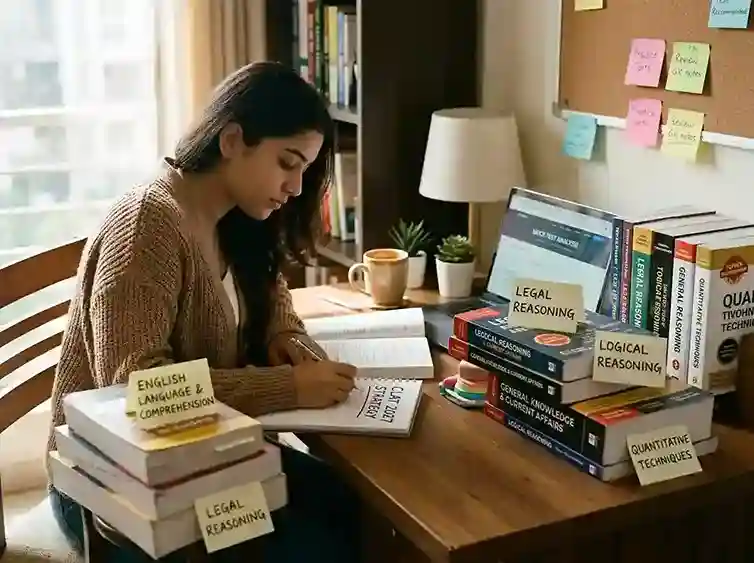
📚 CLAT 2027 Best Books Guide | Section-Wise Topper-Verified Picks | Updated May 2026🎯 CLAT 2027 Exam: December 2026 | Registration: July 2026 | 5 Sections | 120 Questions | No Negative Marking⚖️ Top Book: AP Bhardwaj (Legal) + Word Power Made Easy (English) + Lucent's GK | Daily Newspaper: Non-Negotiable📝 Previous Year Papers 2020–2026 = Most Important CLAT Resource | Start Mocks: October 2026
CLAT 2027 | Books & Study MaterialTopper-Verified | Updated May 2026Section-Wise GuideAll 5 Sections Covered
Best Books for CLAT 2027 | Section-Wise Complete Guide | Topper-Verified Picks with Usage Tips
Choosing the right books for CLAT 2027 is one of the most important | and most misunderstood | preparation decisions. This guide gives you a ruthlessly curated, section-wise list of the best CLAT 2027 books, explains how to use each, which edition to buy, what to avoid, and how to integrate books with mock tests for maximum rank improvement.
5
Sections Covered
6–8
Books Enough Total
120
CLAT Questions
Dec '26
CLAT 2027 Exam
25+
Mocks Needed
📅 Updated: May 28, 2026 | CLAT 2027 Book Guide
✍️ By Priya Kumari, LLM NALSAR | Senior Law Education Editor
🔍 Verified: CLAT 2026 topper interviews, Consortium of NLUs pattern, Bar & Bench
Best Books for CLAT 2027 | Section-Wise Topper-Verified Guide | LawGuru India | Updated May 2026
⚡ Best Books for CLAT 2027 | Quick Answer
English Language: Word Power Made Easy (Norman Lewis) + The Hindu / Indian Express editorials (daily) + Objective General English (SP Bakshi)
Legal Reasoning: Legal Aptitude for CLAT & LLB (AP Bhardwaj, Universal Law Publishing) + CLAT Previous Year Papers 2020–2026
GK & Current Affairs: Lucent's General Knowledge (static GK) + Monthly CLAT Current Affairs Compilation + NCERT Class 11–12 Political Science
Logical Reasoning: A Modern Approach to Logical Reasoning (RS Aggarwal, selected chapters) + CLAT-specific LR practice workbook
Quantitative Techniques: Arihant Quantitative Techniques for CLAT + NCERT Maths Class 9–10 (foundation)
Most Important Resource (All Sections): CLAT Previous Year Question Papers 2020–2026 | solve all 7 years before the exam
Golden Rule: 1–2 books per section, mastered deeply + daily newspaper + 25+ full-length mocks from October 2026
The single biggest mistake CLAT aspirants make is treating book selection as a shopping exercise. Buying ten books, stacking them, and feeling prepared is an illusion that costs ranks. Before buying anything, understand three truths about CLAT 2027:
📌 Three Non-Negotiable Truths About CLAT 2027 Books
Truth 1 | CLAT is 100% passage-based. Every question in every section (English, Legal Reasoning, GK, Logical Reasoning, AND Quantitative Techniques) is based on a reading passage. There are no standalone grammar questions, no direct fact recall, no formula-solving puzzles without context. This means books that train you in passage comprehension, inference, and analytical reading deliver far more value than traditional subject books.
Truth 2 | Fewer books, mastered deeply, always wins. Every CLAT topper | from AIR 1 Saumya Singh to AIR 1 Abhinav Somani | used fewer than 10 books total. The differentiation between a rank of AIR 100 and AIR 2,000 is not the number of books read, but the depth of comprehension and the number of mocks analysed. One book solved three times is worth more than three books solved once.
Truth 3 | Newspapers and mock tests are your most important "books." The Hindu / Indian Express (daily, 45 minutes) and a good CLAT mock test series are more valuable preparation tools than any textbook. If you do nothing else, build these two habits and you will clear CLAT 2027.
🔑 The One Rule for CLAT 2027 Book Selection
If a book doesn't train you in passage-based reading and application, it is of limited value for CLAT 2027. Test any book before buying: open to a random exercise page. If questions are standalone (e.g., "Find the synonym of X" or "Which section of IPC covers Y?"), that book is either of secondary value for CLAT or needs to be used only for concept building | not as your primary exam preparation resource.
2. Best Books for CLAT 2027 English Language ~26% Weightage | 28–32 Questions
CLAT English is entirely a reading comprehension exercise. You are given a passage and asked to answer questions about its main argument, tone, implicit assumptions, vocabulary in context, and inferences. There are no standalone grammar questions in CLAT since 2020. Your English preparation must therefore focus on reading speed, comprehension depth, and vocabulary in context | not grammar rules.
1
Word Power Made Easy
Norman Lewis | Goyal Publishers | Latest Edition (any post-2015 edition is fine)
🏆 #1 English Book✔ Topper-Verified📚 Vocabulary & Etymology⏱ 20 min/day
Word Power Made Easy is the most universally recommended CLAT English book by toppers and coaching experts alike. It builds vocabulary not through rote memorisation, but through etymology and word roots | meaning once you learn a root, you can decode dozens of unfamiliar words you encounter in CLAT passages. This is precisely the skill CLAT tests when asking "what does the word X mean in the context of this passage?" The book is structured as a series of 46 exercises covering Negative Words, Words About Domination, Medical Vocabulary, and much more | each built around Latin and Greek roots. It takes approximately 3–4 months to complete thoroughly. Most CLAT toppers who score 35+ out of 40 in English credit this book.
📖 How to Use It for CLAT 2027
Do two exercises per week | not one per day. Complete each exercise, do the review test, and then write the new words in a dedicated vocabulary notebook with an original example sentence for each word (not the book's example | your own). Revise the notebook every Sunday. Do not try to memorise all 3,000+ words | focus on roots. Finish by October 2026, leaving November–December for revision and mocks.
2
Objective General English
SP Bakshi | Arihant Publications | Latest Edition
📖 RC & Grammar Foundation✔ Good for BeginnersPassage-Based Exercises
SP Bakshi's Objective General English is useful for CLAT as a foundational resource | primarily for its Reading Comprehension passages (Section-III of the book). Use it to build the habit of reading passages closely and answering inference-based questions. The grammar sections (Tenses, Articles, Prepositions) are less directly relevant to CLAT since standalone grammar is not tested | but the practice passages and comprehension exercises are valuable for building the analytical reading habit CLAT demands.
📖 How to Use It for CLAT 2027
Focus exclusively on the Reading Comprehension sections. Solve 2–3 RC passages daily from this book (especially in months 1–3 of your preparation). Skip or skim the grammar correction exercises | they are less relevant to current CLAT pattern. Once comfortable with RC from this book, shift to actual CLAT Previous Year Papers for your RC practice material.
A newspaper is not a book | it is the most important preparation tool for CLAT 2027. Reading The Hindu or Indian Express editorial section for 45 minutes every single day simultaneously builds: English comprehension (the passages are complex, analytical, and match CLAT passage difficulty exactly), General Knowledge and current affairs (direct marks in GK section), and contextual understanding of legal and policy issues (helps legal reasoning and GK passages). Every CLAT AIR sub-200 topper since 2020 has confirmed newspaper reading as their single most important daily habit. CLAT passages are frequently adapted from newspaper editorials.
📖 How to Read Newspapers for CLAT 2027
Do not just scan headlines. Read 3 full editorials per day from The Hindu | Editorial, Op-ed, and one long-form news analysis. After reading, ask yourself: (1) What is the author's main argument? (2) What evidence supports it? (3) What is the tone? (4) What is implied but not stated? These are exactly the questions CLAT English asks. Maintain a daily one-paragraph summary of the most important news story | this doubles as current affairs revision.
3. Best Books for CLAT 2027 Legal Reasoning ~30% Weightage | 35–39 Questions
Legal Reasoning is the highest ROI section in CLAT | it carries approximately 30% of total marks, and strong performance here is the biggest single predictor of a top rank. The critical insight: CLAT Legal Reasoning does not require prior legal knowledge. Every question is passage-based | you read a passage containing a legal principle or Supreme Court judgment excerpt, then apply it to a new fact scenario. The right books train this principle-fact application skill, not legal memorisation.
1
Legal Aptitude for CLAT & LLB Entrance Examinations
AP Bhardwaj | Universal Law Publishing | Always buy the latest edition
🏆 Gold Standard | Must-Have✔ Used by 90%+ of Serious Aspirants⚖️ Principle-Fact MethodLatest Edition: 2025–26
AP Bhardwaj's Legal Aptitude book is the single most important CLAT book for Legal Reasoning | used by virtually every serious aspirant and mentioned by most toppers. It covers: (1) how to read a legal passage and identify the stated principle, (2) how to apply the principle to fact scenarios without importing outside legal knowledge, (3) legal GK (landmark cases, constitutional provisions, legal maxims), and (4) a large bank of principle-fact questions. The book is regularly updated with recent Supreme Court judgments and constitutional developments. Buy the latest available edition | older editions miss recent legal developments that appear in CLAT passages.
📖 How to Use AP Bhardwaj for CLAT 2027
First read the conceptual chapters on how to solve Legal Reasoning questions | especially the section on the "stranger test" (pretend you have never heard of the law; use only the passage). Then work through one topic at a time: Torts → Contracts → Constitution → Criminal Law. Solve exercises with a timer. Most importantly: after finishing Bhardwaj, switch to actual CLAT Previous Year Papers for Legal Reasoning practice. The 2020–2026 CLAT papers are more passage-dense and inference-heavy than Bhardwaj | use Bhardwaj to build the method, use papers to build exam-level skill.
2
Universal's Guide to CLAT & LL.B. Entrance Examinations
Universal Law Publishing | Latest Edition
📚 Comprehensive CoverageAll Sections + Legal GK✔ Good Supplementary Resource
Universal's Guide is a comprehensive all-in-one CLAT guide from the same publisher as AP Bhardwaj. It is most useful as a supplementary resource for legal GK | landmark judgments, legal maxims, constitutional provisions, and important legal definitions | which sometimes appear in CLAT GK passages with a legal context. It also contains passage-based Legal Reasoning sets that give additional practice beyond AP Bhardwaj. If you are short on time, AP Bhardwaj + PYQ papers are sufficient | Universal's Guide is for students who want more legal reasoning practice material.
📖 How to Use It for CLAT 2027
Use primarily for legal GK revision | landmark cases (Kesavananda Bharati, Maneka Gandhi, Navtej Singh Johar), legal maxims (Audi alteram partem, Volenti non fit injuria), and constitutional provisions list. This takes 2–3 weeks. Then selectively solve the passage-based legal reasoning sets for additional practice, prioritising the more difficult passages.
4. Best Books for CLAT 2027 GK & Current Affairs ~30% Weightage | 35–39 Questions
The GK section is perhaps the most misunderstood in CLAT. Most aspirants treat it as a trivia quiz and buy heavy GK books to memorise facts. This is wrong. CLAT GK tests contextual understanding of events, not fact recall. You are given a passage about a current event, policy, or legal development | and asked to infer, analyse, or identify implications from the passage. A student who reads newspapers understands context; a student who memorises GK capsules only remembers isolated facts. Context beats memorisation every time in CLAT GK.
1
Lucent's General Knowledge
Lucent Publications | Buy the latest edition (updated annually)
Lucent's GK is the standard reference for static General Knowledge | Indian history, Indian geography, general science, Indian polity overview, economy basics, and world GK. For CLAT, use it to build the static GK foundation that gives you context when reading current affairs passages. If a CLAT passage discusses a constitutional amendment, knowing your Polity basics from Lucent's helps you understand the passage faster and answer inference questions more accurately. Do not try to memorise Lucent's cover to cover | it is too expansive. Select and focus on the chapters most relevant to CLAT: Indian Polity, History of India, Important Days, Awards, and Science & Technology basics.
📖 How to Use Lucent's for CLAT 2027
Cover the following chapters (do not read all): Indian Constitution & Polity (most important), Modern Indian History (1857–1947), Important Government Schemes & Bodies, Indian Economy basics, Environment basics, and Important Awards. Skip deep-dive geography and ancient history unless you have surplus time. Finish this within 6 weeks, then shift focus entirely to newspapers and monthly current affairs. Revise Lucent's selectively (Polity and History only) in the final 2 months.
2
CLAT-Specific Monthly Current Affairs Compilation
From leading CLAT coaching institutes | LegalEdge, CLATapult, Law Prep Tutorial | Monthly PDFs
🏆 Dynamic CA | Must Have✔ Updated Monthly⚠️ Must Cover 12 Months Before ExamCLAT-Pattern Focused
Dynamic current affairs | the news events of the 12 months immediately before CLAT | must come from a CLAT-specific monthly compilation, not from general CA apps or news websites. CLAT-specific compilations (published monthly by coaching institutes and available as PDFs) filter news events for CLAT relevance, format them as passage-based Q&A sets that mirror the actual CLAT GK format, and include legal developments (SC judgments, legislation), economic policy, India-international relations, sports, and environment | all weighted for CLAT frequency. Cover every month from December 2025 to November 2026 for CLAT 2027 (December 2026 exam). Each month's compilation takes approximately 2 hours to read and 30 minutes to revise.
📖 How to Use Monthly CA for CLAT 2027
Download or purchase a CLAT-specific CA compilation each month. Read it within the first week of the following month (so December 2025 CA is read in January 2026). After reading, solve the included practice questions. Every 3 months, do a cumulative revision of the past 3 months' highlights. By October 2026, prepare a consolidated "rapid revision" document of all major events, judgments, and policy changes | and revise it daily in the final 2 weeks before the exam.
3
NCERT Class 11–12 Political Science (Part A: Indian Constitution at Work)
NCERT | Free Download at ncert.nic.in
✔ Best for Indian Polity FoundationFree ResourceSupports Legal Reasoning Too
The NCERT Class 11 Political Science textbook "Indian Constitution at Work" is an underrated CLAT resource. It explains fundamental rights, DPSP, parliamentary system, judicial review, and constitutional amendments in clear, accessible language. CLAT GK passages regularly deal with constitutional issues, government policy, and institutional mechanisms | and students who understand these at a conceptual level (not just factual level) can answer inference questions that pure memorisers cannot. It is also directly useful for Legal Reasoning passages dealing with constitutional law.
📖 How to Use NCERT Polity for CLAT 2027
Read Class 11 Political Science Part A (Indian Constitution at Work) completely | it is only 200 pages and takes approximately 3 weeks at 45 minutes per day. Read for understanding, not memorisation. Note how different constitutional provisions relate to each other. This foundation makes reading CLAT GK passages about governance, rights, and policy dramatically more insightful and faster.
5. Best Books for CLAT 2027 Logical Reasoning ~26% Weightage | 28–32 Questions
CLAT Logical Reasoning is not a traditional puzzle-solving section. It is critical thinking applied to text passages | evaluating argument strength, identifying unstated assumptions, drawing analogies, and making logical inferences. Traditional LR puzzle books (seating arrangement, blood relations grids) have minimal CLAT relevance. The right books train analytical reasoning in passage format.
1
A Modern Approach to Logical Reasoning
RS Aggarwal | S. Chand Publications | Use selected chapters only
🧩 Analytical Reasoning✔ Widely Available⚠️ Use Selected Chapters Only | Not AllChapters 1–12 Most Relevant
RS Aggarwal's Logical Reasoning is a comprehensive book | but not all chapters are relevant to CLAT's specific LR format. The CLAT-relevant chapters are: Analogies, Series Completion (number and letter), Logical Deductions / Syllogisms, Statements and Assumptions, Statements and Conclusions, Cause and Effect, and Argument Evaluation. The seating arrangement, blood relations, and direction-sense chapters are less directly relevant to passage-based CLAT LR. Use this book to build the conceptual foundations of logical analysis | then apply those skills to actual CLAT LR passages.
📖 How to Use RS Aggarwal LR for CLAT 2027
Focus only on: Chapter 1 (Analogy), Chapter 3 (Series Completion), Chapter 5 (Logical Deductions), Chapter 7 (Statements and Assumptions), Chapter 8 (Statements and Conclusions), Chapter 9 (Statements and Argument), and Chapter 10 (Cause and Effect). Solve 20–30 questions from each of these chapters. After completing, immediately switch to actual CLAT LR passages from Previous Year Papers (2020–2026) | the real exam format is far more passage-heavy than RS Aggarwal exercises.
2
Analytical Reasoning
MK Pandey | BSC Publishing | Older classic but still useful for CLAT argument analysis
🧩 Argument Evaluation SpecialistStrong for Inference & AssumptionSecondary Resource
MK Pandey's Analytical Reasoning was recommended by CLAT 2017 AIR 1 Rajat Maloo and remains relevant for CLAT 2027's passage-based LR. It is particularly strong on Critical Reasoning | identifying the assumption an argument depends upon, evaluating what weakens or strengthens an argument, and identifying the logical flaw. These question types dominate CLAT LR. If RS Aggarwal is your primary LR book, MK Pandey is an excellent secondary resource specifically for argument analysis practice.
📖 How to Use MK Pandey for CLAT 2027
Use the "Critical Reasoning" and "Argument Evaluation" chapters primarily. Spend 3–4 weeks on this book after completing your RS Aggarwal LR chapters. This is not a mandatory resource | use it only if you find your LR argument analysis skills weak after solving actual CLAT previous year papers.
6. Best Books for CLAT 2027 Quantitative Techniques ~13% Weightage | 13–17 Questions
The Quantitative Techniques section carries only ~13% of total marks | the lowest weight among all five sections. Do not over-invest here at the expense of Legal Reasoning or GK. The section tests Class 10-level mathematics in a passage format | you read a data-heavy passage (graph, table, statistical text) and answer calculation questions from it. The goal is 70–80% accuracy on this section (10–12 out of 15), not perfection.
🏆 Best CLAT-Specific Quant Book✔ Passage-Based DI FocusClass 10 Level
Arihant's Quantitative Techniques for CLAT is the best choice because it is specifically designed for the CLAT exam format | covering Data Interpretation (graphs, charts, tables), percentages, ratios, profit & loss, simple/compound interest, and averages in the passage-based format CLAT uses. Unlike general quantitative aptitude books (which train for bank exams or CAT), this book's practice sets match CLAT's specific format where you must read a data-rich passage before answering questions. This is a critical distinction.
📖 How to Use Arihant Quant for CLAT 2027
Complete the entire book over 4–5 weeks (1 chapter per day, with daily practice). Focus most time on Data Interpretation (50% of your quant study time) since DI passages are the most common in CLAT. For arithmetic (percentages, ratios, profit/loss), if you're comfortable, revise NCERT Class 10 Maths chapters first. Solve 10–15 quant questions daily throughout your preparation | not in one mega-session. Speed and accuracy matter more than depth in this section.
2
NCERT Mathematics Class 9 & 10
NCERT | Free at ncert.nic.in
✔ Free Foundation ResourceArithmetic Chapters OnlyFor Maths-Weak Candidates
For candidates who are weak in mathematics (especially from Commerce or Arts backgrounds who haven't studied maths since Class 10), NCERT Class 9–10 Maths provides the arithmetic foundation needed for CLAT Quant. Focus specifically on: Chapters on Percentage, Ratio & Proportion, Simple Interest and Compound Interest, Statistics (mean, median, mode), and basic Data Interpretation. Do not read beyond these | CLAT does not test Trigonometry, Coordinate Geometry, or Polynomials.
📖 How to Use NCERT Maths for CLAT 2027
Spend 1 week on the relevant NCERT chapters (arithmetic only), then transition to the Arihant CLAT Quant book for CLAT-format practice. If you are comfortable with Class 10 arithmetic, skip NCERT entirely and go directly to Arihant. This is a foundation resource, not a primary exam-prep tool.
7. Previous Year CLAT Papers | Your Single Most Important Resource
If you could only use one resource for CLAT 2027, it should be the Previous Year Question Papers from 2020–2026. Seven years of actual CLAT papers are worth more than any textbook for three reasons: they show you exactly what the exam looks like, they train you in the actual question format (passage-based in all sections), and they reveal the examiner's recurring themes and favourite question patterns.
📋
Why 2020 is the Starting Point
CLAT changed to 100% passage-based format in December 2020. Papers before 2020 had a different format | do NOT use them for pattern practice.
First untimed (understand patterns) → then under strict 2-hour exam conditions → then deep analysis of every wrong answer
💡 Where to Find CLAT Previous Year Papers
Official CLAT question papers are available from two sources: (1) the Consortium of NLUs official website (consortiumofnlus.ac.in) | free download, but interface is sometimes inconsistent; (2) Published compilations by Arihant, Universal Law Publishing, and leading coaching institutes | these include answer keys, detailed explanations, and error analysis frameworks. Buy a physical book that compiles CLAT 2020–2026 papers with detailed explanations. The explanation quality matters | generic "correct answer is B" explanations are useless; look for books that explain why each option is correct or incorrect in terms of the passage.
8. Complete CLAT 2027 Book List at a Glance | 7 Books + Newspaper
Here is your definitive, minimal, high-impact book list for CLAT 2027. Buy these, master them, and you will not need anything else:
Section
Primary Book
Supplementary
Free Resource
Time Investment
English Language
Word Power Made Easy (Norman Lewis)
Objective General English (SP Bakshi) | RC chapters only
The Hindu / IE Editorials (daily)
3–4 months (2 exercises/week)
Legal Reasoning
Legal Aptitude for CLAT (AP Bhardwaj)
Universal's Guide to CLAT | Legal GK section
CLAT PYQ Papers 2020–2026 (legal passages)
3 months (1 topic/week)
GK & Current Affairs
Lucent's GK (selected chapters)
NCERT Class 11–12 Polity
Monthly CLAT CA Compilations + The Hindu
Ongoing | daily newspaper + monthly CA
Logical Reasoning
A Modern Approach to Logical Reasoning (RS Aggarwal | selected chapters)
Analytical Reasoning (MK Pandey) | optional
CLAT PYQ Papers 2020–2026 (LR passages)
2 months (5 chapters + PYQ practice)
Quantitative Techniques
Quantitative Techniques for CLAT (Arihant)
NCERT Maths Class 9–10 (arithmetic chapters only)
CLAT PYQ Papers 2020–2026 (quant passages)
4–5 weeks + daily 10–15 questions
All Sections
CLAT Previous Year Papers 2020–2026 (7 papers) | Single most important resource
Ongoing throughout prep
9. CLAT 2027 Books to Avoid & Common Book-Selection Mistakes
Knowing what NOT to buy is as important as knowing what to buy. Here are the most common CLAT book selection mistakes that cost aspirants ranks and time:
❌
Buying Pre-2020 CLAT Books That Cover the Old Exam Pattern
The CLAT exam changed fundamentally in December 2020 | moving to a 100% passage-based format. Books written before 2020 train you for a fundamentally different exam (standalone grammar questions, direct legal fact recall, traditional LR puzzles). Check the edition year before buying any CLAT preparation book. If it was published before 2021 and hasn't been substantially updated, it may train you for an exam that no longer exists.
❌
Collecting 5+ Books Per Section
The "book hoarding" trap is one of the most common CLAT preparation mistakes. Buying 5 English books, 4 Legal Reasoning books, and 3 GK books creates the illusion of preparation without actual progress. The student who reads AP Bhardwaj cover-to-cover twice, solves all 7 years of PYQ Legal Reasoning passages, and analyses every wrong answer will outperform the student who touches 4 legal books superficially | every time. Commit to 1–2 books per section and master them.
❌
Using General CA Apps (Unacademy, BSC, Inshorts) as Primary GK Source
General current affairs apps deliver headline-level information | dates, names, one-liners. CLAT GK tests issue-based contextual understanding. An aspirant who reads The Hindu's full editorial on a Supreme Court judgment understands the implications, the legal framework, the historical precedent, and the societal impact | which is exactly what CLAT GK passages test. A student who reads "SC rules XYZ" in an app understands only the headline. Newspaper reading cannot be replaced by CA apps for CLAT.
❌
Treating RS Aggarwal LR as Your Entire LR Preparation
RS Aggarwal's Logical Reasoning is a strong book, but it was written for traditional LR sections (seating arrangements, blood relations, direction sense) that CLAT no longer tests as standalone questions. Using it as your only LR resource without transitioning to actual CLAT passage-based LR is like preparing for a swimming race by training at cycling. Use Aggarwal for concept building (selected chapters), then immediately transition to CLAT Previous Year Papers for actual exam-format practice.
❌
Spending Equal Time on All Sections Regardless of Weightage
Legal Reasoning (~30%) and GK (~30%) together account for 60% of CLAT marks. Quantitative Techniques (~13%) accounts for only 1 in 8 marks. A time allocation strategy that treats all sections equally | spending the same daily hours on Legal Reasoning as on Quant | misallocates your most limited resource. Recommended time split: Legal Reasoning 30%, GK & CA 25%, English 25%, Logical Reasoning 12%, Quantitative Techniques 8%.
❌
Starting Mock Tests in November or December
Many aspirants delay mock tests until the final month, then panic-solve 50 mocks in 30 days without analysis. This is the opposite of what works. You should start full-length mocks from October 2026 (2 months before the December 2026 CLAT) | one mock per week initially, increasing to two per week in November. Each mock should be followed by 1.5–2 hours of analysis. Your error patterns across 20 mocks will teach you more than 40 mocks with no analysis.
10. How to Integrate CLAT 2027 Books with Mock Tests
Books and mock tests are not separate preparation activities | they are a continuous feedback loop. Here is the integration framework that top-scoring CLAT candidates use:
Spend the first 3 months almost entirely on books and newspaper reading. Complete: AP Bhardwaj (Legal Reasoning), Word Power Made Easy (English), Lucent's GK (selected chapters), NCERT Polity. Daily: newspaper reading (45 min) + section-wise practice questions (1 hour). Do not attempt full-length mocks yet | concept clarity is the priority. Solve untimed PYQ papers (2020 and 2021) once each to understand the exam format, not for score practice.
2
Phase 2 (September 2026): Transition | Timed Sectional Practice
Begin timed sectional practice: solve one CLAT section's full question set under exam time pressure per day. Start with Legal Reasoning (highest ROI), then GK, then English, then LR, then Quant. Use PYQ papers 2022–2023 for this phase. Analyse every error | categorise as comprehension error (re-read the passage more carefully), conceptual error (revisit the relevant book chapter), or time-management error (practice timed reading). September is also when you start one full mock per week.
3
Phase 3 (October–November 2026): Mock Test Intensive
Two full-length CLAT mocks per week under strict 2-hour exam conditions. After each mock, spend 1.5–2 hours on analysis using this system: (1) mark every wrong answer as C (comprehension), K (knowledge/concept), or T (time); (2) for C errors | re-read the passage with fresh eyes; (3) for K errors | re-read the relevant book chapter; (4) for T errors | practice timed reading at higher speed. Track your scores and error distribution across all mocks in a performance log. Aim for 25–30 mocks total before December.
4
Phase 4 (December 2026 | Exam Month): Revision Only, No New Books
In the final month before CLAT 2027, close all books. Revise only: your vocabulary notebook (Word Power Made Easy words), AP Bhardwaj's key legal principles list, your rapid-revision current affairs document, and your personal error pattern analysis from mocks. Maintain mock cadence (one mock every 3 days). In the final week: no new material, revise only, ensure 7–8 hours of sleep, and eat light before the exam.
11. CLAT 2027 Book Reading Roadmap | Month-by-Month Plan
Here is a structured month-by-month reading plan for a student starting CLAT 2027 preparation in June 2026 (6 months before the December 2026 exam). Adjust the starting month if you are reading this earlier or later.
Month
Primary Focus
Book/Resource
Daily Commitment
June 2026
Foundation | Legal & English
AP Bhardwaj (Ch. 1–10) + Word Power Made Easy (Ex. 1–10) + Newspaper starts
RS Aggarwal LR (selected chapters) + Arihant Quant + Word Power (Ex. 20–40)
4 hrs/day
September 2026
PYQ Practice + First Mocks
CLAT PYQ 2020–2023 (untimed then timed) + 1 mock/week
4–5 hrs/day
October 2026
Mock Intensive + CA Revision
2 mocks/week + Monthly CA Dec 2025–Sep 2026 revision + PYQ 2024–2025
5 hrs/day
November 2026
Mock Intensive + Final Revision
2–3 mocks/week + rapid revision of all books + PYQ 2026 (most recent)
5–6 hrs/day
December 2026
Exam Month | No New Books
1 mock/3 days + daily CA revision + vocabulary notebook + error analysis review
3–4 hrs/day + rest
12. FAQs | Best Books for CLAT 2027
Which is the best book for CLAT 2027 preparation?
+
There is no single best book for CLAT 2027 | you need one strong book per section. The most universally recommended picks are: English | Word Power Made Easy (Norman Lewis); Legal Reasoning | Legal Aptitude for CLAT & LLB (AP Bhardwaj); GK & Current Affairs | Lucent's General Knowledge + The Hindu daily; Logical Reasoning | RS Aggarwal's A Modern Approach to Logical Reasoning (selected chapters); Quantitative Techniques | Arihant Quantitative Techniques for CLAT. Complement all books with CLAT Previous Year Papers 2020–2026 | the most important resource of all.
How many books are enough for CLAT 2027?
+
6 to 8 books total are more than enough for CLAT 2027 preparation | one strong book per section plus a comprehensive previous year paper collection. Most successful CLAT candidates and toppers use 1–2 books per section, master them thoroughly, and complement with daily newspaper reading and mock tests. The rule: fewer books, mastered deeply, always beats more books, covered superficially. Collecting too many books is the single most common CLAT preparation mistake.
Is AP Bhardwaj enough for CLAT 2027 Legal Reasoning?
+
AP Bhardwaj is sufficient as your primary legal reasoning book but must be complemented with CLAT Previous Year Papers (2020–2026). The exam has moved to 100% passage-based legal reasoning since 2020 | Bhardwaj builds the method and conceptual foundation, but actual CLAT papers provide the passage-format practice you need for the current exam. Use Bhardwaj to learn the principle-fact application method, then apply it to real CLAT legal passages. Do not use Bhardwaj alone without solving actual exam papers.
Is newspaper reading necessary for CLAT 2027?
+
Yes | daily newspaper reading is absolutely non-negotiable for CLAT 2027. Reading The Hindu or Indian Express for 45–60 minutes daily simultaneously improves English comprehension, GK and current affairs, and legal reasoning contextual understanding. No GK book alone can replicate the contextual understanding and reading speed that a daily newspaper habit builds. CLAT passages are frequently adapted from newspaper editorials. Every CLAT AIR sub-200 topper since 2020 has confirmed daily newspaper reading as their most important preparation habit.
What are the best books for CLAT 2027 English section?
+
Best books for CLAT 2027 English: (1) Word Power Made Easy (Norman Lewis) | best vocabulary book, teaches word roots and etymology; (2) The Hindu / Indian Express editorials | daily reading for reading comprehension skill; (3) Objective General English (SP Bakshi) | Reading Comprehension sections only; (4) CLAT PYQ Papers 2020–2026 | most important; actual CLAT English passages are the best practice. Avoid standalone grammar books | CLAT English tests reading comprehension and inference, not standalone grammar.
Are NCERT books useful for CLAT 2027?
+
NCERTs are useful for specific CLAT sections but should not be your primary resource. Class 11 Political Science NCERT (Indian Constitution at Work) is excellent for GK and Legal Reasoning | building understanding of constitutional law and government. Class 10 Maths NCERT (arithmetic chapters only) is useful for Quant foundations. However, NCERTs are not passage-based while CLAT 2027 is entirely passage-based | use them to build conceptual foundations, then transition to CLAT-specific material. Allocate 15–20% of your GK and Quant study time to NCERTs.
Which current affairs source is best for CLAT 2027 GK?
+
The best current affairs sources for CLAT 2027 GK: (1) The Hindu or Indian Express | daily newspaper reading; read for context, not just headlines; (2) Monthly CLAT-specific current affairs compilations | covering December 2025 to November 2026 (12 months before CLAT); (3) Lucent's GK for static foundation. Avoid general CA apps as primary sources | they lack contextual depth CLAT passages require. CLAT GK is issue-based and context-driven, not factoid-based.
🏆 LawGuru India's Final Verdict | Best Books for CLAT 2027
The best CLAT 2027 preparation is not about which books you buy | it is about what you do consistently every day. Buy AP Bhardwaj and Word Power Made Easy. Subscribe to The Hindu. Download a CLAT-specific monthly CA compilation. Get CLAT PYQ papers 2020–2026. Start mocks in October 2026. Analyse every mock deeply. Read the newspaper every day without exception. That system | consistently followed for 6 months | will get you into the NLU of your choice. The books above are the tools. The discipline is yours.
LLM from NALSAR University of Law, Hyderabad. 8+ years covering CLAT preparation strategy, NLU admissions, and law career guidance. This book guide is compiled from verified topper interviews (AIR 1–50, CLAT 2022–2026), Consortium of NLUs official syllabus (consortiumofnlus.ac.in), CLAT coaching expert recommendations, and a review of all major CLAT preparation books currently available. Last updated: May 28, 2026.
Ready to Start CLAT 2027 Prep? Use Our Free Resources.
Free CLAT 2027 preparation guide, sample papers, cutoff data, and NLU college comparisons | everything you need alongside your book preparation.